Galactic Suburbia 112
In which we help you with your (possibly last minute) Christmas shopping with a ton of our favourite recommendations from the year, plus culture consumed. You can get us from iTunes or at Galactic Suburbia.
Don’t forget to send us your recommendations for the GS Award: for activism and/or communication that advances the feminist conversation in the field of speculative fiction
Christmas gift suggestions!!
Alisa: Soapasaurus; Ancient Arts Yarn
Alex: Orphan Black. Abhorsen trilogy (plus prequel), Garth Nix. Bitterwood Bible and Other Recountings, Angela Slatter. Hav, Jan Morris. Rupetta, Nike Sulway.
Tansy: Ms Marvel Vol 1: No Normal, G.Willow Wilson; Teen Titans Go; Dimetrodon, The Doubleclicks; The Musketeers (BBC 2014); Sex Criminals, Matt Fraction
TPP: Drowned Vanilla! Secret Lives of Books; The Female Factory, Kaleidoscope, The Total Devotion Machine and Other Stories; Perfections;
Other Personal Stuff to Plug: The GS Scrapbook, The Twelfth Planet Press Tab, Musketeer Space
What Culture Have we Consumed?
Alisa: Scrivener; Monstrous Affections edited by Kelly Link and Gavin Grant; Champagne and Socks (Alisa’s personal blog)
Alex: The Slow Regard of Silent Things, Patrick Rothfuss; Troll: A Love Story, Joanne Sinisalo; Uncanny #1; finished Project Bond.
Tansy: Young Avengers 2: Family Matters; Civil War: Young Avengers/Runaways; Young Avengers Presents, The West Wing, Chicks Dig Gaming, Jennifer Brozek & Robert Smith?
Have a great summer… even if it’s winter where you live.
Please send feedback to us at galacticsuburbia@gmail.com, follow us on Twitter at @galacticsuburbs, check out Galactic Suburbia Podcast on Facebook, support us at Patreon and don’t forget to leave a review on iTunes if you love us!
Mitosis
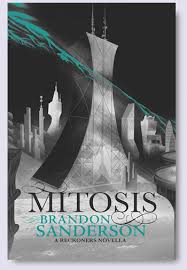 I haven’t read Steelheart so the characters and the problems in this short story didn’t mean as much to me as they would to someone who has read it. And it turns out that the story is actually half of this cute little number’s pages; the other half is a teaser for the second book in the series.
Still, I read it, and I think it does actually work as a stand-alone. There’s obviously a lot that’s gone on in the past, but that’s often true of a good short story. The one thing that could have been cleared up by a single additional sentence is the nature of the ‘Epics’, who are clearly the villains (usually) and clearly some sort of humans but… that’s all a bit obscure.
Anyway, it’s got a good pace and the setting – Newcago – is nicely set out. The narrator, David, is a bit of a nothing character to be honest; this is more about action than it is about character, but that’s not necessarily a bad thing. The villain was quite fun and I enjoyed Sanderson’s take on his particular ability.
This book was provided to me by the publisher.
Troll: A Love Story
 I am torn.
On the one hand, this is a beautifully written story that deals with some fascinating issues. And trolls are real.
On the other hand, I was uncomfortable with the implications of some of the relationships.
So, the first hand: it is lovely, and made all the more impressive by the fact that it’s translated – that can never be an easy task. I love the fact that it alternates story with ‘non-fiction’ grabs from pseudo-websites, dusty old tomes, poems and mythology – some of those are real, I’m pretty sure – and newspaper reports. I know that some people find this annoying; don’t read the book if that’s you. And I know that sometimes it really doesn’t work. But here I lay claim that it adds wonderfully to the depth surrounding the central idea of trolls being a real animal, known to science for the last century or so, and that this story is seeking to add to what humanity knows about Felipithecus trollius. Additionally, although there is a central narrator – Angel – as the story proceeds more of the incidental characters get to add their own perspectives, also in the first person. I know some people have found this changing around to be irritating or confusing, but at least in my edition each chapter clearly labels who is speaking, so rather than confusing I found that it added to the richness of the novel.
Sinisalo raises a diverse range of issues in her story, some more central than others. Trust and love and manipulation; ethics in art and journalism and business; the relationship between humanity and the natural world; mail-order brides, sex as power, desire as all-consuming. Angel, the central narrator, finds a wounded young troll and decides to care for it… which leads to encounters with a neighbour, an ex-lover, a would-be lover, and an object of his affection. Plus a business opportunity.
Which leads me to the other hand. And from this point on, SPOILERS.
Firstly, I know Angel ended up feeling ashamed of taking advantage of the troll, but it was still an unpleasant thing to do – taking advantage of Pessi’s trust in him for entirely mercantile purposes. Given how much Sinisalo works to make Pessi seem if not human then certainly above the animal, I really didn’t like it. Again, I’m sure that was the point, but it doesn’t matter; I still read it, and felt uncomfortable.
And then there’s the implications of the relationship between Pessi and Angel. Perhaps it’s prudish but I was very uncomfortable by Angel’s sexual reaction to Pessi. This is partly because Pessi is coded as being quite young, so the power differential of age exists; partly that Pessi is clearly in a submissive position with regard to Angel in tribal terms, so again the power differential; partly, hello different species – where Pessi is <i>not</i>, especially at first, coded as being as capable/sentient as a human. I know that Sinisalo is trying to problematise issues of desire and sexuality – Palomita’s experience as a mail-order bride is certainly not meant to be endorsed but is still far more socially acceptable – but… it was a problem for me.
Lastly, the ending. I knew it was coming – that Sinisalo was working up to the idea that trolls were either evolving, and catching up with humanity, or that they had always been that clever and were now coming out of the forest and starting to demonstrate it. I really liked it, and but for the sexual relationship stuff I really liked the ambiguity of what was going to happen to Angel, too.
I think, on balance, that I really liked this book. Sinisalo is certainly doing intriguing things, and she does write beautifully.
You can get Troll from Fishpond.
The Slow Regard of Silent Things
 In his Foreword, Rothfuss points that that people may not want to read this book. It’s not an ordinary book; there’s no plot. There’s no explanation of who Auri is, who she is anticipating, or even where she is. It’s probably not the first thing by Rothfuss that you want to read.
But.
But it is a beautiful object, but it’s a haunting chronicle of six days, but Auri is indeed a bit of the sun.
It’s a beautiful object: I have a hardcover version, and the cover picture is all shadows and moonlight and flowers and Auri’s silhouette. Nate Taylor’s black and white pictures are strewn throughout like the objects that Auri finds, and the text makes way for them so they work together companionably. I’d like to see more books with pictures in them, like this.
It’s not a novel, or a novella (150 pages in this wee format); it’s a chronicle. It outlines Auri’s actions and thoughts for six days. Some days are good, some days are bad. Some days Auri manages to fix rooms and objects so that they are just so and some days she doesn’t have anything to eat. Some days she makes soap. Some days she weeps.
Auri is the only character in this chronicle. In watching her for six days, the reader learns only fragments of her past and nothing of her future. We learn that she is a joyful creature – she grins all the time, and that mostly didn’t get annoying – but she is also deeply broken, and she knows she is broken and feels it keenly. And she knows that the world is broken, too, and she wants desperately to put it to rights, one little bit at a time – finding a place for a bottle, feeding another’s imagination, making soap properly. Anticipating a visitor and fretting about having the right gift.
Auri’s entire life revolves around doing things properly, and making the world right, and not wanting things for herself. I was at points humbled by her, and her willing and joyful self-sacrifice; at times enraged on her behalf, because clearly something has happened to make her so completely self-effacing. At times I was horrified – she has so little to eat – and at time intrigued, as when she contemplates her soap and knows that while it would be perfectly serviceable without perfume and other additions, how joyless to live in a world that was simply <i>enough</i>.
There’s something like 16 pages of making soap. Sounds crazy, I know. Trust me, it works. Or, you know, don’t trust me, because this isn’t your sort of book anyway. That’s fine. I really liked it. (I really liked the first two of Kingkiller Chronicles: The Name of the Wind, then The Wise Man’s Fear.)
This book was provided to me by the publisher at no cost. You can get it from Fishpond.
The Book of Life
 1. I received this as a review copy from the publisher.
2. I have not read the previous two books in the trilogy. As well as impacting on my understanding of relationships, it’s possible this review will therefore have spoilers for the first two books.
Vampires are not, in general, my thing. Yes I have read an enjoyed a number of books that include vampires, but I do not go out of my way to read them. And I don’t especially like vampires for their own sake; I have enjoyed books they’re in when the story itself is great. (Cyborgs, though? I like cyborgs. Sometimes I don’t even care about the plot.) So The Book of Life is not inherently my thing – so if you love vampires, this review probably isn’t going to be useful to you.
The main characters are a witch/historian, Diana, and her vampire/scientist husband, Matthew. They’ve just got back to the 21st century from Elizabethan England and things are messy, not least because there’s not meant to be such mix-marriages and it’s compounded by Diana being pregnant. Also there’s a threat a brewing both to their family and to the supernatural species in general – which also includes daemons but they hardly feature at all in the book – AND they have to continue their search for the titular Book of Life for reasons that are never clearly explained. This involves Science, and History, and the occasional It’s Not Really a Significant Crime, right? Also getting humans involved in their work, travelling across Europe, family arguments, snark, more snark, the odd bit of sex and being a bit creepy.
Pretty standard stuff really.
I was dubious when I received this from the publisher, having not read the others. But I decided to give it a go and I was impressed by how well Harkness managed to basically catch me up. For those completing the trilogy this may well have been annoying info-dump, of course. There were random characters who appeared that had no impact on me but were clearly significant, and call-backs to previous events that I just shrugged past, but I certainly never felt like I was being left behind. So that’s a positive. As well, this is the epitome of page-turning-ness. I read the whole thing on a public holiday (580 pages). I didn’t give it the world’s greatest amount of attention (it’s not like reading Ann Leckie), but I also didn’t skip pages searching for dialogue (um, a few books I won’t mention). Thus, highly readable.
At times I almost forgot that this was meant to be a supernatural kinda book, and read it as a family drama – and it works exceptionally well as such. Every now and then there were odd, jarring notes (yes, I’ve been mourning for five centuries…), but really most of it works on ‘you can’t marry him’/’I just did’ – ‘what do you MEAN you’ve got a [insert unknown family member here]’ – ‘I hate you but I’ll work with you anyway’ interactions. Which can be quite fun when they’re written with enough snark. (Harkness could have added a little more snark, and I wouldn’t have minded.) In this way, it reminds me a bit of the Gail Carriger books – the Parasol Protectorate, while having awesome stuff about tech etc, boils down to relationships and how to negotiate them ((maybe everything does ultimately…).
Harkness touches on some interesting issues, too. I quite liked that Diana and Matthew at least in theory had jobs – they didn’t do much for their employers in this novel, too busy being Indiana Joneseque, but they DID use their professional skills. And Diana is absolutely expected to use hers, because why not? That was nice. Also that Diana keeps working right up til she hatches. And the discussion around why witches and vampires and daemons aren’t allowed to congregate, while a little heavy handed at times, was yet another example of exploring racial separation/ ‘purity’ issues. Aided by the appearance of Diana’s best friend Chris, ‘a black man from Alabama’.
Problems? I don’t like Matthew’s possessiveness. There’s at least one jab aimed at Twilight (‘no, I don’t sparkle’), and maybe others – I haven’t read it so I’m not sure. But I do know from reading some discussions that the possessiveness is present there, as it is here, and I don’t like it. Explain it by saying he’s got a great sense of smell if you like; I don’t care. Plus I am SO BORED by love triangles. Also, on the narrative, there are some holes and a few bits that are just left hanging. Which was annoying. And finally, not something that’s unique to this story but something I’m getting a little weary of: all of the main characters are exceptional. They’re world renowned in their fields. No one is just average. Which, sure, I guess it helps the narrative, but ‘oh I’ve read your work!’ got a bit eye-rolly.
Overall I was pleasantly surprised, because I really didn’t think – when I picked it up – that I’d end up finishing it, let alone in a day. If vampires and witches and love and mystery are your thing, don’t start here – I imagine you want to go back and start with A Discovery of Witches. But anyway, you can get The Book of Life from Fishpond (and Discovery of Witches too).
Galactic Suburbia 109
In which we solemnly swear we will repeat the title of our culture consumed after discussing it. Pinkie promise. You can get us from iTunes or at Galactic Suburbia.
Update on Gamergate with particular focus on Brianna Wu AKA @spacekatgal
(This episode was recorded before the Felicia Day incident)
Alisa’s con report – Conflux
Tansy’s con report – CrimesceneWA
Strange Horizons fundraising
We read and appreciate all your Twitter comments and emails, even if we don’t reply. We love your feedback!
It’s time to start thinking about the GS Award, yes already, WTF 2014 why are you moving so fast?
What Culture Have we Consumed?
Alisa: Landline, Rainbow Rowell (NB since recording, Alisa actually finished this book YES SHE DID); Night Terrace S1 1- 5
Alex: Sarkeesian’s XOXO talk; Garth Nix’s Abhorsen trilogy (Sabriel, Lirael, Abhorsen); Mothership: Tales of Afrofuturism and Beyond; Indistinguishable from Magic, Catherynne Valente; Bitterwood Bible and other Recountings, Angela Slatter; The Dish.
Tansy: Unmade, Sarah Rees Brennan; Night Terrace S1, Agents of SHIELD S1, The Flash S1 Ep 1-2
Please send feedback to us at galacticsuburbia@gmail.com, follow us on Twitter at @galacticsuburbs, check out Galactic Suburbia Podcast on Facebook, support us at Patreon (http://www.patreon.com/galacticsuburbia) and don’t forget to leave a review on iTunes if you love us!
Mothership
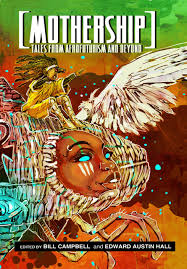 When I finished reading the first story in Mothership, a little voice in my head said “Was that really the story to start this anthology with? I mean, sure it’s got a black protagonist, but is that enough?”
And then the rest of me took a step back, looked horrified, and said: “Have you learned nothing from Pam Noles’ essay “Shame”? And from the entire Kaleidoscope project? The story has a black protagonist. That’s entirely the point.”
And then I sat, aghast at my own white ignorance, and felt ashamed.
And then I kept reading, because that’s the obvious way to combat such an attitude and is at least part of the point of this project and why I supported its production.
There’s a really wide variety of fiction in this anthology. Some skirt the edge of being ‘speculative’ (Rabih Alameddine’s “The Half-Wall”) while others hurtle over the edge and throw themselves at it. I didn’t click with every story (Greg Tate’s “Angels + Cannibals Unite” really didn’t work for me, and nor did Ran Walker’s “The Voyeur”), but many of them were absolutely breathtaking.
Nisi Shawl’s “Good Boy” – one of the only stories that really qualifies for the ‘mothership’ appellation by being set in space – is a glorious fun romp.
“The Aphotic Ghost”, by Carlos Hernandez, did not go where I was expecting and was utterly absorbing.
SP Somtow’s “The Pavilion of Frozen Women” has a wonderful line in bringing together several quite disparate cultures and tying them together into a fairly creepy thriller.
NK Jemisin does intriguing things with the notion of online communities in “Too many yesterdays, not enough tomorrows.”
“Life-Pod” is Vandana Singh’s haunting reflection on family and identity and connection.
In “Between Islands,” Jaymee Goh suggests how different things might have been for the British in colonising Melaka and surrounds with different technology…
Tenea D Johnson’s “The Taken” is a profound reflection on contemporary issues and problems stemming from the historical transportation of enslaved African to America… I don’t even inhabit the culture that’s dealing with it.
One of the intriguing things about this anthology is that it’s not focussed on African-American fiction, which I had basically expected thanks to the title’s reference to P Funk and Afrofuturism. Instead, there are stories here that draw on Egyptian, Native American, Caribbean (I think? I’m Australian, sorry!!), Japanese and Malaysian (again, I think) traditions and cultures – and those are just the ones that I (think I) could identify. There are definitely others that draw on other Asian cultures (I think there’s an Indonesian one?). The author bios don’t universally identify where the authors are from, so that doesn’t assist in figuring out what might have influenced them… which is not a complaint, by the way, because so what? (in the most prosaic ‘fiction is fiction’ sense). So it’s a really broad understanding of what falls into “Tales from Afrofuturism and beyond” – much more inclusive therefore than, for example, many anthologies of the last few years, let alone decades.
This is an good anthology, period. That it’s exploring and accomplishing a particular political aim is icing on the cake. You can get it from Fishpond!
The Falcon Throne
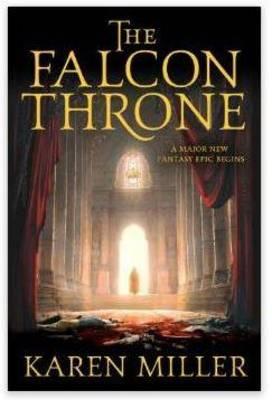 I received this book as a review copy from the publisher.
I am sad to announce that I abandoned this book. Mostly for “it’s me not you” reasons – although not entirely…
1. I’m really not in an epic fantasy kinda zone at the moment – and “at the moment” has lasted for a few years now (albeit with a few exceptions – though not many). So that counts against it for me – but for anyone who’s really in that mood, I think this is probably a good option. It’s certainly epic (in a good way!).
2. I’m not really a – argh, I don’t like the term – grimdark fan. And I’m pretty sure this counts as such. Others have compared it to A Song of Fire and Ice, and while I’ve only seen the show not read the books that sounds like the right sort of comparison. So the style is really not for me. I don’t mind bad things happening to characters, but there’s something about unrelenting unpleasantness – especially before I care about any of the characters – that frustrates and bores and annoys me. So that’s a style issue that is my problem, not the book’s.
Then there’s the style thing that I had an issue with, and it’s the way sex in general and women on occasion are described. I’m not a complete prude, although I guess I’m closer to that end of the spectrum than not, but there’s something about descriptions like “he’d have had the little wagtail pinned against a wall long since” (64) or “Aside from a writhing woman pinned on his cock, was there anything better in the world than a lance in his hand, a grand horse between his legs, and a man before him a handful of heartbeats from defeat?” (15) that leave me not just cold, but actively uncomfortable. As for the women – I got to about page 90, and most women by this stage are dead, useless, or conniving. The wet-nurse clearly has gumption and I hope she’s allowed agency and smarts, but that’s about it.
So there it is. Not a book for me. I am sad because it’s an Australian female author… but not sad because it’s an epic series I don’t have to get invested in so that saves me some time… but sad because I really don’t like abandoning books.
Kaleidoscope
 Declaring my connections: the publisher and half the editors of this anthology, Alisa Krasnostein, is a Galactic Suburbian with me; so is the author of the first story, Tansy Rayner Roberts.
I’m a lucky person because I’m white, and straight. I’m marginalised in fiction because I’m a woman who reads science fiction. I’m one of those female readers who long ago learned the trick of imagining myself with the fellas in the books I was reading – courtesy of all those Biggles books, mostly, and all that never-written-down fanfic of joining the Fellowship of the Ring (mostly to swoon over Legolas). So my emotional connection to the idea of needing diversity in fiction is somewhat less than, say, Julia Rios – one of the editors of this anthology – who notes that “As a bisexual Mexican-American woman, I didn’t see myself reflected very often in books I read as a child or teen…”. Nonetheless, I do get personally terrifically bored of straight while male characters, and I intellectually and ethically passionately support the need for diversity in all fiction. All of which is a long-winded way of saying that this project was a great one in theory, and has turned out to be a great one in practise.
Krasnostein and Rios got themselves an awesome set of authors to approach the idea of stories whose protagonists represent diversity, but where that diversity isn’t the point – it just is. Just like it should be in life. So this isn’t an issues book, and it’s not even really a themed anthology. There’s superheroes (hey Roberts, where’s that novel?) and d-mat transportation and mythology and aliens. There’s neurodiversity and mental health issues and gender and sexuality questioning and non-whites! and teens being teens and why haven’t you bought it yet?
I’ve noted before my assumption that picking the first story of an anthology must be hard. I say this with no reference to Tansy being a friend: “Cookie Cutter Superhero” really does deserve to springboard more stories. A universe wherein machines to create superheroes have appeared around the world? Where different countries take different routes to figure out who gets to use it, and the machine decides what they’ll be like? Seriously. Someone get that woman a contract and option the TV rights. And Roberts setting this in Sydney, casually mentioning the indigenous superhero who refused the media’s attempt to make him tribal, and our soon-to-be-superhero lacks a hand and it’s not the focus of the story… everything is right about this story. Up to and including the ending.
There are other stories in the anthology too. Sean Williams throws in a story set in his Twinmaker world, and it’s mighty fine. Gabriela Lee’s “End of Service” is a bit creepy both for the SF elements and for its real-world elements. Faith Mudge’s “Signature” is wonderful and not only because it reminded me strongly of The Changeover which is a pretty sure way to my heart. I hadn’t read a new Dirk Flinthart in a while, so finding “Vanilla” in here was a delight. The title suggested one thing, especially with the discussion around identity and what being a ‘proper’ Australian, or Somali, or Somali-Australian actually means… and then it turned out to have another meaning as well. Karen Healey’s “Careful Magic” is a bit Holly Black, and all awesome. I should not have read Sofia Samatar’s “Walkdog” in public – let that be a warning – I love her use of footnotes, and the eccentric spelling works beautifully, and the format does too. It’s not often you see Celtic mythology get utilised in a story, and Amal El-Mohtar does so wonderfully in a story about owls and displacement.
This isn’t a complete list, by any means. There’s also Jim Hines, Ken Liu and John Chu, Shveta Thakrar and Alena McNamara, and a bunch of others coming at the notion of diversity in YA from different points. As a reader, therefore, thanks to everyone who helped get this anthology off the ground – this is a great book that should do the rounds of every YA reader you know.
You can get this from Twelfth Planet Press direct – Australian release coming in October!
Galactic Suburbia 108
In which we level up in Gamergate, give away Kaleidoscope, and give each other Guardians of the Galaxy mix tapes. You can get us from iTunes or from Galactic Suburbia
TRIGGER WARNING: discussion of virtual attacks and physical violence towards women.
Gamergate & Zoe Quinn:
Charles Tan does a breakdown: Understanding Gamergate.
The word of the day is: doxx
Kaleidoscope ebook giveaway – contact us via email or social media with a recommendation of a Kaleidoscope-esque YA book or short story in order to enter.
What Culture Have we Consumed?
Tansy: Guardians of the Galaxy, Please Like Me Season 2, Kaleidoscope, Sensation Comics featuring Wonder Woman, John Chu “The Water That Falls On You From Nowhere” yes finally, shut up.
Alex: Alias season 1; Planet of Exile, Ursula le Guin – and a whole bunch of essays, from Dancing at the Edge of the World and Language of the Night; Landline, Rainbow Rowell; Kaleidoscope; Anita Sarkeesian’s Women vs Tropes in Video Games; Guardians of the Galaxy as well; Radio Lab podcast
Alisa: Rocket Talk – interviews with Kate Elliott and Nora Jemisin; Kameron Hurley; Renay; Podcasts abandoned – This American Life and TED Talks; Frankenstein (Pemberley Digital), Guardians of the Galaxy
Please send feedback to us at galacticsuburbia@gmail.com, follow us on Twitter at @galacticsuburbs, check out Galactic Suburbia Podcast on Facebook, support us at Patreon (http://www.patreon.com/galacticsuburbia) and don’t forget to leave a review on iTunes if you love us!


