The Incandescent, Emily Tesh

I had absolutely no idea what this book was about before I started reading it. I had pre-ordered it months ago purely on the basis of “Emily Tesh”. That’s how much I loved Some Desperate Glory: Tesh has become an insta-buy.
So then I discovered that it’s a school story, with the focus on one of the teachers; and that it’s modern, and a fantasy. Very different from Some Desperate Glory! Which is not a problem – but intriguing.
TL;DR I adored this book. Like, a lot.
The school bit: I was a teacher for a fair while. Not in a private school, not in a private boarding school, and not in a British private boarding school. And yet, this book was so clearly written by someone who was a teacher. The notes about no one getting on the wrong side of the office staff. About respecting the groundskeepers. About how experienced teachers view new teachers, and why teachers even do the job… and that’s all before the actual teaching, and the teacher-student interactions. I loved it. And it’s all necessary and appropriate for the story, too.
The fantasy side: this is a world where magic-users can access the demonic plane and make use of their power to do… well, magic. There’s also other ways of doing magic but that’s the focus here. The main character teaches invocation, and is an acknowledged expert in her field. Some of her students are remarkably strong and intuitive. You can probably start to anticipate some of the ways things might go wrong.
There’s also romance: it’s a significant thread throughout, although more along Han-Leia lines (important but not actually driving the narrative) than Wesley-Buttercup lines. It’s real and powerful and deeply believable.
Tesh writes beautifully, I wouldn’t change a thing, and I know that I’ll be re-reading this novel. And I’m sorry if you’ve got a lot on your plate, Emily, but please can you write more novels?
The River has Roots, Amal El-Mohtar

I read this courtesy of NetGalley and the publisher. It’s out now!
This was simultaneously very sweet and very biting.
It’s a delight to read, and it will have you clutching at whatever you’re sitting or lying on whilst doing so.
It’s set kind of-ish in our world and also in Arcadia, which might be Faerie. It’s about sisters and love of all kinds, loyalty and spite, riddles and justice and fidelity and rivers.
The River Liss is a character, and I love them.
The willows are characters, too, in a more understated way. I’m Australian so willows don’t play a huge role in my botanical experience – but I’ve read enough European folklore to understand why they feature here.
This novella is completely captivating, like everything El-Mohtar writes, and I want to gently throw it at everyone so they read it and get to enjoy it with me.
Esperance, by Adam Oyebanji

Read courtesy of NetGalley and the publisher. It’s out in May.
Starts as a police procedural, which is fine by me – I love them: Chicago cops turn up to investigate a death, the cause of death is very weird, and how it was managed is baffling. Cops hear about a similar murder a long way across the country…
Meanwhile, someone has just arrived in England – we don’t know where from – and talks like someone from a bad 1930s film. She meets a grifter, they fall into some trouble together, and of course their paths eventually cross the paths of the American cops. And I can’t tell you why or how without going into some of the key revelations, the discovery which was a massive part of why I enjoyed this novel so much.
I spent a lot of this novel not really sure who the traveller was, where they were from, and what their purpose would turn out to be. Sometimes this sort of suspense is really annoying, but not here: although their overall intention was mysterious, Oyebanji still managed to create a character who was fascinating and appealing enough that I wanted to keep hanging out with them. He also does some very clever things with the American cops, I think, although as a white Australian I’m really not in a position to fully comment on that.
The book is fantastic. There’s wonderful characters, excellent interactions between them, and an intriguing and compelling mystery. It covers racism, mammoth questions like what justice really is or looks like – and is a standalone story. Highly recommended.
Beast, by Jade Linwood
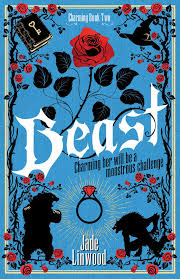
I read this courtesy of the publisher and NetGalley. It’s out in June, in Australia.
This was a lot of fun.
I haven’t read the first book, Charming, which presumably introduces the titular prince and the variety of ladies he has rescued. Fortunately, there was enough backstory provided – and without it being super info-dump-y – that that wasn’t too much of a problem; I picked up fairly quickly that Charming is every Prince Charming, that he’s therefore regarded as a conman and a rogue by the rescuees who have now banded together, and that there’s also some sort of curse on Charming himself, organised by Mephistopheles, that the ladies need to work with Charming to break. Which is all well and good until Charming gets pulled into yet another curse – the focus of this novel, which is of course the Beauty and the Beast one. And it’s gender-swapped, with Charming as the Beauty and a woman as the Beast.
It’s interesting to read a flipped B&B, especially when it’s primarily from the man’s perspective (now I want to read a flipped version from the woman’s perspective). Because of the sort of story this is, Charming never finds Beast particularly offensive, and indeed appreciates many of her qualities from early on. The novel does acknowledge that other men have not been as generous, with some reduced to gibbering wrecks because they’re incapable of seeing past the idea of a very large furry bipedal ‘animal’ coming towards them while inside a house. There’s no great interrogation here or psychoanalytical discussion of what it means to have been transformed; that’s not what this novel wants to do. But there is commentary on Beast having to use a tankard rather than a wine glass, and not wanting to eat in front of potential suitors, and a few other notes that compare how a well-bred lady of the pseudo-medieval society would be expected to look and behave compared with how she looks now.
Other fairy tales also get a look-in here, in particular Red Riding Hood and Hansel & Gretel; they are likewise fractured in really fascinating ways. Linwood seems to have had a lot of fun playing with all of these stories and thinking about how to make recognisable and yet just a bit other. (Red’s hanging out with werewolves; Gretel is traumatised from her childhood – and not by a witch – and now protects herself with bears.)
Fast-paced in a good way, easy to read, some delightful characters: this book was great.
Mary Darling, by Pat Murphy
Read courtesy of NetGalley and the publisher, it’s out in May.
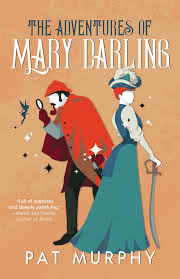
The Peter Pan/Sherlock Holmes mash-up I didn’t know I needed.
I’m a big fan of taking old stories – especially well-loved ones – and either putting women in, or re-telling the women’s stories to give them more agency, or just flat-out actually making them a character rather than sexy (or maternal) lampshades. Here, Murphy gives life to Mary Darling: wife to George, mother to Wendy, John, and Michael – and previous inhabitant of Neverland, courtesy of Peter Pan. She grew up in Cooktown, Qld; is the niece of Dr John Watson; and is generally awesome.
The story is partly Mary’s story, as she goes off to find her own children – recognising all the signs, as she does, of a Peter Pan abduction – and partly Watson’s story, as he (along with Holmes) follow in Mary’s wake to try and find Neverland. Along the way there are adventures, including other Victorian lady adventurers, and brothel-keepers, and several pirates. There’s also flashbacks to Mary’s childhood, as well as to the experiences of various members of the party: Sam, a South-Sea Islander friend from Mary’s childhood; some of the pirates; the people who become known as Princess Tiger-Lily and her family; and George Darling himself.
Murphy has made Barrie’s (and Conan Doyle’s) much richer by restoring the women and people of colour who would really have existed in London, let alone the rest of the world, to the story. She’s also written a zippy tale of adventure and family and identity that kept me completely enthralled.
Holmes does not come out of this story very well. Nor does Peter Pan. I was naturally reminded of AC Wise’s Wendy, Darling, which is a very different book but likewise asks questions about exactly who, or what, Peter Pan could possibly be.
This was brilliant. Loved all of it.
City of Dancing Gargoyles

I read this because Ian Mond told me to. I mean, not personally or directly, but he definitely recommended it within my hearing, and I took that to heart. I am very, very glad that I did.
This is not a linear narrative. As I was reading, I was trying to figure out what it reminded me of, and I finally realised: it’s Christopher Priest’s The Islanders. It’s not identical, but there’s a similarity in the way it tells a story through vignettes and moments. It’s got a bit more traditional story-telling thrown in there than the Priest, I’ll admit, but the comparison is still valid. Especially since I loved both.
The book is set at some point in the future – not too far future, there are no galactic empires; but also not quite tomorrow (sometime early in the 2100s-ish). Something… odd… has happened in the USA (insert joke here and then move on); something alchemical, perhaps. Previously inert things have been affected – built things, and natural things. The title gives you a suggestion of one way things have been changed. There are also towns where trees shoot guns, and a city where chocolates glare at you, where books fret, where blankets cringe and candles sob. Why? Absolutely no idea. Part of the story is told in communications between Meena Gupta and Joseph Evans to their boss, Manfred Himmelblau, as they go exploring and reporting on these places. Part of it is the experience of M and E – two gargoyles searching for their place in this new world. And part of it is about Dolores and her mother Rose, who are likewise looking for safety and community.
It’s a beautiful book. It’s about identity, and dealing with change and opposition and the weird, and finding community. It’s somehow also about the things that are already remarkable in our world by imagining how things might go really (really weird). An utter delight.
You can get it from the publisher.
The Fall of Egypt and the Rise of Rome
Read via NetGalley and the publisher. It’s out now.
My feelings on this book are conflicted. There are some good bits! There are also some frustrating bits that definitely got in the way of my enjoyment.
The good bits: just the existence of a book about the Ptolemys is a pretty good thing, I think. They so often get ignored in histories of Egypt; and they just end up as a prologue to Cleopatra VII. And I get it – it’s hard to figure out where they fit in, as an invading ruling family that doesn’t fit with OG Egypt. I am also intrigued by the idea of putting the Ptolemaic dynasty and the rise of Rome together: if you know anything about the two, you know they have a stunning convergence in Cleopatra VII/ Caesar / Marc Antony, but what de la Bedoyere shows is the ways Egypt and Rome had been interacting for generations beforehand, and why therefore Caesar went to Egypt and Cleopatra thought getting the Romans involved made sense. I have a much greater appreciation now for the ways Rome was meddling in their surrounds, and how Egypt and Syria and others were using external players in their internal struggles.
Other positive aspects are the fact that the women get some discussion (although that’s also a source of frustration, see below), and the fact that this is written fairly accessibly, within the confines of ‘there are a lot of the same names and that gets very confusing’. I appreciated that the author did acknowledge things like ‘Roman historians have a LOT of prejudice’ and that there are several aspects of Ptolemaic history where historians simply do not have enough information to adequately explain things.
So. The less good bits. Firstly, the frustrating-ness is partly a product, I suspect, of writing a book that’s intended to be generally accessible – so it doesn’t go into a lot of detail about some aspects, and doesn’t have all THAT many references either. Instead, the author just makes claims… which are sometimes such that I raised my eyebrows. Perhaps the most egregious, from my perspective, is the fact that he doesn’t try to examine why various non-Roman kings in the Mediterranean world would appeal to Rome at the start, when Rome is an international upstart. He simply says that it happens because the Romans had won some wars. There seems to be an underlying assumption that Rome was always going to preeminent, so it makes sense that everyone acknowledged this early on. I wanted to write “needs more evidence” in the margin.
Secondly, the portrayal of the women is fairly problematic. The second Ptolemy was the first to marry his sister. De la Bedoyere blithely states that the sister, Arsinoe, basically made the marriage happen after she ran to her brother for help when previous marriages had gone badly wrong, because she was so ambitious. There is no explanation offered for her characterisation as ‘ambitious’. The fact that she married various rulers doesn’t tell us anything about HER attitudes. There is no suggestion that maybe Ptolemy forced or convinced her to marry him. Given the extravagant after-death cult stuff set up by Ptolemy II – which may be partly about playing into Egyptian religion – it seems more like to me Ptolemy II was either besotted or very, very political (why not have both?!). There are other moments when the various other Cleopatras, Berenices, and Arsinoes are also treated like this: mothers acting as king instead of stepping down for their sons, or manipulating brothers… and maybe some of them were indeed political machines! But I need evidence of that – because achieving that in such a patriarchal world would be admirable and worthy of applause! I point you also to this claim: “Worried that her power and influence were waning after his triumph over [another ruler], [Cleopatra Thea] tried to poison her son. Having already killed one child, killing another must have seemed comparatively easy.” NO WORDS.
Fourthly, connected to what I said earlier about acknowledging the problems with Roman sources in particular: relaying what those sources say in great detail, AND THEN spending a couple of lines saying ‘but we can’t take everything they say at face value’ doesn’t really work. Pretty sure that’s what lawyers do when they know a jury will be asked to ignore some evidence, but THEY’VE ALREADY HEARD IT (lol, at least that’s how it works on tv, and you see what I mean). I really think those sections – usually bad-mouthing a Ptolemy, and especially Cleopatra VII – needed to be PREFACED with ‘but the Romans had an agenda’. I really got the sense that de la Bedoyere doesn’t care for Cleopatra VII at all, to be honest; he claims she didn’t care for Egypt in the slightest, just her own power, and again – I’d like to see more evidence please.
Finally, there are some odd choices in terms of the book’s presentation. Every now and then there are boxes with random bits of information that is tangentially connected to the main part of the story. I found these more distracting than helpful – although I guess YMMV and maybe for some people this really works.
Overall… I’m reluctant to recommend this to an Egypt or Rome novice. I really think you need a slightly sophisticated reader who is able and willing to question some of the assumptions, and put things into context. So like I said: I am conflicted.
The Green Man series

I’ve been aware of this series for a few years, but never got around to reading them. Then I found out that Cheryl, of Wizard’s Tower Press, was going to have a table at WorldCon in Glasgow – where I would also be present – and I knew it was finally time to give it a go. I picked up the first book – Actual Paper! – and read it in early September. In a day. And then I bought the next two ebooks… and I read them pretty quickly… and then I caved to the inevitable and bought books 4, 5 and 6 in ebooks, knowing that this was a series I would be consuming in entirety.
All of which is pretty convincing evidence that I am loving this series. Another indication: I am very glad there’s a 7th book coming out this year.
The series follows Dan Mackmain, son of a dryad mother and human father; a carpenter by trade, who moves around following jobs (until he gets ongoing work a couple books in). Having greenwood blood, he can see things ordinary humans can’t – like boggarts and hobs, and dryads and nereids in their natural form, black shucks and wood woses: basically the things out of British folklore. He also seems to have been singled out by the Green Man as the go-to human for when bad things are happening either to, or because of, those folk: murder, mayhem, and other inconveniences. Over the course of the six books he has developed connections across Britain both with actual mythical creatures (dryads, mermaids, nereids, swan maids) and with humans who are either like him (offspring of human/not human couples) or who, somehow, have knowledge of that other world. Together, they basically act to make the world safer whenever issues arise.
The series is set in the here and now, which was clear from the technology, but I don’t think McKenna ever actually specified a year in the early books. Which means she could just have kept writing as if it were 2019 forever. Or she could have chosen to make this a completely alternate world. Instead, the fourth book – which came out in 2021 – talks explicitly about Covid, lockdowns, social distancing… it’s all there. I think it might be only the second book I’ve read (after John Scalzi’s Kaiju Preservation Society) which includes the plague. And that’s largely on me, and the sort of books I read (I do not regret this fact); but it still made it quite remarkable to read, and something I really valued. The other thing I continue to find intriguing across the books is the amount of mundanity that McKenna includes – and I mean this in a good way. Characters are in a cafe; they read the menu, they order, they eat, they pay. There’s a great deal of observed everyday-ness that makes the whole story feel real.
I have no idea whether the stories across these books are building to some grand finale – there have been some hints that maybe some of the otherworldly types are becoming restless, because of something stirring – or whether this is going to be an ongoing crime series as Dan needs to deal with yet another unexpectedly real creature (I don’t know my British folklore well enough to know what hasn’t been included yet, but I’m sure the Celtic fringes in particular will have a lot to offer). I think I would like to see some grand denouement… but who am I kidding, I can totally imagine reading several more of these books even if there isn’t.
The Green Man series is immensely fun: a fast-paced mystery/crime element with a delightful dose of folklore, characters who are generally charming and enjoyable to be around, and engaging writing that means I’ve read pretty much every book in a day. Highly recommended.
Ocean: A History of the Atlantic before Columbus
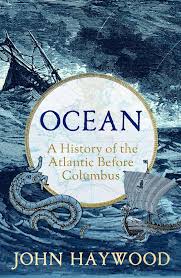
I read this courtesy of the publisher and NetGalley. It’s available now.
Broad sweeping history like this, even when done well, is both very intriguing and enjoyable to read, and occasionally frustrating. As long as you know what you’re reading, you can get around that.
To get the frustrating bit out of the way: the book focuses almost entirely on the European experience. It touches briefly on Africa, and even more briefly on the Americas, but largely through a European lens. Now, I am sure that this is partly a dearth of written records – but a significant portion of the book is about pre-history and/or relies on archaeology, so that doesn’t hold as a reason. I would have less of a problem with this if the book itself made clear it was “the European Atlantic,” but it doesn’t.
So, on the understanding that this book is largely about the European experience of the Atlantic before Columbus sailed across it, this is a pretty good book! It’s a survey, so it covers an enormous swathe of time and, within the European bounds, a broad range of cultures too – which does mean it doesn’t have really nitty-gritty detail, but that aspect is entirely expected.
Having recently visited Skara Brae, on Orkney, I was delighted to discover a section on that site, and to learn more about what it reveals of how Neolithic folks used the ocean. Haywood covers what we can know about how humans have eaten from the ocean (isotopes in bones, how amazing), as well as – when the literary sources exist – how they thought about it, used it in myths and stories, and so on. And then of course there’s sailing, for a variety of reasons and in a variety of vessels.
I left this book intrigued by the different ways people have used this ocean over time. I generally enjoyed Haywood’s writing style, and think this is accessible to the general reader.
The City in Glass

I am relatively new to Nghi Vo and now I want to read pretty much everything she has ever written.
There is so much that is enchanting about this book.
I love the idea of an immortal being having a long-term connection to, basically a relationship with, a particular place and group of people. What that looks like over a long period of time is a key part of what Vo is looking at here. I think connection to place is something that we don’t talk about enough.
And then there’s the fact that the main protagonist is called a demon, while the antagonist is an angel… nice work on the challenging expectations and flipping conventions, Vo.
The writing itself is also just a delight. This was such an easy book to read – it was so easy to just KEEP reading, to be sucked into the world and desperately need to know what was going to happen. This is always a good sign.
I remain delighted to have read this.

 Randomly Yours, Alex