Ashling
Spoilers for the first two Obernewtyn books.
 Ashling. The point at which Carmody’s editor said, let’s make it big! Sigh. 520-odd pages is large. Still, she is a page turner, so it didn’t take me that long to plough through it a second time.
The book opens with a halfblooded gypsy about to be burned at the stake by a Herder, which is nicely dramatic and also introduces the gypsies themselves, who have only been vaguely alluded to in the previous books. Here, beginning with Elspeth’s rescue of the gypsy woman (oh come on, that’s not a spoiler; as if she could ride past and let it happen!), gypsies and their place in the Land play a large, and intriguing, part. And so does Dragon, the mysterious child discovered in the Beforetime ruins who turned out to be an immensely powerful coercer.
The narrative continues to follow Elspeth and her somewhat torturous groping after her destiny as presented to her by the Agyllian birds, as well as the Misfits of Obernewtyn striving towards acceptance, or at least not open hatred, in the Land. For Elspeth this means travelling away from Obernewtyn for much of the book, meeting new people – gypsies and foreigners amongst them – and experiencing a wide variety of responses to herself and the things she has to say. For the Misfits it means confronting the unTalented rebels also present in the Land, and whether the Talented have a place with them or not.
The word ashling refers to a sort of dream, and dreams play a prominent role here, especially when Elspeth discovers the dreamtrails. This is a really interesting aspect of the world Carmody has created for her Talents, although not many can access them or understand how they work.
This is a third book in what has turned out to be a six-book series, and to some extent it suffers from classic middle book syndrome. It doesn’t really start anything, and it certainly doesn’t bring any real resolution (except in one matter). It definitely doesn’t stand alone, not least because there’s not much effort to explain Obernewtyn and the Misfits, because much more infodump would have made me very impatient. What it does do well, though, is character development. Elspeth is of course the focus – she’s telling the story, after all, and apparently the fate of the world actually does rest on her. But other characters do become more well-rounded. Dragon, the foundling who is gradually being civilised; Matthew, the impetuous and romantic farseeker, has a big role to play; Kella, the healer, whose feelings and attitudes are perhaps the most complex of the lot. And then there’s Brydda, the rebel, who plays Big Bluff Larrikin but whom Carmody rescues from buffoon by giving him gentleness and wisdom as well.
It’s not a perfect book; it’s definitely a bit slow going in some parts, and could have done with some better editing. Still, enjoyable.
Thief of Lives will steal your time
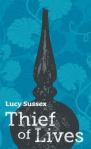
This is the delightfully-packaged third book in the Twelve Planets series, from Twelfth Planet Press. I should mention that I am friends with the editor/publisher, Alisa Krasnostein, and a passing acquaintance of the author, Lucy Sussex. But don’t worry; I would have no trouble saying I didn’t like it much, if that were the case…
The first story is, for me, the blazing outstanding story of the four. Called “Alchemy,” it is set in Babylon, a city as evocative, perhaps, as it is foreign. We are presented with a story told from two perspectives. The first is that of Tapputi, a perfumer from a long line of such. She is a mother, a widow, and a skilled artisan. She has also attracted the attention of Azubel, a spirit whose point of view we also read. Azubel has knowledge of the past and the possible paths of the future, with a particular passion for and understanding of what we would call chemistry. The stories of these two, over a long span of time (by human standards) has many strands, weaving in examinations of knowledge and the dangers thereof; juggling career and family; tradition and innovation and the pitfalls of each; and that essential conundrum, discerning good from evil when the world is grey, not black and white. Tapputi is finely, delicately drawn, the balance of concerns inherent being in being a widowed mother and artisan nicely indicated. She is both practical and romantic and, perhaps most wondrously, is actually based on a woman known to historians because her name and trade are recorded in cuneiform from the second millennium BC. This is a story that mixes fantasy and history in a glorious blend, and is one of my favourite stories for the year.
The second story in the collection is Krasnostein showing her readers that the Twelve Planets series is not going to follow the path set by the first two sets (Nightsiders and Love and Romanpunk), because it neither follows “Alchemy” (sigh) nor falls into SF/fantasy. “The Fountain of Justice” was first published for the Ned Kelly Awards, given in Australia to crime authors, and is indeed a story of crime and policing set in Melbourne, Sussex’s home city. It wasn’t really my sort of thing – crime never really has been. We get the story predominantly from the point of view of Meg, a solicitor who works mainly for the Children’s Court, and with the juveniles accused there. It’s a convoluted story questioning issues of justice and truth, asking I think whether our legal system delivers justice and even whether it can/should. It is clever, but it didn’t ultimately work for me.
Thirdly, “The Subject of O” is again completely different, and perhaps on the face of it far simpler than the preceding two – although it would be a mistake to actually believe that. Petra, a probably twenty-something university student, is the focus, as a stupid comment from an acquaintance sends her memory over the past few weeks and months in which she has been thinking about, and learning about, women and orgasms. On one level it is quite a funny story about students and their conversations, and plays into the common theme that university students are all rather busy with sex and drugs. But the reality is that underneath is a genuine questioning of why discussion of women’s sexuality and experience of sex is more often than not hidden, or spoken of only hazily, or left to blokes leering and imagining them as God’s gift to womankind. It’s frank and honest, refreshingly spiked with wry humour. But don’t read it on public transport if you are the blushing type.
Finally, the collection is rounded out by the eponymous story, “Thief of Lives,” which itself contains a book of the same name (confused yet?). This is the most complicated story of the set, although fortunately almost everything is clarified by the end, making hindsight a wonderful thing. It’s set in Bristol, and told from the first person by someone who is not what they at first appear to be, and whose intentions in Bristol are far from straightforward. It’s impossible for me to give a good idea of the narrative, really, without spoiling it. Let me say that it toys with ideas like a cat with string: why (as the blurb puts it) do writers think that other people’s lives are fair game? How do writers get their ideas? Can writers and their writing have a concrete impact on those around them, especially when drawing on them for inspiration? It’s a little bit labyrinthine, which is echoed somewhat in the maze-like qualities of Bristol itself for our protagonist. It’s very, very clever, and the main character herself is a little bit hypnotic.
Also, isn’t it a totally lovely cover?
Galactic Suburbia 45
 In which Alex and Tansy wax lyrical about Joss Whedon’s Much Ado About Nothing (despite knowing next to nothing about it), welcome the new Apex overlord Lynne Thomas, celebrate the twin dawns of All Hallows Read and Nanowrimo, and embark upon an epic marathon of Culture Consumed. You can stream us at Galactic Suburbia or get us from iTunes.
News
Joss Whedon makes Much Ado About Nothing in secret
at first we knew next to nothing
then we knew something
and every new bit of something brings squeeage!
Harry Potter DVDs to disappear from the shelves after Christmas (and Tansy’s still not over the whole Disney revelation)
Lynne Thomas’ first issue of Apex comes out next week featuring an article by Tansy on The Australian Dark Weird.
As the new editor, Lynne talks about what she wants from authors at Outer Alliance
The lack of (paid) women reviewers (in the lit scene) continues to dismay and fascinate us in equal measure.
All Hallows Read is upon us
And if you’re going to gift a scary book to someone, why not make it Australian?
Nanowrimo is imminent!
What Culture Have we Consumed?
Tansy: Zoo City by Lauren Beukes
Alex: Life on Mars S2
Tansy: Bumped by Megan McCafferty
Alex: Obernewtyn, The Farseekers, and Ashling, by Isobelle Carmody
Tansy: Debris by Jo Anderton
Alex: God’s War, Kameron Hurley
Tansy: Marvel’s Ultimate Universe: Ultimate Spiderman, Ultimate X-Men, The Ultimates
Alex: Shadow Unit
Tansy: Big Finish and Mary Shelley: Mary’s Story (for 99p) & The Silver Turk.
Please send feedback to us at galacticsuburbia@gmail.com, follow us on Twitter at @galacticsuburbs, check out Galactic Suburbia Podcast on Facebook and don’t forget to leave a review on iTunes if you love us!
Eyes like Stars
 The premise: a theatre set in NoParticularTime, inhabited by every character of every play, who come on stage to perform when their scene is announced. Also inhabited by appropriate backstage personnel, and Beatrice Shakespeare Smith, an inappropriate foundling who loves the theatre (her home) with a passion and who is followed around by the Midsummer Night’s Dream fairies, who are as crude and rambunctious and loyal and awesome as (William) Shakespeare would have wanted. Also, two love interests. With this sort of set-up it would have been hard for me not to be completely in love. Happily, Mantchev does not disappoint.
Beatrice – sorry, Bertie – is a wonderful heroine, defiant and strong-willed, fiercely loyal and amusingly devious. She causes all sorts of mischief in and around the theatre – enough that eventually, she might have to leave, unless she can prove herself. This is a coming of age story, with Bertie discovering her gifts and talents and likes and dislikes, as well as dealing with how other people react to her and act on their own. She faces loss – new and old – and disappointment, confusion (especially about love) and revelation, and the glory of strong and true friendship. Basically, it’s all the good and bittersweet bits of the classic coming of age, in a marvellous and enchanting package.
I loved the Theatre Illuminata. I love the way the scene changes work, I love the irascible backstage types and their petty feuds. I was delighted by how Mantchev took mostly Shakespeare’s characters and used them on stage but also imagined them as people outside of their scenes (much like Rosencrantz and Guildenstern does, without the loopy philosophising and dialogue…). The characters from Hamlet were especially amusing, playing on and reflecting so many of the tensions that can easily be imagined from the play itself, and that might arise from the people playing those characters day in, day out. It’s just really clever. And then there’s the fairies: Cobweb, Mustardseed, Moth, and Peaseblossom. Pulling hair, mooning important people, eating all the cake… it’s all in a day’s work, really, and there better be cake after, too. Oh, and Ariel. I am not a huge fan of The Tempest, but I’ve read and seen it; I loved Dan Simmons’ play on Caliban in Ilium and Olympos… but I’ll never be able to see Ariel in the same light again. (Huh; this connects with Obernewtyn, by Isobelle Carmody, which I’ve also just read. Interesting.)
How much did I love this book? I’ve just ordered books 2 and 3. I HAVE to know what happens.
Slight spoiler: One thing bugged me. She’s all hung up about her mother, and wanting to find her mother, but she doesn’t seem worried about her father until right near the end. This is a girl who’s grown up around Shakespeare, where half the time it’s the mother who is missing, but the father is present. Surely, when she knows neither, she should be curious about both? Also, growing up around those stories, shouldn’t she be wanting to know the romantic story of how they met?
The Farseekers
 Well, it’s better than Obernewtyn, for sure.
*Spoilers for Obernewtyn, the first book*
Continuing my re-read of the Obernewtyn chronicles, I devoured most of this one in a night. Interestingly, it’s set some time after Obernewtyn ends, and therefore we don’t get most of the fight against Alexi and Madame Vega, nor Rushton’s work at being made legal owner of the place. Possibly because Elspeth is out of it for a while thanks to the burns to her legs? Anyway, we open here rather abruptly to discover that Rushton is in charge, and the Misfits have formed themselves rather (too) neatly into Guilds according to their mind powers. This was one thing that bugged me about the book – they all seemed to have come into their powers rather quickly, and easily, whereas I had the impression from the first book that many of them were uncomfortable and certainly not that good at using them because of the fear of being discovered. Perhaps Carmody imagines that once released from that fear, most young people would flourish in experimentation… and when I put it like that, perhaps she is not far wrong.
Anyway, the bulk of Farseekers is not actually set at Obernewtyn, but in the lowlands, as Elspeth and some others set out on a joint mission to find a library and a strong Talent they’ve sensed. Of course, things do not go easily, and they encounter most of the villains foreshadowed in Obernewtyn – Council, Herders, and the Druid himself – in various ways and with various consequences that I shan’t spoil. It is a more convincing narrative than the first book; while there are still happy coincidences and useful chance-meetings, well, that’s really the stock in trade of a fantasy, in some ways; and here it’s done more smoothly and with less jarring “oh hai, yr conveniently who i need” moments.
Characters are more interesting and well developed in this second novel, too. Elspeth is a bit more complicated and nuanced, conflicted between the desire for safety and an impatience with staying put. The characters she goes travelling with show hints of personality and individuality; the most developed and interesting are the animals, and particularly the arrogant stallion Gahltha. He’s way cool. Rushton continues to be gruff and remote but still appealing (to me, anyway!). The new people our Misfits meet on their travels are probably the most interesting characters aside from Elspeth, and although one of them gets a bit preachy and info-dumpy that’s hardly his fault, and I liked him for his rash-yet-considered ways.
Finally, the world is built up just that bit more in this novel, mostly thanks to the travels of our heroes. We learn more about the current society – which is complex enough to be not all bad, but simple enough that the reader knows (well, this one did) that they really wouldn’t want to live there. There’s more about the Beforetimes, too, and I seem to remember that it took me until this book to be absolutely sure that Carmody was envisioning this as OUR world after some sort of human-caused apocalypse. Which is a bit embarrassing frankly. Anyway – more Beforetimes things, and stories too. This sort of idea isn’t unique, but I like how Carmody runs with it.
Obernewtyn, again
 I first read this and the next three a number of years ago; I am re-reading them at the moment, in one hit (probably) because the sixth and final book is FINALLY! being published.
I remembered a fair bit about this story – bits and pieces of Elspeth’s story, like the cat, and Ariel, and aspects of life at Obernewtyn. I had forgotten – or didn’t notice the first time – that the quality is quite patchy. There are some bits that really ought to have been picked up by an editor, like the fact that Elspeth uses Ariel’s name without ever being told it (and with no indication that she had got it telepathically either). Some of the scenes are very rushed, and others are just oh-so-convenient. It reminded me, actually, of Harry Potter & the Philosopher’s Stone. I understand that bits of this were first written when Carmody was in high school, so perhaps this was her debut, which means I’ll give it some leeway. Because it really is a fascinating story, underneath it all. A world recovering from the Great White, which has poisoned significant portions of the land and caused various mutations; now-forbidden knowledge that perhaps humanity caused the Great White with very amazing weaponmachines; the society which has developed over hundreds of years initially to ensure survival and now, of course, ensuring that the social structure and power hierarchy is maintained. And in to the mix a secretive and fairly unpleasant religious group called the Herders (following the god Lud, which I presume is a corruption of Lord? and being Herders is a bastardising of the idea of priests as shepherds?), and then a group of Misfits with mental powers… and there’s a lot of potential for enthralling storytelling.
Elspeth, the main character and narrator, has her moments of awesomeness and her moments of not. She does develop nicely in terms of her sociability, over the course of the novel, and the conflict she feels over who to trust sometimes works and then at other times seems to melt away far too fast. Of the other characters, I always liked Rushton, the gruff farm overseer; the other Misfits Elspeth encounters are hardly developed at all, but have their flashes of brilliance.
If I were reading this for the first time today, I’m not sure I would continue reading it, which is a surprise to me and a sad one. I am going to keep reading, of course, because I know that the plot becomes ever more tricksy… and the incurable romantic in me remembers some of the emotional conniptions from the later books and desperately needs resolution.
Retribution Falls: a review
I received this book to review for ASif!
 I read about the first 150 pages of this 373-page novel properly. I mostly read about the next 100 or so, then skimmed the final 100-odd in case something interesting happened. It didn’t.
The setting is a world where dirigibles are kept up thanks to some element or compound called aerium and electricity is available but by no means universally accepted. The story seems to be entirely set within an enormous mountain range with lots of convenient valleys and hidey-holes for freebooters such as the main characters, with little suggestion of what else what might make up the world (they do visit an icy waste, but it wasn’t clear to me how this worked with the rest of the geography).
The story opens with Frey, captain of an airship and small-time/some-time pirate, being threatened by another lowlife, along with one of his crew. Frey is something of an idealist, in a weird sort of way; all he wants is to be able to captain his ship and fly where he wants. He doesn’t have the heart of a pirate, but takes on shady deals to keep skin and bone together. Also, the travel seems to be good for meeting women. The rest of his crew, whom we meet in the first few pages, have backgrounds in varying shades of grey; they are none of them keen to share their stories, and although the Ketty Jay is far from perfect, it’s a pretty good place to get away from the past, literally and metaphorically. There’s a crazy flyboy, a mysterious navigator, a drunk surgeon, a mysterious upper-crust passenger… as the crew showed their colours, I began to feel like they and the situation as a whole was oddly familiar. Then I realised that it was. They are the crew of the Serenity, from the short-lived TV show Firefly. But not as interesting, not as unique in their characterisation. The captain, Frey, was the most annoying and flat of the lot. I began to suspect that this was not the sort of story I was really going to enjoy when Frey was reminiscing about how close he had come to marriage in the past, and congratulated himself on escaping those dreadful bonds while fooling the woman into thinking he was going along with it, and still sleeping with the woman. With no irony or other commentary in the story about this being a poor way to treat her. This was accompanied by such protestations as the idea that women “forced [men] to lie to them” (128) in talking of sex and marriage. If you are likely to find this, a seemingly throw-away commentary on the relationships between men and women, insulting, then this is not the book for you. It might be argued that this is a minor point, but Frey’s view on women as a whole – especially those he wants to sleep with – permeates the whole book, and besides it is insulting.
As if inspired a tad too much by Firefly, Retribution Falls proceeds in an episodic fashion that was intensely irritating to read. There was connection and continuity between the various set-pieces, but each took place in a new location and the travelling there was generally treated with little interesting detail – there was simply An Arrival (thunk). Some of these individual set-pieces were well constructed, and gave some of the other members of the Ketty Jay depth and interest such that I began to care about them, Crake (the upper-crust passenger) in particular. He is a daemonist, meaning that somehow he manipulates daemons (which I think are like spirits) in order to do… things. It seems akin to enslaving them into objects so that those objects Do Things. He became interesting as he developed a rapport with various other crew members, and as his backstory was revealed. But he still wasn’t that intriguing.
Most of the set-pieces eventually contribute (some in roundabout ways) to the development of the conspiracy which ultimately drives the story. However, getting there took too long and I had already lost interest by the time the scope was revealed. It turns out to have ramifications for the entirety of the… area? (it’s ruled by an Archduke but I’m not sure whether it’s an archduchy or a country or what) – but so little time is spent establishing how big this area is, how many people care about its system of government, how many people are ruled by it, or anything else that might have been relevant that I just didn’t care.
Another aspect of the world-building which lets the novel as a whole down is the religion of the Awakeners. The portrayal of religion in fantasy is a particular bug-bear of mine. It annoys me when a religion is either badly explained or not mysterious enough, and it really annoys me when a religion is whitewashed as stupid and/or evil without adequate reason. There is some discussion here of how the Awakeners began, but no indication of why or how they have risen to a place of prominence. Various characters are shown to be contemptuous of it, but without properly discussing issues such as atheism or agnosticism that would make such rejection of organised religion make sense. Instead, it feels like another aspect of this world that was poorly thought through.
Overall, I was very disappointed in this novel, and do not intend to read the sequels that I am sure are planned.
Galactic Suburbia 42*
In which we discuss Orson Scott Card’s Hamlet, the agent who said no way to gay YA, Tansy’s Blake’s 7 dolls, the superhero who fights with her hair, and Alisa works through her issues with Doctor Who. You can get us on iTunes or download/stream us from Galactic Suburbia.
News
Subterranean Press address email complaints about “Hamlet’s Father” by Orson Scott Card (and the Rain Taxi review that started it)
The other big Internet Thing – agent says no gay in YA dystopia please & authors speak out
New podcast – Live and Sassy
Twelfth Planet Press opening for novel submissions
What Culture Have we Consumed?
Alex: Retribution Falls, Chris Wooding; Blake’s 7; Hyperion, Dan Simmons.
Tansy: Torchwood (non spoilery), Justice League comics (the new 52), The Business of Death by Trent Jamieson
Alisa: Podcasts: Locus Roundtable (Gail Carriger and Francesca Myman; Kathleen Goonan, Eileen Gunn and Gary K Wolfe); Eurocon 2011 Gender in SF&F Panel; The Outer Alliance Podcast Episode 11, Season 3 Doctor Who
[Book calling for papers on the topic of race and Doctor Who]
Please send feedback to us at galacticsuburbia@gmail.com, follow us on Twitter at @galacticsuburbs, check out Galactic Suburbia Podcast on Facebook and don’t forget to leave a review on iTunes if you love us!
* Alisa and Tansy recorded no. 41 without me, as a Spoilerific Book Club episode about The Hunger Games trilogy. It’s on iTunes or at the website if you’re interested.
Hyperion
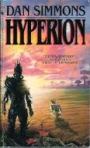
This is my second time reading this book, and happily it was as wonderful and intriguing this time as the first. Of course, I am older and at least a little more knowledgeable this time, so I think I’m actually getting more out of it.
Firstly let me admit to my own blindness the first time I read it: I don’t think I picked up on the resonances with The Canterbury Tales, which is just embarrassing… although at that stage I’m not sure I’d read any of that poem, so perhaps that excuses me slightly! But still, the pilgrims’ stories are each labelled as such, so you would think that I would have picked up on it. But no. There is also – and I guess this is really only obvious right at the very end, but it doesn’t spoil the story – a bizarrely amusing parallel to The Wizard of Oz.
This is is a story set in the 28th century AD, when Earth is no more and humanity has spread to the near reaches of the stars in the Hegira. Multiple planets have been colonised, technology has advanced, there are sentient AIs… and there are still divisions, squabbles, and politics. Sad, but tragically believable. The plot itself revolves around seven pilgrims who have been chosen to visit the Time Tombs at a time of war between the Hegemony – to which most planets belong – and the Ousters, a renegade human faction. The Time Tombs are on Hyperion, they are protected by a terrifying something called the Shrike, and it all goes from there.
Fascinatingly enough, most of the book itself is not taken up with the pilgrimage. Instead, in the spirit of Chaucer, the pilgrims share their stories with each other in an effort to understand both why they have each been chosen and what might happen when they are arrive. Their stories are very different – a military officer, a diplomat, a private investigator, an academic, a Catholic priest, a spaceship captain, and a poet – but they all have common elements of pain and loss and tragedy. And a connection to Hyperion.
I love the different elements that Simmons combines in this book, through the device of the background stories being told through a deliberate and completely plot-appropritate info-dump. I love the mystery of Hyperion, I love the mix of characters, I am enthralled by the diversity of world tied to a somewhat pessimistic view of humanity itself. One of the things that I really love about the book is its exploration of religion and its place in this future. The first story is that told by Father Hoyt, the priest, and it deals very honestly with the issues that do and will face the Church in confronting technological change and everything else the future promises. I appreciate that he imagines a place for such faith, even in a dwindling and sometimes confused manner. And the academic, Sol, is Jewish, and his story ties in many elements and ideas of Judaism. I hope that a Jewish person reading it would have the same reaction to his portrayal as I did to Hoyt (although I am not Catholic). As well as these Old Earth religious hangovers, Simmons also imagines a plethora of brand-new religions based on all sorts of different things. Which is cool.
I am a bit sad that there is only one female pilgrim amongst the seven. Simmons does imagine an improvement in gender relations overall; the CEO of the Hegemony is female, there are female soldiers, etc. He also does not imagine an entirely Anglo future, either; I don’t know whether the pilgrims are ever described in terms of skin tone, although a few of them are described as ‘paling’ and other such giveaways. But many of the worlds have non-Anglo names and predominant cultures. I think his idea of the great Hegira is that humans will have colonised in like-cultural groups, as a number of SF writers have prophesied, and I guess I see the sense in that. But with the ‘farcasting’ technology of the Hegemony, people are able to move around even more easily amongst these planets than we currently do on Earth, so there is a great deal of intermingling.
The other really clever aspect to Hyperion is its connection to the poet John Keats. Hyperion was a Titan of Greek mythology, is a moon of Saturn, and an abandoned poem of Keats’ about the Titans. He tried again with “Fall of Hyperion,” which is also the name of this Hyperion’s sequel. There are nods to Keats in a number of the stories, and I’m sure I missed a few of them. I loved this idea of incorporating a 19th-century poet into a story set a millennium after his death.
I have a lot of books for review on my shelf at the moment, so I haven’t decided whether to read the sequel yet… heh. Who am I kidding.
Galactic Suburbia 40!!
Weird Tales sold
Strange Horizons Fundraising Drive
Galactic Chat: Kelley Armstrong and Ben Peek
What Culture Have we Consumed?
Alisa: Doctor Who Season 2, Outer Alliance Podcast
Alex: Trouble and her Friends, Melissa Scott; Only Ever Always, Penni Russon; Synners, Pat Cadigan; Blake’s 7.
Tansy: SF Squeecast #3, Panel2Panel (http://panel2panel.podbean.com/), Among Others by Jo Walton, Alcestis by Katherine Beukner, Stormlord’s Exile by Glenda Larke, KINDLED
Pet Subject: Hugoriffic!
Were you there for the Hugo Twitter party? Or did you have to resort to sitting in the live audience?
The stats
The results
Hugos commentary round up.
Please send feedback to us at galacticsuburbia@gmail.com, follow us on Twitter at @galacticsuburbs, check out Galactic Suburbia Podcast on Facebook and don’t forget to leave a review on iTunes if you love us!

 Randomly Yours, Alex