The Fall of Egypt and the Rise of Rome
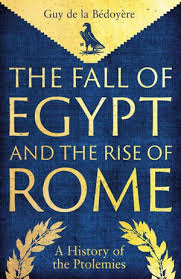
Read via NetGalley and the publisher. It’s out now.
My feelings on this book are conflicted. There are some good bits! There are also some frustrating bits that definitely got in the way of my enjoyment.
The good bits: just the existence of a book about the Ptolemys is a pretty good thing, I think. They so often get ignored in histories of Egypt; and they just end up as a prologue to Cleopatra VII. And I get it – it’s hard to figure out where they fit in, as an invading ruling family that doesn’t fit with OG Egypt. I am also intrigued by the idea of putting the Ptolemaic dynasty and the rise of Rome together: if you know anything about the two, you know they have a stunning convergence in Cleopatra VII/ Caesar / Marc Antony, but what de la Bedoyere shows is the ways Egypt and Rome had been interacting for generations beforehand, and why therefore Caesar went to Egypt and Cleopatra thought getting the Romans involved made sense. I have a much greater appreciation now for the ways Rome was meddling in their surrounds, and how Egypt and Syria and others were using external players in their internal struggles.
Other positive aspects are the fact that the women get some discussion (although that’s also a source of frustration, see below), and the fact that this is written fairly accessibly, within the confines of ‘there are a lot of the same names and that gets very confusing’. I appreciated that the author did acknowledge things like ‘Roman historians have a LOT of prejudice’ and that there are several aspects of Ptolemaic history where historians simply do not have enough information to adequately explain things.
So. The less good bits. Firstly, the frustrating-ness is partly a product, I suspect, of writing a book that’s intended to be generally accessible – so it doesn’t go into a lot of detail about some aspects, and doesn’t have all THAT many references either. Instead, the author just makes claims… which are sometimes such that I raised my eyebrows. Perhaps the most egregious, from my perspective, is the fact that he doesn’t try to examine why various non-Roman kings in the Mediterranean world would appeal to Rome at the start, when Rome is an international upstart. He simply says that it happens because the Romans had won some wars. There seems to be an underlying assumption that Rome was always going to preeminent, so it makes sense that everyone acknowledged this early on. I wanted to write “needs more evidence” in the margin.
Secondly, the portrayal of the women is fairly problematic. The second Ptolemy was the first to marry his sister. De la Bedoyere blithely states that the sister, Arsinoe, basically made the marriage happen after she ran to her brother for help when previous marriages had gone badly wrong, because she was so ambitious. There is no explanation offered for her characterisation as ‘ambitious’. The fact that she married various rulers doesn’t tell us anything about HER attitudes. There is no suggestion that maybe Ptolemy forced or convinced her to marry him. Given the extravagant after-death cult stuff set up by Ptolemy II – which may be partly about playing into Egyptian religion – it seems more like to me Ptolemy II was either besotted or very, very political (why not have both?!). There are other moments when the various other Cleopatras, Berenices, and Arsinoes are also treated like this: mothers acting as king instead of stepping down for their sons, or manipulating brothers… and maybe some of them were indeed political machines! But I need evidence of that – because achieving that in such a patriarchal world would be admirable and worthy of applause! I point you also to this claim: “Worried that her power and influence were waning after his triumph over [another ruler], [Cleopatra Thea] tried to poison her son. Having already killed one child, killing another must have seemed comparatively easy.” NO WORDS.
Fourthly, connected to what I said earlier about acknowledging the problems with Roman sources in particular: relaying what those sources say in great detail, AND THEN spending a couple of lines saying ‘but we can’t take everything they say at face value’ doesn’t really work. Pretty sure that’s what lawyers do when they know a jury will be asked to ignore some evidence, but THEY’VE ALREADY HEARD IT (lol, at least that’s how it works on tv, and you see what I mean). I really think those sections – usually bad-mouthing a Ptolemy, and especially Cleopatra VII – needed to be PREFACED with ‘but the Romans had an agenda’. I really got the sense that de la Bedoyere doesn’t care for Cleopatra VII at all, to be honest; he claims she didn’t care for Egypt in the slightest, just her own power, and again – I’d like to see more evidence please.
Finally, there are some odd choices in terms of the book’s presentation. Every now and then there are boxes with random bits of information that is tangentially connected to the main part of the story. I found these more distracting than helpful – although I guess YMMV and maybe for some people this really works.
Overall… I’m reluctant to recommend this to an Egypt or Rome novice. I really think you need a slightly sophisticated reader who is able and willing to question some of the assumptions, and put things into context. So like I said: I am conflicted.
The Seven Wonders of the Ancient World

I received this book to review at no cost, from the publisher Hachette. It’s out now (trade paperback, $34.99).
As someone who has been keen on ancient history since forever, of course I was intrigued by a new book on the seven ancient wonders. And I’ve also read other work by Hughes, and enjoyed it, so that made me doubly intrigued.
Before I get into the book: of course there is controversy over this list. Hughes acknowledges that, and goes into quite a lot of detail about how the ‘canonical’ list came about – the first surviving mention of such a list, why lists were made, what other ‘wonders’ appeared on such lists in the ancient world of Greece and Rome, as well as what other monuments could be put on such a list were it made today. I appreciated this aspect a lot: it would have been easy to simply run with “the list everyone knows” (where ‘everyone’ is… you know), but she doesn’t. She puts it in context, and that’s an excellent thing.
In fact, context is the aspect of this book that I enjoyed the most. For each of the Wonders, Hughes discusses the geographical context – then and now; and the political, social, and religious contexts that enabled them to be made. This is pretty much what I was hoping for without realising it. And then she also talks about how people have reacted to, and riffed on, each of the Wonders since their construction, which is also a hugely important aspect of their continuing existence on the list.
- The Pyramids: the discussion of the exploration inside, by modern archaeologists, was particularly fascinating.
- The Hanging Gardens of Babylon: the discussion of whether they even existed, and if so where, and what ‘hanging’ actually meant, was intriguing.
- Temple of Artemis: I had no idea how big the structure was.
- Statue of Olympia: I had NO idea how big this allegedly was.
- Mausoleum of Halikarnassos: NOT HELLENIC! Did not know that.
- Colossus of Rhodes: also had no idea how big it allegedly was, nor the discussion around its placement.
Cleopatra’s Daughter, by Jane Draycott
I read this courtesy of NetGalley; it’s out in November 2022.

Ever since I read a biography of Beregaria – the only English queen who never even visited England – I have been very keen on biographies of women who have just been overlooked. (It wasn’t Berengaria’s fault; she was married to Richard I while he was on his way to crusade, then he got kidnapped and then he was off fighting in France, so… she never got across the Channel.)
Did I know Cleopatra VII had a daughter? Yes. That she was taken as a prisoner by Octavian back to Rome? Yes, although it wasn’t as immediately accessible knowledge. Did I know that this daughter then went on to marry Juba. king of Mauretania, and that she ruled there with him for many years? NO I DID NOT. And I kind of feel a bit aggrieved that I got to be 42 without knowing this.
Draycott has written a quite splendid biography, especially considering the limitation of the source material available. One of the things I particularly like about her style is that she’s not pretending knowledge that she doesn’t have. The reality is that there’s very little information about Cleopatra Selene’s childhood, either in Alexandria or in Rome; so Draycott presents what is known for children and families in those places in those times, indicating that this is a good estimation. I like this approach a lot.
Having said that the material is limited, I was surprised at the sources that do exist – see above, not knowing anything about Cleopatra Selene’s adulthood. There are (probably) statues (identifying ancients in statue is notoriously hard); there are coins; and there are some written references, too. So it’s not all a guessing game ; and when Draycott does make some leaps (like Zenobia maybe being a descendent??), she’s pretty clear about the tenuous nature of the links.
It’s likely that both Cleopatra Selene’s twin, Alexander Helios (yes, yes, Mark Antony, you have a great sense of humour AND hubris), and their younger brother Ptolemy, both died as young boys – Draycott makes a compelling case that this was probably from natural causes, given that Rome was a malaria-ridden swamp and that there doesn’t seem to have been a reason to kill the boys and leave the girl alive. Cleopatra Selene marries Juba, also a sort-of captive in Rome, and then they’re sent off to rule Mauretania – possibly, Draycott argues, with Cleopatra Selene taking an active part as co-ruler, given the example she’d been set by her own mother. She seems to have lived there for around 20 years, although there’s no definite date of her death recorded anywhere.
Finally, I particularly liked Draycott’s handling of the question of Cleopatra Selene’s ‘ethnicity’. That modern understandings (or imaginings) of ‘race’ and ‘ethnicity’ are very different from what people of her time would have thought about themselves or others, that it can’t be resolved what colour her skin was given the lack of definite knowledge about Cleopatra VII’s ancestry, and so on. I think she deals sympathetically with the idea of Cleopatra being ‘Black’, within the context of both not knowing for sure and those ancient people having different notions of what it means; she does make the firm point that Juba himself was (what today would be called) a Black African, and therefore their children were ‘mixed race’ and ‘mixed ethnicity’ (Greek, Roman, Egyptian, African). I like that Draycott is aware of these issues and isn’t pretending that such discussions don’t exist, or that they are somehow irrelevant to the discourse she’s part of.
Well written, thoughtful, and giving a broad understanding of both Cleopatra Selene as a human (as much as can be from the limited sources) and her context in time and place. This is what I want from a biography.
Hatshepsut
They found her mummy! – well, they think so, and it’s not so much found it as identified it…
Hatshepsut is so cool. Her iconography is fascinating, false beard and all (although, despite how incredulous the narrator of that vid sounds, male pharaohs did the false beard thing too… and I have never actually heard someone say Thutmose. I’ve only heard Tutmosis…). I think actually one thing that makes her so interesting is the fact that her descendents tried so damned hard to erase her from history. Humans are contrary like that; tell me something I don’t want to know about and dammit, I do!
I also like that Zahi Hawass sometimes seems to be a bit of a rock star in Egypt. Not everyone likes the way he does his job, but darn he is a good front man for archaeology in Egypt.
A Tale of Three Egyptian Mummies
“New Science on Ancient Livesâ€
Dr Karin Sowada, assistant curator at the Nicholson Museum, Uni of Sydney. Spoke at the Melbourne Museum last year.
*Mummies currently held by the Nicholson; had never been studied before this.
*Two have coffins; one an inscription. Curators were trying to see what they could find out from textiles etc, not just the body.
*Why mummify at all?
–probably arose through seeing natural mummification in the desert sand.
–once you start building structures for holding bodies, you remove them from the sand and heat, so you need to do it artificially.
—-But why?
–to be recognisable to the soul coming back
–be identified with Osiris
NB: mumiya = bitumen (in Arabic); in the 19th century, it was thought that bitumen was used on the mummies, because of the colour.
Mummy 1
*A very well-decorated coffin.
*Possibly priestly; has the title ‘Beloved of the God’ – not really sure what this means.
*Name is Padiashaikhet, meaning “One given by Ashaikhetâ€; a very unusual name, because Ashaikhet is a personal name, not a god. Could be some sort of debt the parents had??
*From c.720-700BC.
*Wrapped in used linens, despite signs of his obvious wealth and status.
*Nothing left in the body, not even the heart; no broken bones.
*Possibly died of dental abscesses (ouch).
Mummy 2
*Female, from c.1950BC. Her name was Meruah (sp??). Had priestly duties.
*Highly decorated coffin. People couldn’t afford big funerary houses, so coffins get the pictures usually found on the walls.
*Torso filled with something. The mummy encased in a plaster carapace! Painted red over face, green over body (for Osiris).
*But: the DNA says the body is male! Red face of carapace is the colour used for males on coffins. Shows re-use of funerary stuff? Or, possibly, that it was done by a nineteenth-century dealer….
**Huge issues over whether you can actually trust that the coffin and body match in other cases**
Mummy 3
*A child, 7-9 years old. From early second century AD, so Roman.
*No coffin accompanying the mummy. Has a painted mask. The linen wrappings were once dyed red, blue and yellow. The colours have probably faded after arriving in Sydney – was stored in a large, airy room, with lots of indirect sunlight; no knowledge of this.
*All organs removed; linen plug at the incision site. Some sort of package inside; no idea what.
*No DNA sample taken because the wrappings are so thick.
My take: this was a great lecture; it was fascinating to hear about the processes undergone to examine the mummies, as well as the sort of stuff that could be learnt. And just bizarre to think that these mummies had never really been examined before.

 Randomly Yours, Alex