The Bitterwood Bible
Sourdough and Other Stories by Angela Slatter has been on my radar for ages, but somehow I’ve just never got around to reading it. For a while I didn’t realise it was available as an ebook – and Tartarus Press does lovely hard copies, but they’re a leedle expensive for a book you’re taking a chance on. And I also wasn’t sure that these stories were ones that I would really connect with. I mean, yes, I loved “Brisneyland by Night” in Sprawl, and a few others Slatter has written – especially with Lisa L Hannett – and Midnight and Moonshine made me cry with its beauty, but… I just wasn’t sure. And then I found out that Slatter had a set of ‘prequel’ type stories coming out, so I thought I should read those first.
 Halfway through reading The Bitterwood Bible and Other Recountings, I finally bought myself Sourdough because there is no way I can now not read that collection. Because I am absolutely an Angela Slatter convert.
The stories collected here are not quite a mosaic in the same way that Midnight and Moonshine are. There, each story was clearly connected – most often by family, which made it seem a generational saga. Here, while there are a couple of stories that feature the same protagonist, a few more with recurring cameos, and most set in the same place or with the same background characters, it’s more like a series of stories set in a couple of distinct suburbs or small towns. Of course you’re going to get the same bars, or neighbourhood characters, or landmarks mentioned; that just makes sense. But the narratives themselves aren’t necessarily connected… although sometimes they are. And these locales that Slatter has invented are very believable. They’re well-realised, and they’re familiar in that fairy-tale sort of way. Because these are indeed a sort of fairy tale. There’s not a whole lot of magic; what there is is generally a quiet, dare I say domestic without it being in the slightest derogatory, magic; no flashiness or gaudiness here, no winning of wars. That would draw too much attention, and drawing attention in these stories is generally A Bad Thing. The women – and the protagonists are almost all women – mostly want to be left alone, to get on with their lives. Sometimes they’re forced to interact with the world, or with other people, that they’d rather not; because they need to achieve some specific goal, or because they’re being manipulated, or they otherwise have no choice. But you certainly get the feeling that most of them would just prefer never to be in the limelight, not to be a household name… not to stand out.
There are scribes and poisoners, seamstresses and pirates, teachers and coffin-makers and servants. They are mothers and daughters and child-free and orphan, young and old and neither; rural and urban, rich and poor. They have varying degrees of agency and control, varying chances of living after and of living happily ever after.
This is a wonderful collection of stories. They can and should be read and enjoyed separately; they can and should be read and enjoyed together, making a whole even greater than its parts. Oh, and Kathleen Jennings’ lovely little illustrations throughout are a delightful addition; I imagine they’re even more impressive in print, but electronically they’re still fine.
This review is part of the Australian Women’s Writers 2014 challenge.
Galactic Suburbia 105!
 This episode of Galactic Suburbia is brought to you by the flavour vanilla and the colour of fairytales. You can get us from iTunes or at Galactic Suburbia.
News
Drowned Vanilla Cover reveal – order the book at the publisher’s site.
Tansy’s Drowned Vanilla Pinterest board
Wiscon Update
Aussie Spec Fic Snapshot is on again.
What Culture Have we Consumed?
Tansy: Go Bayside (April Richardson); Breaking Bubbles; Dimetrodon, the Doubleclicks; First 3 Harry Potter movies, The Prisoner of Azkaban
Alisa: Squaresville; The Secret Diary of Lizzie Bennet; What book will she discard?
Alex: The Elenium and The Tamuli trilogies, David Eddings; Snowpiercer; Reality Dysfunction, Peter F Hamilton; Extant
Please send feedback to us at galacticsuburbia@gmail.com, follow us on Twitter at @galacticsuburbs, check out Galactic Suburbia Podcast on Facebook, support us at Patreon (http://www.patreon.com/galacticsuburbia) and don’t forget to leave a review on iTunes if you love us!
Fairy tales. New ones.
Sometimes I forget how much I love reworkings of fairy tales. How crazy is that?
Ever since my mother (I think?) gave me a lovely little collection of twisted fairy tales – I have no idea what it was called, whether they were all by the same person, or whatever – I have been passionate about people taking well worn stories and twisting them. Sometimes slightly, sometimes extremely. But, it turns out, I forget this. And then I read Troll’s Eye View, and I remember… because sometimes the villain is absolutely the most interesting character, and sometimes they’re not actually a villain if you look at them a certain way. And I read To Spin a Darker Stair, and the prose is wondrous and the stories gripping.
But then I forget. And I have something like Paula Guran’s anthology Once Upon a Time: New Fairy Tales sitting there waiting… waiting… waiting to be read, and when I finally get around to reading the first one I think, why have I been waiting so long?
Maybe having written this, I am less likely to forget in future. I can hope.

I enjoyed every story in this anthology; some more than most, but there wasn’t a one that I flicked through impatiently. There’s a great range of stories. Yoon Ha Lee, whom I’m just discovering, brings a Korean-inspired story in “The Coin of Heart’s Desire” that fits into the “be careful what you wish for” zone; Cinda Williams Chima brings native American folklore into a “gritty industrial landscape” a little bit like Charles de Lint. Angela Slatter turns a princess into a bird in a story of revenge, while Priya Sharma, in “Egg,” wonders about all those stories where all the woman wants is a child… There are retellings, too: Genevieve Valentine plays with “The Snow Queen,” Jane Yolen and Ekaterina Sedia take “Sleeping Beauty” in two completely different directions (Sedia does it better, I think); Tanith Lee uses the one about the dancing princesses. Richard Bowes brings a sardonic Puss in Boots into the world of social media and Caitlin R Kiernan takes Little Red Riding Hood into space. Cory Skerry smashes “Beauty and the Beast” and AC Wise makes “The Six Swans” a rather darker story about desire and selfishness. Perhaps most profound is Erzebet Yellowboy, whose story means I will never, ever view the (step)mother in Snow White in the same way again.
This is a glorious anthology – one that you could sit down and read cover to cover, or dip in and out of.
You can get Once Upon a Time from Fishpond.
More graphic novels: Birds of Prey and Castle Waiting
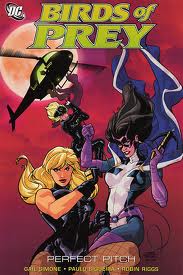
Perfect Pitch
I am beginning to see that not reading these in order may indeed have its drawbacks. This set appears to be the start of the Birds of Prey proper, with Huntress unconvinced that she really wants to be a part of it and Batman making a rather unexpected appearance (well, unexpected for me; I know nothing about Bats in comic-world). It also spans the Infinite Crisis… thing… about which I know nothing, except that a year is skipped and all of a sudden Black Canary is off doing weird things in a nameless Asian jungle while the mysterious Shiva is scaring the pants off people in Gotham.
In terms of plot, occasionally hard to follow for someone with little to no backstory, and also not a nice continuous arc like the previous Birds of Prey (Dead of Winter) I read. The art was usually pretty fun, although I did feel uncomfortable with some of the shots of Black Canary and her kicks. It’s nice to see a group of women working together with no arguments about who gets the guy (well, ok, some arguments, but ‘getting the guy’ in this case means ‘kicking the guy’) – they’re by no means perfect, and there is some dysfunction, but it makes sense. So that’s definitely a plus.

Castle Waiting
Starts off with only a slightly off-kilter telling of Sleeping Beauty – I really liked the focus on the fairies/witches at the start here and moves into the castle and surrounding area essentially becoming a refuge for people who have nowhere else to go, or nowhere else they want to be. The reader arrives via o
ne such, a pregnant woman who later gives birth to a rather… peculiar… baby. But for me, this set of stories is really all about the bearded nuns.
Yes, bearded nuns. Never did I think that someone could have the sympathy, and the art, to draw very attractive women with beards, but such is the accomplishment of Linda Medley. This order of nuns is begun by women escaping an unhappy fate and continues to present just such a chance for other unhappy women. There are many things I loved about the bearded women, just one being that the idea of a man loving one of them was perfectly natural – they are by no means freaks to anyone in the book except those who are clearly immoral/unpleasant/otherwise non-relateable anyway. There’s a nice variety within the bearded women community – the beards and being female are about the only thing they have in common, except that a few of them have also experienced being in the circus. If for nothing else, Medley won me as a fan for this aspect.
She does win me for other reasons: the art is delightful without being distracting or overwhelming; the numerous sub-plots are nicely woven, and I love that the knight in armour is actually a horse.
I look forward to reading more.
Rapunzel’s Revenge: a graphic novel
 Fairy tales in the wild west. Yes indeed.
(I could say something here about the idea of the wild west being as much of a fairy tale as Rapunzel herself, but I’ll leave that for another day.)
This one is c/-Tansy, and I’m very pleased to have got hold of it. Hale expands on the role of Mother Gothel, and although she’s still a mean nasty magicy person, she’s much expanded: she has a political role in the surrounding lands, there’s a purpose of sorts to her magic, and there seems to be more of a purpose in her taking Rapunzel, too.
Rapunzel herself is way, way more interesting than most of the stories make her, which is unsurprising. She’s learning to lasso from a young age – not with her hair at that stage, that comes later – and she’s much more rounded in terms of motivation, naivety mixed with determination, and so on. She rescues herself from her tower (which is a most awesome tower), she rescues herself and others in a variety of situations, and she has interesting relationships with a bunch of other characters.
The other characters are a really nice part of this story. Rapunzel’s companion for much of it is Jack (who has a goose, and a bean…), who is NOT WHITE – as are a number of the other characters. Jack is quite nuanced, I think, moving from flighty schemer to serious and earnest – in a good way though. The pair run into a variety of law-types and rogues, and while I think all of the authority figures (except Mother Gothel herself) are male, a good proportion of the others, who help or hinder on the way, are female – just because they could be and it really doesn’t matter.
The pictures are fun. Lassoing with hair looks… painful, actually. Also, I loved Rapunzel’s costumes. She basically starts off in a dress that she wears for four years; then she’s in what looks like a nightie, with a belt and awesome green tights – she looks like Pippi Longstocking; she gets into pants eventually, but even when she’s in a ball gown (in which she is uncomfortable), she manages to fight effectively. Which is fun.
Spinning a darker stair (review)
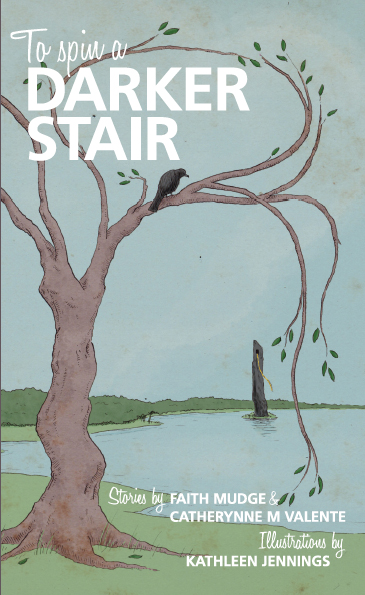 Firstly: oh my goodness look how CUTE this is! Seriously, this itty bitty 50-odd page bookling is so cute. Does this count as a chapbook? I don’t know the official definition of chapbook, but part of me thinks this should be one, while part of me thinks no! Chaps won’t read this! This is a ladybook, or a dreamerbook, or something.
Yes, well. Anyway.
This delightful product, whatever it is, comprises two short stories that riff off different fairy tales. Catherynne M Valente’s “A Delicate Architecture” is the first, and I know I read it in Troll’s Eye View but my memory is bad enough that I had forgotten the kinks in the tale. Which was good and bad, since it got to break my heart all over again. This is Valente at her best, spinning an impossible and impossibly beautiful story about a girl and her confectioner father and the dark dark things that can be done in the name of hunger (in all its many variations). This story is complemented by Faith Mudge and “Oracle’s Tower.” While it wasn’t clear to me which fairy tale was being meddled with by Valente until very near the end, it’s clear relatively early on who Mudge is playing with. This does not, of course, prevent the story from working in dark and sometimes sinister ways. This is not a nice story. It is very clever, though, and very nicely told.
Both of the stories are given that extra something by the illustrations of Kathleen Jennings.
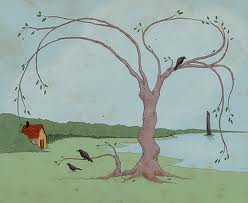 The front and back covers are hers, and within there are four more pictures of the women featured in the stories. They’re line sketches (… I am no artist, so forgive me if I get the terminology wrong), and they are delightful and beautiful and add a great deal to the overall feel of the package.
Also? my copy came wrapped as a present. That definitely adds to its specialness.
Full disclosure: I am friends with Tehani Wessely, owner/editor of Fablecroft (the publishing house responsible for this book).

 Randomly Yours, Alex