The Farthest Shore
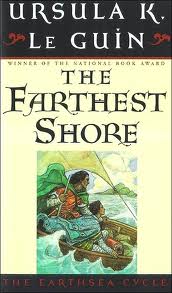 For a book written for children – perhaps a young adult audience – this sure is a bleak book. It’s also a deeply philosophical book, as well as having a great deal of adventure and learning about life. It’s the most Tao book of Le Guin’s Earthsea series. It’s an odd book to come after The Tombs of Atuan, as that was after A Wizard of Earthsea; the pace is so different. I think Wizard must come first but for these two the order is irrelevant. It’s also back to bring an almost exclusively male narrative.
I know young adult books are often bleak; we have a rash of dystopian novels to prove that. But in roughly 170 pages Le Guin explores the consequences of rushing off after life at the expense of losing life; of fearing death so much that you give up on life; and the sheer loss of hope, and what that might do to society. Somehow the fact that Le Guin does it so quickly makes it seem more bleak. Like the first book
this book is about one quest, one search for one man. Instead of taking an entire trilogy, with lots of disappointments and setbacks and newfound friends, Le Guin has Sparrowhawk, now with a new young friend, simply track that man down. Of course it’s not really a case of doing anything “simply”. There are set backs. The book does show us more of Earthsea and its environs, and we meet a variety of different people; but everything is designed to assist in the one quest. And as I said before, it is only 170 pages. Le Guin’s words are evocative and precise. There is glorious description, but it doesn’t go on forever. Characters are swiftly sketched. Swiftly, and brilliantly. The story is as driven towards its conclusion as Sparrowhawk is towards his.
We always knew that Sparrowhawk would turn out to be the archmage. We were told that in the first book. And here he is, Archmage for five years, now being confronted by something strange going on to the south and to the west of the Inner Lands. Unsurprisingly Sparrowhawk is feeling confined by the walls and the tasks and the requirements of being archmage. It’s not clear how long after the events of the previous books this is happening. And in some ways, as the book reminds us, it doesn’t really matter. Sparrowhawk has had a long and distinguished and occasionally difficult career as a sorcerer. Many of those deeds get recorded in the songs made about him at some point in the future. This is another one to add to his long list. Of course, he is not the only – and perhaps not even the main – protagonist of this book. He is joined by a young prince, perhaps just slightly older than Sparrowhawk himself was in A Wizard of Earthsea. It’s therefore a coming-of-age story for young Arren, as that book was for Sparrowhawk. Not that Sparrowhawk doesn’t have a lot to learn: about himself and about his world and about what must be done.
Life and honour and death and hope and love and fear. What more could an author hope to explore?
The Tombs of Atuan
While there’s a similar feel in the language – sparse and intense – this is a very different book from A Wizard of Earthsea. It’s bound to just one place; it’s focussed on a girl. The struggle for identity is similar but Tenar/Arha has less agency than Ged, which is understandable given her very different situation. There’s very little magic.
I might love this more than A Wizard of Earthsea.
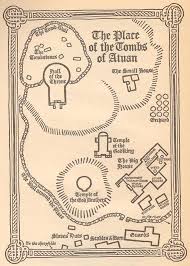 It’s so… peculiar. It’s simple enough to find parallel stories – mythic ones, modern ones – for Ged, since he is basically a young man finding his purpose and his way in the world. It’s a coming of age story, if not ‘simply’. For Arha though… the situation is different. It’s still a coming of age story; it is about Arha finding her purpose and place and understanding the world. But it’s focussed so tightly on the Place that it feels completely different. Is there a difference in a girl coming of age and a boy? Certainly in terms of myth there is, and Le Guin is, I think, interested in writing Myth in these stories. In fact she makes some quite obvious comments about mythology; we know, in A Wizard of Earthsea, that Ged goes on to become something great (how’s that for foreshadowing and reassurance?), and that there are stories about him. Arha is basically living a myth.
I’m fascinated by Arha. I love Le Guin’s exploration of the fact that she is a wilful young girl – and who wouldn’t be, being told that they are the First Priestess reborn, and basically untouchable by any of the people around her? When you are so set apart from those around you, it makes sense that you would become aloof and indifferent. And yet Arha is also vulnerable; she fears Kossil, the High Priestess of the Godking, but also relies on her. She is overcome by her fear of the dark, when first taken to the Undertomb, and then overcomes the fear in turn. I can imagine that, left to her own devices, she would have become quite formidable… within the restricted space she can access.
This is a claustrophobic novel. Where A Wizard introduces the reader to many parts of Earthsea, this one only really allows us to see one remote, nearly forgotten, temple complex. And yet the plot itself doesn’t feel that constrained, perhaps because – for most of it – Arha doesn’t notice it. It’s a testament to Le Guin that she makes such a small area so intensely powerful and important.
I had forgotten how much I love this book. In fact, perhaps I didn’t used to love it so much, and this is a reflection of greater maturity… I guess I read this in early high school, and I don’t think since. Onwards to more Le Guin!
A Wizard of Earthsea
I first read this… I don’t remember when. I think I was at primary school. And I’m not sure whether I’ve read it since, but it had a very big impact on me. I could still remember a lot of the little details, and my fierce appreciation, fear, and sympathy for Ged.
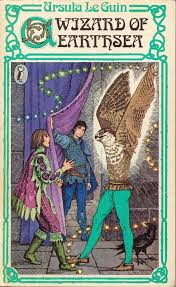 A friend who read this as an adult just couldn’t cope with Le Guin. It made me think that perhaps Le Guin is like a really amazing pencil sketch, where someone like Martin or other such epic writers are oil painters. Le Guin doesn’t waste words; she doesn’t give lush, page-long descriptions. But this isn’t a detraction; she’s evocative and masterful in her language, and she tells a grand tale in (in my copy) well under 200 pages. That’s not something to be frowned upon! … but it could be something that people with tastes shaped by more modern fantasy writers find hard to cope with. And that’s fine; it’s just a different tastes thing.
I love that Le Guin starts with Ged as a wild young thing. I read somewhere that when she was commissioned to write a children’s book she looked at the wizards she knew and they were all old men (she’s a big LOTR fan), and she thought: how did they get there? So forty years before Rowling, she wrote of a wizard school. And Ged is nothing like Harry.
The friendships are wonderfully understated but nonetheless feel real; the dangers are never dwelt on in horrific detail but are nevertheless palpable. Ged’s efforts, his fears, his determination – all come through. Perhaps this is why I appreciate Rosaleen Love: her sparse language is a lot like Le Guin’s, and they both manage to capture a great deal in few words.
I also love that the only white-skinned people in this story are the invading barbarians, who only occupy a few pages.
Chimes
This book was provided by the publisher.
I’m a little conflicted by this book, and I know I won’t write a review that does it, or that ambiguity, justice.
 On the one hand this is a book of gorgeous prose. It’s lyrical (heh) and it’s evocative, setting up beautiful word-pictures. This is a world where although sight still exists, hearing has become far more important for many people – an inversion of today? There’s talk of whistling directions, of using tunes as advertisements and as aides memoire, and then there’s Chimes. Chimes is music that plays at Matins and Vespers, and no matter where you are (well, within the small geographic scope of the novel) you have to pay attention. It’s fairly fast-paced; Smaill does a good job of showing the dystopian nature of the world without a whole lot of detail; I found the conclusion satisfyingly dramatic.
On the other hand… there are enormous questions that are never answered about how ‘the world’ got like this (there’s hints but that’s all), whether the entire world is like this or just some area around London, and there are a few plot holes here and there that are glanced over. What I can’t figure out is whether these things matter or not. On balance, I think I can live with those problems, and it’s mostly because of the beauty of the language. If this were a more pedestrian novel I would have more problems with it. The one problem with the language is the use of musical terms. No one does anything quickly or slowly; it’s all piano, lento, tacet… and I don’t even know if some of the words were invented. I have zero musical training so there were times where I was confused about whether we were rushing or going stealthy. Still, I coped. I was a bit sad at about the halfway mark that the novel was so boy-heavy (I hadn’t read the blurb so I actually thought the narrator was a girl, at the start), but by the end I was a bit more content with the gender choices overall.
The novel is written in the first person and in present tense; I feel like I haven’t read a whole lot of present-tense stuff recently, so that was intriguing. Our protag is off to London with a mission from his dying mother, but he has to hurry because he’ll lose his memory of what he’s doing pretty soon. Because everyone does. This is a world where people are just about living Fifty First Dates. They keep ‘bodymemory’ – usually – so they remember how to eat, how to do the manual parts of their job, and so on; and maybe ‘objectmemory’ can help with some specific events… but unless relationships, for instance, are renewed every day, pretty soon those people are gone from your mind. Because of Chimes. The music you can’t not hear.
Simon, of course, is a bit special – he’s got a slightly better memory – and while the whole You’re Special thing might be a bit old, that’s because it’s such a good way of making change happen in a difficult world. Anyway, Simon starts finding out more about his world, thanks to a new friend, and things progress from there. I liked Simon, overall, as a voice for showing the world, but really we don’t find out that much about him – I think as a factor of the first-person narration. That’s not necessarily a problem; you’re enough in his head on a day-by-day basis that I, at least, certainly cared what happened.
The musical aspect is original, at least in my reading experience, and the prose is a delight. For a debut novel I’m even more impressed – and not surprised to discover that Smaill is both a classically trained violinist and a published poet. I hope she gets to publish more books, and I hope this features on the Sir Julius Vogel ballot next year (she’s a Kiwi). You can get it from Fishpond.
The Broken Eye
 I got this to review but I haven’t read the first two books in the trilogy.
I quite like the style and the colour magic stuff is fascinating; I like some of the characters and there are clearly complex relationships happening. But it’s inaccessible to someone who doesn’t know the context and I’m not sure I have the time to read massive fantasy trilogy.
Is this one I should keep, and go seek out the other ones? I’m not completely averse to the idea, but I do have a lot of unread books…
Tam Lin
I was in my mid 30s when I finally watched The Breakfast Club. I rally enjoyed it but I’m glad I didn’t watch it when I was at high school; school was already something of a disappointment.
 I read Tam Lin for the first time this year, 15 years after finishing my undergrad studies – yes, with a BA. I am really glad that I didn’t read this before or during my studies. I thoroughly enjoyed university, but there was very little spontaneous Shakespeare and Milton and Keats quoting going on.
I’ve heard about this on and off over the years; Tansy is a huge fan. I didn’t really have any idea of what to expect – I don’t know the ballad on which it is based, and although I knew there was some Fae element I think I was expecting a kind of Tom’s Midnight Garden experience, going in and out of fairyland? Or something. So it wasn’t what I expected, but mostly in a good way.
Spoilers ahead, if you’re like me and not up on your faery-tinged-undergrad-learning love story!
(That is, it’s a love story to undergrad learning. Although there are love stories in the novel as well.)
Like I said, I was expecting the fairy stuff a lot earlier than it actually turned up. To the point where I got to wondering that because the university experience was so exquisite, was that actually the fairy land? And Janet would eventually wake up? Or something? It was amusing to note the similarities in Janet’s experience of college and my own, as well as the differences, some of which are temporal (25 years different), many I suspect are geographical (US expectations of a ‘liberal arts degree’ are very different from Australian ones… doing physical education? As a compulsory unit??… plus I will never, ever understand the necessity of rooming at college – and I lived in residence for two years), and most of them are of course fiction v reality. With the hindsight of my mid-30s, I enjoyed this fantastical take on college, while acknowledging just how unreal it was. I really liked the discussions Janet and co had around poetry and theatre and what to major in – those discussions can be, and sometimes were, glorious – as well as the fact that Dean includes in-class stuff, with good lecturers and bad. It did make me a little sentimental for my own experience, which I am definitely seeing with a rosy tinge these days. I was also interested in the fact that, published in 1991, it was set 20 years prior. By the end this decision made sense – the stuff about pregnancy and being on the pill would presumably have been a much more raw and radical issue in the early 70s, socially speaking, than in the 90s. Plus I suspect that many people look back on the early 70s rather romantically, as a time of liberation and so on.
Obviously there are hints that things are A Bit Odd from quite early on: the stories about Classics majors (heh; I only have a minor in it), the odd temporal questions and connections, the intensity of some of the relationships…. I admit that I cracked about 2/3 of the way through and looked up some of the names… and yes, there were a couple of them, in the roll of Shakespeare’s company. So that gave me a bit of a clue of what was going on. Like a few reviewers on Goodreads I found the denouement a little bit rushed – in, what, the last 40 pages? it’s revealed what Medeous actually is, and is doing. But… ultimately, for me, the faery aspect isn’t what the book is actually about. But still, I liked the triumphal-tinged-with-doom ending – although a sequel would be extremely ill-advised. I hadn’t picked up the Thomas Lane/Tam Lin connection! Oops.
I liked Janet. Yes, she’s a bit spoiled, and she would almost certainly have driven me a bit mad if I’d met here at 18 – she’s so confident in her own knowledge. But I admired that, too, and the fact that she struggles and overcomes. I liked that her friendships weren’t always easy and that she acknowledged the necessity of working on them – even if she didn’t always do it well; I’m a nerd so I definitely liked her dedication (mostly) to learning!
I can imagine reading this again. I would love to recommend it to young friends, but I don’t think that in good conscience I can – not until they’ve finished at university.
A Face like Glass
There is an exquisite agony in expectation.
A few years ago I read Gwyneth Jones’ Bold as Love sequence. I owned all of the books but I read them over almost a year… because it was kind of almost fun to wait, even though I had no need; and because I didn’t want the ride to be over.
Last year I did the same with Naomi Novik’s Temeraire series (which still isn’t finished because I haven’t got around to finding the last two), and Sarah Monette’s Mirador.
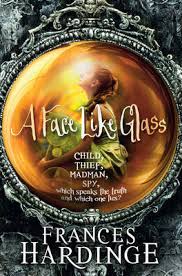 I had Frances Hardinge’s A Face Like Glass sitting on my desk for a full week, waiting to be read. It’s not exactly a year, but the principle is the same: knowing that I had it there waiting to read was incredibly exciting; knowing that as soon as I started reading it would soon be over was excruciating. Because oh my Hardinge is a glorious, glorious author.
And now I’ve read it and it was as I expected – which is to say even better than I expected – but now I am FINISHED and I am BEREFT.
A curmudgeonly cheesemonger is so antisocial he just lives in the tunnels with his cheeses (no ordinary cheese, it should be said, but cheese that can make you see visions and hear songs and maybe spit acid at you. TRUE Cheese). One day he finds a girl in a vat of whey… and her face: well, he makes her wear a mask.
Now, you might be thinking this guy is a bit odd. And he is. But the society he’s turned his back on is that of Caverna; they all live underground. And the other thing that’s different about them is that as babies, they don’t learn facial expressions. At all. Babies, toddlers, even adults if you’ve got the money, have to learn Faces: initially from family, and then from Facesmiths. Yes, this is as weird as it sounds… and it ends up being a really interesting reflection on class issues. Once you’re an adult, it costs a lot to learn new and interesting Faces; so of course, the poor don’t. And can’t. Does that mean they don’t have the emotions that require such a range of emotions?
Indeed, what does it mean to feel an emotion if you can’t express emotion via your features? Hardinge doesn’t pretend to have all the answers, but she makes a compelling, swoon-worthy novel from the issue.
It’s not all cheese and frowns, though. There’s also intrigue, friendship, losing your way, kleptomancy (my new favouritest way of telling the future), True Wine and Cartographers whose words can make you go crazy. There’s recognising your own emotions as well as others’, figuring out who to trust and how to trust yourself, and the willingness to Go With The Crazy.
And then there’s the glory that is Hardinge’s prose. Her words don’t just flow; sometimes they trickle and sometimes they gush but they always worm into your brain and create stunning pictures and magnificent juxtapositions. I’m pretty sure I could read Hardinge’s shopping list and it would be a work of lyrical beauty.
Get it from Fishpond. If you have never read a single Hardinge, read this one… and then read the rest….
One Small Step
Soooo this anthology came out in 2013 aaaand I’ve only just got around to reading it. Um. Oops. I have no excuse for this. It just didn’t happen.
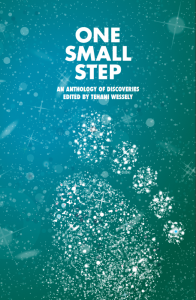 In my defence I read the whole thing last Sunday. That counts, right?
The subtitle is “An Anthology of Discoveries” and what’s really interesting is that this is such a broad anthology but yes, the theme of discovery – of place, or self, or strangers – is the unifying factor. Sometimes it’s obvious and sometimes it’s subtle; sometimes there are world-shattering consequences and sometimes not so much.
The other superbly interesting thing about this anthology is that it’s all women. From memory of Tehani discussing the process, pretty much accidentally so. And it’s not all just dresses and kissing! (Sorry; /sarcasm.) It’s basically a who’s who of established and emerging Australian writers, too, which is a total delight.
Some of these stories really, really worked for me. Michelle Marquardt’s “Always Greener” is a lovely SF story that ended up being simultaneously darker and more hopeful thanI expected (yes that’s a contradiction, too bad). And then to have it contrasted with the fantasy of Lisa Hannett and Angela Slatter’s “By Blood and Incantation” – which is not my favourite HannSlatt but is still quite good – neatly skewered expectations that it was going to be an SF anthology, pointing out that ‘discovery’ is a mighty broad concept. And then “Indigo Gold” by Deborah Biancotti! Detective Palmer!!! and !!! The Cat Sparks story is awesome (it feels like ages since I read a Cat Sparks story), Penelope Love is quietly sinister in “Original,” Faith Mudge does fairy tale things beautifully in “Winter’s Heart.” And the final story, “Morning Star” by DK Mok, is a magnificent SF bookend to match Marquardt but on a much grander, more extravagant scale.
This is a really fun anthology and I’m sorry it took me more than a year to read it. You can get it right here.
The Lies of Locke Lamora
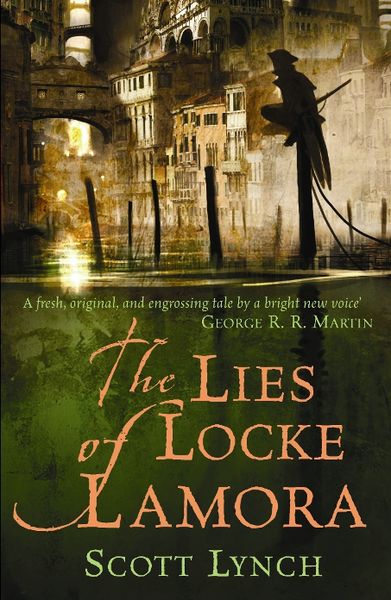 This has been on my radar for a while; when I finally added it to my Goodreads page, Katharine went a little mad and next thing I know it’s appeared in my mailbox.
Some slight spoilers below, although not that many and none too significant.
It took me about 4/5 of the book to figure it out, but finally I realised what Camorr reminds me of: it’s Ankh-Morpok at its grimiest. Maybe Ankh-Morpok crossed with Gotham? All the inhabitants are human, but it’s got that chaotic mad feel that Ankh-Morpok has… without the cheerfulness that Pratchett adds. The grimdark version of Ankh-Morpok? Dare I suggest the more realistic version of Ankh-Morpok… So anyway, I quite liked Camorr, although it’s not as ‘original’ as the George RR Martin quote on the front might suggest. This isn’t necessarily a bad thing – originality is great of course, but building on others can be too. I am also a bit puzzled about the inclusion of the ruins of some long-forgotten alien race. Yes they add to the cityscape, and the idea of Falselight is really cool, but I was kinda expecting a bit more to be made of the Elderglass. Actually I was expecting that Locke was going to be a descendant of that alien race (spoiler! he’s not… well ok, there are apparently another six books after this, so maybe that’s a reveal in the fifth?). So… yes, it’s cool and it does add to the knowledge that this is a complex and complicated world and Lynch has given it great thought. But there was both too little info – who were they? how long ago are we talking?? – and too much info, because there were these teasers all throughout about the glass (can’t be broken, except there’s this one Broken Tower OOOooh, etc).
Is it passé of me to comment on the laydees? Or, let’s be honest, the lack thereof. Locke’s ladylove is mentioned a couple of times – very much in passing – and is completely forgotten for more than half the book. That bugged me. I loved that there were what I think of ‘incidental women’ – guards and merchants and criminals were just as likely to be women as men, but the ones that Locke and his Merry Band of Bastards interact with are almost always men. There are two significant female nobles, and they are awesome and get to be competent and I like them a lot. Buuuut… it could have been better.
So far you might be thinking that I didn’t think much of the book. Actually, I really enjoyed it. Like, a lot. Someone suggested it was an Ocean’s 11 kinda story, and it definitely is – except see that comment about missing the cheerfulness of Pratchett? There are some magnificent one-liners, and the variety of hustles are breathtaking and occasionally hilarious, but this definitely falls on the grimmer end of the scale. It’s a bit of a spoiler I guess, but… people die. I hadn’t really expected that, with my George Clooney/ Brad Pitt expectations. Talk about a kick in the guts.
The plot? It’s a con. There’s one con that threads through the entire thing, and a number of others that crop up. There are external things that get in the way and need to be dealt with; there’s everyday life, there’s death and mayhem, there’s revenge and pain (lots of pain), no romance and a lot of bro-bonding. Oh, so much dude-platonic-love. The ties of brotherly love have rarely had their praises such so highly… and I’m not even being sarcastic at this point.
The protagonist is, of course, Locke Lamora. He’s in the line of Miles Vorkosigan and other such brains-over-brawn heroes: he can hold his own in a fight but he’s not really very good at it and ends up with a lot of cuts, bruises, black eyes and a serious lack of blood at various points. But of course he makes up for it with a devious, cunning brain that comes up with madcap, near-to-impossible schemes. It’s just lucky he has willing confederates to help him carry it out. I really liked Jean, his bruiser with brains best buddy. I was initially a bit wary of the way that he was described as fat, and that seems to be forgotten for bits of the book – I can’t figure out whether that was a good thing or not. But their relationship works; they work well together but they’re not completely reliant on each other.
The villains are… interesting. For a while I couldn’t even tell who the villain was going to be, or even if there was going to be one; after all, the main characters are thieves – let’s not kid ourselves, much as they like to talk about their own code of morality, Locke and his friends get a great deal of joy out of stealing from, conning, and generally making life miserable for many of the honest people of Camorr. But there is/are indeed villain/s – their number depends on how you want to view things like “I was doing what I was paid for” – who of course make our heroes look positively virtuous. I have to admit that I was a little disappointed by the driving force behind the villainy. It felt a little… small.
Ocean’s 11, yes – and 12 and 13. I was also reminded of Mission Impossible: Ghost Protocol (and the others, but that’s the one I’ve rewatched recently). It’s… well. Fun, yes, although with its fair share of rip-your-heart-out moments. It’s a good thing I got to the last fifty-odd pages with nothing else to do, because I just could not figure out where it was all going to end up and I nearly had to put the book down to breathe but I didn’t. I really enjoyed it.
You can get it from Fishpond.
The Tamuli
Earlier this year, Tehani, Jo and I read and reviewed The Elenium (The Diamond Throne, The Ruby Knight, Sapphire Rose). It was fun! We enjoyed them – again! So we decided to do the same for The Tamuli! … and that took a bit longer.
ALEX:
Dear readers,
Here’s an interesting thing. We’ve been writing these reviews in a Google document. This one, entitled Domes of Fire, has existed for a few months without anything being written in it. This is despite the fact that I think we would all have said that we enjoyed the second trilogy a lot, if not as much as the first, and that we all devoured the second trilogy on this re-read just like we did the first.
TEHANI:
Aw Alex. You don’t think all of us being crazy busy had anything to do with it? 🙂
ALEX:
It’s just that…well, there’s not really that much to say. We said most of it with the first trilogy, and the reality is that this second set, the Tamuli, is basically a reworking of the first.
TEHANI:
Heh, I like that Eddings pretty much acknowledges that about halfway through The Shining City:
“It has a sort of familiar ring to it, doesn’t it Sparhawk?” Kalten said with a tight grin. “Didn’t Martel – and Annias – have the same sort of notion?”
“Oh my goodness, yes,” Ehlana agreed. “I feel as if I’ve lived through all of this before.”
JO:
One will not point out similarities to the Belgariad either. Or the Mallorean. One will not.
ALEX:
Almost identical set of people, very similar set up – except just like any sequel, things are More Impressive and More Worse. Not just a puny god, but a serious one! Bhelliom’s not just an object but an imprisoned eternal spirit! Sparhawk is Amazing!!
…ok that one’s not that new.
What follows therefore is a general discussion of the entirety of the Tamuli – what we liked, what disappointed us, etc.
TEHANI:
I think part of the problem was that once we started reading, we just couldn’t stop – having glommed all six books in such short order made it super hard to separate this batch into separate reviews! So this one giant piece is a much more sensible idea.
JO:
Oh that’s absolutely it! I read all six in this big BINGE… and then you wanted me to sit down and be sensible about each one? Can’t I just say ‘yay’ Sparhawk? Also where are my notes…?
ALEX:
I quite like the opening to Domes of Fire proper, with Sparhawk riding through the streets but this time being recognised. It sets up the idea of familiarity and parallels with the first trilogy very neatly, and suggests that it’s all done deliberately. While I do recognise that this is somewhat lazy writing, I definitely understand the appeal of it for readers – because it appeals to me, when its done well: it’s the same reason why people like staying in the same hotel chain everywhere. Familiarity is comforting. I like reading for comfort sometimes.
JO:
I don’t see it as lazy at all. I see it as fanservice 🙂
TEHANI:
You know what else can be lazy writing? The “As you know, Bob” thing, which Eddings employs over and over to let us know/remind us what’s going on. AND I DON’T CARE THAT HE DOES! It’s still completely and utterly readable. I’m not sure what it says about me. Or maybe it’s just that even something “lazy” can actually be done well?
ALEX:
I think it’s done with humour, too, often, and that certainly helps his cause.
JO:
Yeah usually it’s just so much fun to read the ‘as you know’ doesn’t bother me as much as it should.
ALEX:
We are such fan girls.
So, straight into the issues: Danae manipulates a lot of people with kisses in these stories. It made me uncomfortable.
TEHANI:
Yeah. Despite the efforts to show women in positions of power, and able to WIELD that power, with Sephrenia, Xanetia, Ehlana, and even Aphrael/Danae herself and so on, there is still a lot of dodgy gender stuff going on.
ALEX:
Women and power… Ehlana comes into her own, but she does still get damsel’d – again. She shows herself quite resilient etc, but still… I’m really not sure what I think of Melidere. Great that she’s smart. Kinda fun the way she plays Stragen and all – you never see it but I have no doubt Stragen sees himself as a stud. Very uncomfortable about her manipulation of him into marriage. Urgh.
JO:
Yeah the gender stuff in these books really pissed me off by the end. SO MANY of the female characters are ‘strong’ because of their ability to manipulate the men around them. And do so ‘prettily’ so awww it’s actually ok. We got more ‘haha women are obsessed with marriage, poor men’ too.
ALEX:
Yes. Icky.
However and meanwhile, SEPHRENIA AND VANION 4EVA.
TEHANI:
They are so adorable! And I love that even though things get tough, they work things out. I also love they are a mature and completely lovely couple who appreciate and work with each others’ strengths!
ALEX:
And a Styric city! While there are some uncomfortable instances of racism that don’t get dealt with, I think this trilogy makes a sturdy – if, I don’t know, simplistic? – attempt at confronting it. Sparhawk confronting his own prejudices – being willing to protect meek and submissive Styrics but being affronted when they’re all assertive and happy – is a really nice moment.
JO:
Simplistic, definitely. But yes, at least it’s there.
TEHANI:
Yes! An excellently written scene. Very impressive to see this sort of examination of prejudice (however briefly) and the understanding that it can be unconscious and inherent to human nature, and challenging to deal with even when one is self-aware. Sparhawk’s conversation with Stragen where he says, “I just found something in myself that I don’t like.” is so short but encapsulates things very well.
ALEX:
Aw Sparhawk. Poor darling. Also? Older man learning about himself and still growing as a person? That is awesome.
JO:
Yes, very good point! That’s not something you usually see, is it. Older men are so often described as set in their ways etc. That’s a part of Sparhawk’s character I’d not noticed before. And it’s nice that he can be strong in ways like this, not just chopping off heads, but emotionally too.
TEHANI:
I particularly like how this comes around again later, when Vanion confronts Sephrenia about her behaviour towards the Delphae, and he says, “Nobody’s different! We have to believe that, because if we don’t, we deny our own humanity as well.”
ALEX:
And Sephrenia’s whole arc for the last novel or so is dealing with her prejudice against Xanetia and the Delphae.
That said, a “universal sisterhood of all women”?? Uh. No. Not until a lot of other issues are dealt with.
JO:
I have a BIG issue with Xanetia that I’d not noticed before, but this re-reading really hammered it home. She and her ability to read people’s minds are just one big plot device. After all the machinations and the foreshadowing, how do we bring the conspiracy out into the open? Xanetia reads people’s minds. BAM. How convenient.
I like her relationship with Sephrenia and the growth that Sephrenia goes through, but Xanetia herself… she’s just there to tell everyone who the bad guy really is so the story can progress. And it’s a revelation that isn’t earned, at all.
ALEX:
I quite like Xanetia – she’s kind of taken Sephrenia’s role as serene and helpful lady, in this series, because Sephrenia gets a bit more development. But yes, the mind-reading is a leedle too convenient.
JO:
Oh don’t get me wrong, I *like* Xanetia, because she’s an Eddings character so how can you not? I just find her mind reading abilities and their place in the plot a little bit of a cop-out. Same can be said for Bhelliom’s ability to jump around the world in the blink of an eye, but that doesn’t stop it being hilarious and cool.
ALEX:
Also meanwhile, I heart Bhlokw. And the Troll-Gods as a collective.
TEHANI:
They definitely grow on you! I really enjoyed how much more intelligent they are by the end than they are first presented. In fact, Eddings was actually rather clever there – when we first meet trolls, they are scarcely more than animals, but by the end of the series we have come to realise they are a complex culture with a firm religious beliefs and a strong sense of right and wrong. Fascinating really, if you’re looking at it from a tolerance and acceptance point of view…
JO:
Or he hadn’t thought that far ahead and just kinda shoe-horns the trolls into that role… but hey, maybe I’m a cynic.
TEHANI:
The whole religion thing in this trilogy is much more in-depth than in the Elenium I thought. There was more exploration of the idea that Danae is actually a goddess, but one among many, and that the gods and goddesses of Styricum are quite different from the other religions as well. I found some of the discussion, particularly pertaining to the Elene god, rather interesting.
ALEX:
There’s definitely more about religion here. The bits about the exquisite politeness between them – how hard it was to get the Atan god in the right frame of mind – is mostly endearing.
TEHANI:
The discussion of slavery in this series (focussed around the Atans and Mirtai in particular) is interesting. On one hand, that Atans are effectively a slave race, yet they are self-governing and pretty much are the means by which the Tamul empire works. However, Mirtai’s experience in slavery outside of this context was pretty horrific. I’m not sure how to unpack that juxtaposition.
ALEX:
It made me quite uncomfortable a lot of the time. The idea that the Atans had put themselves into slavery to look after themselves seemed way too disingenuous… and the fact that they basically rule themselves and that the ‘slavery’ is largely titular does nothing to make it feel better. Because SLAVERY. And as you say, it does lead to Mirtai having a seriously awful set of experiences.
JO:
Yeah, I agree with you there. It always made me feel uncomfortable. They whole “oh but they WANT to be slaves! They’re better off that way. No really, see if they weren’t slaves they’d all kill each other” made my skin crawl.
TEHANI:
It was good to see Eddings didn’t skip the class issues in this trilogy either. Khalad takes Kurik’s role in examining the nobility, but there are lots of instances where peasants are underestimated and aristocrats proven silly. Does it go too far, do you think?
ALEX:
I think it does, mostly because Our Heroes are almost all nobly born but they’re not idiots – which just adds to their exceptionalism. Which is now so overloaded it’s groaning.
JO:
Aristocrats who aren’t knights are usually the silly ones. Funny that.
ALEX:
Do you know, I don’t think I’d picked up that differentiation! and you are so right!!
TEHANI:
I originally read these trilogies in the wrong order, with the Tamuli first, and I still think that Eddings did a really great job with them. I didn’t ever feel when reading that I didn’t know the characters and it was never a problem figuring out what had gone before, or the dynamics of the relationships. Not because Eddings over-explained, but because the characters are so well-drawn. Take Kurik and Khalad for example. They essentially play the same role in the two trilogies, but they are still distinct people (and it’s lovely that Sparhawk never stops missing Kurik throughout the books). That’s not easy to achieve with a large cast.
JO:
It still breaks my brain that you read them out of order!
ALEX:
Me too!! That’s just… inconceivable 😉
Anyway – it would have been so easy to treat Kurik as “hey, remember that guy?” I’m so glad the Eddingses didn’t. I really like Khalad.
JO:
And the brief moment where we get to see Kurik again… *sniff*
TEHANI:
The way Bhelliom slowly grew a personality was sweet – I particularly liked the scene where Sparhawk has it create a wall to stop the trolls, and when Sparhawk compliments the wall, it gets all self-deprecating. I also enjoyed the point where Aphrael realises that it seems Bhelliom had actually manipulated her into the events of the world, rather than her machinations being at her own instigation.
ALEX:
Oh I do love Bhelliom. Referring to the Earth as its child is so cute! And that brief SF moment of showing other worlds, and the alien soldiers they’re fighting, is quite weird. The discussions of origins is fun.
JO:
Oh me too! Love how it starts off all formal and uber-god-like, but Sparhawk and the gang rub off on it. Soon enough its cracking jokes. Pure Eddings.
TEHANI:
Some favourite quotes:
“I wish she wouldn’t do that,” Stragen complained.
“What’s the problem?” Kalten asked him.
“She makes it seem as if the light in her eyes is the sun streaming in through the hole in the back of her head. I know she’s far more clever than that. I hate dishonest people.”
“You?”
“Let it lie, Kalten.” (Domes of Fire)
“Is she speaking for all of us?” Talen whispered to Berit. “I didn’t really have a girlhood, you know.” (Domes of Fire)
“You’re all just itching for the chance to do Elenish things to those border guards.”
“Did you want to do Elenish things to people, Ulath?” Kalten asked mildly.
“I was suggesting constructive Elenishism before we even got here.” (The Shining Ones)
“Thine Elenes are droll and frolicsome, Sephrenia of Ylara,” Xanetia said.
“I know, Anarae,” Sephrenia sighed. “It’s one of the burdens I bear.” (The Shining Ones)
“Knights, your Grace,” Komier mildly corrected his countryman. “We’re called Knights now. We used to be brigands, but now we’re behaving ourselves.” (The Hidden City)
ALEX:
omg I loved that we got more of the Preceptors in these books. Also eeee Bergsten!
JO:
Personally, I never understood the ending. Would you really give up godlike powers to live a normal life? I mean REALLY? Maybe that’s just me, but that’s never rung true to me. Hmm superamazingmagic or your ‘humanity’. I’ll take the powers thank you very much. (My husband informs me that yes, this is probably just me…)
TEHANI:
He knows you well…
ALEX:
It would have been a very different book if that had happened; Sparhawk would not have been the hero we know if he had kept the powers. I’m not saying I wouldn’t read that book, but I think it would have been super jarring. For all he’s awesome etc, there is an effort to make him at least a little humble, and certainly content with his station in life. Staying a godlike being would have been a serious curve ball.
JO:
Maybe I should change that to – I never understood Sparhawk’s choice at the end. I mean yeah, totally works from a character and story telling point of view but… god-like powers man! I’d keep ‘em 😀
TEHANI:
So the verdict? Clearly we still loved the experience of reading these novels again — not just a nostalgia trip but a genuine pleasure. And yet, with the weight of experience and a few years, we also can clearly see there are problematic elements with the books that we may not have noticed when we first fell in love with them, or they may not have seemed quite so concerning then. Is it okay to like books even though they are flawed?
JO:
This is pretty much what we decided for the first three, wasn’t it? Yep, flawed but still so much fun. I think it’s perfectly reasonable to like any media AND be aware of its flaws at the same time. I know that a big part of it for me is that I read these at just the right time and fell so completely in love with them. That feeling stays with me, flaws and all.
ALEX:
As you say, I think that loving any problematic thing is ok – we’re women, we kinda have to be ok with it on some level, right? Doesn’t mean we shouldn’t point out the flaws and work for things to be better, but nothing is going to be perfect and accepting that can sometimes be ok… I think? I hope so. Because while I may never read these again (although I wouldn’t rule it out!), this has been a fun ride.

 Randomly Yours, Alex