Clariel
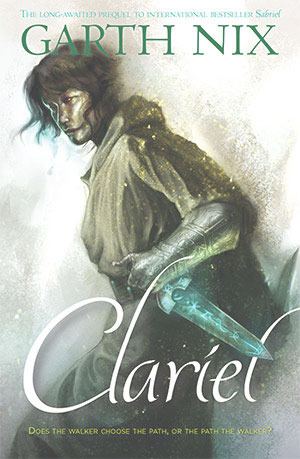 Some spoilers for the Abhorsen trilogy at the start; spoilers for this book at the bottom, and flagged.
Clariel is another wonderful addition to the world of the Old Kingdom, with magic (good and bad), Abhorsens dealing with the dead, and a complex and compelling young woman growing up in a difficult world with a difficult family. There’s adventure and misadventure, a few friends, unwanted romance, moving to a new place and being forced to do what you don’t want to do. A lot of people – I’m going to assume, anyway – will be able to identify with Clariel being forced to go somewhere and consider a future that are neither of her own choosing; I could absolutely identify with her desire to just be left alone. The first is something that young adults are often dealing with in novels; the second is rarer, and it was really nice to see, rather than always having it suggested that gregariousness and being in groups is automatically a good thing and to be desired.
There was one thing that frustrated me enormously, and it has nothing to do with the plot and everything to do with my desire to see sentences constructed well: there were far, far too many comma splices. They prevent sentence flow and sometimes they actively interfere with meaning making. And now I can’t find any examples but THEY ARE THERE.
For those of us who know and love the ‘original’ Abhorsen trilogy, Clariel (set 600 years before Sabriel) is a little bit unbearable. While those books take place in an Old Kingdom bereft of a king, at least the Abhorsen is doing his job – and I submit that the Abhorsen making sure that the dead stay dead, and that necromancers aren’t being evil, is of more immediate import than a king making laws. Yes the lawlessness helps the necromancers, but at least the Charter Magic is strong and there is someone to combat the problems. … I found this excruciating.
And…
SPOILERS!!
When I first heard about this I thought it was a sequel, and I was kinda hoping for a continuation of Lirael. Then someone told me it was a prequel, and I immediately wondered if it was the story of Chlorr of the Mask given it’s suggested she was an Abhorsen and OMG I WAS RIGHT. I was SUPER excited to realise that Clariel would indeed eventually become Chlorr, and I loved how Nix made this more and more obvious but actually only confirms it right at the very end – in fact not in the story proper. Of course it’s pretty obvious when she puts on the mask. And I really love that this book absolutely stands alone… and actually now it occurs to me that I kinda wish Nix hadn’t confirmed her as Chlorr, because that’s a spoiler for people who come to this fresh. Sigh. Anyway, this is probably the darkest of the Abhorsen books so far, but perhaps only for those of us with knowledge of the future: it looks like Clariel could possibly avoid Free Magic, although of course that conniving Mogget certainly is going out of his way to make that not be the case. MOGGET. That treacherous beast. Imagine coming to Sabriel etc knowing what Mogget is actually capable of! That’s going to really influence your reading. I was intrigued that there was no connection with the non-magic world, given how wide-ranging it is otherwise, and the suggestion that the Old Kingdom and magical territory apparently extend quite a lot further than might be guessed from the original books. And how on EARTH does the Abhorsen family fall so far?!?
I’m excited that Nix is writing another in the Old Kingdom, too – this time following on from the original set!
Troll: A Love Story
 I am torn.
On the one hand, this is a beautifully written story that deals with some fascinating issues. And trolls are real.
On the other hand, I was uncomfortable with the implications of some of the relationships.
So, the first hand: it is lovely, and made all the more impressive by the fact that it’s translated – that can never be an easy task. I love the fact that it alternates story with ‘non-fiction’ grabs from pseudo-websites, dusty old tomes, poems and mythology – some of those are real, I’m pretty sure – and newspaper reports. I know that some people find this annoying; don’t read the book if that’s you. And I know that sometimes it really doesn’t work. But here I lay claim that it adds wonderfully to the depth surrounding the central idea of trolls being a real animal, known to science for the last century or so, and that this story is seeking to add to what humanity knows about Felipithecus trollius. Additionally, although there is a central narrator – Angel – as the story proceeds more of the incidental characters get to add their own perspectives, also in the first person. I know some people have found this changing around to be irritating or confusing, but at least in my edition each chapter clearly labels who is speaking, so rather than confusing I found that it added to the richness of the novel.
Sinisalo raises a diverse range of issues in her story, some more central than others. Trust and love and manipulation; ethics in art and journalism and business; the relationship between humanity and the natural world; mail-order brides, sex as power, desire as all-consuming. Angel, the central narrator, finds a wounded young troll and decides to care for it… which leads to encounters with a neighbour, an ex-lover, a would-be lover, and an object of his affection. Plus a business opportunity.
Which leads me to the other hand. And from this point on, SPOILERS.
Firstly, I know Angel ended up feeling ashamed of taking advantage of the troll, but it was still an unpleasant thing to do – taking advantage of Pessi’s trust in him for entirely mercantile purposes. Given how much Sinisalo works to make Pessi seem if not human then certainly above the animal, I really didn’t like it. Again, I’m sure that was the point, but it doesn’t matter; I still read it, and felt uncomfortable.
And then there’s the implications of the relationship between Pessi and Angel. Perhaps it’s prudish but I was very uncomfortable by Angel’s sexual reaction to Pessi. This is partly because Pessi is coded as being quite young, so the power differential of age exists; partly that Pessi is clearly in a submissive position with regard to Angel in tribal terms, so again the power differential; partly, hello different species – where Pessi is <i>not</i>, especially at first, coded as being as capable/sentient as a human. I know that Sinisalo is trying to problematise issues of desire and sexuality – Palomita’s experience as a mail-order bride is certainly not meant to be endorsed but is still far more socially acceptable – but… it was a problem for me.
Lastly, the ending. I knew it was coming – that Sinisalo was working up to the idea that trolls were either evolving, and catching up with humanity, or that they had always been that clever and were now coming out of the forest and starting to demonstrate it. I really liked it, and but for the sexual relationship stuff I really liked the ambiguity of what was going to happen to Angel, too.
I think, on balance, that I really liked this book. Sinisalo is certainly doing intriguing things, and she does write beautifully.
You can get Troll from Fishpond.
The Slow Regard of Silent Things
 In his Foreword, Rothfuss points that that people may not want to read this book. It’s not an ordinary book; there’s no plot. There’s no explanation of who Auri is, who she is anticipating, or even where she is. It’s probably not the first thing by Rothfuss that you want to read.
But.
But it is a beautiful object, but it’s a haunting chronicle of six days, but Auri is indeed a bit of the sun.
It’s a beautiful object: I have a hardcover version, and the cover picture is all shadows and moonlight and flowers and Auri’s silhouette. Nate Taylor’s black and white pictures are strewn throughout like the objects that Auri finds, and the text makes way for them so they work together companionably. I’d like to see more books with pictures in them, like this.
It’s not a novel, or a novella (150 pages in this wee format); it’s a chronicle. It outlines Auri’s actions and thoughts for six days. Some days are good, some days are bad. Some days Auri manages to fix rooms and objects so that they are just so and some days she doesn’t have anything to eat. Some days she makes soap. Some days she weeps.
Auri is the only character in this chronicle. In watching her for six days, the reader learns only fragments of her past and nothing of her future. We learn that she is a joyful creature – she grins all the time, and that mostly didn’t get annoying – but she is also deeply broken, and she knows she is broken and feels it keenly. And she knows that the world is broken, too, and she wants desperately to put it to rights, one little bit at a time – finding a place for a bottle, feeding another’s imagination, making soap properly. Anticipating a visitor and fretting about having the right gift.
Auri’s entire life revolves around doing things properly, and making the world right, and not wanting things for herself. I was at points humbled by her, and her willing and joyful self-sacrifice; at times enraged on her behalf, because clearly something has happened to make her so completely self-effacing. At times I was horrified – she has so little to eat – and at time intrigued, as when she contemplates her soap and knows that while it would be perfectly serviceable without perfume and other additions, how joyless to live in a world that was simply <i>enough</i>.
There’s something like 16 pages of making soap. Sounds crazy, I know. Trust me, it works. Or, you know, don’t trust me, because this isn’t your sort of book anyway. That’s fine. I really liked it. (I really liked the first two of Kingkiller Chronicles: The Name of the Wind, then The Wise Man’s Fear.)
This book was provided to me by the publisher at no cost. You can get it from Fishpond.
The Falcon Throne
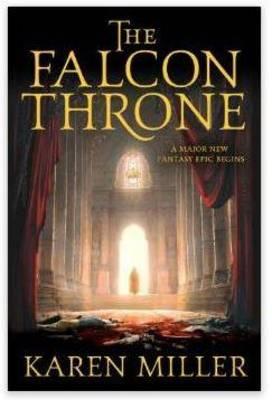 I received this book as a review copy from the publisher.
I am sad to announce that I abandoned this book. Mostly for “it’s me not you” reasons – although not entirely…
1. I’m really not in an epic fantasy kinda zone at the moment – and “at the moment” has lasted for a few years now (albeit with a few exceptions – though not many). So that counts against it for me – but for anyone who’s really in that mood, I think this is probably a good option. It’s certainly epic (in a good way!).
2. I’m not really a – argh, I don’t like the term – grimdark fan. And I’m pretty sure this counts as such. Others have compared it to A Song of Fire and Ice, and while I’ve only seen the show not read the books that sounds like the right sort of comparison. So the style is really not for me. I don’t mind bad things happening to characters, but there’s something about unrelenting unpleasantness – especially before I care about any of the characters – that frustrates and bores and annoys me. So that’s a style issue that is my problem, not the book’s.
Then there’s the style thing that I had an issue with, and it’s the way sex in general and women on occasion are described. I’m not a complete prude, although I guess I’m closer to that end of the spectrum than not, but there’s something about descriptions like “he’d have had the little wagtail pinned against a wall long since” (64) or “Aside from a writhing woman pinned on his cock, was there anything better in the world than a lance in his hand, a grand horse between his legs, and a man before him a handful of heartbeats from defeat?” (15) that leave me not just cold, but actively uncomfortable. As for the women – I got to about page 90, and most women by this stage are dead, useless, or conniving. The wet-nurse clearly has gumption and I hope she’s allowed agency and smarts, but that’s about it.
So there it is. Not a book for me. I am sad because it’s an Australian female author… but not sad because it’s an epic series I don’t have to get invested in so that saves me some time… but sad because I really don’t like abandoning books.
Indistinguishable from Magic
Sometimes when people talk about an author’s work being ‘raw’, it’s as if they think words just appear on the page and there’s no mediation whatsoever. That these words, ideas, thoughts had been flying across the savannah just minutes before the author brought them down with a flying leap to serve them up still warm for the reader. I’m not silly enough to think that – and even if I were, Catherynne Valente’s excoriating essay against people who think authors are just the conduit for some muse (“she  wrote it but…”) would have made me rethink my position.
When I say that much of Valente’s work, as presented in Indistinguishable from Magic (provided to Galactic Suburbia for review by Mad Norwegian Press) is raw I mean that she has not hidden her emotions, she has not hidden herself, from the world while writing these essays.
(One presumes. It could all be a very elaborate persona, with a very detailed background and crafted voice. Y’know, I wouldn’t put that past her – she certainly has the mad writerly skillz to accomplish such a feat. And if that’s the case, well, more power to her.)
The essays collected here are variously from Valente’s blog, speeches, and a few other sources. They’re arranged into categories: pop culture and genre; writing and publishing; gender, race, and storytelling; fairy tales, myth and the future; and “Life on Earth: An Amateur’s Guide.” And they showcase the brilliant variety of Valente’s interests passions: Persephone and Doctor Who (… possibly not so much of an antithesis there…), fairy tales, equality in all manner of things, Jane Eyre (see, Tansy? she’s on MY side), poetry, and Single Male Programmer Types managing to have sex (trust me, it’s very a very funny essay).
The pop culture musings range between 2003 and 2011. Valente’s writing is beguiling enough I actually read the entirety of the first essay, which is about Buffy and Angel, despite having watched maybe three episodes of the two shows combined. Her comments on what the show meant to 20-somethings nonetheless resonated – and that pretty much set the tone for the rest of the collection. I’m also not a big Trek fan, and have watched very little DS9, but her musings on what the station would have been like with social media? Priceless. More seriously – no, it’s all serious; more academically, her essay on why World War 2 and the Nazis keeps on popping up in comics and other fantastic culture is deeply insightful.
I read about half of the essays on writing and publishing; not being in the game myself means that I don’t really have the emotional attachment to the issues necessary to connect with much of what she writes here. That said, the first essay – the one about writing actually being hard work – is a glorious piece of writing; her explanation of her love of the term metal makes me itch to use the word more; and her utter dismantling of the argument that ‘traditional publishing is dead = a good thing’ is brilliant.
Valente is wonderfully, evocatively, angry and sincere and honest and passionate and conciliatory and clinical in her essays about gender and race and why those things matter in storytelling. “The Story of Us” skewers very neatly the whole ‘but why does it matter?’ complaint – and matches nicely with Pam Noles’ “Shame,” which I read in a Tiptree Anthology. She gets dangerously personal in “Confessions of a Fat Girl” – dangerous to herself, I would guess, because of potential backlash (I really, really hope she didn’t get any); dangerous to some readers because of how it might make some squirm at their reaction; dangerous to other readers because it might just call out their own troubles, and make them confront them.
All the essays up to this point have been easy to read – delightful to read. Some have shown Valente’s academic training. With the essays on fairy tales and folklore, though, she gets her academia on. Katabasis in Alice in Wonderland, The Wizard of Oz, and The Nutcracker? Why fantasy keeps going back to the medieval (“Dragon Bad, Sword Pretty”)? The purpose of Persephone, and her multiple faces? Oh yes.
Finally, the last set are more whimsical as a group – they don’t really have a collective theme, aside from ‘some thoughts on living in the world’. Her reflections on why people love apocalyptic literature are fascinating; her frustration at being of a generation told to live as well as their parents without the means to it revealing; and her reflections on Cleveland surprisingly moving. Her essay on her love of the anchorite idea just sings, as does her discussion of “Two Kinds of Love.”
I read this not quite in a sitting, but with nothing else around it. It certainly works like that. It would also work beautifully as a collection to dip in and out of – none of the pieces are very long, after all. There is so much going for Valente’s writing – for those who are writers, for those interested in fantasy and folklore, for those interested in the world in general. And even if you’ve been a faithful reader of Valente’s blog, Rules for Anchorites, I would suggest this is still a great collection because reading these essays in this order, with essays from elsewhere to add depth and piquancy – it just works.
The Bitterwood Bible
Sourdough and Other Stories by Angela Slatter has been on my radar for ages, but somehow I’ve just never got around to reading it. For a while I didn’t realise it was available as an ebook – and Tartarus Press does lovely hard copies, but they’re a leedle expensive for a book you’re taking a chance on. And I also wasn’t sure that these stories were ones that I would really connect with. I mean, yes, I loved “Brisneyland by Night” in Sprawl, and a few others Slatter has written – especially with Lisa L Hannett – and Midnight and Moonshine made me cry with its beauty, but… I just wasn’t sure. And then I found out that Slatter had a set of ‘prequel’ type stories coming out, so I thought I should read those first.
 Halfway through reading The Bitterwood Bible and Other Recountings, I finally bought myself Sourdough because there is no way I can now not read that collection. Because I am absolutely an Angela Slatter convert.
The stories collected here are not quite a mosaic in the same way that Midnight and Moonshine are. There, each story was clearly connected – most often by family, which made it seem a generational saga. Here, while there are a couple of stories that feature the same protagonist, a few more with recurring cameos, and most set in the same place or with the same background characters, it’s more like a series of stories set in a couple of distinct suburbs or small towns. Of course you’re going to get the same bars, or neighbourhood characters, or landmarks mentioned; that just makes sense. But the narratives themselves aren’t necessarily connected… although sometimes they are. And these locales that Slatter has invented are very believable. They’re well-realised, and they’re familiar in that fairy-tale sort of way. Because these are indeed a sort of fairy tale. There’s not a whole lot of magic; what there is is generally a quiet, dare I say domestic without it being in the slightest derogatory, magic; no flashiness or gaudiness here, no winning of wars. That would draw too much attention, and drawing attention in these stories is generally A Bad Thing. The women – and the protagonists are almost all women – mostly want to be left alone, to get on with their lives. Sometimes they’re forced to interact with the world, or with other people, that they’d rather not; because they need to achieve some specific goal, or because they’re being manipulated, or they otherwise have no choice. But you certainly get the feeling that most of them would just prefer never to be in the limelight, not to be a household name… not to stand out.
There are scribes and poisoners, seamstresses and pirates, teachers and coffin-makers and servants. They are mothers and daughters and child-free and orphan, young and old and neither; rural and urban, rich and poor. They have varying degrees of agency and control, varying chances of living after and of living happily ever after.
This is a wonderful collection of stories. They can and should be read and enjoyed separately; they can and should be read and enjoyed together, making a whole even greater than its parts. Oh, and Kathleen Jennings’ lovely little illustrations throughout are a delightful addition; I imagine they’re even more impressive in print, but electronically they’re still fine.
This review is part of the Australian Women’s Writers 2014 challenge.
The Sapphire Rose
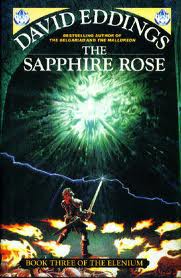 EDDINGS RE-READ: The Sapphire Rose, BOOK THREE OF THE ELENIUM
Because we just don’t have enough to do, Alex, Joanne and I have decided to re-read The Elenium and The Tamuli trilogies by David (and Leigh) Eddings, and – partly to justify that, partly because it’s fun to compare notes – we’re blogging a conversation about each book. We respond to each other in the post itself, but you can find Tehani’s post over here and Jo’s post here if you’d like to read the conversation going on in the comments. Also, there are spoilers!
ALEX:
Almost the very first page of this book has an Author’s Note, which says that the wife wants to write the dedication. And “since she’s responsible for much of the work,” he’s going to let her. Why don’t you just acknowledge the co-authorship, DUDE?
JO:
I don’t see the ‘David Eddings’ on the covers any more. In my mind, it’s ‘David and Leigh’ 🙂
TEHANI:
Of course, when I first read these I had no idea, but since finding out, it’s been an annoyance every time I picked up one of the books.
Also, I think this is the first of the books where we see a really intrusive breaking of the fourth wall by the author/s? For example:
The appearance of the detachment at the gate was, in Preceptor – ah, shall we say instead Patriarch – Darellon’s words, disgraceful. (p. 155 of my version).
ALEX:
The descriptions of Ehlana, who gets cured of the poison in this book, are beyond horrid. There’s “overpowering femininity,” and women being “notoriously adept” at recognising things like a ring being an engagement ring (did I miss that seminar? How DO you tell that a ring is an engagement ring? How do I know whether I’ve been stooged?). Ehlana is unbearable smug about “netting” Sparhawk. I will admit that the point about wavering between wanting to flaunt her “womanly attributes” and wanting to hide them is fair – and even perceptive – but it’s surrounded by so much URGH. And I’d like to say that I, for one, am glad that Sparhawk tried to get out of their marriage. I know that 17 years’ difference doesn’t HAVE to be a barrier, but there is SUCH a difference between the two of them.
TEHANI:
By the end of this book, I was starting to get an uncomfortable feeling about the number of very young girls who become obsessed with older men. And Aphrael’s manipulation with kisses is most disturbing!
JO:
Oh yes that’s definitely a thing in these books.
ALEX:
urgh.
JO:
And we meet Mirtai! Isn’t she an interesting character? Super-strong, super-warrior who is quite happy to be a slave. In fact, she insists on it.
TEHANI:
Mirtai is such a contradiction! Not always deliberately on the author’s part, I think… This bit really got up my nose on this reread though:
Mirtai’s skin had a peculiarly exotic bronze tinge to it, and her braided hair was glossy black. In a woman of normal size, her features would have been considered beautiful, and her dark eyes, slightly upturned at the corners, ravishing. Mirtai, however, was not of normal size. (p. 324 of my version)
SO. MUCH. WRONG. To begin, what the heck is “normal size”? And the “exotic” bronze tinge of skin and “slightly upturned eyes”? ARGH!
JO:
I should probably leave this discussion for Domes of Fire, because there’s not much Mirtai in The Sapphire Rose.
ALEX:
Jo – indeed – but yes, that exoticising is repellant. And the whole ‘normal size’ thing makes me cross-eyed.
In the last book there was the issue of being ‘misshapen’. I couldn’t help but notice that in this one, when the Pandions are being domineering of the Elenian council, there’s the pederast Baron and Lenda and “the fat man”. Does the fat man ever get named? Fat isn’t entirely an evil thing like deformity is, in these books – Platime is fat but approaches genius-ness on the council, Patriarch Emban is very clever, and both of them are good – but it’s still always mentioned. There’s barely a reference to Emban without mention of his belly. And he uses that sometimes – to defuse tension, for instance – but I’m still not entirely comfortable with it.
TEHANI:
That’s interesting though, because both Platime and Emban are important, good characters – not presented as useless or bad people, and so I guess I read that as subverting the trope? Although there is Otha…
JO:
Even though Platime and Emban are good and important characters, their ‘fatness’ is mentioned a lot. Like it’s a personality trait.
TEHANI:
Very true.
ALEX:
Speaking of the council, I would like to declare my sympathy for Lycheas. He’s a dimwit and a pawn, but surely he deserves sympathy.
TEHANI:
Oh, I disagree! He’s not very bright and he’s been led astray I accept, but I think he knew he was doing wrong, and there were times he could have chosen another path. He was as hungry for power as the rest of them!
ALEX:
Hmm. Perhaps. How much choice did he have with a mother like that probably poisoning him from the start? (If we accept the premise of the story.) … oh wait, does that shoot my theory down, at least somewhat, given that is probably exactly the reason why he’s hungry for power? Dang.
JO:
I think the Eddings set him up to be disliked, and he simply has no say in the matter. He’s always portrayed as snivelling and pathetic and stupid. He may or may not be hungry for power, it doesn’t matter. He’s there to be a lesser baddy that everyone can look down on and routinely threaten to kill.
ALEX:
You’re saying he’s just a narrative device? SAY IT AINT SO.
A rather chilling part of this novel is the utter lack of regard for the civilians in Chyrellos, during the siege. It was really quite unpleasant reading.
JO:
I find the siege so boring I have to say that never really bothered me. The scene that does stick in my mind is when Sparhawk and an unnamed soldier witness a woman dragged into an alley and quite obviously raped (though thankfully off camera). The soldier, crying because she ‘could have been his sister’ shoots the rapist. But then the woman staggers out of the alley, sees her not-quite-dead rapist, takes his dagger and violently finishes the job and steals his loot. The soldier ‘retches’ and Sparhawk says “Nobody’s very civilised in those circumstances”.
This scene was always a WTF moment for me. When you consider Sparhawk’s career, what about her actions make them ‘uncivilised’, exactly? He does much worse things to people and is rewarded for them! Is it because she’s a woman? Or because she’s not a Church Knight and it’s okay when they do it. Or because she took the loot? I mean, seriously…?
ALEX:
Yes!! This!! I was so ANGRY at that reaction from the men – who are safe on so many levels from this sort of thing – getting all uppity about her taking revenge. I don’t like her doing it either, but I don’t like the initial rape even more.
I cried at Kurik’s funeral. Not at his death – that all happened too fast, I think – but when I got to the funeral…well, I was glad to be by myself. However, I am still suspicious of the idea of Aslade being quite so accommodating of Elys.
JO:
Kurik *sniff* 😦
TEHANI:
And you know, none of that business really makes sense. Kurik is portrayed as steadfast, loyal, moral and really quite upright (even uptight?), so the fact he cheated on Aslade (and their four sons, essentially) is, well, just a bit weird. It was a useful way to have Talen important to the group, I guess, but the character path is very odd.
ALEX:
YES. Also it makes adultery completely fine, which… I know there are other ways of doing relationships than ‘conventional’ monogamy, etc etc, but not within THIS world’s framework – everyone else who does that is regarded severely. Whereas Sparhawk etc are all, “dude, no worries! Everyone sleeps around sometime, the wimmens is so attractive we can’t help it!”
JO:
YES from me too. Never felt right to me for exactly those reasons.
TEHANI:
I do like the way the Kurik’s sons talk about their “mothers” in the later books though. That said, remembering I read the Tamuli trilogy first, I was quite certain Aslade and Elys had been both married to Kurik, the way they are referred to there!
JO:
Heh yes. I can imagine. Although I was always proud of Aslade and Elys for being able to put aside their potential conflict and just get on with life. So often the relationships between women are portrayed as bitchy, jealous, spiteful things. And usually its over the attention of a man. So I appreciate that they went down the opposite path.
Actually, in the Tamuli there are a lot more examples of strong female friendship too.
TEHANI:
Some more perpetuation of stereotypes here, too. In this case, the temper of the red-head:
In Delada’s case all the cliches about red-haired people seemed to apply. (p. 282 of my version).
JO:
Yeah I thought they got a little carried away with that!
TEHANI:
And what the heck is this bit of elitism? Stragen says, Whores and thieves aren’t really very stimulating companions… (p. 410 of my version). Um, well Talen and Platime AND HIMSELF are thieves and all presented as quite stimulating! The whores get a poorer presentation, but still!
ALEX:
That bit also made me very cranky. Again with the superior attitude.
TEHANI:
And this awful bit of Ehlana characterisation:
“Would you all mind too terribly much?” Ehlana asked them in a little-girl sort of voice.
YUCK! The woman is a queen, and fully in command of herself and the power she wields, yet she resorts to that (for no reason, anyway!)?! No! We talked a bit about this in one of the earlier reviews, how the women themselves are supposed to be powerful, and there are quite a lot of them, which is nice, but the actual presentation of them really undermines this at times.
JO:
Yes! This is what’s been irritating me the whole time, and it only gets worse as the series goes on. Doesn’t matter how strong a woman is, she still resorts to hissy fits and theatrics or childishness to either get what she wants, or basically keep control of the ‘relationship’. Even Sephrenia does it in the later books! It just feels to me like the books believe that deep down, women are irrational children. OR that they will resort to acting like them as a way of keeping their men in line.
JO:
Am I the only one who finds Ehlana’s speech to the council a little…difficult to believe. All these supposedly hardened politicians/Patriarchs completely suckered in by her ‘divinely inspired’ speech? Just because she’s pretty, or something? And because she ‘fainted’?
TEHANI:
I have such a different view of the Patriarchs to you! I always read ANY of those political gatherings as being a bunch of little boys just grabbing for power, none of the “hardened” politicians at all! In fact, Eddings seems to have very little respect for political systems at all. They’re all corrupt or useless!
ALEX:
I don’t think they’re MEANT to look like that, but they sometimes do – and it’s another thing that annoys me about the Eddings portrayal of religion, because it’s JUST another instance of politics and again there’s so much uselessness and cunning and unpleasantness. Also, Ehlana manipulates them, and I think it manages to make her look silly – conniving and dangerous with the using feminine things in dangerous ways – AND it makes the Patriarchs look silly for falling for such obvious, feminine strategies. Way to go for insulting two groups there!
JO:
Last time I said that I found The Ruby Knight a lot faster-paced and more enjoyable than I remembered. I have to say the opposite for The Sapphire Rose. Oh god I was so sick of the siege by the time it ended, and it seemed to take forever to get to Zemoch. It felt like so much padding. Just destroy Azash already!
TEHANI:
Some excellent examples of Faran the human horse again:
Faran made a special point of grinding his steel-shod hooves into a number of very sensitive places on the officer’s body.
“Feel better now?” Sparhawk asked his horse.
Faran nickered wickedly. (p. 155 my version)
JO:
I could summarise the plot again but you probably don’t want me to do that this time!
They cure Ehlana. She’s all grown up now and in love with Sparhawk. They ‘accidently’ get engaged. Off to Chyrellos to stop Annias being elected Archprelate. There’s a siege which goes on forever. Then Wargun and Ehlana turn up and the siege is over. Ehlana and Sparhawk get married. They go to Zemoch with Bhelloim to kill Azash. It takes forever. They get to Zemoch. Kurik dies. Martel dies. Otha and Annias die. Azash dies. Lycheas dies. Arissa kills herself. They return to Cimmura. Everything’s peaceful, but kinda crappy, because the gods are shell-shocked by Azash’s death. Danae happens. Eventually, Aphrael and everyone go on holidays and spring returns.
ALEX:
Nice work there, Jo. I would add: Sparhawk and Ehlana get married in the same way that a person might buy a horse; Martel dies but everyone’s real sad, because actually he was decent and just led astray, y’know? And “Danae happens” means that a goddess is incarnate in a different racial family and that’s really kinda cool.
JO:
Heh, that’s awesome.
TEHANI:
Well, we’ve picked a lot of nits in the Elenium books, but final verdict on the first three? For me, I have to admit I still thoroughly enjoyed reading them, with grins and tears throughout, and the comfy blanket feeling of an old favourite that still (mostly) holds up. Although there were definitely a lot more grimaces at the rough patches than when I was younger!
ALEX:
I think I feel basically the same as you, Tehani. It really is a warm comfy blanket… with moth holes and a few scratchy bits… but a lot of love and memories holding it together.
JO:
Couldn’t agree more! I might snipe at them, but I still love these books and rereading them has been thoroughly comforting. It also reminds me what I love about reading and writing in the first place. It’s just so much fun!
Snapshot: Kathleen Jennings
Kathleen Jennings is an illustrator and writer based in Brisbane, Australia. Her (mostly illustration) blog is at http://tanaudel.wordpress.com. Her art has won a number of Ditmars and been nominated for two World Fantasy Awards. When she doesn’t have paper to hand she has been known to draw on people.
1. You always seem to have a number of art projects underway – can you tell me what you’re working on at the moment, and what process you’re using to construct it?
I’m working on several book covers, but am moving between them at the moment, so I’m not sure which I’ll be working on when this is published!
- For one, I’m constructing a scene out of several existing elements – a digital collage of sorts, but with my own work. I anticipate some frustration with this, as I will have left it to the last minute (since it’s new) and because I have to *make* things fit, instead of creating them to.
- Another is part of a series of covers for Laurie Marks through Small Beer Press. The intention is for the covers to interlock, but the books weren’t all ready when I started. So we had to design an interlocking element and add the specific elements as we went.
- And I’m sketching ideas for Fablecroft’s Cranky Ladies while waiting for the contents to be finalised so I can lock it down! That’s an interesting one as it needs to work both as a cover and a separate piece of art, for crowd funding reward. I’m also doing a cover for its twin publication Phantazein.
- I’m also evolving a possible project with Tiny Owl Workshop. She creates marvels, and is inventing as she goes, which is wonderfully freeing, because we are both working out what can be done. The process so far is a series of fits and starts: idea, inspiration, procrastination, angst, frantic activity, lull, run into each other at parties, apologise, scheme to exclusion of all others… Once we lock it down, it will run much more swiftly and smoothly. It seems to involve Hounds.
- And I’m usually doing something unexpected for Angela Slatter and/or Small Beer Press!
These will be a combination of digital, cut-paper silhouettes, scratchboard and pen-and-ink. My usual process involves about 90% angst, sketches and delay. If I have a lot of sketches to do (a wide variety of ideas to work up, or internal illustrations & collateral material), I’ll use an accordion-fold sketchbook of watercolour paper to make a little book of ideas, colour, reference – that way there’s something physical and pretty at the end! Then I send thumbnail sketches for approval. If the final piece is very constructed and detailed I’ll send developed pencils for approval, but often it’s a more organic piece, particularly when people want a sketchy style. Then I might just get approval on direction and the final before tidying up.
I’m never sure if I enjoy more getting art direction, or just being turned loose. Both are great privileges. It really helps to work for someone with a strong sense of purpose and aesthetic judgement, but who will let me use mine – it’s nice to know that they will have an opinion if I need one, or at least parameters I can work within.
2. A number of your artworks are available on your RedBubble page, including the cover of Midnight and Moonshine. How has a site like RedBubble affected the way you think about art, and where it might be used or seen?
I’m still learning to see art as a decoration/product. I grew up seeing art-as-part-of-story, and I’m on continuous horrifying journey of discovery of the organisation and logistics involved in the fine/decorative arts, and in making art products, which doesn’t exist in illustration by itself. Also striking a balance between pictures full of movement and more static images, which works best in which context, etc.
I plan to take some time to sit down and explore the possibilities of RedBubble and similar sites in a more deliberate and systematic way, instead of just putting something up when requested!
But it’s so delightful when people show up to something wearing a shirt with my drawing on it – gratifying, but also that sense of a shared discovery: “this came out of my pen, and you liked it too!!”. I hope to make things beautiful, and that suggests to me it may have worked.
Part of it is learning to manage time and think about money, too, and how they feed into each other.
3. In the next five years, do you hope to be doing more art or more writing or balancing the two? Are there projects that you’re desperate to get onto the page?
I hope to be storytelling, in words and pictures. It is a balance act practically, because one has more paying deadlines, and the other takes longer! But even though I don’t often combine them in my own work, illustration and writing are inextricable for me.
I am desperate to get more stories on the page. Short stories, long pieces. I have a number of works in progress, short and long (including the infamous Large Amorphous Manuscript and a novella I’m turning around trying to work out how to expand it into a novel). I am learning how to create the space I need for editing when I lack mental, temporal and physical room (everything in my house gets taken over by ink and paper). Angela Slatter flenses things for me with great patience and enthusiasm – a vigorous Slatterian pruning does wonders for a writer’s growth.
But writing is happening, if slowly. I have two or three stories coming out this year so far: “Skull and Hyssop”, an airship adventure (maybe this year, details to come at some point); “The Last Tale of Detective Charlemagne”, a noirish tale of inspiration and publishing in Insert Title Here, and “A Small Wild Magic”, a comic in Monstrous Affections: an anthology of beastly tales. So you know, I am a writer too!
I want to develop my own illustration projects as well – I’m getting too used to only being guided by other people’s deadlines, and need to fool myself into believing in some of my own. I keep coming up with all these ideas during workshops and lectures – scraps of paper full of sketched notes for stories about invisible paths, or crane mothers…
And I still keep an illustration wishlist, which has a habit of coming true very indirectly. Endpapers are still on it! I’ve tried twice, but the first time they turned into cover art for Kelly Link’s Stranger Things Happen (Subterranean Press) and the second time they became internal illustrations for Angela Slatter’s Bitterwood Bible (Tartarus, forthcoming). Endpapers and a wine label and being asked to be artist-in-residence on an expedition or unusual worksite. Among other things.
Thinking about time and finances, as mentioned above, are high on my list of Things To Be Done. Where is time made? How do we create and contribute to a sustainable industry, do we do it for love, how do we show and transfer love? What is professionalism? What about patronage? Can you be self-supporting? How many different ways are there to do this, and which don’t we talk about enough? What are the interstices between starve-your-art, starve-for-art and become-wildly-successful? What about resilience when circumstances change – what gives? What matters? Where are the interesting conversations? Is this all just procrastinating? Peter Ball is covering a lot of this territory – the business of creative work – on his blog, and Clare Bowditche’s Big Hearted Business takes another inspirational angle.
4. What Australian works have you loved recently?
Everybody’s! This feels like a trick question… Alas, most of what I read now is the manuscript form of something I’m illustrating. I need to get out more.
I will mention Shaun Tan, always, because he creates worlds that you can fall into – hugely textured and detailed and just inexplicable enough to be all-encompassing. I’ve been seeing his art for his latest, Rules for Summer, in Spectrum for ages, so I’m delighted to have it all in one book at last. I don’t know if he gets enough credit for his writing, as well as his art. Tales from Outer Suburbia is one of my very favourite books of short Australian fiction – unsettling, enchanting, hopeful. It’s like a little box of wonder. And the art and words are so interwoven…
Angela Slatter’s Bitterwood Bible should be coming out from Tartarus very soon (full disclosure: I illustrated it). Dark and vivid and beautifully tragic, and I still get choked up by a few of the titles. “Now All Pirates Are Gone”. Good grief. Oh, and Black-Winged Angels is coming from Ticonderoga Publications.
And everything Tiny Owl Workshop is doing, and everyone with whom it is done. Utterly charming and delightful.
5. Have recent changes in the publishing industry influenced the way you work? How do you think you will be writing/creating in five years from now?
Yes, but not in the way I would have predicted. Ebooks were meant to be the death of illustration, and hard copy books, and of course this failed to be true in the usual ways. But then people also started being freed up to make beautiful books-as-objects again, and now there’s this niche where gorgeous, heavily illustrated books are taking off – I mean, look at Subterranean and Folio and Tiny Owl (not saying Folio or even Subterranean are that recent, but it seems there’s a new resurgence and visibility, and I keep seeing my favourite illustrators showing up in their catalogues). It’s given small press a new niche as well, to do really jewel-quality limited-edition pieces, often for an established market. And of course the internet and social media have opened up the visibility of those books, without traditional marketing channels, and created ways to finance them.
The biggest impact for me has actually been the shift from ‘traditional’ publishing finance back to an older form of raising funds: pre-orders and subscription printing. That is, crowdfunding. It’s both good and… weird. On the one hand, it lets everyone get paid reasonable amounts, commensurate with market rates and audience, so it removes that curious guilt/bargaining/barter barrier to quoting on projects you really, really want to work on, lets people make high-quality books and a real community around a book, and can remove a lot of the game-of-chance quality. And it can be tremendously exciting and fun. On the other, it completely skews timeframes and deadlines. Definitely positive on balance, but a learning curve.
So, how will I be writing/creating in five years from now? Not how I expect to be. But I hope to team up with publishers and authors who’ll experiment with new technology to create beautiful physical objects, and beautiful communities online or in real life. As technology and services are more affordable, open-source, widely available, etc, small presses will be able to take a keen look at the aesthetics of what they’re making, and afford to compete on that level, as well as the content. Beautiful stories.
This interview was conducted as part of the 2014 Snapshot of Australian Speculative Fiction. We’ll be blogging interviews from 28 July to 10 August and archiving them at SF Signal. You can read interviews at:
Snapshot 2014
Snapshot has taken place four times in the past 10 years. In 2005, Ben Peek spent a frantic week interviewing 43 people in the Australian spec fic scene, and since then, it’s grown every time, now taking a team of interviewers working together to accomplish!
In the lead up to Worldcon in London, we will be blogging interviews for Snapshot 2014, conducted by Tsana Dolichva, Nick Evans, Stephanie Gunn, Kathryn Linge, Elanor Matton-Johnson, David McDonald, Helen Merrick, Jason Nahrung, Ben Payne, Tansy Rayner Roberts, Helen Stubbs, Katharine Stubbs, Tehani Wessely, Sean Wright and me. Last time we covered nearly 160 members of the Australian speculative fiction community with the Snapshot – can we top that this year?
To read the interviews hot off the press, check these blogs daily from July 28 to August 10, 2014, or look for the round up on SF Signal when it’s all done:
http://crankynick.livejournal.com/tag/2014snapshot
http://bookonaut.blogspot.com.au/search/label/2014snapshot
http://www.davidmcdonaldspage.com/tag/2014snapshot/
http://fablecroft.com.au/tag/2014snapshot
http://helenstubbs.wordpress.com/tag/2014snapshot/
http://jasonnahrung.com/tag/2014snapshot/
http://kathrynlinge.livejournal.com/tag/2014snapshot
http://mayakitten.livejournal.com/tag/2014snapshot
http://www.merwood.com.au/worldsend/tag/2014snapshot
https://randomalex.net/tag/2014snapshot/
http://stephaniegunn.com/tag/2014snapshot/
http://tansyrr.com/tansywp/tag/2014snapshot/
http://tsanasreads.blogspot.com/search/label/2014snapshot
http://ventureadlaxre.wordpress.com/tag/2014snapshot/
The Ruby Knight
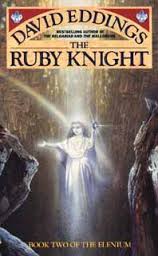 EDDINGS RE-READ: The Ruby Knight, BOOK TWO OF THE ELENIUM
Because we just don’t have enough to do, Tehani, Joanne and I have decided to re-read The Elenium and The Tamuli trilogies by David (and Leigh) Eddings, and – partly to justify that, partly because it’s fun to compare notes – we’re blogging a conversation about each book. We respond to each other in the post itself, but you can find Tehani’s post over here and Jo’s post here if you’d like to read the conversation going on in the comments. Also, there are spoilers!
ALEX:
Sparhawk starts this book a) immediately after the end of the first one, and b) wanting someone to jump him, so that he can get all violent on some unsuspecting footpad. I don’t think I was really paying attention to that sort of thing when I was a teen. He’s actually not a very nice man a lot of the time, and that makes me sad.
JO:
It is a bit sad isn’t it 😦 Sparhawk’s most common reaction seems to be violence, and the narrative and tone celebrates that part of him.
TEHANI:
Alex, you say “not a very nice man” but I never read it that way (and still don’t, I guess!) – he’s a product of his culture and his time. They seem to quite happily wreak havoc on people at the drop of a hat, and he IS a knight, trained to battle!
ALEX:
OK, maybe I don’t have to be quite so sad about him – that he’s a product of his time – but still his active desire for violence does act, for me now, against my lionising of him as a teenager. He is flawed, and I’m troubled because Jo is exactly right – the narrative celebrates him and his anger/violent tendencies.
TEHANI:
You’re both completely right. I still choose to read it in the context of the book, AND STICK MY HEAD IN THE SAND. Damn. That’s the problem with rereading with a few more brains behind us, isn’t it?!
ALEX:
Something we didn’t note in our review of The Diamond Throne is that the book is prefaced by a short excerpt from a ‘history’. This is a really neat way of building up back story and developing the world without having to info-dump – although of course the Eddings pair don’t really have an issue with info-dumps; after all, why else assign a novice knight to teach a young thief history? Anyway, I still like it, and it does show that there has been a fair bit of thought put into the world, even if much of it simplistic.
JO:
Yeah I enjoy these histories too. Good way to set the scene, highlight anything that’s going to be important for the book (like Lake Randera) and do a quick recap. They definitely like an info-dump, but at least the Eddings do it with style and humour!
TEHANI:
I reckon there’s reams of world-building behind these books, especially if the work that we see in The Rivan Codex (for the Belgariad/Mallorean world) is any context!
JO:
I enjoyed this book a lot more than I expected. I remembered The Ruby Knight as a very ‘middle book’, just basically a long build up to finding Bhelliom and saving Ehlana. But on the reread it was a lot more engaging than that. Maybe it’s because Eddings has the space here to really get into the characters, and I love these characters so much that I enjoyed that to no end.
TEHANI:
It really does boggle me that even though I’ve read this several times, I still don’t get bored of this long questy-ride-alonging. It really IS a middle book, and nothing terribly much happens, but it’s still a really enjoyable read! Bizarre. Is it nostalgia that makes it so, or some quality about the book that means I don’t chuck it across the room like I would most other “middle books” that really just march in place?
ALEX:
I found this one a bit more boring than I remembered – it really is just them wandering around. I totally still enjoyed the character development, and it is banter-ific, but on this re-read I got a bit impatient with the lack of actual plot movement.
JO:
They’re also very good at throwing everything in Sparhawk’s way. I mean, this is basically a quest book. We even have a ‘fellowship’ don’t we – Sephrenia mentions how important it is to have a certain number of people on the quest, it’s all about symmetry. But from the outset, everything that can go wrong does, and all of this does a great job of increasing the tension. Not only that, but characters we meet in the beginning and/or middle come back towards the end, which makes these side-quests feel a little less side-questy. By the time Sparhawk and Co. get roped into Wargun’s army I just wanted to scream because they were so close and it is so not fair! But I do love it when characters get put through the wringer like that. Nothing’s easy.
TEHANI:
Masochist! But I’m right there with you – wouldn’t be any fun if things just went to plan, right?
ALEX:
omg when I got to that and remembered that they were being co-opted I think I might actually have groaned out loud. GET ON WITH IT.
TEHANI:
I like that there’s a few points in this book that smack back at the classism – Wat and his fellows teach Sparhawk a thing or two: “Not meanin’ no offence, yer worship, but you gentle-folk think that us commoners don’ know nothin’, but when y’ stack us all together, there’s not very much in this world we don’t know.”
Ulath backs this up some chapters later: “Sometimes I think this whole nobility business is a farce anyway. Men are men – titled or not. I don’t think God cares, so why should we?”
“You’re going to stir up a revolution talking like that, Ulath.”
“Maybe it’s time for one.”
ALEX:
Tehani, you beat me to it – I LOVE that bit; I metaphorically punched the air.
JO:
Go Ulath! 🙂
TEHANI:
Unfortunately, there is also some nasty gender stuff – it doesn’t stem from our heroes, but isn’t challenged by them, and is somewhat supported by them to an extent (Kurik emphasises the nasty noble’s words by drawing his sword in this exchange):
“Mother will punish you.”
The noble’s laugh was chilling. “Your mother has begun to tire me, Jaken,” he said. “She’s self-indulgent, shrewish and more than a little stupid. She’s turned you into something I’d rather not look at. Besides, she’s not very attractive any more. I think I’ll send her to a nunnery for the rest of her life. The prayer and fasting may bring her closer to heaven, and the amendment of her spirit is my duty as a loving husband, wouldn’t you say?”
(more follows on p. 217 – of my copy…)
ALEX:
urgh. Hate that.
JO:
And it’s ok that he feels this way because it was an ‘arranged marriage’. Poor bloke, getting stuck in an arranged marriage like that. *flat stare* There are a lot of comments in these books about women being obsessed with marriage and men ‘escaping’.
ALEX:
And there’s other uncomfortable gender moments, too, like the serving girls in the tavern often being blonde, busty, and none too bright… *sigh* And then there’s Kring, who asks whether it’s ok to loot, commit arson, and/or rape when they partake in war with the Church Knights.
TEHANI:
Oh, so many uncomfortable moments…
JO:
Yeah I’d totally forgotten that about Kring. I was so excited to see him, because I always liked him, but that took the wind out of my sails a bit.
TEHANI:
But Kring kind of changes, I think (though later on) and that element is quite lost later. However, it does NOT do well to realise which culture the Peloi are intended to represent. Oh, the casual racism…
ALEX:
On the topic of racism – every time Sephrenia rolls her eyes and says “Elenes,” I can’t help but think of the bit in The Mummy where Jonathan says “Americans” in that insulting tone of voice (which I can’t find on YouTube, darn it).
TEHANI:
I think Sephrenia is quite within her rights saying it in that EXACT tone of voice!
ALEX:
Also, Ghwerig being ‘misshapen’ isn’t quite suggested as the reason for his being evil, but it’s pretty close – and keeps cropping up throughout the series. I can’t imagine how that makes a non-able-bodied reader feel, given it makes even me gnash my teeth.
TEHANI:
You know, I never actually read it that way – it mustn’t be quite as overt as some of the other uncomfortable things. But of course, now you’ve pointed it out, yes, I completely see it.
JO:
Oh hey I never really noticed that either! But now that you mention it, I can’t unsee it. Which says a lot. Why do I see all the gender stuff immediately, but this passed me by? Of course there’s a long literary tradition of physical deformities = spiritual ones. That’s no excuse. I must be more aware in my reading.
TEHANI:
Kurik’s acknowledgment of Talen (p. 392) made me cry as much as it did Talen!
ALEX:
You softy. I didn’t cry in THAT bit…
JO:
Oh no, the bit that always made me cry is still to come…
ALEX:
Mine too.
Apropos of nothing, did either of you find it a bit odd that Kurik checks on Sparhawk in the middle of the night?? I bet there’s fanfic out there…
TEHANI:
There’s fanfic out there for EVERYTHING! I didn’t think it odd, though I did love the naked man-hug in the early pages of the first book! (go on, go check, I’ll wait…) 🙂
JO:
I am NOT going to go looking for fan fic. I am NOT…
ALEX:
Oh, I don’t need to check, Tehani, I remember 😀
Also, do you remember whether you suspected Flute of being actually divine before the great revelation at the end of this story? I’m not sure! I hope I did…
TEHANI:
Well, I read these completely backwards (Tamuli before Elenium), so I was spoiled for that already I’m afraid!
JO:
Tehani that breaks my brain.
I had suspicions about Flute from very early on. I remember being very impressed with myself at the time. I reread it now and think how could you not? They do kinda hit you over the head with it :p
TEHANI:
I think by now we’ve read WAY too much in the field to be surprised by something like that – but a newish reader to the genre? Maybe they wouldn’t pick it!
Well, being the middle book of the trilogy, there isn’t really much by way of plot to chat about, I guess, so shall we move along? Perhaps faster than the plot of the book itself… 🙂
JO:
We should talk about plot shouldn’t we 🙂
Sooo… As usual the book opens up with Sparhawk travelling through Cimmura at night in the fog. Notice how often that happens in these books?
TEHANI:
Yes, you’re right! It’s a trend in the books, for sure.
JO:
I quite like the repetition. He’s got both rings, and now he knows he needs Bhelliom to cure Ehlana and it’s time for the sapphire rose to be found again anyway. The fellowship head off on their quest for the magic jewel and have adventures along the way, including being stuck in the middle of a siege, dealing with Count Ghasek’s possessed sister, raising the dead and finally fighting the Seeker who has been chasing them all this time.
Eventually they make it to Ghwerig’s cave – after the introduction of Milord Stragen, another favourite character – fight and defeat the troll. Flute is revealed as the child-Goddess Aphrael, and gives Bhelliom over to Sparhawk.
Was that the kind of thing you had in mind? 😉
TEHANI:
This is why YOU’RE the writer…! Nicely summed up indeed. The Count Ghasek storyline was a bit of a tough one. On one hand, Ghasek seemed like a nice enough chap. On the other, the motives behind his sister’s madness, well, not great to examine that too closely, I think.
JO:
Although I did appreciate the throwback to book one – Eddings could have introduced any old character here, but Bellina is the woman Sparhawk and Sephrenia witnessed going into that evil Zemoch house.
TEHANI:
Well seeded indeed…
ALEX:
GET ON WITH THE STORY, EDDINGS PEOPLE!

 Randomly Yours, Alex