Snuff
Way back when I was doing my undergrad degree, I did a subject called Popular Fiction. I was excited to be reading popular fiction and calling it work for uni! I was less excited when I got to the first tutorial to discover that, of about 20 of us, I think only 2 or 3 admitted to actually reading popular fiction regularly… everyone else said they were doing the subject “to know what other people read” (I paraphrase).* This made me a bit bullheaded. So did the lecturer insisting on differentiating between the reading/appreciating of literature, versus the consumption of popular fiction. This one still makes me angry, although I do wonder now how much the younger me missed nuances here; the lecturer was definitely cluey enough to understand Austen and Shakespeare as originating in the popular sphere. So perhaps I overreacted and/or misunderstood some aspect.
Anyway, over time I have come to terms with the fact that yes, actually, I am a consumer of popular culture, and that is OK. It does not make that culture bad, it does not mean that I am no appreciating it properly, etc etc. Basically I have grown up, and grown into my skin. So I am quite happy to say that hell yes I consume Terry Pratchett books. I devour them: I read them quickly, in concentrated blocks of time; they don’t require me to stop and worry over words or sentences that don’t make sense. That said, I tend to treat Literature (when I have to read it) in much the same way. At the very same time, though, as Anita Sarkeesian rightly insists, just because you enjoy a product of popular culture doesn’t mean it shouldn’t be critically analysed (again, I paraphrase).
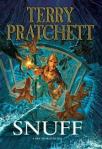
This is the long way round to saying “I read Snuff! It was awesome!”
… and dealt with some big issues in clever ways, as you would expect. (There are some spoilers below.)
Pratchett has dealt with racism, via speciesism, before: human reactions to werewolves, vampires, dwarves, trolls, zombies, etc etc – these have all been coded as racial. And, from memory, generally done well (I could be wrong there; it’s been a while). In Snuff Pratchett makes this the central issue, because the main problem revolves around goblins and whether they ought to be treated as sentient, sapient, creatures. For a long time they have been regarded as vermin, and many people have treated them in ways matching that perception. But now Sam Vimes and family are off for a Holiday, and there are Hints that all is not well in the bucolic surrounds he finds himself in. Not least the difficulty of understanding crockett, and having to confront horses.
I’ve had to think carefully about the way Pratchett portrays the goblins. One of the crescendo moments is a goblin, Tears of the Mushroom, playing the harp for a huge crowd in Ankh-Morpok. That is, a member of a subjected race, wearing ‘civilised’ clothes, goes to the heart of civilisation and plays an instrument that is coded as approaching the zenith of musical accomplishment, and there impresses the (civilised) bigwigs. This could all be seen as uncomfortably close to recreating the classic idea of the western civilising mission.
… Except. Except that the goblins have already been shown, very clearly, to have their own culture and don’t need ‘civilising’. They have a rich language, evidenced clearly by their names (Tears of the Mushroom!); they make art (some of which is so precious that humans who regard the goblins as little better than animals will steal it); they care for one another and about justice. They are wretches in that they are wretched – through no fault of their own. And Tears of the Mushroom plays her own composition, and is in no way dismayed by the audience before her. By the time Tears of the Mushroom plays, the reader should be so convinced about the sentience and sapience of the goblins that any of the characters doubting it should cause serious eye-rolling. Many of the human characters are also convinced early on, which is also intended to convince the audience, just in case you missed all of the other very obvious signs.
Thus what Pratchett is doing is showing, to some extent, an example of the old westernising/civilising mission – there’s no doubt that’s what Miss Beadle is doing, whatever her intentions – and then… not entirely sending it up, but certainly undermining it, and definitely showing that is is quite unnecessary for the sake of the goblins themselves. Although maybe it’s necessary for the acknowledged-as-civilised, to make them realise what they are doing to this race.
There are other issues under examination here too. The place of landed gentry and inherited titles (written after all by Sir Pratchett), with a lovely sneaky homage to Jane Austen; and how a copper manages to love both his work and his family. Pratchett has delved into Sam Vimes’ head a few times in the recent books and I think his ideas about policing etc are utterly intriguing. I especially loved here the abstracted notion of the Street as something that stays with people like Vimes, and helps him to be who he is.
I love the Discworld. I think the books are, as a whole, getting better. I wish I thought there were many more to come.
*I was also less excited about having a Jackie Collins novel on the booklist. In three years of English at uni, this is one of the few books I just did not read.**
** One of the others was Charles Darwin’s Voyage of the Beagle.***
*** I also didn’t finish James Joyce’s Ulysses. Peh; bad taste in the mouth.
Tooth and Claw
Tooth and Claw is, by its own admission, a modern attempt at writing a Victorian novel. As it opens, the patriarch is dying, and the family have gathered. Soon enough there is a squabble over the inheritance: there’s not much wealth left, and the eldest two children are already established, so the younger three are meant to get the lion’s share to help them out. But the brother-in-law decides he disagrees with the interpretation of the will, and takes more than what the younger son, in particular, thinks is fair. He then begins court proceedings to deal with it. (The blurb on my copy calls this a search for “greedy remuneration,” but I thoroughly disagree with this interpretation.)
The family is gently-born, but with little wealth and a fairly small estate this isn’t overly much use. The younger son is struggling to make his way in the corporate world, and could use all the help he can get. His older brother is established as a parson in a good living, with a fairly generous benefactress, a wife, and some children; the older sister is married, with children and expecting more. The situation is of course most desperate for the two younger sisters. Without significant dowries, attracting suitable (and nice) husbands is going to be more difficult than pleasant… and it’s made more difficult for the older one when an unwanted suitor very nearly ruins her completely.
The story revolves mostly around the three younger siblings, although the older brother gets an occasional look-in. The sisters are parcelled off to their older siblings with hopes of finding suitors or at least not being too much in the way; the younger son goes back to his city life, and the things he’d rather his family not talk about.
… all right, all right. Those in the know are amused and eye-roll-y by this stage, everyone else is confused.
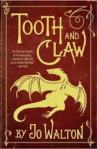
Everything I’ve written so far is true. But all of the characters? They’re dragons.
Yes. Dragons. Scales, claws, eating raw meat, flying, concerned about polishing their scales, sleeping on gold, breathing fire if they’re lucky, dragons. And it works. Walton takes some of the ideas of the Victorian novel and makes them real; her take on the blushing bride is brilliant. Her vision of menial dragons is perhaps the most shocking aspect – that their wings are tied down, such that they can never fly. This is a wonderful visual of the reality of life for many ‘in service’.
Also, dragons eat each other.
This is a great, fun story. It’s light-hearted overall with a serious social message (a few, really; perhaps closer to Gaskell than Austen?). The characters are approachable, the plot plays out nicely – it’s a delight to read.
Galactic Suburbia 91
 In which Alisa has a baby, and Alex & Tansy put a bow on it. Not the baby. The podcast!
Birth Announcement: Welcome to Mackenzie Charlotte & all our love and best wishes to the recovering and delighted new parents, Alisa and Chris.
World Fantasy Awards
British Fantasy Awards
Culture Consumed:
Alex: Feminist Frequency’s Tropes vs Women in Video Games; Ancillary Justice, Ann Leckie; Menial: Skilled Labor in SF, Kelly Jennings and Shay Darrach
Tansy: Nanowrimo! Cranford, Elizabeth Gaskell; Horrible Histories; Wife in Space by Neil Perryman, The Time Machine (Destiny of the Doctor), 1963: Fanfare of the Common Men, The Space Race, The Assassination Games; Night of the Doctor
INK BLACK MAGIC BY TANSY RAYNER ROBERTS available now from Fablecroft, Amazon & bookshops who order it in.
GOODREADS GIVEAWAY FOR INK BLACK MAGIC
Doctor Who Women on the Radio including Tansy
Pet subject: SFF for children (they cross genres more easily than adults, basically)
Alex: Victor Kelleher (especially Taronga); Playing Beatie Bow, Ruth Park; Riddle of the Trumpalar, Judy Bernard-Waite; The Hobbit, JRR Tolkien
Tansy: Diana Wynne Jones; Robyn Klein (Halfway Across the Galaxy and Turn Left); Which Witch, Eva Ibbotson; Margaret Mahy, Aliens in the Family and all her books about pirates; Ruth Chew; Five Children and It, E. Nesbit; Edward Eagar (Half Magic and Seven Day Magic – stories for kids who love to read and know how to manage a magical adventure!); comics like Gunnerkrigg Court, Zita the Space Girl, Betty & Veronica spin-offs. The Case of the Origami Yoda bridging fantasy and reality!
Also Possum Magic, Magic Pudding, and other Australian picture-book classics! From England, Charlie and Lola by Lauren Child and various books such as Fairy Shopping by Sally Gardner are appreciated for their gorgeous collage art as much as the stories.
Please send feedback to us at galacticsuburbia@gmail.com, follow us on Twitter at @galacticsuburbs, check out Galactic Suburbia Podcast on Facebook and don’t forget to leave a review on iTunes if you love us!
Galactic Suburbia 90!
 Listen to us via iTunes or over at Galactic Suburbia!
In which we present The Subgenre Report. Is the concept of subgenres meaningful to readers and writers, or just a marketing trick?
Which subgenres are OMG so hot right now, and which genre is doing subgenres better than spec fic?
In other news, Alisa hurls herself into crowdfunding with the baby clock ticking down to midnight…
Grimdark as a Young Man’s Genre? (do read the comments, seriously, that’s where all the crunchy discussion/challenge is)
The Rise and Fall of Grimpink
Culture Consumed:
Alisa: Continuum S1, crimeScene convention, plug for Kaleidoscope, Coode St Podcast ep 162 with Rachel Swirsky; Report from Planet Midnight, Nalo Hopkinson
Tansy: BBC Radio Neverwhere; Untold by Sarah Rees Brennan, Ancillary Justice by Ann Leckie, The Almighty Johnsons
Alex: Agents of SHIELD; Star Wars: The Paradise Snare, AC Crispin; Ragnarok, AS Byatt
Please send feedback to us at galacticsuburbia@gmail.com, follow us on Twitter at @galacticsuburbs, check out Galactic Suburbia Podcast on Facebook and don’t forget to leave a review on iTunes if you love us!
Galactic Suburbia 89
 In which we recommend books to buy as presents, books we love, books we made, and basically BOOKS BOOKS BOOKS. You can get us from iTunes or at Galactic Suburbia.
Alisa’s picks: 2012; Trucksong; A Trifle Dead; Rosaleen Love’s Twelve Planets collection; the entire Twelve Planets suite (get them while they look the same! especially Love & Romanpunk)
Alex’s picks: Temeraire by Naomi Novik; Ocean at the End of the Lane by Neil Gaiman; Shades of Milk and Honey by Mary Robinette Kowal; Left Hand of Darkness by Ursula Le Guin; House of Suns by Alistair Reynolds
Tansy’s picks: Glitter and Mayhem; Chicks Unravel Time; The Wife in Space; The Worst Witch books by Jill Murphy; Creature Court trilogy (Power and Majesty)
Culture Consumed:
Alex: Reap the Wild Wind, Julie Czerneda; Ocean at the End of the Lane, Neil Gaiman
Tansy: Flying Higher eds by Michael Damian Thomas & Shira Lipkin [download free from Smashwords], Doctor Who: Prisoners of Time 1-4, Supurbia by Grace Randolph, Elizabeth Sladen the Autobiography, The She-Hulk Diaries by Marta Acosta
Alisa: Glamour in Glass, Mary Robinette Kowal
BLATANT PLUG: Songs For Europe, two short plays about Eurovision & war by John Richards of Splendid Chaps & Lee Zachariah of the Bazura Project on this week only as part of the Melbourne Fringe.
Please send feedback to us at galacticsuburbia@gmail.com, follow us on Twitter at @galacticsuburbs, check out Galactic Suburbia Podcast on Facebook and don’t forget to leave a review on iTunes if you love us!
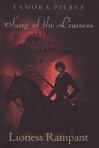
Alanna 4: Lioness Rampant
SPOILERS
Once again, let’s talk about that cover. It’s way too dark, for a start. Alanna is still not in armour, even though she becomes the king’s champion. The horse is still the wrong colour. The red glow makes sense, I guess, but… yeh. This really doesn’t work for me. The title basically works; it’s better than In the Hand of the Goddess at least.
And again: junior section of the library, people! Weird!
At last, a proper quest. I was beginning to wonder whether it would happen! We had two books of boarding school, one book of… I dunno how to characterise the third, actually. And then here, a quest. Not your average quest, of course, but a quest nonetheless. In fact, a road trip! Alanna learns of a Fabulous Jewel and decides that hey, this is exactly the sort of thing she should be adventuring after as a knight errant. Along the way she meets – and Takes Up With – one of the few men genuinely her match in fighting, Liam; plus a refugee princess, who she eventually matches with Jonathan to take that little problem off her hands; and when she gets back to her home, she helps to bring down a plot against Jonathan (now king), with the back-from-the-dead Roger at its heart. Plus she finally ends up with George, who’s been holding out so faithfully.
The quest angle was interesting, not least because it takes up less than half of the book. The Dominion Jewel does end up being fundamental to Jonathan keeping ahold of his kingdom (literally), but the trip is definitely more about the travel than the destination. Alanna’s relationship with Liam is perhaps the most fascinating of all her loves. For a start, Liam is terrified by her use of magic – so she knows right from the start that they won’t be a long term item (although I am mighty, might sad that he died). His knowing more about some aspects of fighting lends an interesting tone to their relationship, since it takes on a teacher/student aspect – it’s not overdone, though. Her frustration at his occasional desire to protect her comes through well, and not usually as an ‘I’m the strong man’ attitude but more of a ‘I love you so I want to protect you’ thing – which is quite reasonable, from his perspective, if frustrating from hers. And then finally we get female relationships, with Alanna relating to the princess Thayet and her bodyguard, Buri, on a fairly level playing field: Thayet actually outranks her, as no woman she has interacted with daily ever has; Buri is pretty nearly as good a warrior as her. And they manage to have occasionally spiky but generally very good friendships, based on mutual trust and equality. Hooray!
Oh, and she gets the jewel, by nearly defeating and then amusing an elemental being. Awesome. Off home then.
Alanna’s relationships with Jonathan and George have complicated, as they ought. Jonathan is willing to be chivalrous, but really knows that their marriage wouldn’t be awesome; plus, he’s smitten by Thayet, as Alanna was planning. Plus, being married to your Champion would just be awkward. George keeps on being the faithful one, and eventually that pays off. Awww.
Clothes play a rather interesting role in this story. I like that Alanna has a complicated relationship with clothes. It makes sense. I love that she is allowed to mash somewhat-feminine clothes with her status as a knight when she is presented to the court. Liam’s poor reaction to her being in a dress, because that doesn’t suit the box into which he wants to place her, is a wonderful exploration of identity and expectations. The resolute determination of showing that she can be feminine – and like feminine things – and that this does not detract from her status or fighting abilities is magnificent.
There are some things that are rushed, here, as they have been throughout. Alanna’s relationship with her brother Thom, in particular, is never fleshed out enough for my liking; Thom as a character is too distant and unrealised. We just have to accept that he’s become proud because of his power, but that he gets tricked by Delia into resurrecting Roger.. and then he finally gives in and is willing to accept help from his former teacher whom he previously seemed to despise. It’s all a bit of a mess, really, which is unfortunate because I think the twins’ relationship could have been a much more intriguing aspect of the story than it was allowed to be.
I am unconvinced by the conclusion, too. I am happy enough with her ending up with George, although it is just oh-so-convenient that he’s noble now (not to mention pardoned), so there’s no issue of her marrying below herself. However, the idea that she would immediately agree to have children after a year or two of marriage struck rather an off note for me. She’s just made him amend his suggestion that she settle down to going off roaming with him, and now she’s confirmed to near-immediate motherhood? Given the rather pointed bits about her knowing nothing about children – although she does learn – this just seems out of character. And it was an unfortunate way to end, too; I don’t really see why there had to be a discussion of children along with the discussion of marriage.
Overall, I am pleased to have read this quartet; I read the last three in about 24 hours. I may at some stage seek out the next set of books set in Tortall, but I’m (really) in no hurry. Pierce was doing some interesting things, here, but I’m too old and well-read to be as completely overwhelmed as I might have been in my teens. Still, I’d have no hesitation in shoving them down anyone else’s throat.
You can get Lioness Rampant from Fishpond.
Alanna #3: The Woman who Rides like a Man
SPOILERS

Soooo… let’s talk about that cover then. Can you spell Twilight? SERIOUSLY, PEOPLE. There is so much more to this story than a love triangle! And WHAT the heck is she WEARING?? Is there a Valley Girl in the desert that’s not mentioned? She’s a KNIGHT. She could at least be wearing a burnoose, given she spends a large amount of the story in the desert. But nooooo they have to make it look like this almost modern. You can pretty much ignore the sword in her hand, even! Urgh. Also, I wouldn’t go for either of these fellas.
Still, at least this is a better title than the second one. “Woman who rides like a man” is both directly relevant to the story and intriguing.
Also, found in the junior section. Really makes me think that the staff haven’t read it.
Alanna is now a knight, and like she has been saying for two novels, is off to seek whatever knights errant seek. Warmth in winter and some distance from both Jonathan and George, in this case, plus getting away from people who disapprove of boobs behind armour. She ends up in the desert that she visited in the first book, and stays with a tribe of the Bazhir. She accidentally becomes the tribe’s shaman because she kills the existing one; oops. She also becomes teacher to three young Gifted teens, one of whom dies, and she challenges notions like girls-can’t-d0-stuff. Meanwhile, she breaks up with Jonathan when he gets very high and mighty about her marrying him, is adopted by Sir Myles as his heir – so now she gets to have her own title because after all her brother inherits Trebond; and takes up with George, at last.
Again, a lot happens in a short novel. I think this one felt better paced overall – perhaps because now Alanna is a knight, which was the whole point of the first two, things can slow down a bit and events can happen kind of for their own sake, rather than to move Alanna along to that particular end. This also covers a shorter period of time, but still felt like there were important things going on.
Again, Alanna grows and changes. In particular her attitude towards being female comes out in fits and starts, and this really makes sense. After all, she’s hidden being a woman for so long – and put all of the potential trappings of femininity out of her mind for so long, disregarding them in her quest to be a knight and definitely seeing them as the lesser of her options – that it makes sense it would be hard to change. I think it does make sense that it might eventually start to be appealing, or at least provoke her curiosity; especially when her lover makes rude comments about not being feminine enough.
There are some problematic things in this novel – I wasn’t entirely comfortable with the characterisation of the Bazhir. However, Alanna’s stay with them does twist some conventions nicely; her very presence challenges some of their notions, and many of them show willing to change when shown that the alternative isn’t disastrous (mostly). I like that there is an insight into the women of the tribe; after all, Alanna is in that sometimes awkward, sometimes useful liminal space of female-knight: she inhabits both masculine and feminine sides. So she learns the magic and the fighting… and then she also learns weaving, and values that, seeing that the women have as much to offer as the men. I love that she is not actually very good at weaving when she starts.
I am intrigued again by the… I hesitate to use the word ‘casual’, because it makes her sound like she just sleeps with anyone, so let’s go with ‘straightforward’ attitude shown towards sex. She’s broken up with Jonathan; George again makes a move; she takes up with him. It’s more than pragmatic – after all George declared his love back in the other book; it’s not rebound sex; and she’s not hung up on the morality of it. This is definitely a different way of portraying such things from your average faux-medieval story.
I think this is my favourite of the four books. Alanna seems to get to be most herself with the Bazhir; she faces challenges and makes decisions like a knight would and should. And she faces the consequences squarely, occasionally with remorse as required. She’s growing into someone to genuinely admire.
You can get The Woman who Rides like a Man at Fishpond.
Alanna #2: In the Hand of the Goddess
A while back, I read Alanna: the First Adventure. I said at that time that I would read the rest of the quartet at some point, but I wasn’t in a screaming hurry. Then the other day on Galactic Suburbia, Tansy announced that she was commencing a re-read. Well, I couldn’t let her re-read beat my initial read, could I? What if she said spoilery things?? So, I went out and borrowed the next three. And read them…
SPOILERS

So. The second book. First off, let’s talk about this cover. It’s from the 2011 re-release, and it is less than awesome. Her horse’s name is Moonlight, fercryinoutloud. At least she’s got a sword and is dressed in squire-ish clothes. Secondly, let’s talk about where I found it: in the junior section of the library. Not the YA section; the junior section. I can maybe see the first book fitting there, but not the entire series. I found that weird before I read them, and then as I read the casual attitude towards sex – the sex isn’t explicit, in the slightest, but it is very clearly present – I was even more astonished. Also, the killing of people with swords, which again isn’t the most graphic violence but still, not sure you’d want a ten year old reading it. Thirdly, the title… well, it makes sense in some ways, but it doesn’t inspire me and in fact makes me roll my eyes. I would not pick this up based on the title. (Of course I would already have been put off by the cover of this particular edition.)
Anyway. The story picks up with Alanna now being squire to Jonathan, the prince, who knows that she’s actually a girl. The story essentially covers her progression towards becoming a knight. It covers three or four years in 240 pages. Sometimes you blink and it’s a year later. Some writers carry that off with aplomb – mostly I’m thinking of Ursula le Guin here I think – but I’m not entirely convinced of it by Pierce. Over that time, Alanna acquires a cat, Faithful (many of the names that appear in this series I am entirely unimpressed by); a lover, in Jonathan; and of course becomes a knight. And, in a very rapid turn of events, she kills her nemesis, Duke Roger. That particular bit happened so fast my head was spinning.
Alanna grows up, as she needs to, and generally that’s well done. She frets about things fairly convincingly. It was good to see that Pierce allowed Alanna’s friends to accept her being a girl relatively easily; that she had proved herself enough that it was straightforward for them to still see her as a knight.
Battle scenes aren’t dwelt on, which I appreciated. The aftermath, though, is not ignored; Alanna throws up after her first real skirmish, the patching up of soldiers is shown in as detail as the battle itself – which isn’t glorified – and when Alanna isn’t able to fight, she goes off and helps the healers. I like how practical Alanna is; I like that the reality is shown, although of course Alanna is Super Gifted in every area necessary (which sometimes does get a bit wearing).
Jonathan is a bit boring. I was surprised when he and Alanna fell into bed together relatively easily; later, there is a suggestion that this diminishes Alanna’s virtue in some eyes, but she doesn’t worry about it at this stage. I can’t help wondering about the power issues of a prince sleeping with a vassal – although of course this has always happened in history – but also the rather weird situation of a knight sleeping with his squire… although of course this may well have happened in history….
As a rogue, George of course is more interesting. I’m a bit impatient with love triangles though.
Really, this book gets through things extraordinarily fast.
You can get In the Hand of the Goddess from Fishpond.
Galactic Suburbia 85
In which we talk about gender stuff in publishing and gaming, Alex votes in the Hugos and Alisa’s thesis starts coming together. A good week! You can get us from iTunes or over at Galactic Suburbia.
Caught Our Eye
Sexism in genre publishing: A Publisher’s Perspective
JK Rowling and Robert Galbraith – An Open Letter to Writers & Would Be Writers
The Mary Sue & gaming culture: What we aren’t talking about when we talk about inclusion and representation, and what we are
Culture Consumed:
Alex: Hugo reading (novellas and novelettes)
Alisa: Publishing and Reading as Dissent: Resistance, Literary Tourism and Arsenal Press, Casey Stepaniuk (The Word Hoard Vol 1, Issue 1)
Tansy: Alanna the First Adventure by Tamora Pierce, All-New X-Men: Yesterday’s X-Men, Brian Michael Bendis & Stuart Immonen; Red Sonja #1 by Gail Simone; Much Ado About Nothing!
The Galactic Suburbia Road Trip – we have fun over at the SF Signal Mind Meld!
Tansy’s review of The Other Half of the Sky is up at the Cascadia Subduction Zone.
Kaaron Warren won a Shirley Jackson for “Sky”!
Please send feedback to us at galacticsuburbia@gmail.com, follow us on Twitter at @galacticsuburbs, check out Galactic Suburbia Podcast on Facebook and don’t forget to leave a review on iTunes if you love us!
Some Hugo thoughts
I’ve been doing reading towards voting in the Hugo Awards, so these are some thoughts on what I’ve read recently – all in the shorter fiction categories:
Novelettes
“Fade to White,” Catherynne M Valente (Clarkesworld, August 2012) – DAMN, man. This novelette is astonishing. Non-linear structure, with advertising copy complete with snarky editorial commentary interspersed throughout the stories of two adolescents living in a post-WW2 alternative America: alternative because things have clearly gone from defeating Germany straight to Hot War with Russia, and that war has come to American soil. Not only is this a fascinating and chilling look at the repercussions for adolescents growing up in such a world, it’s also a frightening and perceptive look at how gender and race issues might play out, too, in an America so threatened. A bit like Handmaid’s Tale in that respect. I should have talked about this one last because much as I liked Pat Cadigan’s “The Girl-Thing who Went out for Sushi” (Edge of Infinity), I think this gets my vote.
“The Boy Who Cast No Shadow”, Thomas Olde Heuvelt (Postscripts: Unfit For Eden, PS Publications) – a really lovely story. One of those stories that uses a fantastical idea but makes it normal (well, ish) in the society: in this case, a boy made of glass. The eponymous character is regarded as a freak for having no shadow; the two form a friendship based on their bizarreness. This is poignant and lovely; I’m very happy I got to read it
“In Sea-Salt Tears”, Seanan McGuire (Self-published) – I read the first October Daye book and was completely unimpressed. I had no idea that this was connected to that series until I saw someone mention it on Goodreads. So, with no background at all, I actually really liked this story. Selkie stories are so hot right now (and it’s pretty funny reading this after recently reading Sofia Samatar’s “Selkie Stories are for Losers,” which I adored) – this one felt like it did something a bit new with the mythology, which I enjoyed.
“Rat-Catcher”, Seanan McGuire ( A Fantasy Medley 2, Subterranean). Meh. Cat-fae in 1660s London.
Novellas
After the Fall, Before the Fall, During the Fall, Nancy Kress (Tachyon Publications) – totally my pick. Again with the non-linear structure, as the title suggests. Bits of the story happen in a world recognisably our own where one of the main characters is trying to figure out a series of kidnappings. Bits of it happen in a very weird future world where some cataclysm has occurred and a small remnant population is trying to get on with. And there’s a bit during the fall as well, of course… and by that stage everything has started to come together, and both of the main characters really make sense and are utterly captivating. Very, very nice.
The Emperor’s Soul, Brandon Sanderson (Tachyon Publications) – haven’t managed to finish it yet. Possibly shouldn’t therefore comment.
On a Red Station, Drifting, Aliette de Bodard (Immersion Press) – I don’t know anything about this universe of de Bodard’s, so I have no idea whether I’ve missed important character references or whatever. Nonetheless the story was highly engaging, and made basic sense – war isn’t hard to understand, and the repercussions for refugees are of course familiar. The intricacies of family entanglements are taking to an extreme and fine degree, but again the basic notion isn’t hard to grasp. It’s beautifully written and very absorbing.
San Diego 2014: The Last Stand of the California Browncoats, Mira Grant (Orbit) – have not read, won’t bother because I haven’t read the Newsflesh series (and don’t like zombies).
“The Stars Do Not Lie”, Jay Lake (Asimov’s, Oct-Nov 2012) – interesting idea. Would have been a whole lot better if it wasn’t transparently a Galileo/scientists in general vs Catholic Church story, with little effort to develop an interesting take on the religion.
So, for what it’s worth – those are some of my thoughts!

 Randomly Yours, Alex