The Diamond Throne
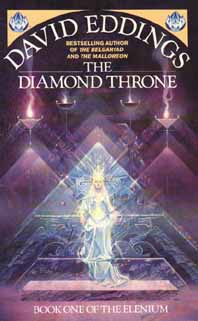 EDDINGS RE-READ: The Diamond Throne, BOOK ONE OF THE ELENIUM
Because we just don’t have enough to do, Tehani, Joanne and I have decided to re-read The Elenium and The Tamuli trilogies by David (and Leigh) Eddings, and – partly to justify that, partly because it’s fun to compare notes – we’re blogging a conversation about each book. We respond to each other in the post itself, but you can find Tehani’s post over here and Jo’s post here if you’d like to read the conversation going on in the comments. Also, there are spoilers!
TEHANI:
I was feeling a little book-weary yesterday so thought I might as well start my reading for this conversational review series, given it’s usually a soothing experience. Within a single PAGE, I was reaching for Twitter, because SO MUCH of the book cried out to be tweeted! Great one-liners, the introduction of favourite characters, and, sadly, some of the not so awesome bits as well. I was having a grand time pulling out 140 character lines (#EddingsReread if you’re interested), but the response from the ether was amazing! So many people hold these books firmly in their reading history, and it was just lovely to hear their instant nostalgia.
ALEX:
And I read those tweets and everything was SO FAMILIAR that I immediately started reading as well. And finished a day later.
JO:
Ok. A) You people read too quickly! B) Tehani those tweets were enough to start me feeling all nostalgic. I was in the middle of cooking dinner and had to put everything down, run upstairs and dig the books out of their box hidden in the back of the wardrobe.
TEHANI:
I am not at all repentant! 🙂 Also, did you both find this a super easy read? Is it the style, or just that I’ve read it several times before? It really was like sinking into a warm fluffy hug, hitting the pages of this book again. I actually can’t remember the last time I read it, but it’s got to be over a decade, yet I felt instantly at home again. Eddings was one of the authors who caused my addiction to the genre, and even in the very first chapters, it’s easy to see why. The light and breezy writing style is instantly accessible, and the way we’re thrown straight into the action, with our hero Sparhawk leading us through, makes the book start with a bang.
ALEX:
Reading that first page was a little bit like going back to my high school, many years after graduating. It just felt so familiar, and comfortable. And like high school, I know it’s not without problems – but it’s still somewhere that has a lot of ME wrapped up in it. I also don’t remember when I last read these, but it’s not for aaaaages… And yes, super easy to read. TOO easy! ;D
JO:
Oh yes, absolutely. As soon as I started reading it all came back to me. I remembered the moment I found The Diamond Throne in the library, and the first chapter and intro of Sparhawk hooked me instantly. While I think as a teenager I identified the most with Polgara from the Belgariad (I wanted to BE her) I have always loved Sparhawk.
ALEX:
Polgara is still one of my absolute favourite characters! Sparhawk is too, though – one of the great characters for me in my early teen years. I adored that he was older, and cynical, and world-weary. When I was 14 I thought I was all of those things…now that I am 34 I still absolutely empathise! This story also shows that his cynicism is cut with a very large streak of sappiness, which I think serves to make him just a bit more relatable. His love for Sephrenia, his respect for Vanion and Dolmant and Kurik – he’s actually a fairly well-rounded character, as these things go. His habit of calling people ‘friend’ and ‘neighbour’ is why I call everyone ‘mate’ to this day. True story. I also adore the relationship he has with Faran, that ugly roan brute; I love Faran unconditionally.
TEHANI:
He is so pragmatic, completely prepared for violence at all times, and yet from the very early pages where he gives the street girl some coins and calls her “little sister”, we see he’s an absolute marshmallow inside. I’m with you Alex, I adore him.
JO:
I have an admission to make. I still love him, but Sparhawk’s making me a little uncomfortable in this reread. For all his neighbours and his giving money to the scrawny whore, I’m starting to feel like he’s a bit of a bully. He gets what he wants because he can and does threaten violence if he doesn’t get it…and it feels like Eddings thinks this is ok because he’s Sparhawk. He’s a Pandion (not only a Pandion but the best of them, as we are repeatedly reminded) and the people he threatens are ‘evil’ anyway so no harm done… I dunno, it’s just made me feel a bit squeamish this time round.
TEHANI:
That’s a really good point. I’ve had a similar discussion with my Doctor Who reviewing buddies Tansy and David about David Tennant’s Doctor – he does and says some pretty awful things, but we accept it generally without question a) because he’s the Doctor, but more importantly b) because David Tennant plays him so charismatically. Sparhawk has the same sort of issues – we know (or are given by the narrative to believe) that he’s on the side of right, and that he is the Champion, therefore we accept his behaviour because it’s presented as being for the right reasons.
ALEX:
*sigh* you are of course both correct – Sparhawk’s use of “might is right” is totally accepted by the novel because he is so awesome. And if that’s not an abuse of power, right there, then nothing is.
On a more positive note, I think I like all of the other characters, too. Sephrenia is delightful although definitely not rounded out enough here…and I do have a problem with her “we Styrics are so simple and you Elenes are so complex” thing. I want to believe that she’s just serving back to the Elenes what they believe about themselves, so that she can manipulate them, but I’m not sure if that’s knowledge of the rest of the series or wishful thinking (more on that below). Talen is already totally amusing and reminds me a lot of Silk, from the Belgariad, which is unsurprising. The Merry Men really are dreamy; Ulath and his blonde plaits will always be my favourite, because who doesn’t love the quiet cryptic type?
TEHANI:
And I adore Kalten, because he’s always needling Sparhawk yet they clearly love each other. Talen was a definite favourite from early on too, and Kurik is marvellous – a definite father figure, or maybe more an uncle…
ALEX:
The classism and the racism…ouch. The Rendors are meant to be Arab analogues, right? Because everyone knows that living in the heat makes your brain go soft. OUCH. Also, why have I always thought the Styrics were analogues for Jews? Is it just that the Elenes burning their villages is frighteningly similar to pogroms in Christian Europe in the Middle Ages? (But of course there’s no religious similarity at all, and the only ‘real’ similarity is the refusal of pork.)
JO: I always thought that about the Styrics too.
TEHANI:
Oh yes, that was the first thing I picked up on in terms of the negative stereotypes – completely over my head when I read these in my late teens, front and centre now. I actually wrote a uni paper on representations of reality in Eddings and Feist, but I’ve sure learned a lot since then! I could easily IDENTIFY the real world correlations, but did I notice the negative aspects of this? No I did NOT. *sigh* Bad past me, bad!
This time around, the classism was just as interesting too – I think I was so indoctrinated into the usual process of high fantasy in my 20s that this would never have even occurred to me to see. This time though, Sephrenia’s derision about the intelligence “common” Elenes and Styrics is, ugh, just awful. And when it’s other races as WELL as commoners, well, that’s terrible.
ALEX:
The class aspect is ugly as all get out. When they’re in the council chamber confronting Vanion, Dolmant – the lovely, gentle Dolmant – says why believe an untitled merchant (his words!) and a runaway serf over and above the honorable Preceptor (code: titled)? Now we know that those are both lying, but that’s beside the point. I dunno, Dolmant, maybe because truth and honesty aren’t actually the privileges of the wealthy and titled?
JO:
Oh goodness yes. I have to admit this is something that passed me by the first time I read these. Maybe because in the world Eddings writes it does feel so natural. Which is disturbing.
TEHANI:
It really is, isn’t it! And once you see, you can’t unsee…
ALEX:
This is one of the first real instances I remember of the Crystal Dragon Jesus trope – taking what can be broadly recognised as a version of the medieval Catholic Church and transporting it to a secondary fantasy world.
TEHANI:
I’ve not heard of the “Crystal Dragon Jesus trope” – please elaborate?
JO:
Neither have I!
ALEX:
Instead of creating your own religious system for your magical fantasy world, you take the broad brush strokes of (usually) the medieval Catholic Church – because hey, everyone knows that medieval stuff is bad, plus Catholics are easy to laugh at, right? It generally involves a monotheistic religion with a convoluted hierarchy, seemingly-pious churchmen (and only men) who are meant to be celibate but often aren’t, because that also makes them easier to turn into evil characters. The only thing that the Eddings missed is the saviour/messiah/ someone who sacrificed themselves bit, of the religion. It irks me because it is so lazy.
JO:
I did not know there was a term for that 🙂
ALEX:
Tehani, you said there was a Lord of the Rings reference early on – did you mean Ghwerig the Troll-Dwarf being like both Sauron and Gollum, with the whole rings thing? (Also, how did Ghwerig ‘casually’ smash a diamond?) There’s also a Hamlet reference, at the end, when Sparhawk comes across Annias praying in the chapel and chooses not to kill him.
TEHANI:
Yes, exactly! I missed the Hamlet reference, and I think there were a couple of others in there!
I could hand-wave the diamond smashing – I figured if he was working under the influence of the gods, he could pretty much do anything!
JO:
You know, there’s a lot of repetition in this book. It almost feels like any time anything happens, it has to be reported back to the group in the next scene, and discussed. Same goes for any time they meet a new character, we have a recap of events up until this point. All done with amusing dialogue, of course. But still!
TEHANI:
You’re right, but it’s so breezily written I hardly notice it! I do quite like the way travelling actually takes a significant amount of time, even when that slows down the action.
ALEX:
Thanks to your tweets, Tehani, I noticed every single time the word ‘peculiar’ was used.
JO:
By the end there I was getting a little sick of “I’m (terribly) disappointed in you, ___.” Or something similar. I noticed it a couple of times then couldn’t unsee it!
TEHANI:
Yes, Eddings has several “tics” of writing that once you notice them, you ALWAYS see them! “Flat stares” are my favourite 🙂
JO:
Particularly when they come from Faran. I love that horse and his flat stares.
TEHANI:
That horse is practically human.
ALEX:
That horse and his prancing make me happy.
JO:
I’m having a strange and conflicted reaction to the female characters in these books. On the one hand, they are such wonderful strong people. Sephrenia is powerful, but that’s almost not what makes her strong – rather her pacifism compared to the bloodthirsty knights around her, and her determination to do her duty to her goddess. And her relationship with Vanion. Ehlana’s still encased in diamond at this point, but the effect she had on Sparhawk pretty much says it all! Even Arissa has her own desires and knows her own mind. But…but… I dunno, something feels off to me. Maybe because there are few of them? Maybe Lillias’ rather large hissy fit soured it all for me. I just don’t know. Would love your reactions.
TEHANI:
I actually thought the Lillias thing was reasonably well handled – it was made pretty clear it was a cultural “norm” rather than her personal feelings, which made it okay for me, I guess. The female characters are interesting though; I wonder if it’s because they are constantly stamping their feet at the men and pretending to be less powerful than they are to get their own way that’s the problem? Possibly I’m getting ahead of myself though – this is only the first book!
ALEX:
I loved Lillias’ melodramatic turn – and that Sparhawk played to it for her sake. I am conflicted about Sephrenia: are the knights looking after her because they love her, or because they see her as weak? Or is that an “and” situation? I don’t like Arissa but I admire her strength. For me, I think it’s that this is such a boys world the women feel a bit out of place. The other female character of course is Flute, and she’s quite funny, but one thing I wanted to point out: she ‘somehow’ escapes the convent where they leave her, and meets the crew further on…and no one goes back to tell the convent she’s ok?! Seriously??
TEHANI:
Don’t look too hard Alex, there’s all SORTS of little nitpicks like that! I think we’re almost ready to move on to the next book. I don’t suppose it really matters that we’ve not talked about the plot, right? It’s your basic high fantasy quest, with lashings of barriers thrown into our hero’s journey, a cast of thousands (seriously, it gets quite large in the end…) and lots fun dialogue that means you completely don’t notice that sometimes nothing really happens for several pages *cough chapters cough*.
ALEX:
Things happen! Characters develop! Banter is committed! 😀
JO:
Yeah, what more could you possibly want? Lots of riding horses to get to places. Things go wrong for our heroes all the time. I do think Eddings is good at that in particular. Just when you think they might finally achieve something, *bam* something goes wrong. Usually involving Martel. And yes, lots of banter. Banter is awesome.
TEHANI:
Hey, have you two seen this? http://42geekstreet.com/fantasy-casting-agency-the-diamond-throne-the-elenium/
ALEX:
omg. How awesome. One big nitpick: they CANNOT make David Wenham Martel! Nononononono. No. Kalten maybe?
JO:
LOL ‘who could play Sparhawk in a movie’ is my husband’s favourite pastime. It drives me nuts.
Also, Gerard Butler? Gerard Butler? That’s it, I quit the internet. *walks away from the internet*
TEHANI:
What’s WRONG with Gerard Butler! *wanders off whistling* See you both back here for the next exciting instalment of our reread!
The Reluctant Swordsman
This is not the sort of book I would have picked up of my own accord. But a friend loaned me the entire series, and I felt obligated to give it a go, since we usually have similar tastes.
 This is a fairly standard portal fantasy. The main character is dying in our world and then wakes up in the body of a remarkable swordsman in another. Intriguingly, we get very little of Wallie’s life in the ‘real’ world. We know he’s an engineer, has no family, and… that’s about it. The focus is entirely on The World.
Of course, the swordsman/Wallie has a task to complete, and there are many and significant obstacles to that. This book is basically a getting-the-band-together story, as Wallie figures out what he has to do (which he doesn’t really know even by the end of the novel), and gets his people together – an appropriately motley group for an unlikely hero (well, an unlikely hero’s mind, anyway).
Wallie himself I am largely indifferent towards at this stage. He’s an excuse to explore different aspects of the world, and question some of its aspects (more on that later). He’s approachable enough, and hasn’t done anything quite as repellant as Thomas Covenant manages in his first fifteen minutes. Of the other characters, his sidekick has a phenomenal memory and developing sword skills; his slave girl will hopefully develop a personality; and the elderly priest is the one that I hold out most hope for, of being snarky and clever.
The novel suggests a world where gods exist and interact with people – sometimes – and although I guess a direct intervention from a god would have an impact, I found Wallie’s change from sceptic to fervent believer a bit fast. I am interested to see how this aspect develops. I’m also intrigued by the notion of unstable geography which strongly connects to the idea of the Goddess; I think this may be the most interesting facet of the world building so far. The rest of the world building… well. There’s slaves, and Wallie reacts strongly against this initially, but he does then go and buy one. Admittedly he does so for noble reasons, and he really likes her, honest!… still. That’s playing into the system, right? There could have been more conscience wrestling about that. And any moral objections raised are rather undercut by Duncan later in the novel when another character buys a slavewoman entirely based on her voluptuous appearance, and this is upheld as humorous in the first instance and then later as advantageous to the plot. This is a problem for me.
I may read the next one, just to see whether Duncan manages to do anything clever or original. I’m not really holding out much hope, to be honest. It would probably have been an enjoyable book when I was 15, but now I’m feeling a little bit too cynical and well-read.
Valour and Vanity
I continue to adore these books. That’s all you really need to know, right?
 This is the fourth book in the Glamourist Histories, in which Mary Robinette Kowal creates an alt version of the English Regency period and gives it ‘glamour’, a form of magic that is generally used to decorate the sitting rooms of the gentry but which can also (we discovered in the last book) be used to create cold, and which maybe just might have military uses as well. I think this book could stand by itself – glamour isn’t that hard to comprehend and the relationships between the two main characters, Jane and Vincent, and their respective families are both spelled out and not vitally important to the plot. But of course, WHY would you want this book to stand by itself? Just read all of them!
If you haven’t yet read the series, there was a spoiler in the first paragraph – sorry – Jane and Vincent end up married. But come on, this is an historical romance with magic; yes I’m sure ‘grimdark’ has made its mark on that genre somewhere, but it’s not here and that’s quite nice, thankyouverymuch. So things generally end up nice at the end… but if you’ve never read this genre and you assume this means everything is always roses, HECK NO. Kowal is quite happy to put her characters through very nasty events. Here, Jane and Vincent are off to visit Murano (near Venice) to visit the glassblowers, but their ship is hijacked and they end up penniless in Murano. In a world without fast communication or access to emergency funds, in a country where they know no one. They’ve never been filthy rich, but neither of them have ever struggled like this before.
There are many things I loved about this novel.
1. Jane and Vincent’s relationship. How often do we get beautiful, complicated married relationships at the core of a story? Where although they’re hitched, there’s still romance… and where complications are real and frightening but working them out is a real and worthwhile goal. I just love this portrayal of love in marriage, not least because it’s not perfect. Both of them do detrimental things, but it’s not the end of the world – and it’s not simply ignored, either, but worked out and worked through.
2. Jane. Jane Jane Jane. Determined, fragile, strong, plucky, innocent, smart. And with marvellous flashes of feminism – she knows Mary Wollstonecraft, hurrah.
3. “The magical adventure that might result if Jane Austen wrote Ocean’s Eleven.” That’s from the blurb, and forgets that Austen didn’t write magic, but anyway whatever. Yes, the plot. Oh my goodness. A heist! Double dealing, shenanigans, gondolas and magic and puppeteers (heh – Kowal is one herself) and nuns. Also international conspiracies and disguises and Byron.*
4. The prose. It’s delightful and ever so readable and captures the places and people beautifully. I don’t love fashion – I’m closer to Vincent than to Jane in my reaction to the necessity to purchase clothes – but Kowal’s attention to detail and simplicity of description amuse even me.
5. It’s not the same as the others. I’d probably still read it, even if it was the same sort of adventures over and over again, but it’s not. Well, there are similarities – difficulties to be overcome, new people to meet and either befriend or contend with – but Jane and Vincent do actually grow and develop over time, and the sorts of problems they face are also different.
6. Issues. This series makes no claims to tackling major issues, but they certainly do not ignore them. The class issues have been present, sometimes as undercurrent and sometimes overtly, from the start – never solved, but certainly problematised. Race appeared as a serious issue in the last book and is acknowledged here as well. Gender is always an issue; that Jane is competent and works as a glamourist, that Vincent is excelling in a traditionally feminine sphere – both of these continue to be part of the complex society presented, along with other problematic aspects of gender relations in the period.
You can get Valour and Vanity over at Fishpond. And you want to. Seriously.
*Don’t worry, not a lot of Byron. Just enough to be amusing but not enough (in my opinion) to get eye-rolly.
Graceling
Reading this was like eating M&Ms. Stopping was very hard. I began it one evening at 8pm. I finally forced myself to go to bed at 10pm. I had read about 200 pages. The prose is just that easy to read.
 This secondary world of Cashore’s isn’t a place where magic happens. It is, though, a place where some people are born Graced: they have a skill, or a thing, that they are superbly, unbeatably, good at. You might be a Graced chef, or a Graced archer; be Graced with mind-reading, some sort of prescience, or being able to eat rocks. I was about to write that I would like to be Graced with memory, but then I remembered the books I’ve read where characters never forget anything and I realise that would be appalling. Perhaps I would like to be Graced with pastry-making. Or with patience. Perhaps pattern recognition.
Anyway, you can tell someone is Graced before they act because they have eyes of different colours. Sometimes this happens as soon as the baby is born; sometimes it takes months, even years, for the eye-colour to settle in. In most parts of the Seven Kingdoms, those who are Graced are automatically feared, and become the property of the King. When you are already the king’s niece and your Grace is fighting… well, Katsa was screwed from the moment she threw her first punch as an under-ten. She’s been fighting for, and being a one-person bully gang in aid of, her uncle for a long time now. But she’s starting to try working around and under the king – helping out people where she can – and this has to come to a head at some point.
The story is a quest for knowledge and for self-identity. Katsa’s age is unclear – she’s certainly late teens if not 20s – and it’s not quite a coming-of-age; she’s cynical and knows about the world already. But while embarking on a quest to help a friend discover the truth about a family member, she definitely learns more about herself and how to be in the world. This search for identity is a current through the whole story, but it’s not overwhelmingly dominant; there are some reflective moments, but there are a lot of moments of action too, for readers like me who usually prefer that sort of story. And the actual quest means that Cashore gets to introduce us to bits of the Seven Kingdoms, which is always fun. I enjoyed the developing friendship between Katsa and Po, I liked the secondary characters, I liked that there were a few plot twists and that while it’s not a light and breezy story, it’s also not grim and gloomy (I have no problem with either, I just like that this one was at the lighter end).
There are a few failings. The ten-year-old is unbelievable enough that I thought she was going to end up being Graced with something that made her wiser than her years. Some of the secondary characters, especially Katsa’s cousin, could have withstood a bit more character development. Over on Goodreads I briefly saw two complaints. One is that it’s an enjoyable book except for the “raging feminist agenda.” I am bewildered by this. Is it a raging feminist agenda to have a supremely competent female lead, to suggest a woman can be a monarch, to not have a female character desperate to get married, to allow characters sex before marriage, to have female characters who don’t care that much about clothes? If so, AWESOME I WANT MORE. Me, I just see that as, y’know, reflecting the real world. The other complaint is about the romance – spoiler! There is one! (If you didn’t know that, you could read the cover quote which claims it has “a knee-weakening romance that easily rivals that of Twilight” … Thanks, LA Times. I have nothing to say.) That reviewer, I think, has an interesting point to make which is that (SLIGHT SPOILER HERE) Katsa’s refusal to consider marrying Po means that what they have isn’t really love, because love is meant to be sacrificial. She is NOT saying they ought to just get married – at least as far as I understand it (here, read it yourself – it’s the one written by Miss Clark). However, while I see her point, I think I disagree. I think Katsa is willing to be with Po forever, and that especially at this point it’s not not-love for her to be keeping her options open, and being wary. Or maybe I’m just too dewy-eyed.
There are two other books in the not-quite-series, but I don’t think I will hurry to get either. While I loved this book, it’s the writing and the characters that I adored. I’m not so fussed about other people in the world and their carryings-on.
(Another books from the stash of unread books, busted!)
You can get Graceling from Fishpond.
Galactic Suburbia
Galactic Suburbia the John Campbell Memorial not a Hugo Episode
In which we do discuss the Hugo shortlists both Retro and Current, but this is not an episode. Not at all. For… administrative reasons. We’re on iTunes or over at Galactic Suburbia.
Brandon Sanderson says interesting things about fandom groups, and the Wheel of Time nomination.
Some gender notes on the Hugo shortlist
Tansy’s Hugo links post
Tansy & John DeNardo of SF Signal discuss the shortlist on Coode Street Podcast
THANK YOU EVERYONE WHO NOMINATED GALACTIC SUBURBIA FOR BEST FANCAST, WE LOVE YOU TOO. WE LOVE YOU SO MUCH WE WOULD GIVE YOU FIVE STARS ON ITUNES.
Galactic Suburbia 98
In which we approach Fringe from multiple sides, rant about Game of Thrones, muse about cake lit and Alisa is a PhD student again! Bonus supplemental awards chat (but not in depth about the Hugos because we recorded before the shortlist went public) and an invitation to CAKE OUT for our 100th. See you there…
You can get us from iTunes or over at the Podbean site. I should warn you that I felt entirely off my game for this ep, but Tansy and Alisa keep the ball rolling very nicely.
Culture Consumed:
Alex: Fringe season 1; A Million Suns, Beth Revis; The Crooked Letter, Sean Williams;
Tansy: Game of Thrones rant, Jenny Colgan novels, Jago & Litefoot 7, Yonderland!
Alisa: Game of Thrones; Generation Cryo; The Cuckoo by Sean Williams, Clarkesworld Issue 91; the PhD Report
Aurealis Awards were awarded.
(sidetracked: Before the Internet from XKCD)
Hugo nomination (!! third time running!!)
CAKE COMPETITION! For our 100th episode, we would like to have a new logo. On a cake. Designed by you. Send a picture of your creation and you could win… something… and you can eat the cake, too. (This is episode 98, so you’ve got 4 or 5 weeks to plan your creation.)
Please send feedback to us at galacticsuburbia@gmail.com, follow us on Twitter at @galacticsuburbs, check out Galactic Suburbia Podcast on Facebook and don’t forget to leave a review on iTunes if you love us!
The Crooked Letter
I’ve read this as part of my great Read Everything I Own but Haven’t Read Yet pledge, which I’m hoping to make serious inroads into this year. We’ll see…
 I got this a number of years ago as part of a show bag at a Swancon. I had read some Williams before, but not much. Since then I have read large chunks of his SF, but – until now – none of his fantasy except for the Troubletwisters books with Garth Nix. (It’s actually been a while since I read much fantasy at all, which is curious to realise.)
Slight spoilers!
Williams clearly has a thing for twins. In this, the twins are mirrors of one another, down to one of them having his heart on the righthand side of his chest. Their names are Seth and Hadrian – and I’ll admit to being a bit disappointed with the name choice, given that both lend themselves to some nice tricksy name-association, just not with each other. Moving on… Seth and Hadrian are on holidays in Europe. They end up travelling with a girl, Ellis, and then everything gets weird when one of them is stabbed. That’s not the weird part, though – the weird part is the non-stabbed one waking up and realising that the world is very, very different from when he last had his eyes open. And then things just get worse. For both of the twins.
There are some really nice elements to this story. Overall I thought the twins’ relationship was a well-developed one, nearly perfectly balanced between love and… not hatred, but perhaps despair at being tied to this same person in so many ways for so long. Occasionally I got a bit bored by the whinging, but perhaps that’s teenagers for you. The cherry-picking of mythology and characters from all over the world was a nice touch – it certainly avoided being eurocentric, which is always nice to see, and plays into a bit of a Jungian idea of the great subconscious with these commons themes that can (maybe) be seen. And I especially loved that Hadrian’s adventures mostly took place in a city – THE city, the great underlying city, what every city dreams of being. While I do love me some epic horse-riding and camping out, grand fantasy played out on city streets also has a lot of appeal.*
There are, though, some aspects that grated. Hadrian’s absolute insistence on finding Ellis – and that people are willing to help – strained credibility: HELLO, everyone ELSE appears to be dead, so how exactly are you planning on finding one probably-dead girl in the great uber-city? I was hoping right from the start that Ellis was going to turn out to be more than just a girl, and that all of the non-humans knew it, since that would excuse it to some extent. The first was correct but not the second, so my annoyance with that plot element still exists. Sometimes the mashing of multiple mythologies did not gel for me, and the explanation of the Three Realms really didn’t work for me. I can’t explain why; I don’t think it’s my faith getting in the way, since it rarely does with this sort of fantasy (that is, the sort that’s clearly playing with pagan ideas, rather than Crystal Dragon Jesus types).
I did finish it, which means I did enjoy it even if I didn’t adore it. I own the second Books of the Cataclysm, The Blood Debt. While it’s not next on my list, I will definitely be reading it at some point… and from there I’ll see whether I get around to the other trilogy that this is actually a prequel to, the Books of the Change.
You can get The Crooked Letter from Fishpond.
*Hmm. Do I need to read Lord of the Rings again sometime? I’m getting an itch…
Midnight and Moonshine
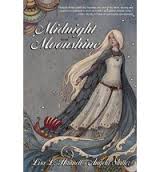
This book. Oh, this book.
It took me a few months to read this collection, this mosaic novel. This is no reflection on the quality of the book. Well, actually it is, but not the way you might think. See, I’d read a story, and then I’d be forced to close the book, sigh, and stare into space in order to wallow in the beauty of the prose. And then I’d have to go read something else, because (like with me and Gwyneth Jones’ Bold as Love series) sometimes too much beauty is painful and you need a break.
First off, look at that cover. Is she not glorious? are the colours not soothing and enticing? Created by the awesome Kathleen Jennings (who chronicles the saga of its production on her blog), I would absolutely have this on my wall. LOVE.
Angela Slatter and Lisa L Hannett created the contents. Writers who collaborate are even more of a mystery to me than authors who work alone, and to produce this sort of magic has to be just that – occult somehow. And they haven’t been content to just a straightforward story. Instead, as suggested above, this could be seen as a collection or a mosaic novel. A collection because it is made up of short stories that can basically stand by themselves. You could take one and put it in an anthology and it would still work ok. However – and here’s a metaphor I’m very pleased with – that’s like taking a candle out of a chandelier. Yes, it still sheds light. But when you put it with its fellow candles and they’re ringed with crystal, the whole effect is so much more just a few candles in one place. These thirteen stories, read together and in sequence (and wrapped in that art), are far more than the sum of their parts. Together, they create a history of an entire people: their origins, their interactions with humanity, their crises and triumphs, and the ongoing impact of a few families and their heirlooms. Thus, a mosaic novel – there is continuity, but it’s thematic and genetic; there’s only one character appears in or influences lots of the stories. I couldn’t help but be reminded of Edward Rutherford (London, Sarum) and James A Michener (The Source) following multiple generations in one place in order to fictively illustrate local history. Slatter and Hannett do just that… with magic. And Norse gods. Same amount of revenge though.
The premise, as set out in “Seeds,” is of Odin’s raven Munin (memory, here called Mymnir) surviving Ragnarok and setting out for Vinland (thought to be somewhere on the north-eastern corner of North America) with a few followers. Once she gets there, she creates an enclave and peoples it with servants, and sets out to rule it I guess like she learned from the Aesir she’s observed for however many centuries. Of course this does not go entirely well either for her or for her people. There’s love and betrayal, selflessness and vindictiveness; people get beaten up, rescued, married off, wooed… and some people even manage to make their own destinies. My estimate is that the stories take place over roughly a millennium, but that’s based entirely on the fact that that’s about how long ago it’s posited that Vikings did historically head off for Vinland and settle for a short span. The early stories take place in a sort of timeless, medieval-ish zone; from memory there are no dates in the first seven stories, and it feels like that sort of myth/fantasy where time itself is important but recording it is less so. Then, with “Midnight,” suddenly the external world exists and thrusts itself onto this dreamy place. From then on, time is relentless, and within 5 or 6 stories it’s the modern world. This development works mostly because although the stories do stand alone, there is continuity within families. Sometimes the names give them away, sometimes it’s an heirloom appearing, occasionally a reference to a past event. This often means that rather than having to struggle for a new emotional connection every time, the reader can build on the investment already made in the character’s family, from an earlier story. It’s the same reason Rutherford and Michener’s works can be successful.
And on top of all of this, the sheer beauty of the prose. I do not have the words to explain how delightful the words in this book are. It just all works.
Did I mention it’s an Australian production? Produced by Ticonderoga, in Perth.
You can get Midnight and Moonshine over at Fishpond. (Although it does ship from a US supplier.)
The Dream Archipelago

This collection of stories is characterised by non-completion. By ellipses, gaps, loss of memory, tantalising hints of more, general incompleteness. In the stories themselves, in the people, in the world.
This turned out not to be the book I thought I was reading. Having adored The Islanders, I thought I was getting an earlier novel set in the same place. Uh, no. This is a set of short stories (including a couple of novellas): some set in the Dream Archipelago, some just referencing it. So I was quite discontent when I read the first ‘chapter’ – The Equatorial Moment – and accepted it as setting the premise for the book… and then realised that The Negation was quite separate, although with strong links. Don’t worry; I got over my disappointment.
“The Equatorial Moment” is not a story. It’s a vignette, explaining the very odd thing about this world: that there is a time vortex, which means it’s the same time everywhere on the world at the same time. It also means that flying somewhere is a rather difficult business. It also sets up that this world is experiencing a war, which – far more than issues to do with time – informs the entirety of this collection. “The Trace of Him” is also a vignette, of a lover and a funeral, that doesn’t really seem to fit the rest of the collection. It’s set in the Dream Archipelago, but that’s all.
Some of these stories are directly about the war, and its impact on soldiers and civilians. “The Negation” is framed around a draftee and his experiences, but also around an author whose art might be subverted by the war. (Its connection to the Dream Archipelago is tenuous – the novel that the soldier loves is set there.) This story was the first taste of incompleteness that flavours the rest, as Priest suggests and hints but does not fulfil. It’s marvellous. “Whores,” too, examines soldiers and civilians, through a different lens. This time the soldier has been granted leave due to sickness which manifests as synaesthesia; the civilians are women who have become whores because of the exigencies of war. This aspect, that the women are not simply whores but that they became such for real, usually economic reasons, and that they might also have other concerns, was a delight. Too often whores (and slaves) just exist in the same way that horses or dogs do, with no reference to what came before. So that worked. And there’s a tantalising question over whether the soldier in these two stories is the same man or not. The last story in the collection, “The Discharge,” also brings together art and war and ellipses. It’s the fullest exploration of the war that’s been affecting this world for a ridiculous amount of time, and makes it clear that ridiculous is exactly what it is. But then the narrator ends up in the Dream Archipelago, and starts exploring art… a type of art that has a genuinely visceral impact on its viewer by messing with the hypothalamus. And the story takes on a whole other layer and attacks a whole other idea. It’s maddening and glorious and a bit creepy.
You know that thing where you’re reading along, and you’ve been assuming something about the race, gender, location or attitude of a character and then something happens and you have to go back and read everything again to see whether you were stupid and made a mistake, or whether the author has been deliberately messing with you? That was “The Miraculous Cairn” for me. And I’m pretty sure the answer is the latter. It’s set half on the mainland and half on an island; half in the present and half in the past; and it’s a horror story. One of those slow, creeping horror stories that might not be a horror story but probably is. Gave me the shivers, anyway, and is the exemplar of non-completion. It has nothing to do with the war. Neither does “The Cremation,” which is set more fully in the Archipelago and whose horror aspects stem directly from that fear of not knowing the local traditions and attitudes and behaviours. It works all too well. Also largely separate from the war is “The Watched,” whose horrific nature really only comes through in the last few pages. Before that, it definitely has its creepy elements but they’re not the focus (although on reflection perhaps that ought to have made it more creepy…). The tantalising gaps in this story are the sort of thing that in another author’s hands would just indicate a lack of imagination, or pages where they’ve simply deleted “MUST ADD MORE INFO HERE”. Instead, the reader is left just as much in the dark as Ordier about the society of the Qataari, his object of frustrated fascination. What makes the novella really work is that this fascination, while at the heart of the story, is not its sole preoccupation. Ordier – living in the Dream Archipelago but not a native, having left the mainland and his war-related work – lives a relatively ordinary life with a girlfriend whose job is demanding and disappointing, and we get many pages of relatively ordinary life along with Ordier’s growing obsession. This adds to the creepiness but it’s not just there as filler; actually I would have been happy reading about Ordier and Jenessa and their experiences, they’re so intriguing. Which is why it works as a novella.
Are they SF? Is this fantasy? No. The collection is set on a different world, yes; but there’s no exceptional technology – it would be easy to read much of it as set in a generic olde worlde rural setting until you get references to planes, grenade launchers and microwaves. There’s also no magic; the time vortex just exists, and except for stuffing around with air travel doesn’t actually impact on life. The people are human, with nothing special about them. This is just… a world. But I would still argue that it counts as speculative fiction, because I am contrary like that.
This is not the sort of collection I can imagine reading again. The stories are demanding, they’re frustrating, and I think they may only work once. But that once was pretty glorious.
Galactic Suburbia 92
 In which we get the band back together again, just before we go on our summer holidays!
Culture Consumed:
Alisa: Doctor Who; The Fall; Orange is the New Black, Black Mirror Season 1
Tansy: Adventures in Space and Time; Cranford by Elizabeth Gaskell, Apex Issue 55
Alex: Snuff, Terry Pratchett; Thor: the Dark World; Tooth and Claw, Jo Walton
Pet subject: The Year in Review
Alisa: PhD, Conflux, Nancy Kress’ After the Fall, Before the Fall, During the Fall, Twelfth Planet Press (Trucksong, A Trifle Dead, Twelve Planets, Shirley Jackson/WFA), made a SF fan
Tansy: Hawkeye; The Almighty Johnsons; A Song of Ice & Fire; reading with Raeli (Edward Eager & Diana Wynne Jones); Doctor Who
Alex: Saga; Doctor Who; Naomi Novik’s Temeraire; re-reading; Lizzie Bennet Diaries.
This is our last episode of the year, because we’re going on a summer hiatus… but we will back in 2014!
Please send feedback to us at galacticsuburbia@gmail.com, follow us on Twitter at @galacticsuburbs, check out Galactic Suburbia Podcast on Facebook and don’t forget to leave a review on iTunes if you love us!


