The Lord of the Rings: the films
Confession: I watched almost the entire LOTR trilogy in one day last weekend. The extended versions. I was up to the arrival of the eagles when I decided enough was enough and I went to bed; I grouched at myself for watching the extras attached to Game of Thrones seasons 1 and 2 before starting it, since clearly that’s what stopped me from actually finishing.
This is not the first, nor the second, nor the third time I have watched these movies. I love them. I have read the book more times than I have kept count. Some thoughts on this viewing:

1. I still do not like Elijah Woods. He just doesn’t work for me. While the Frodo+Sam bits are my least favourite bits overall, in the books, I think Woods is too sappy in the role. And given Frodo is my least favourite character, that’s saying something.
2. I was struck quite forcefully by how much of a love triangle Frodo/Sam/Gollum are. Frodo is the innocent object of Sam and Gollum’s affections – where ‘innocent’ means ‘not looking to attract either of them.’ Same is the long-time friend who has been harbouring love in his little faithful heart for a long time, just waiting for Frodo to notice him; Gollum is the slightly bad-boy new kid on the block, come to whisk Frodo off his feet. And here they are, all stuck together, Sam and Gollum forced to work together to look after the object of their mutual desires…
3. It still makes me angry that they screwed with Faramir so drastically. There is no narrative need for Frodo etc to be taken to Osgiliath, so why not allow Faramir to be the pure one the whole time? Why does he need a moment of coming to his senses? It’s a much more stark difference between him and Boromir when his struggle about whether to take the ring takes place over minutes, not over days. Grump grump grump.
4. The death of Saruman annoys me less, since I do understand it from a narrative point of view. Like the deaths of Agamemnon and Menelaos in Troy, they’re audience-pleasers. It does mean of course that there is no Scouring of the Shire, which – y’know – bit sad about…
5. … but since the ending of Return of the King can already be argued, by those who haven’t read the books, as having a multitude of mini-endings, I do understand not including it. I’ve heard arguments for finishing the film with the arrival of the eagles to save Frodo and Sam; that can’t be the end, though, partly because there needs to be that reunion between everyone, and partly because Aragorn HAS to get crowned; note the name of the movie. While I love the departure from the Grey Havens, I wonder whether the film would have been better off finishing with everyone bowing to the

hobbits. Although that would have left out Sam’s marriage to Rosie, which would have been annoying because…
6. I was thinking about the women in LOTR. Yes, I completely agree there are too few. It is absolutely a product of its time and Tolkien’s context, which doesn’t make it less annoying but it does give context. Still: Eowyn is brilliant and played magnificently here (especially of course in Tolkien’s little stick-it-to-Shakespeare moment). Arwen is crucial, even though she doesn’t have much direct action; Galadriel likewise, and aren’t we all so glad Cate Blanchett was alive to take the role? Other than that… well, there’s Rosie. There’s a fleeting glimpse of Lobelia Sackville-Baggins, who could have had a bigger role with a Shire scouring. Ioreth, wisewoman and healer in Minas Tirith, doesn’t appear in the films. Those are the women I can think of who have roles of any significance in the story. So much as I don’t like Jackson taking liberties, I can see that adding a female elf who takes some action will (hopefully) be a good addition to The Hobbit.
7. There are other bits that I am still sad they missed out, but can understand. Tom Bombadil was never going to work; Freddy Bolger is probably just as happy to be out of it; Ghan-buri-Ghan would have been awesome in a tiny little cameo but would have made no sense to those not having read the books.
8. My goodness but the VFX are almost universally astounding. I adore Minas Tirith. And Fangorn.
I am very happy I own these movies.
Without a Summer: the third Glamourist History
The following has spoilers for Shades of Milk and Honey and Glamour in Glass, I guess. Seriously, why haven’t you read them yet?

I read this quite a long time ago, and I have no real excuse for not having reviewed it earlier; it’s certainly no reflection on the story. Is it a good story? Yes. Does it fit in well with the other two Glamour novels? Yes. I think that this is the sort of book you don’t need to read the review of, if you’ve already read the others or like the idea of Jane Austen with magic (basically). Actually that’s not quite right… this one, in particular, is more like Elizabeth Gaskell with magic – and I say that having only watched film/TV versions of Gaskell, but given she’s described as Austen with ethics (that is, a more explicit examination of society and ethics than Austen), I feel I can make that claim. Because here Kowal does get into some discussion of class, in particular, and race as well.
The idea of a year ‘without a summer’ is actually based on fact; 1816 was a year that felt summer-less, because of the effects of volcanic ash from an eruption in the ‘East Indies’ as Kowal describes it. For the sake of the novel, Kowal introduces the idea of blaming this on coldmongers – people whose glamour is particularly attuned to making cold, so they get jobs doing things like keeping food or rooms cool. The story has both political aspects – which revolves especially around class – and personal aspects, which also revolves around class and race but also around family relationships.
The political: this is a time of Luddites, and issues of unemployment; tie in the cold, and fear of glamourists, and there’s a very dangerous situation brewing. It would be hard to talk about that without giving away some of the details whose revelation is part of the delight of the story, so I won’t. Suffice to say that the concerns Kowal raises fit perfectly into the period, and complement the personal issues going on for Jane and Vincent perfectly.
The personal: Jane and Vincent are faced with a number of issues to deal with, and to my delight not all of them are dealt with easily. The one that most struck me, by the end, was Jane’s relationship with her sister Melody. Pride and Prejudice hints at the difficulty of older and younger sisters relating, as does Sense and Sensibility – but these tend to show the older as being in the right, and the younger as needing to be tamed in some way. Kowal does very clever things here with that trope; Jane and Melody’s relationship is more realistic, and more painful, than in the Austens – and this makes the story the more uncomfortable and real as a result. Secondly, there’s the introduction of Vincent’s family. They’ve been less than shadows to this point; all that we’ve known is that Vincent has cut himself off in order to be a glamourist, and his family don’t approve – and that they’re from High Standing. They arrive with a vengeance here, and Kowal spares no mercy. Vincent definitely comes out of the whole thing as a more impressive man for overcoming the family issues that he was dealt.
Some of the other issues facing the pair mingle with the political. In particular, they are confronted by race issues, both because many of the coldmongers – whose problems they can hardly help themselves from being involved with, touching as it does on glamour more generally – are black, and because one of the families they end up heavily involved with are Irish. This may seem strange to those without knowledge of how the United Kingdom worked in the nineteenth century; but as Kowal points out in her afterword, at this time “the notion of ‘white’ excluded not only people of Anglo-African or Anglo-Indian descent but also Irish” (356). Some of Jane’s own prejudices are confronted, along with those of London at large – not comfortably, but I think, for the reader anyway (at least, this white reader; I won’t try to imagine how to read it as someone confronted with racism on a regular basis) in a sympathetic manner. That is, not that the racism is easy to read, but the confronting of it is more like what 21st century tolerant sensibilities would prefer.
I’m sure I had more to say when I originally read this, but – the characters remain engaging and delightful, Kowal continues to find genuine circumstances for them to interact with, and her style remains a delight to read. I’m not sure if I want more stories here; there would surely be a danger of Jane and Vincent turning into the unexpected epicentre of everything interesting in 19th-century England, which would end up being silly. And would insist on bringing up the issue of pregnancy and children… which might not be a bad thing, I just can’t think how it would be done. But then, I’m not an author. Maybe I should just Kowal to know what is best for her characters…
You can get Without a Summer from Fishpond.
Two seasons of Game of Thrones
I have not read GRRM’s books, and probably won’t; I’ve got too impatient for big fat fantasy novels that aren’t finished yet. I wasn’t sure that I would watch the TV show either, but look at me now… we’ve just finished season 2. Yes, season 2; if anyone reveals any spoilers for season 3 of the TV show or anything from the books in the comments, so help me I will hunt you down and CRY AT YOU.
These are just some random thoughts about the show so far; there’s so much amazing criticism out there that another commentary almost feels pointless (not that I’ve read most of it because yo, SPOILERS). There are, of course, spoilers below for s1 and 2, in case there’s anyone who cares and is even further behind than me.
 Yes, I am pleased to have met Brienne at last.
Someone – maybe Sean? – at last year’s Continuum warned me about something nasty in the first couple of episodes of this season, and thought that it would put me off. It’s one reason why, although we’ve owned this for a while, I’d been reluctant to dive in (the other reason being, um Downton Abbey). But… maybe I blinked? Or was distracted? Because there wasn’t anything that shocked me; certainly not after season 1. I would go so far as to say that this season is relatively restrained, in GoT terms: there’s not that much sex, relatively speaking; there’s a fair bit of (female) nudity, but again not as much as s1 I thought; and the violence, while gory and gruesome, seemed less frequent. Or perhaps I am cold-hearted and inured to it all from the first season. Anyway, I thought that was an interesting change – I had half expected that they would ramp it up to keep people shocked and watching. (You can tell me whether season 3 is more shocking or not, just no details.)
Like I said, I have no knowledge of this story, and from the first season I thought the focus would just be on the Iron Throne itself. At the end of this season, though, I’m quite impressed to realise just how many thrones are being played for: King beyond the wall, King of the North, King of the Iron Isles, King of Qarth, and King of Westros. I’m not going to be at all surprised to discover that the end – or at least the mid-point – is the seven kingdoms utterly splintering. That would actually make a lot of sense.
Deaths: Renli’s I was saddened by; I presume that was the point. The betrayal of the so-called King of Qarth was a neat twist and he so deserved that end. The Winterfell maister dying was very sad; I presume the Onion Lord is dead too, after the way he went flying when the ship exploded, and that’s sad too.
Near-deaths: I admit to having panicked when I thought Tyrion had been killed, even though I’ve accidentally seen enough stuff to know that he’s at least in the next season.
Characters: I think the most interesting thing, overall, is the fact that with the exception of Joffrey (soon may he be bumped off), pretty much all the evil characters have been shown to have some redeeming feature. I was unconvinced by Tyrion last season; my long-suffering husband can testify to how much hand-flapping there was when I realised he had organised a fire-boat OMG I WAS SO IMPRESSED (partly that I guessed correctly); Tyrion for king, I say. Cersei is redeemed by her maternal love; Jaime by Cersei’s love. Sansa is finally starting to have a backbone (and menstruate, poor dove; glad to see that aspect of life portrayed as brutally realistically as the rest of it); Tywin Lannister is rapidly becoming

quite a favourite, despite his often despicable actions (this is a problem for my brain). Daenerys is redeemed also by her love for her dragons – that scene where she’s being tempted to forget them is awesome (and I’m always happy with a Jason Momoa cameo). Iain Glen – Jorah – is pretty convincing as a good guy at the moment, but I won’t ever be convinced of his fidelity, given his previous roles in dooming my beloveds (Spooks, Downton Abbey… oh Lucas…).
Predictions – for the amusement of those who know better and so I can see how badly I go wrong: John Snow becomes king north of the wall; something terrible happens to Bran; Tyrion ends up aligning with the Starks; Sansa runs away with the Hound and… I dunno; becomes a nun? Do they have nuns? Stanis comes to a very grisly end, Cersei gets away scot-free, and Jaime clearly falls in love with Brienne, but she SPURNS HIM, maybe in favour of one of Baelish’s prostitutes? (yeh that’s never happening.) Everyone ends up as allies against the dragons who try to take over the woooooorld. I would so watch that.
Cloud Castles: the re-read
Spoilers for the first two books, Chase the Morning and Gates of Noon – although really, there’s three books, surely it’s no spoiler to say that Stephen survives and has further adventures?
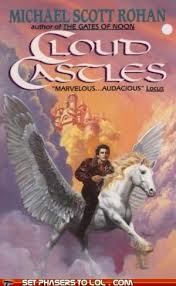 Stephen Fisher, no longer quite such the hollow man as previously; oh look, the brief love and forgiveness of his ex-girlfriend has worked not quite a miracle, but certainly wrought some change. Whodathunkit. When this novel opens, Stephen is in an intriguing position: he remembers the Spiral all the time when he’s in the Core, he’s deliberately had many adventures there – but his life in the Core isn’t harsh or empty enough to give it up. In fact, he’s now the head of his company and he’s got a brand new, very interesting project on the go. No on-going relationship, but still – he’s not the hollow, use-and-leave type that once was. Which is good, right?
The ultimate reveal is brilliantly constructed. Up to that point… well, the story threatens to feel a bit samey. In fact, it is: there’s challenge from the Spiral affecting Stephen’s life in the Core, and he goes out and faces it and there are ups and downs, and something Big from out near the Rim challenges Life As We Know It. All of these things happened in the previous novels, and they happen here too. But the great thing about Rohan’s writing is that it still manages to be interesting and thoroughly enjoyable. For instance, in the mythos he’s mined: there’s been voodoo; and Asian myth from Buddhism to Hindu to animism; and here, Rohan brings it back to Europe. In terms of action, the first two books were similar in involving ships; here, the focus shifts to the possibilities of air travel (AIRSHIPS!). And I swear Rohan must himself have taken up fencing between Gates of Noon and this book, because the fights seemed to get a whole lot more technical… which I kinda skimmed occasionally. And while some of the side characters are the same – really, who could ever get sick of Mall? Really? And there are new characters too: happily, to my mind, especially another woman, who gets a bit more fleshed out than Claire or Jacquie ever managed to be in the previous books.
Yes, there’s some annoying repetition with Stephen bemoaning his life – but Gates of Noon was definitely the worst for that, and his growing/filling up has largely curbed that. And yes, the portrayal of women is not always great – Stephen occasionally has a ‘private’ leer which the reader is privy to – but Mall gets to be Amazing. This could be problematic, because clearly it’s not realistic and it’s annoying if the only woman has to be so much better than any of the men to warrant any air time: but it does entirely fit the idea of Mall being over 400 years old, and moving outwards on the Spiral, and therefore – like Jyp is, to a lesser extent – becoming… clarified. And she’s not the only woman, which helps.
So I firmly believe these books deserve their space on my shelf.
Galactic Suburbia 81
 In which we chew over shortlists, awards winners, book covers and gender issues, all of which pales in comparison to the FIRST QUILT IN SPACE. You can get us from iTunes or Galactic Suburbia.
Hugo Packet! What are YOU going to read? Would password protected freebie novels put you off reading them?
Campbell Memorial Award finalists
Comments: Tansy on “winning too many awards” & Keith Stevenson on why the awards are just fine and don’t need to be ‘sorted out’. To add some positivity (which more accurately reflects most people’s experience of this awards night!) check out Sean’s Storify of the AA’s night and Tehani’s post on attending at the last minute with lovely frockage pics. For even more gorgeous pictures, Cat Sparks’ Flickr feed is the way to go!
The coverflip experiment, started by Maureen Johnson’s piece on Huffington Post.
The artist behind the Georgette RR Martin cover discusses her imaginary brief.
Hawkeye Initiative Coda – using humour & art to get the gender point across in the workplace.
THE FIRST QUILT IN SPACE! Frontier craft for the final frontier.
Also, bye bye Commander Hadfield – thanks for bringing back the sense of wonder
The most significant futurists of the past 50 years
Tansy’s Melbourne public appearances:
Sisters in Crime 14 June http://www.liviaday.com/wordpress/2013/05/20/something-rotten-in-the-apple-isle-sisters-in-crime/
Splendid Chaps 15 June – details tba, keep an eye on the Splendid Chaps website for booking details after the 23rd May.
Culture Consumed
ALISA: Star Trek Into Darkness
TANSY: Iron Man 3 FINISHED GAME OF THRONES BOOKS; Queers Dig Time Lords, 2 Minute Time Lord discussion with editors/contributors of QDTL
ALEX: Alanna, Tamora Pierce; The Thief, Megan Whalen Turner
Please send feedback to us at galacticsuburbia@gmail.com, follow us on Twitter at @galacticsuburbs, check out Galactic Suburbia Podcast on Facebook and don’t forget to leave a review on iTunes if you love us!
The Gates of Noon
Probably spoilers for Chase the Morning.
Ah Stephen. Forgotten the Spiral, really? At least it didn’t happen immediately… still, it shouldn’t be a surprise that your brain couldn’t cope with the weirdness for very long. Too much career, too many one-night stands, to enjoy.
Until it reaches in to grab you again.
 In Chase, a lot of Stephen’s hollowness seems to stem from his long-ago break-up with the lovely Jacquie. Here, Stephen has got himself – and his company – involved in a project to ship the cargo of a charity irrigation system to Bali precisely because of her name. But the project is dogged by malign forces, it seems, such that they cannot organise to move it any closer to Bali than Bangkok. And with a little bit of pushing from external forces, Stephen Fisher – the Hollow Man, defeater of nasty forces last time he ventured into the Spiral – manages to find his way out of the Core again, and sets up a rather unusual method by which to deliver his cargo. It involves an ancient steamer, a seven-foot tattooed Maori, and an outlandishly mixed crew. Also another magician-type, although Ape is nothing like Le Stryge, which is about the best that Stephen can hope for. Cue adventures.
As with Chase, many of the awesome things I remembered are indeed still present. I love Rohan’s descriptions of battles, and also his evocation of sailing – be it on seas or stranger tides. The very idea is still utterly captivating – sailing into the dawn or dusk, into the clouds! – as is the idea that places have shadows. Actually, perhaps they’re closer to Platonic ideals, since they capture what is and was and will be; the essential nature of a place, even if never actually existed anywhere but in the imagination of very many people. And the idea of moving out into the Spiral as somehow refining people, as well as places, is also a wonderful one for story.
Also as with Chase, there are a couple of things that bugged me, and the main one was Stephen and his hang-ups. While the first book was mostly all “woe, I am a hollow man!”, this book is replete with “woe, I done wrong by Jacquie!” – which he did, right enough, but I could have done with a little bit less breast-beating. He does, true enough, make some attempts at restitution – and he was pretty nasty, so maybe I should cut him some slack as his conscience actually teaches him a lesson. But I didn’t have to be subjected to everything going through his head every time; it could have been indicated with a sentence or two, easily enough, especially the fourth or fifth or tenth time.
Also, bit of eye-rolling casual sexism. Irked me. It mostly does all right on the not-racist front – which, given it’s set largely in South-East Asia, is a relief. There are some bits where people’s mannerisms or characteristics are referred to as ‘oriental,’ at which I cringed a little, but on reflection those things are not usually coded negatively so… yeh, not sure what I think about that. But the inherent desire of the book is to balance tradition and ‘progress’, and I cannot fault that.
The other thing I cannot fault, and found also in Chase, is the very suggestion that there must be something MORE. More than career, more than sex-as-an-end, more than selfishness. Stephen finds that in action, but also in helping others; Mall and Jyp and others find it in becoming, and doing, what they are meant to be. It’s a worthy aspiration.
Is it very different from Chase? Well, the intention of the adventure is different, and Stephen doesn’t have to go through all the rooky, learning-to-be-on-the-Spiral stuff, so things happen a bit more immediately. There’s more sexual tension; there’s also more at stake, which I think made it work as a sequel. If it had been yet another “save that girl!!”, I am unlikely to have bothered. Plus, quite different places and different villains, which is great.
The Suck Fairy has been kind.
Galactic Suburbia 79
Alex & Tansy discuss the Stella, the Shadows, behaving badly on the internet, criticising criticism of the Hugo criticism, and whether the suck fairy has visited Farscape, the Star Wars Thrawn trilogy, or The Mists of Avalon. You can get us from iTunes or at Galactic Suburbia.
News
The Stella Prize announced its winner last night at a glittery ceremony. Carrie Tiffany won the $50,000 prize for her second novel Mateship with Birds and promptly gave back $10,000 to be awarded to her fellow shortlistees. Classy!
Australian Shadows Award – and the skulls go to…
Seanan McGuire talks about perceptions about self-promotion and the Hugos
We also wanted to draw attention to the post Seanan linked to, “Language Myth #6 – Women Talk Too Much.” Particularly this quote by Dale Spender:
“The talkativeness of women has been gauged in comparison not with men but with silence. Women have not been judged on the grounds of whether they talk more than men, but of whether they talk more than silent women.”
Hugh Howey – The Bitch from Worldcon post
In response: Tobias Buckell – Don’t Punch Down
Chronos Awards – for SF & Fantasy professional & fan works coming out of the state of Victoria.
Eisner Award shortlists – nice to see Saga & Hawkeye nominated, but Tansy particularly wants to draw people’s attention to the categories for comics & graphic novels aimed at children.
Mind Meld – favourite women writers in genre
(Also – books you savour vs books you devour)
Culture Consumed
ALEX: Farscape season 1; Dark Force Rising, and The Last Command, Timothy Zahn; Rapture, by Kameron Hurley; Sky is Calling, The Impossible Girl (Kickstarted album)
TANSY: Game of Thrones Season 2; Swordspoint the audiobook, The Mists of Avalon, Coode Street Podcast episode 140 featuring Nalo Hopkinson.
Please send feedback to us at galacticsuburbia@gmail.com, follow us on Twitter at @galacticsuburbs, check out Galactic Suburbia Podcast on Facebook and don’t forget to leave a review on iTunes if you love us!
Megan Whalen Turner’s The Thief
I picked this up because someone – maybe Tansy? – was appalled that I’d never read any Megan Whalen Turner. So here we go. (Slightly spoiler-y but not very.)
This is definitely aimed at a YA audience (ish), and I think I would have adored it if I’ve read it a little younger. That said, I enjoyed it more than the first couple of pages suggested I might.
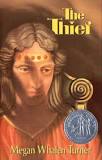 The book opens with a thief, Gen, in prison. He’s pulled out of his cell and taken for an interview with the king’s magus – head scholar, not magician, so an interesting choice of words there – because the magus wants to use his particular talents for a very specific mission. It’s a rahter intriguing beginning because it’s unclear how the reader should feel about Gen: clearly he’s a thief, so that’s bad; but he’s an engaging narrator, which is ambivalence-making; the magus isn’t that nice and the king is a bully, so that makes Gen look good. There’s also a question over Gen’s abilities, since lots of people are taunting him for the boasts he made before his capture, and clearly he’s been in jail for ages, so does that make him a bad thief? On the other hand, the fact that he’s going to be used by the magus is an indication of his skill, so… yeh, lots of ambivalence here. I like well-constructed ambivalence.
Turner keeps Gen an engaging character for the length of the novel. Various bits and pieces come out about his past, and his sense of self, and all of these go to construct an intriguing and likeable man. I had to stop after the first chapter or two and re-read some sections because I half-wondered whether Gen was going to turn out to be female… that would have been really awesome, but alas no. (There’s only two female characters, I think, who get any real airtime, and that not much.) I was really, really impressed with the twist at the end… I had been fully expecting a fairly straightforward ending, and would have been fine with that – although quite what could have been done with Gen when they got back I don’t know, maybe just allowed to slip away? Anyway, the way such a major revelation actually worked in perfectly with what had gone before? Genius. The magus is a bit fickle, especially in his attitude towards Gen but also towards his two students, and I could never quite figure out whether he was meant to be thawing out over the course of the journey or if he was indeed this mercurial, sometimes-ill-sometimes-even tempered teacher that everyone had to be careful of. Overall not entirely convinced. Of the others on the journey – I don’t feel that they were quite rounded out enough for me to care that much. Interestingly, Gen is big enough to basically plug that lack. There are other characters here and there but none that are memorable.
The plot, obviously, is that of a quest – go find this ancient artefact which could have ramifications on… stuff. Along the way there’s politics and mythology and personality clashes, and a lot of walking and some adventures. It’s fun and well-paced – the walking doesn’t drag (heh), the discussions the characters have enliven things nicely, and the conclusion packs a really brilliant punch. I ploughed through this very easily and with great enthusiasm.
So I liked the characters, and the plot was fun. The world is another aspect that made me ambivalent. The author’s note vindicated my feeling from the opening chapters that this was definitely heavily influenced by Greece, and its ancient (and semi-mythologised) past. However I was weirded out by scrolls and books in the same library – which I know must have happened, but it’s still weird – and Turner only notes that Gutenberg did movable type in 1445 in the author’s note, just to give context I guess. So it’s kinda real-world ancient, kinda medieval, kinda… not. That aspect bugged me a little but when they got into the countryside it wasn’t such a problem. For the world itself – I was impressed to see the levels of the politics discussed, which makes me wonder actually at my tagging it YA although it did get to be a Newbery Honor Book. I liked the Canterbury Tales-esque aspect of telling stories to each other, although these were of mythology not everyday life, and that these myths were clearly inspired by Greek tales but made wholly Turner’s own by twists and details; there was some discussion about how much the gods affect everyday life, although not much. In all it was quite a comfortable world, I guess.
This is the beginning of a series; I will definitely be looking out for the rest of them. You can buy a shiny new copy over at Fishpond.
Alanna: the first adventure
I was given this book by a student teacher placed with me some time ago, a major Margo Lanagan and Isobelle Carmody fan who was scandalised that I hadn’t read any Tamora Pierce. And I finally got around to reading it, hurrah! (She also gave me a pencilcase that she made herself and decorated with important history dates – how cool is that?? – and a copy of A Woman in Berlin which I haven’t read yet but I WILL, I SWEAR.)

So, I should say upfront that I don’t think I loved this book as much as M wanted me to, and I think that is entirely the fault of my age and cynicism. Oh, I fully intend to get my hands on the rest of the series at some stage because I do want to find out what Pierce does with Alanna, especially once her secret is out… but it’s unlikely to be a Great Classic in my heart.
That said… some spoilers follow, because I want to dissect a couple of bits.
So, that said… I liked Alanna, although the 30-cough-something in me is intensely amused and eye-roll-y at a ten year old having the nous to set up such a trick on her father. It’s interesting that Pierce made the father neither evil nor dead (the dead bit is left to Mum) but so intensely disinterested and absent that this trick could work; I would have thought this would have a rather larger impact on the child than it appears to. Anyway; it’s set up as ‘special child with special talents’ right from the start, so that’s not something I can complain about. And I DO genuinely like Alanna. Much as I deplore the violence I admire the pluckiness of wanting to beat your own enemies; I like that she speaks in a forthright manner, and her determination to be as good as the boys – and that she fully intends to reveal her secret when she’s passed her tests and go on to have adventures. I really, really liked that Pierce addressed the issue of menstruation and Alanna’s annoyance at having biology forced on her (also, the bit where she realises her chest is jiggling? Priceless). I am sad that she has the “but I’m not good enough because I’m a giiirrrlll!” tantrum, but I do like that it’s the male companion who tells her not to be so ridiculous.
I forgot to mention the premise of the story. Alanna wants to be a knight. Her twin brother doesn’t; he wants to be a sorcerer. Conveniently, boys are taught magic at the convent to which Alanna is to be sent to learn How To Be A Lady; and Thom, the brother, can forge Dad’s handwriting. So, switch-a-roo and Alan(na) is off to the big city to learn how to cudgel opponents… I mean how to be a knight. Essentially this is a boarding school story but rather than being nerds or wizards or international students, this is Knight School. There’s all the sorts of things you would expect – fitting in, working hard, dealing with bullies, annoying/scary/awesome teachers – with added swords.
There are some nicely subversive elements here, against the traditional Learning to be a Knight story, especially in the form of Sir Myles. (It must be said I was a little afeared that Myles was going to end up having a sexual attraction to young Alan, when he suddenly asked Alanna to accompany him to his home castle. Lucky it was only inspired by a dream! Haha!) The undercutting of chivalry, and the seeming contradiction of what is expected of a knight – honour vs beating opponents up, etc, isn’t fully fleshed out and may simply pass a young reader by – but I appreciated it. Especially in contrast to the “yeh, beat up the bully! That’s the solution!” rhetoric, which kinda revolted me.
Things that made me very eye-roll-y: Alanna is so fed up and tired after two days that she decides to leave (but of course changes her mind…) and THEN, a few months later, has enough time to go out and do EXTRA training with George so she can beat up the bully? Really? So she magically found time for travel AND for the lessons?
Also: George. I’m as much a fan of your King of the Thieves as the next person who read David Eddings as an impressionable teen, but… a king in their late teens? Named George? With such a highly developed sense of morality? I don’t buy it.
Also also: “the Gift.” The reality of this magical ability just wasn’t developed enough early on – either what it is or why Alanna hates it so much – for me to be particularly impressed when she pulls out the stunt of making Jonathan recover. I am intrigued by the fact it appears, at least in this use of it, to call directly on the gods – gods who don’t appear to have much impact on everyday life, as far as I can see, in terms of worship or morality.
Things that concern me: I worry that Alanna and Jonathan will end up having a Thing. That will annoy me. Or Alanna and George. So the prince and the king of thieves will end up fighting for her hand. That would be BAD.
All of this aside, I really will look up at least the next book, to see where Pierce takes Alanna. My version of this first book has the opening chapter of the second, as a teaser, and… yeh, I am intrigued.
Green Rider, by Kristen Britain
… meh.
 Look, it’s not that it’s bad, as such. It’s just not especially inspiring, in plot, character or world.
The world might be the bit that lets the book down overall, I think. A fairly straight quest-narrative can be made more interesting and worth reading thanks to an intriguing world. And Britain just doesn’t manage that. I didn’t care that the many-centuries-old wall was crumbling – and I don’t know Game of Thrones real well, but is that a bit similar? – not least because the opening chapter where this disintegration began was pretty overwrought. It’s hard to care about that sort of thing before you know anything about the world it’s affecting. And throughout the story, the world just wasn’t differentiated from any other pseudo-medieval-with-a-touch-of-magic-maybe world.
The characters were all pretty stock. The lead, Karigan, is a plucky schoolgirl, unfairly maligned and therefore running away from school, who falls into an adventure that she turns out to be quite well suited to. What a surprise. A couple of things here: it was never made clear whether this was Fate, or the work of gods, OR whether it was an entirely fortuitous accident. It didn’t feel like it was kept mysteriously ambivalent, either, just… undiscussed. Also: schoolgirl? Really? I don’t think Karigan’s age is ever made clear (if it was, I wasn’t paying attention), and while yes it’s all very exciting to have teenagers going on adventures, this one just felt incongruous. Perhaps I should decide that the ‘school’ is more like a university, and actually she’s at least in her late teens. Plus, there’s a certain bit later in the book where a certain (good) male character seems to be Looking at her, and if she’s 16 – ICK.
Most of the other characters come and go. I didn’t really understand why we got so much of Karigan’s dad; he helps the plot along occasionally, but really it didn’t warrant what felt like a lot of attention. The reader who really identifies with Karigan is unlikely to identify quite so much with Dad. I did like that the leader of the Green Riders, basically the king’s fast message service, is female – there’s no suggestion that women shouldn’t be Riders, nor that they shouldn’t be students. I don’t remember any mention of female governors though. Anyway, Mapstone is cool, and I’d probably rather read a book with her as a central character. The most interesting other characters are two sisters, who turn up completely incongruously at a vital point in Karigan’s adventure and provide all sorts of useful McGuffins. Despite the fact that they only exist for this purpose, they’re utterly delightful and hilarious as sisters living together with no one else around in a very weird house.
The plot… well, it begins as a quest. I like quests. Surprisingly, the quest is over just halfway through, and then it turns into a palace intrigue. Which made sense, given the quest mission was delivery of a message, but it was still quite a change of pace – literally, since now almost everything happens within the palace or nearby, rather than Karigan barrelling along at breakneck speed throughout the realm. The quest didn’t really work for me again because of the world-building; it was lacking. I didn’t get a sense for what made the world tick, and the story felt like a number of random events thrown together that didn’t, in the end, build up to a coherent world. The palace intrigue was, again, exactly that; there was nothing to set it apart from any other story of similar ilk.
So, in the end… meh.

 Randomly Yours, Alex