Galactic Suburbia, #37
News
The Locus Awards
Prometheus Award winners
Sturgeon and Campbell Awards
Shirley Jackson
Recent announcement – Gollancz announces the SF Gateway, huge project to digitise & make available thousands of SF classics as ebooks.
Linda Nagata on ‘What’s in a Name’ and her career trajectory as a female writer of hard SF
Chris Moriarty on label in the women & SF conversation
via Thoraiya Dyer, women and the chilly climate
Liz Williams at the Guardian on the way science fiction reflects human belief
Alastair Reynolds to write Doctor Who novel: Tansy and Alex’s obsessions in one package!
What Culture Have we Consumed?
Alisa: Maureen Johnson on www.whyy.org/podcast; Twin Peaks; Mercy (not genre but interesting feminism);
Alex: sooo much Bujold (3rd, 4th and 5th omnibi, and Memory); lots of books, because of holidays! But particularly Heartless, Gail Carriger; Blackout, Connie Willis; Hundred Thousand Kingdoms, NK Jemisin… also Harry Potter 7 and Transformers 3.
Tansy: The Demon’s Surrender, The Holy Terror & Robophobia (Big Finish), Subterranean’s YA Issue
Pet Subject: Feedback from our Joanna Russ episode
Please send feedback to us at galacticsuburbia@gmail.com, follow us on Twitter at @galacticsuburbs, check out Galactic Suburbia Podcast on Facebook and don’t forget to leave a review on iTunes if you love us!
Tiptree book club: With Delicate Mad Hands
Welcome to July’s Tiptree Book Club story-discussion-thing, which I have inherited from TJ on the closing down of Dreams and Speculation. This month we’re looking at “With Delicate Mad Hands,” which marks the halfway point in the anthology Her Smoke Rose Up Forever. (A note on the next few months – I’ve changed it around a little so that we’re reading kinda-sorta the same number of pages each month: August will be “A Momentary Taste of Being;” September “We Who Stole the Dream;” and “Her Smoke Rose up Forever;” October “Love is the Plan the Plan is Death” and “On the Last Afternoon;” November “She Waits for All Men Born” and “And So On, and So On;” December “Slow Music” (yes those last two are not in the order given in the anthology).)
This discussion is completely riddled with spoilers, so don’t read on if you’d like the joy of discovery all for yourself!
It’s worth saying up front that this story did not go in any of the directions I had expected, which shouldn’t have surprised me with Tiptree. That a story could go from a discussion of how awful a girl’s life was because she had a squashed nose to her being the first human on a extra-solar planet, beloved by an alien and bequeathing an enormous amount of new knowledge… yeh, that’s pretty awesome.
Of course, to get to the awesome you have to struggle through some quite awful stuff. CP’s life is horrid right from the start – and I hope I’m not the only one slightly frustrated by the tantalising looks into this ?post-apocalyptic world offered by Tiptree, where you can rarely see the sky and Managers are the be-all and end-all. CP’s drive to get into Basic Space Crew Training eventually gets her there, and while I was initially impressed with a society that eventually lets girls in, that was rapidly quashed: she has to pay for her own sterilisation, which was awful on numerous levels, and, along with her other duties, she has to allow the men onboard to use her as a sexual ‘waste can’. My horror knows no limits…
The events on the ship, with CP eventually getting rid of the men and taking off towards Galactic North, I found surprising and I’m not sure why. Perhaps because of the no-nonsense way it was all described; and perhaps because CP’s preparedness for just this eventuality is chilling. I did, though, really enjoy her enjoyment of solitude, and finally doing just what she wants; that she went around and pulled off all the blinds to be able to see out felt so familiar that I think at this point I was able to identify with CP, just a bit. And then to have her find a roving planet… as I said, it was unexpected, and utterly utterly intriguing. That life could grow somewhere like this! That radiation could have a positive impact on life… that telepathy etc would develop, and the different ways that can be found to do science… Tiptree had a seriously amazing imagination. (Also, did anyone else feel like she might have been a little influenced by Yoda, in characterising some of her little aliens?? This story came out in 1981, so it’s just feasible….) The poignancy of discovering that yes, there really had been a voice in her head all that time, and that she was and had been loved, was a wonderfully touching conclusion.
Some questions to get discussion going:
How did you feel about CP, and did this change over the story?
Did the story develop as you were expecting?
What did you think of Auln, the alien world?
Galactic Suburbia’s Joanna Russ Tribute Show
We started talking about doing a Joanna Russ Spoilerific episode just after she died, in April, and here it is! We discuss Russ’ non-fiction polemic How to Suppress Women’s Writing, her novel The Female Man, and the short story “When it Changed.” We also discuss whether the issues confronted are still relevant today, and some of the problems we have with these works. All in a spirit of love and respect, of course, and attempting to overcome our feelings of inadequacy and terror in the face of the mighty Joanna….
You can get the episode from iTunes, or download it from Galactic Suburbia. Do leave us a review on iTunes, or email your comments to galacticsuburbia @ gmail . com !
On suppressing women’s writing
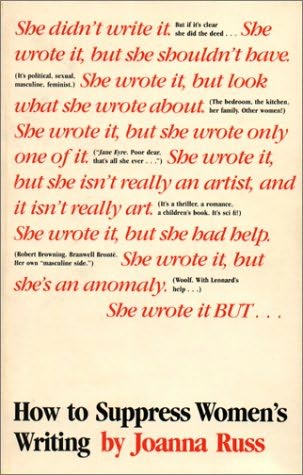 Just the front cover is enough to make me cranky. It’s a list of the ways in which women’s writing (and art) has been suppressed; the book is a brief and eclectic examination of how those different modes have operated, and some suggestion of why, too.
I finally got my hands on this book after I heard of Russ’ death. I’d heard of it in vague terms over many years, and more specifically in the last couple – particularly thanks to Galactic Suburbia, and a growing realisation that I really wanted to understand feminist SF, and that Russ is one entry into that. Plus, she seems like one of those writers everyone talks about… but few (especially of my generation, we post-70s women) have really read.
Russ progresses logically through various modes of suppression, dismissal, and marginalisation. As her evidence, she uses reviews of women’s work over the last century and a half or so; their presence (and absence) in anthologies and university curricula; and in biographies, as well as other sources.
The comparison of the different ways Charlotte Bronte’s work was received when it was believed to be by a man compared with when it was known to be by a woman were distressingly similar in some ways – given the difference in time – to the reception of James Tiptree Jr’s work as male/female. Russ herself notes that while some things have changed – critics are less likely in the late twentieth century to openly denigrate women’s writing simply because of the author’s gender – others have not: said critics have found alternative ways to marginalise the writing.
I’ve been sitting on this review for nearly two months, thinking there must be more to say. There is. I’m going to post this as-is, though, because I’m not sure that I can write down all of my different reactions and thoughts coherently… and we’re going to be doing our Joanna Russ Spoilerific Book Club for Galactic Suburbia soon, and hopefully that will help me clarify some ideas. (It did!)
June Tiptree book club discussion
Along with everyone else, I was sad to see that TJ had made the (sensible!) decision to let her blog, Dreams and Speculation, go. I came across her because of the Women in SF Book Club, and have so far really enjoyed the books and discussion. Rather than letting a good thing go, Shara at Calico Reaction and I have made the decision to jointly host and continue the Book Club; she’s doing the novels, and I get the joy of talking about James Tiptree Jr. So, welcome! And enjoy.
 June’s story from Her Smoke Rose Up Forever is “Houston, Houston, Do you Read?” – a story I have previously read as novella double, paired with Joanna Russ’ “Souls” (there’s a headspin for you). What follows is some of my thoughts on the story – completely full of spoilers, so if you haven’t read it yet, back away! Following in TJ’s footsteps, I’ve added a couple of questions at the end of the post – feel free to consider them in the comments or completely ignore them, as you see fit.
This story sees three astronauts on a solar mission; they encounter a flare and when they come back around to the Earth side, things are… different. Houston doesn’t answer, but someone else does. They get picked up by a very different spaceship, one that seems almost entirely crewed by women – and it’s several hundred years into their future.
This story does what my favourite stories do: with an awesome sf story, its focus is on the people – their reactions, their attitudes, their problems. The astronauts are appropriately different from one another such that a range of reactions can be explored, but they don’t feel like ciphers; Tiptree deftly sets them up as individuals. I believe this story first came out when Tiptree’s true identity was unknown; all I can say is, Seriously? Did they just not see the feminism?
Anyway, the slow unravelling of the men’s good nature at being rescued by women is very cleverly done. I found the attitudes of the men towards the men really quite harrowing; their patronising tone, their easy assumption of supremacy, automatic belittling of the women’s competencies – it was presented as so horrendously normal and obvious. Bud, in particular, is horrendous in his attitude towards women as nothing but sex objects. That said, in some ways Lorimer is almost more horrifying; as the narrator and because of his scientific background I felt sympathy for him, but still his attitudes and perceptions of the women are almost entirely sexist.
The gradual reveal that not only is the entire ship crewed with women but the entirety of the human race is women, thanks to an epidemic three hundred years previously, is very cleverly handled. The idea of a single-sexed humanity has been explored in other science fiction, with varying results; I quite like this idea, with clones to allow reproduction. The most poignant reflection on the differences between a single-sex and two-sex world comes right at the end, when Lorimer tries to defend Bud and Dave’s aggressive actions. I could almost feel sorry for all of them at that point.
Questions:
1. Did you pick that the future society was single-sexed before it was revealed?
2. Was the futuristic society believable for you?
3. What were your reactions to the men’s characters and attitudes?
4. This story was published in 1976. Do you think it is still a relevant story?
The Secret Feminist Cabal – now with extra awards
Since I wrote this review last year, The Secret Feminist Cabal has placed on the Honour List of the James Tiptree Jr Award, and I received a Chronos Award (voted on by the Victorian SF community) for the review itself. Allow me this gratuitous moment of reposting! The other exciting thing that has happened since is that I got to spend time with Helen Merrick herself – an utter delight.
The Secret Feminist Cabal: A Cultural History of Science Fiction Feminisms
Helen Merrick
Aqueduct Press, 2009
“… what kind of self-respecting cabal would openly advertise its ‘secret’ existence through websites and conventions, identify its members through the wearing of garish temporary tattoos, and fund itself by the sale of home-baked chocolate chip cookies?” (p1)
I did not grow up considering myself a feminist; I have no idea whether my mother would identify as a feminist or not. That said, I grew up in the ’80s with a younger brother and there was never a time at which I felt that I could not do exactly the same things as my brother, if I wanted to, so I know (now) that I benefited from second-wave feminism – and from liberal, caring parents. I was regarded as a feminist by at least some people by the time I was in my late teens (looking at you, high school teachers), probably because I was loud and everyone loves a stereotype. It’s only been over the last decade (my twenties) that I have consciously thought of myself as a feminist. And it’s only been in the last couple of years that I have consciously sought out feminist books, feminist perspectives on historical issues, and really come to grips with the idea that feminism is not a singularity.
All of this is by way of contextualising my reading of The Secret Feminist Cabal, a marvellous book that has challenged the way I think about science fiction, fandom, and feminism. Merrick had me from her Preface, where she describes her journey towards writing the book in ways that resonated deeply with me, from the nerdy adolescent to the discovery of feminism and the dismay that many female acquaintances not only do not share our love of science fiction, they are completely mystified by it. Having only recently discovered the niche community that is sf fandom, the fact that so much of this book is concerned with expressions of feminism within that community – and how they impacted on sf broadly – was the icing on the cake.
Merrick begins by examining the very idea ‘feminist sf’, defining which – much like attempting to define sf by itself – is like the proverbial attempt by blind women at describing an elephant. She approaches it by discussing the multiplicities that are the reality of the genre, which is indicative of the approach she takes in the book overall and an incredible relief for those of us who are sick of being told THIS IS THIS and if you don’t fit, get lost. She also gives some space to justifying the use of literary criticism on science fiction, tackling that persistent and derogatory argument that science fiction doesn’t count as literature. While accepting that sf and popular fiction generally have an ambivalent position, as far as literary critics – including feminists – are concerned, Merrick makes no apology for using their tools. The rest of the introduction lays the groundwork for the book: what feminist fiction is or can be, the potentially problematic nature of feminist genre writing, and the ongoing divide that exists between mainstream criticism and feminist sf criticism. I particularly enjoyed that while Merrick engaged with these issues, at no point does her discussion become a polemic against those who have disagreed. Rather, she situates her investigation within the ‘grand conversation’ of feminist sf, and demonstrates constructive ways in which that can be extended to mainstream criticism – to the advantage of both.
I was forced to stare into space for some minutes when I read the opening to chapter 2. Merrick quotes from a letter written in 1938 wherein an sf reader opines that: “[a] woman’s place is not in anything scientific. Of course the odd female now and then invents something useful in the way that every now and then amongst the millions of black crows a white one is found” (p34). If nothing else, this book has made me grateful for the changes that have occurred over the last century, such that I have never been personally confronted with such a statement. This chapter provides an overview of the ‘invasion’ of women, sex, and feminism into sf, with a fascinating if horrifying look at the arguments of the 1920s and 30s for and against women being allowed into the genre. (She makes the point that of course women were already there, both as authors and readers, and that it’s hugely problematic when those foremothers are written out of history, as happens too often.) The 1960s and 70s saw some changes to the field, and the disputes that attended this period of ‘sexual revolution’ make for fascinating – if, again, horrifying – reading. My favourite section is that on Joanna Russ writing letters and criticism and the way such respected names as Philip K. Dick and Poul Anderson responded to her and her comments. I love the fact that what now generally appears on blogs as a long and convoluted comment-thread then featured in magazines, albeit at the mercy of the editor. This chapter alone is worth its weight in cookies for outlining the milieu in which both male and female sf writers and fans existed for so much of the twentieth century – an invaluable resource for a newbie like myself.
The third chapter takes up one strand mentioned in the second and runs with it: the idea of ‘femmefans’. The fact that female fans were distinguished by a separate moniker goes some way to revealing how they were regarded, at least by some males of the community. It’s almost heartbreaking to read of the letters written to pulps such as Amazing Stories by women who imagine themselves as the only female readers of such stories – another reason I love the future that is blogdom. What I particularly love about this chapter is its uncovering of specific women involved with sf fandom, in many and varied ways. Instead of making generalisations about readers and contributors to zines, Merrick goes out of her way to trace named individuals and outline their experience within the scene. Appropriately, there is a section on Australian women, who seem to be even more hidden from view than their American or British sisters.
The development of specifically feminist criticism of sf is discussed in chapter 4, with a fair amount of space given to Joanna Russ, as one of the progenitrices of formal feminist criticism and the name to which many others felt themselves to be responding. Merrick chronicles the rise of feminist fanzines in the 1970s, and the impact these had on writers and fans, as well as the increasing numbers of feminist anthologies being produced. The chapter moves through to the 1980s and ’90s, noting trends and struggles as feminists of those times attempted to define themselves as well as understand their histories. As with the previous chapter, Merrick provides copious accounts of individuals here, and an extensive reading list of both criticism and fiction.
Bouncing back to fandom, chapter 5 examines the development of feminist fandom concurrent with the development of feminist criticism of chapter 4. Again going for the intensely personal stories to illustrate a broad, diverse narrative, Merrick weaves a story of female fans and their involvement in the fannish community from the 1960s to the 2000s. The feminist fanzines sound like an amazing community to have been involved in. Her discussion of the place of Marion Zimmer Bradley in this community – beginning as a fan, becoming a well-known writer, and causing all sorts of controversy over her (at least early) non-identification as a feminist – is enthralling, and beautifully illustrates the axiom that the personal is always already political. The chapter ends with a discussion of how WisCon (a feminist sf convention) and the Tiptree Awards were established.
The last two chapters of Cabal “examine how recognition of the cultural work of sf feminisms filters out into other critical communities,” and as a consequence have a heavier, more literary-critical, feel, which may make them more opaque to some readers than the first five chapters. Chapter 6 deals with sf feminim’s response to cyberpunk, a 1980s sf movement that some saw as eclipsing or superseding the feminist sf fiction of the 1970s. Merrick connects this with theorist Donna Haraway’s call for feminists to consider the cyborg as a way of considering the fundamental issue of what it means to be human. The movement also connects with a growing sub-genre of cultural studies, that examining techno-science and cyberculture. A feminist take on these issues is an intriguing one, especially in its observation that much cyberpunk is opposed to the material, the body – and how problematic that can be.
Interestingly, Merrick takes her discussion in what feels like quite a different, although still relevant, direction for her last chapter: the connection of feminist sf with science itself, and how feminism is and can be in dialogue with that discipline. She suggests very strongly that sf feminisms can and should play a vital role in dialogues negotiating the interplay of science, nature, and culture, and gives examples of a number of ways in which this has already occurred productively.
Finally, Merrick has a provocative conclusion. She addresses new challenges such as those posed by queer theory and postcolonialism, and where or how feminism might still fit in. Along with a consideration, appropriately enough, of what the Tiptree Award has taught us since its inception, Merrick considers the question of whether the science fiction field is ‘beyond’ questions of gender. She argues that feminism – as long as it remains the challenging and diverse field it has been until now – still has a great deal to offer science fiction writers and readers.
A critical work based in a deep-seated love of the genre, Cabal is a testament to the enduring impact of women, feminism, and fandom on the fractured behemoth that is science fiction. 2010 saw it shortlisted on the Hugo ballot for Best Related Work, and win the fan-voted William Atheling award for best critical work. These are well-deserved honours. I hope coming generations of both writers and fans will make use of the cornucopia of references Merrick has gathered, both to understand the history of the field and because most of them make for wonderful reading.
Galactic Suburbia 34
In which we surf the wave of feminist SF news that has deluged the internet this fortnight, plus Margaret Brundage, why YA books are allowed to be as dark as they want to be, the Tiptree Award, Connie Willis, were-thylacines, Ted Chiang and Alex finally discovers Bujold… You can download us from iTunes, or download/stream from Galactic Suburbia.
News
Nicola Griffith on the m/f imbalance in an informal SF favourites poll in the Guardian.
The Guardian: Damien Walter, author of the poll & followup articles revises his comments in response to Griffith.
Niall Harrison follows up on Strange Horizons.
Cheryl Morgan on invisibility of women (some really interesting discussion in the comments, too).
The Guardian again, asking with wide innocent eyes if SF is inherently sexist.
Ian Sales announces the SF Mistressworks blog project.
Nicola Griffith asks you to take the Joanna Russ pledge.
Gwyneth Jones, Karen Traviss & Farah Mendlesohn talk on the radio about the perception of women in British SF. Transcript.
MK Hobson on the term ‘bustlepunk’ and why there is a place for a domestic sub-genre of steampunk; follow up post on the assumptions made about works coded ‘female’ .
2011 Chesley Award Finalists; Cheryl Morgan on female & trans artists.
Nine Reasons Women Don’t Edit Wikipedia (interesting in light of the recent spout of incidents we’ve watched, notably the one with Nick Mamatas where winning World Fantasy Award was considered too regional to be significant).
Wall Street Journal on YA fiction.
Change to the Norma eligibility guidelines.
Why Galactic Suburbia T-shirts are no longer available through RedBubble.
What Culture Have we Consumed?
Tansy: Thyla, Kate Gordon; Will Supervillains Be on the Final? Naomi Novik
Alisa: Coode St Podcast with Ellen Klages, Eileen Gunn and Geoff Ryman; Connie Willis – Even the Queen; Octavia Butler – Bloodchild
Alex: Chill, and Grail, Elizabeth Bear; The Lifecycle of Software Objects, Ted Chiang; Welcome to the Greenhouse, Gordon van Gelder; Steampunk! Kelly Link and Gavin Grant.
Please send feedback to us at galacticsuburbia@gmail.com, follow us on Twitter at @galacticsuburbs, check out Galactic Suburbia Podcast on Facebook and don’t forget to leave a review on iTunes if you love us!
Contact
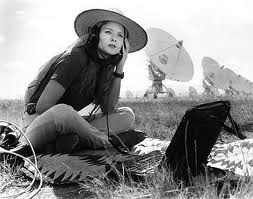 I watched Contact many years ago – possibly even at the cinema – and I read the book, too. I don’t remember the book very clearly, although I do remember thinking it was better than the film (what a surprise). I had fond memories of the movie, so when we decided to watch it again recently, I was a little apprehensive that the Suck Fairy might have visited.
I still really enjoyed it. The opening sequence is still simply marvellous; I utterly adore the perspective given to our Little Blue Dot, of course very appropriate given it was written by Sagan.
Jodie Foster… didn’t do much for me. To be honest I’ve never really understood the hype about her. I’ve never seen any of her early roles, to my knowledge, so maybe I just don’t have the context. But here – well, she’s good, but I certainly don’t see it as a role that no other actress could possibly fill. That said I do really like her character. I love how strong Ellie is, how determined she is to get her science done, that she listens to the radio waves herself rather than leaving it all to the computers. I also really appreciated that there’s really only one character who doesn’t take her seriously as a scientist, and that’s David Drumlin, whom I have called all sorts of rude names because of his treatment of her. His arrogance and sexism are aspects of his characters; they’re not meant to be taken seriously, as reflecting the sensible world. (Also, Tom Skerrit is brilliant.)
The rest of the cast is mostly good. I love William Fichtner: for his cameo in The West Wing as the judge who gets to be Glenn Close’s foil and plays with Toby’s mind, his bit part in The Dark Knight – he’s wonderful. And he’s great as Kent; the being blind is interesting and not over-played, and for me just seemed part of the diversity of characters. Yes, it’s played on to get the “ooh he has super hearing” thing, but it doesn’t feel overdone. David Morse is good in his cameo as Ellie’s dad… and then there’s Matthew McConaughey.
I like Palmer, McConaughey’s character, in theory. I really really like that the religious issue is a fundamental one in the movie, even though I don’t entirely agree with how it was handled; and even though I find it irritating that Palmer, as apparently the President’s go-to man on religion, ignores one of the big moral precepts of Christianity that helps set Christians apart from others in society (that whole no-sex-before-marriage thing). But I think he’s interesting, and I think he provides an interesting contrast to Ellie: for all he’s equally intent, he’s more relaxed than her, and they have some great discussions about evidence and faith. The Palmer character and his interactions with Ellie does, however, provide one of the things which most grieved me about the movie. He admits that he screwed up her chances to do the thing she most wants to do in the entire world not simply for religious reasons (which, actually, I liked – having to make the decision between your lover and your feelings of faithfulness towards the spiritual majority of the world), but for selfish reasons? Seriously? And our heroine still likes him? Pfft.
As a movie, I think it still holds up. The tech etc don’t feel like they’ve dated much, society doesn’t feel like it’s changed that much, and the look of it is still contemporary. Overall I was relieved, and pleased. Contact is still very watchable.
Galactic Suburbia 28
News
Lambda Awards
Kristine Kathryn Rusch discusses the business of being an author
Woman wins award, man gets attention
Ian Sales’ SF Mistressworks & starts the SF Mistressworks meme
Hugo reminder: get your nominations in!
Galactic Chat
T SHIRTS
Tiptree!!
Feedback
Competition open for another fortnight – keep sending in entries! Email us with fave GS moment and what cake you ate.
What Culture Have we Consumed?
Tansy: Burn Bright, by Marianne de Pierres; Laid (ABC TV)
Alisa: Star Trek Enterprise Season 4, Fringe eps 11 -13,
Alex: Genesis, by Bernard Beckett; Redemption Ark, Alastair Reynolds; Version 43, Philip Palmer (abandoned)… Battlestar Galactica
Please send feedback to us at galacticsuburbia@gmail.com, follow us on Twitter at @galacticsuburbs, check out Galactic Suburbia Podcast on Facebook and don’t forget to leave a review on iTunes if you love us!
A quarter-century of Galactic Suburbia
In which we hit and run the Locus Recommended Reading List, tackle e-books and piracy, and delve into the knotty issue of religion in science fiction. You can download or stream us at Galactic Suburbia, or subscribe to us on iTunes.
News
Locus Recommended Reading List – hot off the press!
Philip K Dick shortlist.
First annual Geek Girl Con in Seattle.
Cloud-delivered ebooks from Readings/SPUNC; comments from Benjamin Solah; and a response to comments on the internet about the cloud publishing.
Discussion of ebook piracy: Jim Hines found out the world is not the USA and the rest of the world does not experience publishing nor this ebook revolution apace with the USA. (Hines’ original post here). Charles Tan responds; Karen Healey says I was wrong and I’m sorry.
Weird Tales revamp (new website; pay rate to 5 cents per word; and implemented a new submissions portal for potential contributors).
Feedback (we love feedback)
Sean, Thoraiya, Niall
Pet Subject
The place of religion in science fiction. A Jew, a Christian, and a lapsed pagan discuss.
Modern religions, made up religions, machine religions… or no religions? What place can/does/should religion play in sf?
Jo Walton on religion in SF!
“There’s the kind of SF where the writer is themselves a member of some religion and this imbues their writing… .
Secondly, there’s theological SF… where the writer rigorously extrapolates science fictionally the consequences of some religious dogma being true. …
Thirdly, there’s the story as analogy thing… .
Fourthly, there’s using the way religions have worked in history and extrapolating that into the future.”
Please send feedback to us at galacticsuburbia@gmail.com, follow us on Twitter at @galacticsuburbs, check out Galactic Suburbia Podcast on Facebook and don’t forget to leave a review on iTunes if you love us!

 Randomly Yours, Alex