Olympus Inc novels

Kate Healey says that the Olympus Inc books are finished (for now??) so I felt I should write a brief note about them.
Take Greek mythology. Bring it into the modern world. Remove the supernatural. And remove all of the coercion and ick-ness from the love stories, while keeping (and often revealing) the ick-ness of many of the other relationships. This gives you the basic premise of the Olympus Inc stories.
The first set revolve around Olympus Inc, a publishing powerhouse, and the people who work there. The very first novel makes the Hades/Persephone story an actual delight, and you may be able to imagine just how very weird that is. It also shows up Demeter as basically a monster, and as far as I’m concerned this is now canon. We then get Aphrodite and Hephaestus, and Hera and… well. Spoilers. Around them are Odysseus and Penelope (who actually appear in an adorable prequel novella), Hermes, Hestia, and a bunch of other hilarious nods that you will get if you’re deep into the mythology and otherwise work perfectly well as side characters. You can read these novels as pure (adorable) romance novels, of course, but being able to shriek “I see what you did there, Healey!!” was a large part of the joy for me.

The second set of stories are, I think, a taller order: Healey takes three of the Trojan women and gives them happily ever afters. Which is honestly a big call, and it works incredibly well. Cassie, Xena, and Laodice all famously came to bad ends in the myths, but Healey takes their stories and writes wonderful romances.
All of these books are very, very readable. The characters are a delight and the romances make sense. They do all include some distressing things – mention of abuse, for instance, and disability-shaming, and so on. Healey deals with all of these with compassion and makes it very clear that they are Not OK.
You can find information about the books over at Kate Healey’s website.
The Return
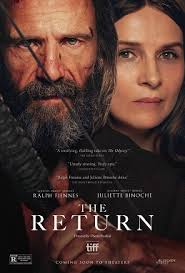
I am a complete sucker for Greek myth films. And even more, I am an utter sucker for films that take bits that have been done less often, and which do so with nuance and a modern sensibility while still keeping true to the original. Nearly impossible? For sure.
The Return manages this with aplomb.
(Spoilers, I guess? If you can spoil a 3000 year old story? Although there are some changes to the ‘original’, which I will discuss.)
The film doesn’t try to cover all of Odysseus’ wanderings – and Troy is covered in a single sentence in the brief introduction. Instead, it opens with Odysseus washed ashore on Ithaka, and Penelope besieged by the suitors. It really only covers a few days – exactly how long is unclear, because Odysseus may have spent a few days in Eummaeus’ cottage, recovering his strength. The narrative moves between several strands. There’s Odysseus, coming to understand what has happened to his island, and Penelope, often at her loom, agonising over what to do and how to look after her sons. Interestingly, there’s quite a focus on the suitors, especially Antinous (the least objectionable on the surface, but shown to be very complex and with a horrible side) and a couple of others, like Pisander (who I spent the whole film trying to place – he was Ricky September in that weird episode of Doctor Who, “Dot and Bubble”). And there’s also Telemachus… and, look. He’s never been a favourite. Ever. I was terrified we’d be subjected to a whole section of him going off and visiting Helen and Menelaus, but thankfully we’re spared that.
This is not an action film. There is action: suitors chasing Telemachus, a couple of fights, and a particularly brutal killing of the suitors. The film is far more interested in conversation, though: discussing what happened at Troy – and whether the Greeks were heroes or not; discussing what Penelope should do; discussing what Telemachus should do; mourning the events on Ithaka.
This is a film that takes Odysseus’ experiences at war seriously, and the reality that a decade of fighting will change a man – and that two decades away from his wife and son will change their relationship. It asks very honestly whether Odysseus can ever truly come home, and how his family can now relate to him. It does not paint Odysseus as a hero, nor laud his accomplishments at Troy. Overwhelmingly, he is tired. He mourns the last two decades; he is remorseful of some of his actions, and fears the future. He’s not yet bitter and angry but you can see it’s a possible outcome.
One of the really interesting changes is that of the “maids” – and I find this particularly intriguing in light of the discussion around them over the last few years, with Emily Wilson’s translation finally making it painfully clear that these women are slaves, not just servants. The choice is to make them almost absent. A few are shown sleeping with (literally and, er, metaphorically) some suitors, but that’s all: no sense of whether they are being compelled, and also no sense of whether all of the women shown are actually members of the household. I guess this is one way to avoid the ‘necessity’ of killing them all at the end.
This is a great film. I appreciate the way it takes Odysseus’ agony seriously. It doesn’t do quite as well with Penelope – it’s not particularly informed by Atwood’s Penelopiad or Claire North’s Songs of Penelope series – but it does give her some agency. Overall, it is an excellent entrant into the halls of Greek myth-inspired films.
Herc – a novel
Read courtesy of NetGalley. It’s out at the end of August.

I am bored by Hercules as a hero. But as a character in other people’s lives – as a messy, complicated, often unheroic, flawed, and realistic person – I am THERE.
The man named Heracles by his parents (who then changes his name to Hercules (which is a cute way of getting around the Greek/Roman thing) because reasons) never speaks to the reader in Herc. Instead, it’s all the people around him who tell his – and their own – story, from birth to death: father, brother, sister, nephew, cousins; wives; lovers (male and female); cousins; others met along the way. This variety showcases the different ways that people interact with the man. Some love him, while others hate him. Some continually forgive his flaws, while others are unable to.
Hercules rarely comes across well. He is strong – but he has little idea how to mitigate that strength around ordinary people, and even seems unaware of what he’s capable of. He is aware of the terrible crimes he has committed – killing his music teacher as a child, murdering his first wife, Megara, and all their children, amongst other things – and accepts that there needs to be consequences… and yet. And yet he is still seen as a hero, by those outside of his immediate circle, and indeed often by himself. And yet he seems to largely get away with being terrible. And the book does not forgive him for that.
This story dives deep into the consequences of Hercules’ actions for those around him and it is pointed, it is complex, and it is deeply thoughtful. I would read more in this style any day of the week.
Elektra, by Jennifer Saint

I received this book from the publisher, Hachette, at no cost. It’s out now; $32.99.
Maybe it’s me, but when I see a book described as a retelling – particularly of something from Greek mythology – I expect to get new insights, a twist on the narrative, or something else unexpected. Sadly, I did not get any of those from this book.
I know a fair bit about Greek mythology – I’m not an expert, but I’ve done my share of reading. I know the story of the House of Atreus; it’s why I was so keen to read a new version of Elektra’s story. I can’t really imagine being someone who doesn’t know about the stories wanting to pick up this book; why would you? But if you are like me, and you do know about Elektra and her parents, then I feel that this book doesn’t really offer anything. And I’m a bit sad about that.
One unexpected thing that the book does have is three narrators. For all that it’s named for Elektra, there’s nearly as much space given to her mother, Clytemnestra, and the Trojan princess/eternally ignored prophet, Cassandra. Now, maybe having Clytemnestra there is an interesting foil for Elektra’s perspective – she is, after all, a child when Agamemnon heads off to war, and it’s Clytemnestra’s desire for vengeance that leads to the later events around Orestes. And Clytemnestra also allows the author to start the story much earlier, with the ‘wooing of Helen’ and all. And I understand why you’d have Cassandra too – the Trojan perspective – but it felt jarring in a book named for the Mycenaean daughter.
My final whinge is some of the anachronisms, which I found a bit uncomfortable. Firstly, the use of ‘Greek’ as a collective term for all the little city states who banned together to go reclaim/recapture Helen. Maybe ‘Hellene’ is too weird for a general reader? Is it too weird to have an explanatory note at the start of the book? I don’t know. But it made me a bit grumpy. And there were other little things too, mostly more concerned with atmosphere: it felt like Saint couldn’t decide whether she wanted this world to feel really familiar, just with added deities and exotic-ness; or whether she wanted to play up the temporal distance from the reader. I think she mostly leaned to the former, and so in an odd way Clytemnestra and Elektra and everyone felt too familiar.
So… a lot of things to complain about. Why did I finish it? It really is well written; it’s easy to read, the pacing is good, the language is often lovely. (I partly kept reading in the hopes of something different, too, which was a bad reason to continue but is nonetheless true.)
Could you read this if you didn’t know the source material? I think so. I think there’s enough explanation that you would be able to follow the intricacies of the different problems with no trouble. And perhaps that’s indeed part of the problem for me – everything was too laid out, I wasn’t required to do any thinking at all.
Medusa

I received this as a review book from the publisher, Bloomsbury. It’s out on November 1; trade paperback $22.99.
Ah, Medusa. I love her as a character – always have. She has so much to give and so much to say about how women are viewed and used; especially women with power. Burton acknowledges Caravaggio for his portrait of her, as part of the inspiration for this book; I’ve seen Medusa heads in the cisterns under Istanbul. She is an evergreen figure.
The blurb suggests that #MeToo was part of the inspiration for the narrative, and you can see a lot of that here. You can tell a lot about the times in which the story is told from how the, uh, interaction between Poseidon and Medusa is framed. It’s crystal, blindingly, clear here that Medusa was absolutely the innocent. So far so good; not entirely new. But what intrigued me here was the framing of Medusa’s whole life: that she has been accused of being vain – after her neighbours started making comments about her appearance – there’s good commentary here on social expectations and how we just can’t win. And even more than that is the way that Medusa’s sisters talk to her, and what she comes to realise: about her value as a person, and about telling her own story. It’s incredibly powerful. I can well imagine giving this to a mid-teenage kid, frustrated by the messages from the rest of society, and hopefully having good conversations because of it.
Oh also there’s Perseus. Yeah yeah.
Actually that’s unfair – he’s presented in a more complex way here than is often the case, too, and I appreciated that. This is very much Medusa’s story, though, and I love that Perseus is there in service of her growth.
The one thing that disappointed me a bit about the story was that Athena is described as making Medusa’s sisters into Gorgons… but what a Gorgon is never gets explained. It’s not entirely obvious whether this is meant to be punishment, or just a change.
As well as the story, Medusa comes with glorious illustrations. I don’t have the vocabulary to really explain them: there are some examples here, and the most incredible portrait of Medusa is here. Olivia Lomenech Gill has made Medusa glorious – Burton describes the snakes in genuinely loving detail, and Gill has captured that. The pictures throughout are a delight; some are almost like collages; the colours are vibrant, and occasionally juxtaposed with almost pencil sketches. There’s a magnificent four-page set where it’s Medusa on one side of a rock, and Perseus on the other. I’m not entirely ignorant of art, but I don’t always appreciate it as much as I should… these pictures definitely add to the overall quality of the book, and it wouldn’t be the same without.
This is a great addition to the overall discussion of Medusa.
The Silence of the Girls
Perhaps unsurprisingly, my mother knows me very well. For my birthday this year, she sent me a book about the science inspiring Shelley’s Frankenstein, and Pat Barker’s The Silence of the Girls. Which I had never heard of but is described as telling the story go The Iliad through the voices of Briseis and other women.
 YES!
YES!
Spoilers, I guess, for the story of The Iliad. I mean it’s been 2500 years or so, but I guess not everyone knows who dies…
A version of The Iliad from Briseis’ POV is different from, for example, that told by Cassandra or Helen. I think this is a marvellous idea, since she’s right there at the heart of the quarrel that is itself the heart of the problems in this story. And the first part is largely what I was hoping for. It starts with Briseis being captured, along with other women, and there’s a marvellous moment where she looks at a slave woman who looks back, and Briseis knows she is thinking ‘now it’s your turn.’ And Briseis knows that’s fair, because she’s never given much thought to the slave women in her life, who themselves have been captured in war. She and the others get carted off to the Trojan beach, and she’s handed to Achilles, and she experiences the life of a slave woman. There are some remarkable moments where she reflects on being a thing, and how she finds it hard herself to think of herself as anything but a thing.
And then. Sigh.
After Briseis is taken from Achilles and given to Agamemnon suddenly we get these sections written from Achilles’ point of view. I’m confused and disappointed. I understand the need to examine that all-important turning point of the story, but why does it have to be through the words of the fellas who’ve always been the ones telling the story? The title of the novel itself starts to seem a bit of a mockery. Couldn’t Barker have inserted some other unnamed slave girl to tell the story that she watches going on in the tent, while cleaning up? Or couldn’t Briseis have heard patches of the story later – she does marry one of Achilles’ companions – and have that patchwork nature of the narrative be a feature? If the death of Hector could be told from inside the weaving room rather than being viewed then I don’t see why we had to be taken into the lives of Patroclus and Achilles and see it from their point of view. And the women find out about the death of Achilles from the wailing on the battlefield – it’s not like they have to view everything to know it! In fact couldn’t that be part of the exploration of the nature of being female, and a slave, in this context?
I think an exploration of masculinity through the lens of the Achilles/Patroclus friendship would be deeply interesting, told well, that is not the story for a book called The Silence of the Girls.
Another minor quibble is that this book is not sure what it thinks of the gods. I am reminded of the film Troy (which I quite liked, fight me): it only shows Thetis, and it hints at her connection to the sea but not her divinity, so it’s definitely a story about humanity men. Here, though… the plague is probably because of Apollo but not definitely. There’s a line about Athens wrapping Achilles in her aegis but it’s unclear whether that’s meant to be read metaphorically. But Achilles is seen as the son of a goddess and Thetis is definitely one, having gone back to the sea when Achilles was a child (also it’s partly her fault he’s a bit of a psychopath), and she really does come out of the sea at Troy. So the gods are real but not especially involved? And there’s no comment from Briseis or others about whether the gods can be trusted or whether slaves just don’t get to call on deities and expect to be heard.
With the sections from Achilles’ perspective, the book verges on becoming just another retelling of the story rather than keeping its promise of exploring the consequences of war for women. It definitely does do some of that exploration, and more than half of it is from Briseis’ perspective (I estimate). But by shoving Achilles back into the story that he has always dominated – and not even to reflect on Briseis et al, which would have been startling and perhaps worthy – Barker undercuts her own apparent intentions of allowing the previously silent girls to speak.
While it’s beautiful work I am disappointed.
Bright Air Black
This book was sent to me by the Australian publisher, Text Publishing, at no cost. It’s out on 20 March 2017; RRP $29.99 (C-format paperback).

This is a tale about Medea, which makes me happy she is definitely one of the more intriguing of ancient mythical women. Kerry Greenwood wrote a take on her ages ago, which I remember enjoying, and she featured in Robert Holdstock’s remarkable Merlin-and-Jason series (hmm… did I ever finish that? Must check). For the modern writer there must be a challenge in trying to understand what could compel this woman to leave her homeland, kill her brother, and eventually kill her children, and a tension is deciding whether to stay true to the “original” (HA) story, or to put a different spin on it – keep the children alive, for instance. Do you play Jason as a helpless fool or an arrogant one, Medea as loving and betrayed or as cunning herself, and perhaps still betrayed – or the witch that she’s sometimes regarded as? Lots of interesting possibilities.
… and I guess those are some spoilers if you don’t know the Medea story.
Vann chooses to set his version properly far back in time, the 1300s BC; there is reference to Hittites, and Ilium, and Egypt. There are no Greeks; Jason and his Argonauts are the Mynae. Intriguingly, his descriptions of the voyage of the Argo back to Iolcus – which is more than a third of the book – is based on Vann’s own experience of traveling on a recreated ship of Hatshepsut’s time, with archaeologist Cheryl Ward, for a French documentary Building Pharaoh’s Ship.
First, let me mention the language. The copy describes it as ‘poetic prose’, which is apt. Bluntly it means there are lots of incomplete sentences and a few extended ones, and lots of adjectives and time spent on description. The gorgeous reality, of course, is not captured in that summation. For example:
Her father a golden face in darkness. Appearing in torchlight over the water and vanishing again. Face of the sun, descendant of the sun. Betrayal and rage. (p1)
and
The sail not a god itself but only the tracing of a god, a more responsive form of temple. Like fire to reveal Hekate. How can we know when we’re worshipping a god and when we’re worshipping only the sign of a god? Wind itself a sign of something else, and even fire, and white hides behind them? (115).
I’m not accustomed to reading quite such flowery language (which I mean positively), so it did take me longer than expected to read the book. It is wonderfully evocative and enjoyable, don’t get me wrong. And the other thing that I appreciated you can see in that last quote – Hekate. Korinth. Kreon. It’s also Iolcus and Colchis so I’m not sure if that’s annoying inconsistency; some Green scholar will have to let me know.
There are lots of threads that Vann is tracing through Bright Air Black (words from a translation of Euripides – the gods “turn the bright air black” in frustrating mortals). One is the role of gods, or lack thereof. Medea frequently calls on Hekate, who sometimes appears to answer in the form of fortuitous weather; but at other times Medea despairs of her goddess and appears to be at best agnostic. There is no magic here (probably); there is luck and poison and human trickery and the use of power. There’s some commentary on the role of those things in developing human society and how men (as a rule) keep power.
This being Medea there is also commentary on the nature of feminine power. Medea has always been a weird girl, going off into the forest and not being afraid of the night; she plays on that and develops her reputation for fearlessness through her familiarity with the unfamiliar and inhuman – forests, the sea, the night. And then she leaves her family for a foreigner. Medea herself ruminates on the power of women versus the power of men; this includes thinking about her own family, and the complicated genealogy whereby it’s unclear exactly who her mother and grandmother are – are they the same person? No one much cares; it’s the men that matter.
This is a pretty straight retelling of Medea’s story – if you know Medea, you know what’s going to happen. Vann has added motive and explanation, an investigation and justification of some events and a whole lot of description. It’s a great addition to the oeuvre of Greek mythological retellings.

 Randomly Yours, Alex