Sylvia Pankhurst
Recently I’ve been really getting into the history of the women’s suffrage movement in Britain. There are professional reasons for this, but the reality is it’s been a simmering interest for a very long time. I don’t remember what grade it was, but I know I did a research essay on Emmeline and Christabel Pankhurst at school – to my teacher’s complete not-surprise – and was quite inspired. It was probably the first time I had felt that voting was actually something I ought to be interested in. And every now and then when I get discouraged by Australian politics and wonder whether it’s worth voting… well, I remember that although it was easier in Australia, women all over the world fought incredibly hard to get someone like me the opportunity to cast a ballot. Who the heck am I to throw that back in their historical faces?
One of the books I got in a rash of purchasing last year was Sylvia Pankhurst: A Life in Radical Politics. I knew Sylvia had fallen out with her mother and sister, and she went on to form her own (somewhat amusingly named) suffrage organisation, ELFS (East London Federation of Suffragettes). Thanks to a biography of Emmeline Pankhurst I knew a bit more about her politics, and her daring/disgraceful child out of wedlock. I also knew, although I don’t remember why, that she was incredibly important to mid-century Ethiopia, of all (seemingly surprising) places. There is, though, a whole lot more to her than these nuggets.
Mary Davis states right out that her intention is not to write a standard biography. Instead, she is aiming to look particularly at feminism and socialism in Britain in the first half of the 20th century via Sylvia. (She calls her Sylvia throughout, and justifies this with pointing that there were four Pankhursts active at the same time as suffragettes, and Sylvia was not the most famous. She also acknowledges that this is a problematic choice, which delighted me for its frankness.) What this book does then is look first at the development of the WSPU (created by Emmeline and Christable Pankhurst, Sylvia also involved); and then how/why Sylvia broke away as her socialist views conflicted with her increasingly right-wing mother and sister. Sylvia worked to meld her feminism and socialism, although this was incredibly difficult – a whole bunch of trade unions wanted nothing to do with feminism or helping oppressed women. As in so many cases, some of the oppressed don’t want to change the system; they want to get to the top of it and take advantage of it. When women eventually got the right to vote (some in 1917, all in 1928) Sylvia was changing her focus to the proletariat – she was a firm supporter, early on, of the Russian Revolution, and was involved in the Communist Party (well, one of).
Socialism and feminism were, if not acceptable causes, at least ones that other people clearly identified with. But Sylvia was also committed to more intriguing causes, which had fewer proponents in Britain at least: like anti-racism, anti-imperialism and anti-facism. Her newspaper was apparently the first in Britain to have a black journalist write for it. She spoke out on Ethiopia’s behalf when Italy invaded. These things got her some flak, as can be imagined, in Britain. But Ethiopia invited her to live there in the 1950s, and Addis Ababa has a street named after her, and her son still lives there (or did in 1999 when the book was published).
I love a good bio. Sometimes they can wander aimlessly, and sometimes they can focus too much on one aspect of a life. Davis’ approach seems, to me, to be the best of both worlds. It doesn’t pretend to be exhaustive; it does focus on one aspect, but that’s the whole point. And I really liked that it pointed out some aspects of British history, too, like bits of labour history that don’t often make it into mainstream historical narratives. In fact this is pretty much a checklist for the history of oppression: workers and women and black people are all covered, and all shown to have vital and real histories. Who knew? This book is a really great way into these areas of history, especially the suffrage/socialism aspect (and it’s only 120 pages long!).
Lefebvre and the French Revolution

Just look at that cover. Does this look like a history book to you? No it does not. But this is the first volume in Georges Lefebvre’s outstanding history of the French Revolution. Rather than, as the cover suggests, a cook book.
This book is definitely not one for beginners. Lefebvre assumes some knowledge of both the Revolution itself and the the late 18th century in Europe more generally, and if you either have no knowledge or aren’t quick on your feet when dealing with names and politics – well, this will be a hard book to read. Me, I’m pretty good on the French side of things, and that’s the only way I managed to read this without feeling like a complete idiot. There’s also no glossary, so woe betide the reader that misses a term that was explained early on… or wasn’t explained at all and you’re just meant to understand it, but maybe don’t.
One of the most awesome aspects of the book is the very fact that it places the Revolution in its broader European context. I had no idea of the Austrian/Prussian/Russian machinations that were going on at the same time as they were posturing about and around France; the controversy over Poland in particular made me realise just how much I have always viewed the French Revolution in isolation. That is, I know that the American Revolution had an impact, and so on; but I had forgotten that of course those countries who eventually invaded had other things on their mind than just an annoying neighbour. This is a common failing of mine, I have realised. So Lefebvre’s insistence on providing a really broad context – much broader than I would have thought necessary, with the internal politicking of Pitt etc – makes this a quite remarkable part of revolutionary historiography.
The most annoying thing about this is that it is part one of two. And this translator did not, apparently, do part 2 – which incorporates the Terror, and Thermidor, and Danton being his most awesome. Still, Lefebvre does give a succinct overview of the issues leading to the Revolution, as well as description of the early years. Perhaps the most amusing aspect is that he appears not to like anyone. He doesn’t seem to like the proletariat (as he terms them), nor the peasants, and the bourgeoisie quite often come in for disapproval. And let’s not talk about the aristocracy. The other thing of note for those of us who’ve done history more recently and have been forced to deal with issues of historiography and the post-modern/post-structuralist turn is Lefebvre’s utter conviction that his interpretation of events is right. In fact, it’s not even a conviction – that would suggest it was something he had given thought to. No; this is just the facts, and that’s all there is. Which is very appealing, if a little dangerous in the 21st century.
The translation is superb; there was no point at which I thought that it was convoluted or messy.
Local suffrage history
This is quite impressive, for me: my mother bought me a book that I read before it got dust on it! (Think I’m exaggerating? See this review and this one for how I am a bad daughter.)
 Anyway, knowing that I am developing a keen interest in the history of women’s suffrage in Britain, Mum found me Burning to Get the Vote, a history of the suffrage campaign in Buckinghamshire.
There were two things that did not work for me in this book; one substantive, the other a niggle. The first is that I don’t know the area, and that definitely had an impact on my enjoyment. This is not really a reflection on the book itself, although a map would have gone some way to alleviating that issue and made it more accessible for non-Bucks readers, and especially non-UK readers. Instead it’s a reflection that probably, this history wasn’t imagined to have a general readership outside of the locality, and an academic one a bit more broadly. So I lived with that; I skimmed over the bits where Cartwright goes into detail about the actually location of various meetings – which is probably a delight to those people who know High Wycombe or Wendover or Aylesbury. The second, the niggle, is a style thing. There were a lot of commas that I felt were misused.
Those things aside, this volume has a lot going for it. Cartwright has clearly undertaken a monumental task in sifting through local newspapers to find references to suffrage (and anti-suffrage) activities in his area, as well as digging up minutes from meetings and some correspondence as well. This in itself I find fascinating: the suffragettes and suffragists (the terms, sometimes interchangeable, were often used to differentiate between militant and constitutional approaches) were often holding important enough meetings that they did feature in the media – despite not always getting big numbers to those meetings, and perhaps sometimes because of the opposition they met.
What this history does is set the national women’s suffrage campaign in a local context. So much of this story that gets popularly talked about is London, or perhaps Manchester, based – which is unsurprising because it’s where the Big Names (Pankhursts, Fawcett) were, and where a lot of the eye-catching activities (pilgrimages to Hyde Park, chaining to gates) occurred. But as I’m increasingly realising, this doesn’t cover the entire campaign. And how could it? Of course it is important to convince non-capital city residents of the righteousness of your cause! The leaders of the WSPU and other organisations all travelled around the country, drumming up support. They corresponded with the women (and men) organising local branches in small towns. Sometimes, they retreated to the countryside to recover from hunger strikes and force feeding. So this book should help Buckinghamshire people to understand their contribution to an important national movement, and it should make everyone else realise that history does occur in small towns, too. It should also be seen as a spur to people who are running similar campaigns at the moment. There is no doubt that many of the people (especially the women, I would suggest) who were involved in Buckinghamshire probably got quite disheartened over time; their numbers were never huge, the number of supporters was varied, there was active dislike and vitriol from the community… and it took a really long time. Cartwright believes that the first 20th century women’s suffrage meeting in the county was held in 1904 – although there was some action in the nineteenth century too; women got limited rights to vote in 1918 (over 30, married to a householder) and then voting rights on the same terms as men in 1928.
I liked that Cartwright went to some lengths to find out details about many of the women involved, which often involved finding their obituaries. I appreciated the extensive quotes – from newspapers largely – from the speeches made, and in debates with anti-suffrage campaigners. (The notion that the newspaper would quote so extensively from speakers is awesome.) And I also liked that he included a chapter on those anti-suffrage activities, to demonstrate the arguments that were being made and to show that the suffragists weren’t just battling indifference but serious opposition.
This book is not for the general reader – unless you’re from central Buckinghamshire, in which case definitely read it since you might be living in a house that was used for meetings! But it’s great if you want to see how local history can and should be interesting, or if you’re interested in suffrage history more generally. There is also a bonus for Australian readers: Muriel Matters, an Australian suffrage campaigner, worked quite a lot in the area and is mentioned several times.
Weimar
In something of a break from my usual reviews, have one about a history of Weimar Germany.
 This is not the book I thought it was going to be. I bought it in the expectation that it would be an in-depth look at the history of Weimar Germany as a political and economic institution, because that’s what I’m particularly interested in. Instead, this takes a much broader look at Weimar Germany as a particular period in a nation’s history, and consequently looks at politics, economics, architecture, sound and vision, philosophy and sexuality across 1918-1933: how these things developed, changed, challenged and were challenged, and what it all meant to at least some of the people living there at the time.
A couple of things to note first of all: one, I am horrified and deeply ashamed that some members of the Lutheran and Catholic Churches espoused the anti-Semitic rhetoric of the age. Yes, church leaders have never been exempt from secular pressures and concerns, and there have been instances of the Church being subsumed into nationalistic/ worldly concerns across its entire history. Nonetheless, the attitudes of some high-profile members (and it was only some) was horrifying to read. And two, if a nation needed an incredibly selfish reason to be inclined towards accepting refugees these days, the list of people who fled from Germany after 1933 should stand as a reminder that people who are forced to leave their country often have exceptional skills to offer the place that will accept them. Perhaps if PNG plays its cards right, it will experience quite the efflorescence in the coming decade?
What did I learn? Well, the politics and development of events across the Weimar period was set out fairly clearly, and added some depth. The economics section proved that I am really not an economic historian, and the imperative towards growth that allowed hyperinflation to get a hold (because <i>some</i> inflation is a good thing) just doesn’t actually work in my brain. The exploration of the Weimar milieu, though, was the bit that I was both not expecting and got the most out of. The impact of architecture – the development of radio (microphones!) and cinema – the sexual reform movement: I understand a little better why the conservative and radical Right were so incensed by what they saw changing, and how they reacted. Weitz makes the Weimar period sound quite captivating if you happened to be in the right place at the right time: Berlin, basically, in the mid-late twenties; and if you had money to burn. If you were planning a time-travel visit, you would arrive in 1925 and leave before 1930; you’d make sure you had a good middle-class office job, too – Weitz is careful to mention that life for the majority was not the glitzy, cabaret-soaked free-loving experience that is sometimes upheld as “Weimar’s golden period.” In fact, the insight into working-class lives is also remarkable – and horrendous.
One of the foci for Weitz, because it apparently was for many of the commentators of the time, was the ‘mass’ aspect of Weimar society: an era of mass communication, mass society… more people moving to the cities, the blurring of art as being for mass consumption or not… it seemed at a few points that Weitz was using Weimar as a case-study in what mass society can be, when it has such poor pre-conditions as Germany in 1918.
I did not love the penultimate chapter. He spends a long time going over what a couple of philosophers and architects do after they flee Germany in 1933. And that was interesting, but it did not need to take forty pages. Forty pages would have been better spent doing more of a survey of the variety of intellectual and art-types that he had covered over the book, not obsessing Herbert Marcuse and Hans Morgenthau – whose work as transmitted by Weitz, I freely admit, I do not understand and care little for.
Overall, this does work as a good introduction to the issues, history, and implications of the Weimar period for Germany, and less completely, Europe and America. If you are interested in history beyond the political and economic, this is the sort of coverage that will work.
You can buy it at Fishpond.
Women’s suffrage in Britain
 I was a bit scared that this book was going to be intensely academic, which is why I’ve put off reading it for a while. But lo, I was wrong! It was instead intensely readable.
In fourteen fairly short articles, this survey covers a wide range of generally lesser-known topics of the movement for women’s suffrage in Britain. It covers things like the drama, poetry and fiction that came out in support of the suffrage movement; some of the lesser known societies, especially during WW1; the actions outside of London, and those undertaken by working-class women; and the continuing work after 1918 to get the franchise on the same terms as men had it (women over 30 who were householders could vote after 1918; men over 21 could vote). The only chapter that covered things I already basically knew was one on Christabel Pankhurst, who along with her mother Emmeline is probably the most well-known of all suffrage activists.
I learnt an enormous amount about the activities undertaken as well as people’s attitudes. I had always assumed there was a basic oppositional dichotomy between the suffragists (constitutional activists) and the suffragettes (militant activists); not so. Friendships networks were at least if not more important for many women than their ‘official’ societal associations. I also really appreciated reading about some of the literary men who contributed towards the movement; it’s salutary to be reminded that the women weren’t fighting against the entirety of the male population, and that those who opposed women’s suffrage were, eventually, quite a minority.
The depressing part of the story overall is that so many of the issues raised against women voting, and having any position in public life, are frighteningly recognisable in contemporary discourse. A hundred years ago. Seriously.
Katherine Swynford
This isn’t a real review, but I wanted to register how much, overall, I enjoyed this biography of Katherine Swynford that I read recently.
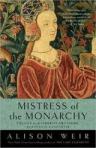
I have read a lot of Alison Weir’s work. I know she sometimes gets accused of writing populist history; personally I find her a really intriguing mix between populist and academic. On the one hand – what’s wrong with being populist if you’ve done your research?? Making intriguing women like Swynford accessible to a general public is something to be lauded very, very highly. On the other hand, there were bits that I absolutely skimmed over because they were so dense; I’m sorry, I just don’t find descriptions of household objects and suchlike that riveting. Maybe that makes me a bad historian… or just not a good domestic historian. Anyway – this was largely very readable and enjoyable, and I think would be found so by reasonably educated people with little detailed knowledge of medieval England.
And then there’s the subject. Katherine Swynford! Attendant to Philippa of Hainault when she marries the English Edward III; governess of some sort to John of Gaunt’s (third some of Edward III) children; then (after his beloved first wife dies, and her possibly lamented but not so much husband also) John of Gaunt’s mistress and mother of at least four of his children; then repudiated for some time when he gets a bit thing about maybe becoming king of Castile, plus pious; then, finally, John of Gaunt’s third wife. Which also wrangles the legitimacy of her children by him. All of which doesn’t include the building works she manages in various places, the bringing up of a number of children, possibly being involved in politics at different stages, oh and her sister married Geoffrey Chaucer.
She’s a major reason the Tudors had a connection to royalty, before forcibly taking the crown (they’re descended from the Beauforts, who are the legitimised children mentioned above). She’s also the progenitrix of six American presidents.
Katherine Swynford was clearly a remarkable woman. She was on good terms with a large proportion of the English nobility – admittedly, partly because she was widely known as John’s mistress and thus had access (heh) to his ear, but nonetheless she was clearly highly regarded. She was also on good terms with most of the clergy with whom she came into contact, for example in Lincoln where she appears to have lived right next to the cathedral for many years. She must have been a remarkable housekeeper – in the very broadest and most impressive sense, since it appears that the place she first lived in with her first husband was a bit crap, frankly, and she was largely responsible over many years for making it a good place to live. Plus, she lived through remarkable times: this is the Hundred Years’ War, and also the time of Wat Tyler’s mob rampaging through London and burning the Savoy Palace… which would be the palace belonging to John of Gaunt. Fortunately, not while he – or she – was in it.
It’s brilliant to see such a woman getting a biography. I love Weir’s introduction to this which confesses that pretty much this is the biography she’s been working towards for years – she just had to have the clout to manage to get her publisher to agree to it. Way to go to get what you wanted!
The Odd Angry Shot
This film is an example of why, and how, Australian cinema is so awesome.
 It’s also quite the who’s who of male actors of A Certain Age in Australian film and TV; there’s even a cameo from Frankie J Holden (for whom I have quite the soft spot).
This is not a film I would tend to watch off my own bat, for a whole bunch of reasons. But I did, and I’m glad I did.
The story focusses on Bill, a fresh young man (John Jarratt!) off to the Vietnam War as part of the SAS. When there he falls in with some likely lads (Graham Kennedy! Bryan Brown!!) with whom he drinks, jokes, and gets into trouble – and goes on patrol with too. Some of them get wounded. Some of them die.
The film has some remarkable character moments. At one point, Harry is explaining why he’s sketching – he was an artist before he joined up. He then goes on to explain that he joined the army after he got a divorce, and why he got a divorce. It’s a sad story – as such stories ought to be – but it is neither pathetic nor overwrought; it is as pragmatic as your classic Aussie bloke would make it. This is not to say that Harry is unfeeling; quite the contrary. He feels it deeply. But he does not make a song and dance about it.
I think the pragmatism, and the understatement, is the big difference between this film and an American one. I’ve seen Born on the Fourth of July, which is a remarkable piece of cinema. But this captures another, equally true (?for given values of…) version of the experience of war. And it is realistic. There’s tinea, porn, fear, death, the random nature of events; there’s camaraderie, and making the best of a dreadful situation. Like having a cage fight between a spider and a scorpion. As you do.
 As with many such films, it’s based on a book. Apparently the author was concerned that the film would turn his anti-Vietnam-but-pro-army story into a buddy war movie. I hope that, when he saw it, he saw a film that did capture some of the essence of his book. Because this is definitely not a pro-war film.
I’m glad I watched it. It’s pretty raw – there are definitely some cringeworthy moments, made all the more cringey because they almost certainly reflect actual attitudes of the 70s, if not the 60s; but as a short, sharp suggestion of an Australian experience in Vietnam, it works.
Rasputin’s daughter
 A little history lesson: Gregory Rasputin was a Siberian peasant who, after being introduced to the Tsar and Tsarina of Russia in the early part of the twentieth century, somehow appears to have had a positive impact on the haemophilia of their son and heir. There were all sorts of rumours going around about him and his relationship to the Romanovs and the way he behaved in St Petersburg, and he was eventually assassinated. This book is more than a hundred pages of his daughter reminiscing about her father, and about 30 – which I didn’t read – of Rasputin’s own reflections on holy places he’s visited.
I recently helped my sister to move house, and one of my jobs was unpacking her books. In doing so I discovered that she had appropriated a number of books that belonged to me but that I’d left at home… anyway. I also discovered this book on her shelf, and I was astounded for a few reasons: that the book exists at all; that she had bothered to nab it (I was reminded that she had studied the Russian Revolution at school)… and that it had belonged to our paternal grandfather. This is somewhat surprising because although not a Communist, our Grandpa was definitely an old-school union man, voted Labor all this life, detested the Vietnam War (wasn’t it awkward when Dad enlisted and went over?)…

etc. So why he had a book aimed at salvaging Gregory Rasputin’s reputation is beyond my ken.
This book is part vindication of Rasputin as a largely good man, part protest at his treatment while alive and his reputation after death, and part somewhat dubious insight into life in Petersburg in the lead up to, and early part of, World War 1. Did I learn anything that I am willing to treat with little scepticism? Yes: Maria Rasputin’s explanation of the fact that her father was not a monk, but was rather a Starets has no need to be distorted and was genuinely helpful in my thinking about him. So too is the fact that Maria and her sister lived with Rasputin for most of the time he was in Petersburg! – this is not something that I have ever seen discussed, and although obviously a father is perfectly capable of being evil and not showing it to his daughters, it’s still an interesting addition to his character. Like I said, Maria (and I’ll keep referring to her by her first name because ‘Rasputin’ would be just too confusing) is clearly aiming to redeem her father’s name, so she stresses that their living room/reception area door was very rarely closed – thus clearly refuting the idea that, at home at least, Rasputin was up to no good and holding orgies (one of the big accusations against him). She doesn’t pretend he was a saint – in fact, she protests against that idea vigorously – and admits that he took up drinking… but blames that on the experience of Petersburg itself, and bad influences, and the need to get just a little bit of downtime.
There’s a whole lot that is pure propaganda. And I can understand that; it can’t have been a comfortable position to be in, as the daughter of such a notorious man. Especially if he had been a loving father, and all the calumny just felt so alien and unlike the man you knew. I was fascinated to read that Maria accepted – or at least wrote that she accepted – the supernatural elements of Rasputin’s story: that he was clairvoyant, enabled by a special connection to God that also enabled him to have special healing powers… I hadn’t expected that aspect.

One problem, for me: I couldn’t help but here Tom Baker’s voice every time Rasputin spoke. That was distracting.

A history of blue
Did you know blue has been the favourite colour of Westerners over the last couple of centuries?
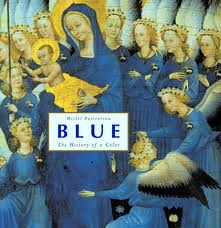 This book is and intriguing idea, although not entirely well executed. I enjoyed the broad sweep of time that Pastoureau attempted to cover – the Neolithic and ancient use of colour very briefly, the medieval world and on in a bit more detail – because the comparison across hundreds of years is fascinating. Unsurprisingly though, this was also one of its downfalls, since the occasional times it treated an idea or subject in detail it felt out of place; and the lack of detail in some areas annoyed me. In some ways this felt, perhaps deliberately, like this was a preparatory work; a number of times Pastoureau raised questions as areas requiring further research, or mentioned medieval manuscripts that have yet to be transliterated or studied in any fashion.
In appearance this is halfway between a history book and a coffee table number. It’s beautifully presented, and the pictures themselves are delightful – most pages have one or two, sometimes three, pictures, illustrating some pertinent point about where and how blue was being used, or other uses of colour at relevant points. But the text is too dense to really work as an art book, while it’s not long enough somehow for it to feel like a really serious treatment of the subject – especially not over such a vast span of time.
As a history book, I remain unconvinced by some of Pastoureau’s suggestions about how blue worked in culture. The lack of blue in very early art, Neolithic right through to much ancient illustration, is curious but I didn’t entirely buy his explanation for its lack of symbolism and therefore appearance and I’m not sure why. Perhaps it just didn’t feel explained enough to accept such a radical idea. This problem permeated much of the text, in fact; the sober, moral overtones that blue acquired thanks to the Protestants, as well as the issues discussed around its symbolism in the later medieval period, were presented as a little bit too definitive, a little bit too unarguable, for me to be entirely comfortable. Clearly Pastoureau was not setting out to write the definitive work on the colour; he himself points out that a vast amount more work needs to be done in a whole range of areas before such a thing is possible. And perhaps it’s also a fault of translation; maybe there was a bit more uncertainty in the original French?
Anyway, overall this is a fascinating book that has made me think about colour and its uses, but not entirely satisfactory.
Amazons of Black Sparta: a review
 My mother gave me this book for Christmas 2010, I think after hearing about it on the radio? I’ve had great intentions of reading it since then, of course, but until now they have gone the way of many other good intentions. The other day, though – at least partly inspired by Tansy’s post about ‘Historically Authentic Sexism in Fantasy’ (which also appeared over at Tor.com, although be warned that one of the first comments is ‘most readers of SF are men’ and…I don’t even) – I decided it was time to read it. (There’s also been a bunch of great stuff written about the historical position of powerful women, as queens and warriors etc recently, calling out people who say women have had basically no part in the Great Historical Narrative That Is Mankind.)
This is a book of history. It appears to be thoroughly researched and meticulously end-noted. Alpern constantly refers to his sources, comparing the differences in their perspectives and attempting to explain them based on time, possible prejudice, and other aspects. This is particularly relevant and important because the sources come from a span of two centuries or so, sometimes using second-hand sources, and occasionally coming long after the actual events.
The book is about genuinely documented, real-life warrior women, who were pretty much automatically called Amazons by European observers, in the kingdom of Dahomey, on Africa’s western coast. And these are not from some far-off misty time; no, they date from the late 1700s at the very latest, and last saw action against the dastardly French when those colonisers decided to fight against and take Dahomey… in 1892. They were experts at the use of muskets and spears and – my favourite – the giant razor: said to have weighed 20 pounds or more, it had a blade 24-36 inches long that folded into a wooden handle. It was wielded with both hands and was particularly good for decapitations.
It’s not quite the book I was expecting. I think I was anticipating that was more narrative-driven, but only the last quarter or so fits that bill. The first three quarters read more like a catalogue: the recruitment, training, weapons, and everyday life of these women. The narrative comes when Alpern documents the battles that the ‘warrioresses’ took part in – first against other local tribes for a variety of reasons, then in two set of skirmishes/pitched battles with the French.
There are a lot of fascinating parts to this book – like the fact that the women as warriors may have originated in them being elephant hunters, and the fact that Dahomey had a lot of symmetry going on with women having parallel offices etc to the male hierarchy. One awesome, somewhat incidental bit – and this is for the fabric fetishists – is that the warrior women may have been involved in creating a gigantic patchwork, along with other palace women. It was composed of samples of every type of fabric imported into the kingdom or made locally. At one stage it was apparently up to 400 yards by 10 feet, and exactly it was intended for is unclear. The other mighty fact in the story is that pretty much everyone acknowledges that the women were mighty warriors, as good or better than their male counterparts, and generally even fiercer in actual battle: like, they were the last to retreat, and on a couple of occasions it was only women who got past the enemy’s barricades. And before anyone even thinks it, apparently the enemy generally did not realise that they were facing women, at least in the early battles, so no it’s not because they let the women in (besides, they were CARRYING MUSKETS or other guns – who would be stupid to let in anyone carrying a GUN? (hmm, perhaps this is a little close to the bone today)).
A very interesting read, and a fascinating period of history in general and in specific.

 Randomly Yours, Alex