Once There were Wolves

This is not the sort of book I would tend to read, but it was our book club pick so I went ahead. And let me tell you, there was a degree of whiplash because I had just finished EJ Swift’s When There are Wolves Again, which has some similar ideas – rewilding, wolves should be back in Britain – but is also completely different.
Content warning: animal deaths, and violence towards women.
Once isn’t linear; we get a lot of flashbacks to points in Inti’s life, explaining how she and her twin have ended up in the Cairngorms. It’s clear that there’s been a significant trauma for the sister, Aggie, but it’s unclear just how far in the past that is – until it’s not, and then it’s sadly predictable.
So there’s the unravelling of what happened to Aggie, and there’s the reintroduction of wolves to Scotland and in particular around a farming community that is deeply divided as to whether the wolves are a good idea. And then there’s the death of a man who has clearly been violent towards his wife, and with whom Inti has been clashing. Figuring out who or what killed him runs parallel with Aggie and Inti’s story.
The book is well enough written; I skimmed a few sections, I admit, because I got a bit impatient with some of the angsting. I didn’t exercise myself to try and figure out what was going on, but let myself be carried along by the narrative, partly because I was feeling lazy and partly because the story didn’t really incite much enthusiasm for doing so – I knew it would all be tied up neatly.
It’s fine. If you’re up for a standalone mystery set in Scotland with a few different threads, this may well be for you.
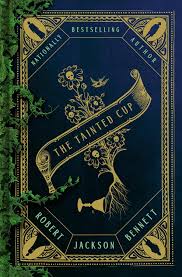
The Tainted Cup & A Drop of Corruption
I have not read much Arthur Conan Doyle. I’m pretty sure I read Hound of the Baskervilles when I was a teen, and maybe A Study in Scarlet? But I’ve never been an aficionado.
Which makes it all the stranger that I have consumed a lot of Holmes adaptations. The Downey Jr films; the Cumberbatch show; Enola Holmes, The Irregulars, and even the not-very-good Holmes & Daughter. And then there’s the books. I have read many of the Laurie R King Mary Russell & Sherlock Holmes books; I pine for the next in Malka Older’s Mossa & Pleiti series. Which brings me to Robert Jackson Bennett.
I had not heard of these books until the Hugo packet this year. And when I started The Tainted Cup I was a bit dubious, because I really haven’t been in the mood for gung-ho fantasy complete with made-up words for quite a while. But I persisted, because the characters were intriguing enough that I wanted to see what they were up to. And then the world grew on me – an empire shoring itself up against incursions from mindless oceanic leviathans (one assumes? I can’t tell whether that is going to get undercut later in the series), and one key way they do that is by changing some of its citizens: to have better reflexes, or more acute senses, or… other things.
And it didn’t take long for me to realise that Din and Ana are Watson and Holmes analogues. He is new to the justice job, struggling to find his place. She is weird, with bursts of manic energy and a delight in music and a desire of illegal drugs and an astonishing ability to put clues together. I mean, it’s not exactly subtle. And it’s an absolute delight. And you don’t need to know about Holmes and Watson to enjoy their interplay – it’s just an added amusement – because Bennett writes compelling characters and intriguing mysteries, and develops a world that stands by itself.

In fact I enjoyed The Tainted Cup enough that then I went and found A Drop of Corruption at the library, and I read it in a day and I have no regrets about that. Interestingly, the library has catalogued it as a mystery – I can only imagine what someone would think if they picked it up expecting something like Thursday Murder Club or a James Patterson. Anyway, it’s another gripping mystery in another part of the empire, and we learn more about how the empire works (and it’s not completely a “we love empire” story, either), and – happily – we finally learn a bit more about Ana, whose role and being are themselves mysterious. I assume Bennett has plans for more Din and Ana; certainly I will continue to read them.
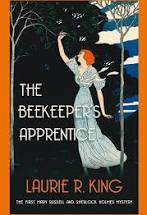
Mary Russell and Sherlock Holmes
 Things I have not read: Sherlock Holmes stories.
Things I only read occasionally: mystery or crime novels.
Things I have read a lot in the last three months: Laurie R King’s Mary Russell series. Ten books and several short stories, in fact.
This is all because of a friend who suggested the series to me while I was travelling (also the Amelia Peabody series). I decided I needed something a bit light, and I thought it would be interested to give it a go… and all of a sudden I’d read two novels and a novella. And it went from there.
Mary Russell is 15 in The Beekeeper’s Apprentice; orphaned and living with a nasty aunt in Sussex. She literally runs into an older man out looking at bees, and he turns out to be a now-retired Sherlock Holmes. She demonstrates a surprisingly keen mind, he is intrigued, she ends up being his apprentice, they have adventures, and so the series sustains itself.
Russell is an heiress, so there’s no money issues (at least once she inherits); she’s Jewish; she’s very bright, obviously – and gets a degree in theology; and she is, clearly, a match for Holmes in terms of personalities. I can’t speak to how well Holmes is portrayed, but there are amusing references to his being annoyed at Conan Doyle, and the way Watson wrote their adventures up.
To some extent I guess you could call this extended fan fiction. Especially when you have Peter Whimsy turn up briefly, and then Kim (Rudyard Kipling’s Kim), and Dashiel Hammett, and for all I know other characters that I didn’t recognise. But… who cares?
Overall the stories are well-written; they’re definitely page-turners. Sometimes the crimes are dreadful, sometimes they’re on the more intimate side; sometimes Russell and Holmes are personally involved, sometimes they get dragged in. The stories start in 1915, and I’m up to 1924 (where I’m going to pause for a long time, I think; I’ve about done my dash for now), so there’s discussion of blue-stockings and women under 30 not yet having the vote, and King keeps the misogyny and some of the racism that would have been par for the course at the time – which does get a bit uncomfortable at times, it must be said, and I’m sad she felt it necessary.
Overall these are entertaining stories that aren’t too demanding. Perfect for right now, as far as I’m concerned.
Blackmail Blend

 Set between A Trifle Dead and Drowned Vanilla, Tabitha once again has complicated boy issues, complicated food issues, and complicated I’m-not-a-detective issues, not necessarily in that order of importance. This time Livia Day has gone suspiciously meta on us, by having the victim of an attempted crime be a glamorous author; the situation is a writers’ retreat. I can’t help but wonder whether she is channelling her own experiences, or vengeful dreams….
As always there is excellent food, although perhaps not quite enough tea. There’s definitely not enough Ceege, although the presence of Xanthippe almost makes up for it, while Nin’s eyebrows only appear once. Tabitha’s discovery regarding high tea is pretty much worth the price of admission, and there is an adequate level of snark.
I read this while drinking Perth Breakfast rather than the specified Blackmail Blend. But that’s because I took Tabitha’s tea to work.
Death comes to Pemberley
 There’s a bit of hating going down for this book, I’ve noticed. Some people are dismissing it simply as fanfic which… yes, I can see that, especially if you don’t think that fanfic can possibly have any merits. But to suggest that this is fanfic and therefore unworthy of engaging with is just lazy.
Other people have dissed this because of its merits, or lack thereof. That, I am totally fine with.
I have read Pride and Prejudice. I have seen, and adored large chunks of, the BBC adaptation. I am not, however, an Austen fangirl. This is, I think, my very first PD James. So on neither count am I particularly invested. I read my mum’s copy; I read it partly to keep up with her, and partly because I was expecting exactly what I got: a bit of light entertainment, and one person’s suggestions for how life might have turned out for Lizzie and Lydia.
I did not expect the reaction I had against Wickham that was very, very strongly influenced by the Lizzie Bennett Diaries. There may have been metaphorical gnashing of teeth at the mention of his name.
Is this brilliant literature? No. There are huge chunks of info-dump where James appears to want to show off just how much she knows about 18th and 19th century law and policing. There is one hilarious bit where she manages to get in a little “America will grow up to be most awesome” message, which had me choosing between giggling and eye-rolling so hard I was going to fall off the couch.
Is this a fun read? I thought so. I had been misled somehow about who it was that died (spoiler! this is a murder mystery!), so that was a surprise. There were obvious tantalising clues dropped early on that I looked forward to having explained properly; some of them were resolved as I half-expected, others were quite different. There are a few different plot-lines woven throughout, which was nice, and it’s not entirely following Elizabeth – James gets to play a bit with Darcy, in particular, although I thought those sections were often the least interesting.
As an homage to Pride and Prejudice, it’s ok but not awesome. I think James does an all right job of capturing Elizabeth and Darcy as a couple; Lydia has turned into a mini-Mrs Bennett, and Jane is a smiling placeholder, nothing more. There are some reflections on other characters – Georgiana, Fitzwilliam (who has completely changed for me thanks to the Lizzie Bennett Diaries, and this version was consequently very weird), and even Wickham. There was one P&P character that James did a very, very clever thing with that I really didn’t see coming – she gets kudos for that, if nothing else.
Overall, a satisfactory murder mystery. Don’t read it pining for Austen; do read it for what it is, if that’s your thing.

 Randomly Yours, Alex