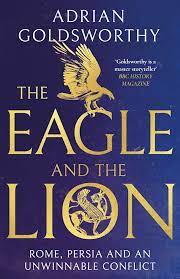
The Eagle and the Lion: Rome, Persia, and an Unwinnable Conflict
I read this thanks to NetGalley and the publisher, Apollo. It’s out now.
Some time back I read a book about the Mongolians, in particular at the western edges of their advance, and how those kingdoms related to what I know as the Crusader States. It completely blew my mind because I’ve read a bit about the ‘Crusades’ general era, and that book made me realise just how western-focussed my understanding had been: the invading Europeans connecting back to Europe and maybe Egypt (thanks to Saladin); maybe you’d hear about the Golden Horde occasionally. But interacting with the Mongols was HUGELY important.
This book does a similar thing for Rome. My focus has always been on the Republic and early principate, so maybe that has had an influence. But in my reading, Crassus’ loss at Carrhae is present but (at least in my hazy memory of what I’ve read), it’s almost like Parthia comes out of nowhere to inflict this defeat. Persia then looms as the Big Bad, but I think that dealing with the Germanic tribes and the Goths etc seem to take a lot more space. Even for the eastern empire, which is definitely not my forte, regaining Italy etc and fighting west and north (and internally) seems to get more attention.
And then you read a book like this. It is, of course, heavily leaning in the other direction; that’s the entire point, to start redressing some of the UNbalance that otherwise exists. These two empires could be seen as, and describe themselves as, the “two eyes” or “two lanterns” of the world (those are Persian descriptions); for basically their entire collective existence they were the two largest empires in this area (China probably rivalled them at least at some points, but although there were tenuous commercial connections, they’re really not interacting in similar spheres). It makes sense that the relationship between them, and how they navigated that relationship, should be a key part of understanding those two empires.
Goldsworthy does an excellent job of pointing out the limitations in ALL of the sources – Greco-Roman, Parthian, Persian – and clearly pointing out where things could do with a lot more clarity, but the information just doesn’t exist. Within that, he’s done a really wonderful job at illuminating a lot of the interactions between Rome and Parthia/Persia. And he also clearly points out where he’s skipping over bits for the sake of brevity, which I deeply appreciate in such a book.
It’s not the most straightforward history book of the era. It covers 700 years or so, so there’s a lot of dates, and a lot changes in this time as well – republic to principate to later empire, for Rome; Parthian to Persian; countless civil wars on both sides. A lot of leaders with the same or similar names, unfamiliar places names, and all of those things that go towards this sort of history book requiring that bit more attention. I definitely wouldn’t recommend this as My First Roman History Book! But if you’re already in the period and/or area, I think this is an excellent addition to the historiography. Very enjoyable.
Persians: the Age of the Great Kings

I read this courtesy of NetGalley. It’s out in April 2022.
I really, really wanted to love this book.
(That, children, is called ‘foreshadowing’. You can almost see the BUT looming behind those words.)
A book that’s basically the postcolonialist version of Persian history we’ve all been waiting for! A view on Persian history that’s not just repeating the Greek and Roman commentaries that were absolutely written with a very particular perspective! YES PLEASE. And even more when Llewellyn-Jones makes the acerbic comment in the introduction about how the concept of European superiority can be dated back to Herodotus etc and the way they presented the terrifying East. So yes, let’s have a version of Persian history that is largely based on Persian sources, or uses the Greek sources very carefully – to find the Persian reality behind the Greek propaganda.
And it starts so well. There’s a discussion about Persia vs Iran as a name – and I’m not sure whether his explanation of the political nuances there are accurate, so I defer to others on that, but it seemed to make sense within what I do know. There’s a discussion about the archaeological activities that give historians what they know from Persepolis etc, and a candid admission about the lack of sources. The Persian history proper starts with a discussion of the movement of different peoples into the area we know today as Iran, and some speculation about how they interacted etc. Then it moves into discussing the development of the Persian empire as empire, and interaction with the Medes. All of this section was intriguing and the use of inscriptions was well done. I did start to get a bit uncomfortable about the lack of reference to other sources – like other historians; I understand that getting the balance of what can seem to be most approachable, and what can seem too scholarly, may revolve around footnotes etc but… there’s just no way the author didn’t use other references.
I also started to get a bit uncomfortable when the author claimed that Cyrus’ mother “delighted in singing Median nursery rhymes to him” (p60 of the e-version), because that seems… weirdly specific? And then I got to the description of him as “lean and good-looking in that way that Persian men are uniquely handsome” (p63 of the e-version) and I had to stop and blink and decide whether to laugh or cry. What happened to treating the Persians as real people and not exoticising them, which I thought was part of the postcolonial agenda? I also have a problem with the statement that “A society that requires such codes of respectful behaviour” (obeisance before the monarch, etc) “is very likely to have autocratic political organisation, characterised by the coercive power of a king” (pp194-5). It just seems too blanket a statement.
And then! We have Darius’ half-sister and wife described as “a Lady Macbeth-like villainess, hellbent on power and ruthless in her bloody ambition” (p288) and I really started to wonder whether it was now a different author, or if he had been to sexy the book up. Next we have “years of adoration and unnaturally demonstrative mother love meant that [Darius] was self-centred, cruel, vindictive, and brutal” (p292); and that mothers experience “that particular twang of jealousy… when their sons give their hearts to other women” (p294). In case we worried that it was about misogyny, we then have a eunuch described as “a veritable creature of the court” (uh, eunuchs who are made eunuchs to BE at court are literally that??) who was “born to corruption, whose ambitions were for the very highest office of state” (p333) and I just can’t even. The author then has the temerity to accuse the Greeks of employing the “topos of the wicked eunuch” and I need to ask some questions about self-awareness.
So. I am ambivalent about this book. It’s a super necessary idea, and the use of Persian inscriptions and the way some of the Greek sources are handled is a really good example of how to read through sources to get more than they think they’re saying. On the other hand, some of the descriptions are clearly ridiculous (robes of “chiffon-like linen, gauzy cotton, and shimmering silk” (p293) – not to mention that nursery rhyme – really need some evidence!). And the bits quoted above are enough to make me despair. Did I learn something about the Persian empire and the kings who ruled, and the way it all worked? Absolutely. Is this the last word in Persian imperial history? I sure hope not.
Would not recommend to someone who is completely new to the history of this area and time, or to someone who is naive in reading historical books. For those looking to deepen their knowledge, it’s useful – with the caveats above.

 Randomly Yours, Alex