Shakespeare’s Sisters, Ramie Targoff
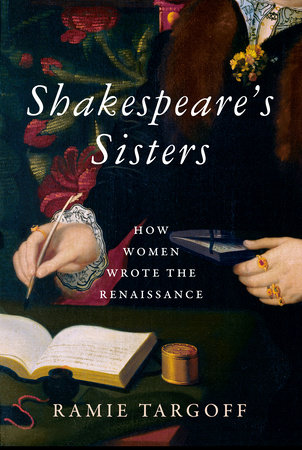
Read via NetGalley. It’s out now.
I’m here for pretty much any book that helps to prove Joanna Russ’ point that women have always written, and that society (men) have always tried to squash the memory of those women so that women don’t have a tradition to hold to. (See How to Suppress Women’s Writing.)
Mary Sidney, Aemilia Lanyer, Elizabeth Cary and Anne Clifford all overlapped for several decades in the late Elizabethan/ early Jacobean period in England – which, yes, means they also overlapped with Shakespeare. Hence the title, referencing Virginia Woolf’s warning that an imaginary sister of William’s, with equal talent, would have gone mad because she would not have been allowed to write. Targoff doesn’t claim it was always easy for these women to write – especially for Lanyer, the only non-aristocrat. What she does show, though, is the sheer determination of these women TO write. And they were often writing what would be classified as feminist work, too: biblical stories from a woman’s perspective, for instance. And they were also often getting themselves published – also a feminist, revolutionary move. A woman in public?? Horror!
Essentially this book is a short biography of each of the women, gneerally focusing on their education and then their writing – what they wrote, speculating on why they wrote, and how they managed to do so (finding the time, basically). There’s also an exploration of what happened to their work: some of it was published during their respective lifetimes; some of it was misattributed (another note connecting this to Russ: Mary Sidney’s work, in particular, was often attributed to her brother instead. Which is exactly one of the moves that Russ identifies in the suppression game). Some of it was lost and only came to light in the 20th century, or was only acknowledged as worthy then. Almost incidentally this is also a potted history of England in the time, because of who these women were – three of the four being aristocrats, one ending up the greatest heiress in England, and all having important family connections. You don’t need to know much about England in the period to understand what’s going on.
Targoff has written an excellent history here. There’s not TOO many names to keep track of; she has kept her sights firmly on the women as the centre of the narrative; she explains some otherwise confusing issues very neatly. Her style is a delight to read – very engaging and warm, she picks the interesting details to focus on, and basically I would not hesitate to pick up another book by her. This is an excellent introduction to four women whose work should play an important part in the history of English literature.
The Bookseller of Florence
This is one of the best history books I’ve read in years.

It’s written superbly. The language is a delight – but not so clever or lyrical that it gets hard to read. The pace is just right, and the level of detail is an absolute delight: the right balance of fascinating without getting into ridiculous minutiae.
It’s wonderfully historical: it uses primary sources and historians to make arguments and illustrate points, and they’re all woven within the story seamlessly. It uses endnotes, so you don’t have footnotes cluttering the page but you still have the reassurance that the author has done the research!
It illuminates (heh) the context magnificently. The Renaissance, Italy, and Florence are really not my scene, beyond knowing a few names (Medici, Borgia. – and Sforza for some reason?). The author sets the general scene for all three so that I felt completely comfortable going in. The book is ostensibly about Vespasiona, the “king of booksellers”, who started as a fairly uneducated boy working in a book binder’s in Florence and became the man who could either track down a manuscript or have a beautiful new one made for you – where “you” could be a wealthy-enough person in Florence or, like, the Pope (a few of whom he knew by name, hello). Beyond being a biography, though (which would have been fascinating but not that long because info about his early life is lacking) this is almost a biography of TEXTS, as objects and sources of knowledge, in this crucial moment – the 15th century. Why was it crucial? Well, a bunch of ancient Greek texts were being rediscovered and translated – especially Plato, who was being brought into the Christian fold as Aristotle was two centuries before. There were changes in the way knowledge itself was perceived, and an increase in the number of people (let’s be honest, basically men, but still) who were chatting/arguing/ getting fiery about various bits of knowledge. OH, and THEN, Gutenberg and his crazy weird moveable type (NOT first invented by him, of course, that was happening over in Asia already, and the author acknowledges that) comes along. The way the author contextualises that, and discusses the stats about book publication (mss numbers rose when print came along – probably because of increasing literacy) – it’s all just an absolute delight.
The book balances political history, social history, and a bit of economic history to make a thoroughly well-rounded examination of the period. And it still manages to revolve around this one man, Vespasiano, who coordinated the production of beautiful books and magnificent libraries, who became an author himself in old age, and was probably a bit of a cranky old man about those new-fangled print books.
Gosh I loved this book.
The Deadly Sisterhood
Not a lady-assassins novel, but a history book about the role of eight significant women in  the Italian peninsula during the Renaissance.
I scored this at a school market for about $2, which was very cool.
Firstly, two problems:
- There were a number of egregious editing issues, which really annoyed me. A major publisher should not be putting out books with mistakes that *I* can pick up as I read it – it’s not like I read with the attention of a copy editor.
- More significantly, the book falls into the trap that many such history books do. They’re trying to write a book about the women, who have largely been ignored by contemporary and modern historians… but there’s so much else! being done by the lads! and honest, it’s needed for context! … that there are large slabs of text that really don’t seem to be connected to the women who are in theory at the heart of the book. Even if there are occasional mentions of “oh, and he was Duchess Blah’s son”. It was frustrating to have the women seem to be ignored in their own book.
Anyway. Frieda focusses on eight women, some of whom I’d heard of – Lucrezia Borgia, of course – and others I hadn’t heard of – of course. It covers the height of the Italian Renaissance, from 1471 to 1527. She discusses their births and marriages and deaths, their children and (often multiple) husbands, as well as the roles they played in politics – both consciously and as marital pawns – and in the artistic and cultural milieu. Actually that last was the bit that, surprisingly, got least attention; I would have thought that the women would have played greater roles as patrons. Perhaps Frieda was more interested in discussing the political aspect, which is definitely at the forefront of her interests here.
Despite the problems mentioned above – and that sometimes the language was a bit too snarky; I don’t need to be reminded that one of the Isabellas apparently got quite fat, unless that contributed to how people treated her – I did enjoy reading this, and I am very pleased to know more about these women of important families who themselves managed to do important and significant things.

 Randomly Yours, Alex