Beowulf, from Maria Dahvana Headley

I read a very abridged version of Beowulf ages ago. I’ve watched that appalling Christoper Lambert film, because Christoper Lambert, but I haven’t seen the Angelina Jolie one. And most recently I read The Mere Wife by Maria Dahvana Headley and fell madly in love with it (it’s roughly a modern imagining of the poem).
Then I heard Headley had done a translation of Beowulf. And then I listened to The Writer and the Critic talk about both Headley books, and they reminded me to buy the translation. Of course, after watching The Dig, it was finally time to read it.
What an absolute joy.
The best way to give you a sense of how Headley has approached the translation is to use the example that a lot of people have pointed to, and with good reason: her translation of Hwaet. This word has been translated several dozen different ways over the years. It’s kind of a placeholder “pay attention!” word; I use ‘so’ and ‘all right’. You might use ‘look’, or archaically ‘lo’, or ‘behold’. Headley? Oh, she uses “Bro”.
Translation is always of its time, even if you’re trying to be anachronistically archaic. Headley has fully embraced the fact that this was published just into the 21st century, so there’s supermodern language – stan and swole and hashtag: blessed – that sometimes feels startling but always appropriate. Simultaneously, she has totally gone in for the ideas of rhythm and rhyme and alliteration found in the original:
The nails were notorious, hard as though
smith-forged, and the heathen’s hand
was callused as a carpenter’s, weathered
by work and warring (lines 985-88).
The above paragraph, by the way, is indicative of the fact that reading the Introduction to this book is highly recommended. You could, of course, go straight into the poem – of course you could. For me, though, knowing about Headley’s approach to the whole concept of translating this thousand-year-old poem, how she considered language and the gendered problems with considering Grendel’s mother, deepened my appreciation for her word choices and the entire enterprise.
The poem Beowulf centres, mostly, on the hero Beowulf, who slays the “monster” Grendel, and Grendel’s mother when she seeks vengeance… and he then goes on to be king for decades (that bit’s largely skipped over in the poem), before battling a dragon when he’s too old for that kind of shit. So in a sense it’s a heroic poem. On the podcast Backlist, though, the claim was made that it’s the original horror story too – Grendel coming in the night to kill men in their sleep, and no one can stop him. There’s also the aspect that it’s a meditation on the notion of kingship, and heroism, and masculinity… honestly there’s a reason that there are many dozens of translations and endless journal articles. There’s a lot to talk about.
I’m not a massive reader of poetry, so if you’re put off by the poetry I would say this one is worth a go. The ideas, the language – it’s just enchanting. And I would also recommend doing it the way I did: give yourself a couple of hours and read the whole thing straight through. You get into a rhythm with the language, you get into the zone of the Danes and Geats being all macho, and you follow the thread of Beowulf from hero to death.
I’m so glad Headley was convinced to do this.
A Year in Provence
Every now and then I fall into reading one of those stranger-in-a-strange-land books, where some person goes to live in a foreign-to-them country and has amusing experiences. Sometimes I feel uncomfortable about this genre – although I’ve never read one that goes out of its way to exoticise the locals, there’s still a potential voyeurism or paternalism that makes me wary. However, I truly loved Under the Tuscan Sun, and Driving Over Lemons was also a delight. The thing that makes me a bit less uncomfortable about these is that they’re white Brits or Americans moving to Europe… which somehow feels less likely to be fraught than, say, a white Brit or American moving to Thailand, or Nigeria. In my mind, that seems much more likely to go difficult places.
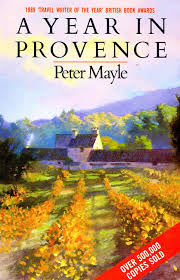
Anyway: when I came across A Year in Provence in a secondhand shop I couldn’t remember if I’d read it – surely I had! it’s a classic! – and then I read the first bit and realised nope, never have. Thus, bought.
And it is a delight. I can see why it’s become such a popular book (although I am deeply unconvinced about watching it as a tv show). The style – that Mayle goes through a calendar year, basically following the rhythms of the seasons and how that affects the way farmers, in particular, live – is deeply affective. Yes, there are bits where Mayle is getting amusement out of locals’ quirks; it never feels to me that it’s malicious, and I hope that’s not just me being naive (although that’s possible). It is, of course, a deeply romantic view of living a provincial life. Part of this is the time in which it’s written – the late 1980s – and that feels like (is, I think) a completely different world. And partly this is Mayle’s love letter to his experiences. He doesn’t completely sugarcoat his life – the exigencies of getting labourers to finish their work sounds excruciating – but the humour and general love of life that he exudes makes reading about it just a dream. Also ohmygoodness the FOOD.
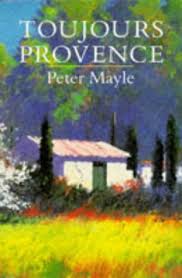
I didn’t know there was a sequel, until I found it, soon after reading the first. It’s different in style – I guess repeating the calendar idea wouldn’t have worked. Basically the first thing he opens with here is the fact that the first book made him famous, to the point where strangers would turn up at his door demanding an autograph – and in some cases just wander into his house. Who does that?! I quite liked that he reflected on the consequences of his work – makes it seem more real, in some ways. Again, there’s a lot about food, and that’s completely fine with me. There’s a lot about the house, and local experiences. It’s… cosy. Delightfully cosy. And it makes me wonder whether anything like this life still exists in Provence; my guess is no. Maybe other parts of France?
Living like Mayle is, of course, a fairly affluent choice; most of his neighbours are farmers, working very hard for their bread, while (if you’re being mean) Mayle is a dilettante gentleman-farmer doing whatever he likes. But if you read this as a semi-fantasy, which I think is how I approached it, they’re lovely books. I understand there’s a third book, too; one day I’ll find it.
The Brendan Voyage, and Tim Severin
Many years ago I randomly came across a book by Tim Severin – I think it was either his Jason or his Ulysses voyage. I was immediately in love: this was a man who takes a mythical journey, makes a ship according to what can be understood of the shipbuilding techniques from the time of the myth, and then sets out to recreate said journey. His point being to see what’s feasible, and to investigate to what extent aspects of the original journey can be matched up to what can be seen today (where ‘today’ is the 1970s, mostly).
Ever since that first encounter, I have sporadically checked secondhand shops to find more Tim Severin books like that first one. I’ve found a few – one of his first travelogues is following the tracks of Marco Polo by motorbike, undertaken long enough ago that he was able to get through Afghanistan but not into China. And just this year I finally came across The Brendan Voyage.

I had never heard of St Brendan and the stories about him and a few monks going to sea in a leather boat (a currach), and visiting various islands, on a voyage lasting months – in the 6th century AD. Severin does a good job of recounting the key points of the story, to give an indication of what he’s trying to emulate.
The first step must be to make the boat, and that in itself is a feat: he literally wants to go sailing in the Atlantic in a boat basically made of leather. Wooden struts, yes, but the hull just… cured leather. Before any construction, therefore, there’s research into what sort of leather and how it can work. Honestly I loved the story of the voyage, but I also really enjoyed the story of just finding the people to make the boat in the first place.
Clearly, the boat is eventually constructed, and the small crew sets out. And here I really appreciated Severin’s skill as a narrator: he doesn’t try to give a day-by-day account, when that’s not necessary. Instead, he gives a great sense of the overall vibe of the thing, and it’s genuinely gripping. After all, the boat is tiny, and we are talking the Atlantic here. As with the Jason and Ulysses stories, Severin is interested to see whether their journey can match up some of the odder, more mythical aspects of the Brendan story, and in many instances I think he makes a fair case. There is no doubt that the achievements of that little boat are remarkable – and show what could have been done by an even more experienced crew, back in the day.
To the Finland Station

I have no idea why I bought this book, or when. I assume that I thought it was mostly about Lenin, and how he got to the point in April 1917 that he arrived at the Finland Station in Petrograd and revved up the Bolsheviks to commit further revolution.
It does have that. But a lot of the book is about the development of revolutionary sentiment more broadly in Europe in the 19th century… or the consequences of revolution… actually, thinking back, it’s a bit confused. And apparently it’s a great classic, which… I am unconvinced by. Maybe I’m out of the appropriate context to really appreciate it.
Turns out the book was written in 1940, which is all sorts of interesting given that it’s by an American, during World War 2 (although before American involvement), and before the Cold War. This date also means the style is not quite what I am used to, and therefore not always enjoyable or easy to read. And there are some seriously cringeworthy aspects too, like Wilson’s insistence on attributing certain things to a stereotyped national character, in both appearance and personality. And the worst times he does this are in relation to Jewish people – Marx, and Trotsky. I found it deeply distasteful; I can’t imagine what it would be like as, you know, a Jewish reader. (Well, I can; if you are Jewish, probably don’t read this.)
The first part of the book focuses on some French authors, the only one of whom I’ve heard of is Michelet. It examines their attitudes towards the French Revolution and suggests the ways that the 19th century changes how many French regarded their first revolution. I’m really not sure what the whole point of this section was, in retrospect. It was interesting to learn that attitudes changed, but I don’t really see how this led to the development of socialism. This development is the focus of the middle half, and was genuinely interesting – I think socialism is one of the most interesting of political ideologies and the different ways people have thought about it and considered its real-world application is fascinating. There is, of course, a significant amount of space devoted to Marx and Engels. I actually knew very little about the two men and their working relationship so that aspect was revelatory – Engels compelled to work as a bourgeois manager basically to support Marx! Marx a deeply unpleasant fellow (this does not surprise me)! I started getting my hopes up that Wilson wold give me a good overview of Marx&Engels’ communism; and while I do now understand the issue of dialectic materialism (… well, ish), without a more thorough grounding in Hegel I’m still in the dark about some of the finer points. As are most people, I think. Possibly including Marx.
The final section of the book is about Lenin and Trotsky (Ulyanov and Bronstein). I don’t know too much about the early lives of the men, so that biographical aspect was again quite interesting. Wilson was surprisingly favourable towards Lenin – the introduction to the book makes excuses for this, pointing out Wilson’s lack of access to sources given when he was writing, and providing some examples of Lenin being a right horror, as balance. I did not, in the end, feel like I got much more of a grasp of Lenin and Trotsky’s politics, which is interesting to reflect on.
I think I’m ok with having read this, having already read a lot around both the French and Russian Revolutions. I won’t be recommending it to anyone, though, except for historical reasons – that is, understanding what someone in 1940 thought about it all.
Friends and Rivals

My mum picks such interesting books for me! I hadn’t heard of this before it arrived for my birthday; I had heard of Turner and Richardson but knew nothing about them – I’ve never read anything by any of these women.
Before talking about the great things, there were two things that disappointed me deeply about this book, and they’re both factual errors that really don’t have a connection to the histories themselves but are nonetheless troubling. I can only hope they’re both editorial mistakes. One: in speaking of the English suffragette movement, Niall mentions “Adela Pankhurst and her daughters”. This should be Emmeline – Adela is one of the daughters. Adela was the one who ended up in Australia, so I guess this is an understandable mistake. However, in speaking of Australian suffrage, Niall gives 1908 as the year in which (white, which is also not stressed) Australian women gained the right to vote; it was actually 1902. Like I said, superficially small errors, but pretty significant for the history suffrage.
The book is set up as biographies – primarily literary biographies – of the four women. As individuals their lives are all quite fascinating: Baynton is probably my favourite, although the one I would be least likely to befriend; for instance, she was annoyed at her third husband for refusing the crown of Albania (there’s a whole story about why taking it would have been a dreadful idea). All four of them dealt with a variety of hardships – some particular to their era, the late 19th and early 20th centuries, while others are all too familiar (family hardship, women ignored, the difficulty of being paid as a writer…). Niall writes engagingly and seems to have done spectacular archival research to dig up letters and diaries to get into the mindsets of these very different women.
Turner wanted to be taken seriously as a writer; Seven Little Australians was a money-making machine and she ended up being pigeonholed as a children’s writer (so familiar for too many women). I’d never realised that this book has an urban setting and just how remarkable this was for its time, when Australia was so much about the bush, thank you Banjo and Henry (whom Turner knew). Conversely, Baynton wrote about the bush – but in almost vicious terms; the one story I really want to read was throwing Henry Lawson’s story “The Drover’s Wife” under a bus. Henry Handel Richardson was considered for a Nobel Prize, and also wrote urban stories – and wasn’t especially interested in being considered a particularly “Australian” author, which was intriguing for the time. And Palmer was, for her time, a leading critic and champion of Australian authors – not a leading female critic, but leading critic, period.
My mum knows me well: this books fits within Joanna Russ’ campaign for women to know their literary ancestry – to remember that there have been women writing before them, that we do have a history to be proud of. Australian literature’s history isn’t all bush ballads, or the agony of Patrick White. It’s also the story of girls at private schools, kids in crappy inner-city suburbs, and epic ‘European’ novels. These writers need to be reclaimed as an important part of our heritage.
Olive and Mabel

Like literally millions of people around the world, I have been highly amused by Andrew Cotter’s sports commentary of his two dogs, which began earlier this year (if you missed it somehow, the first one is here: https://youtu.be/vPhpJuraz14). When I heard that he was writing a book, I was amused; and looking forward to reading it; and a bit worried, because what on earth would it be about?
The answer is that Cotter does actually go on remarkable adventures with his two dogs – bagging Munros in particular (that is, climbing mountains in Scotland over a certain height) – and he has a way with words that makes sense given his normal living as a sports commentator. (Yes, it may have been ghost written, given how quickly it came out; no, I wouldn’t blame him; if someone did help write it they did a very good job of capturing his style and tone, or at least the style and tone that come across in the videos.)
The book starts with how the videos came about in the first place – boredom – and then deals with the global reaction to them – which was completely out of proportion to anything he expected, but completely in line with people going spare during lockdown. I really enjoyed the way he discussed having to deal with the unexpected fame, and the pressure to keep creating content, when that wasn’t something he anticipated. Also the way he talked about aaallll the “marketing opportunities” that came his way and he rejected (except for commentating the Phillip Island penguins, which is utter genius and I’m glad it’s in the world – https://www.youtube.com/watch?v=YIIvTm5xTF0 ).
The rest of the book is about getting Olive, and then a few years later Mabel; a discourse on the Labrador as a breed; and then a lot of descriptions about going hiking in the mountains with two dogs. Which shouldn’t work, but does. This is a gentle, amusing, refreshing book – both an excellent advertisement for having a dog, and an excellent explanation for why having a dog is a terrible idea.
The sort of book you buy for someone in your family and then when everyone’s read it you pass it on to someone else and you know that many people will have had a few hours innocent joy. Much like patting a dog.
Infomocracy
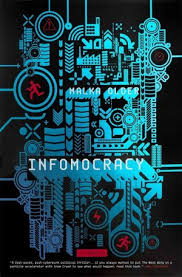
Not sure how I missed this one when it came out a few years ago… some failure of mine or the system, I guess. Anyway, I finally read this (and the rest of the trilogy) last year, and felt a hankering need to reread this year. And apparently I didn’t review it last year, so now’s the time!
There’s no specified year that this book happens; it’s two decades after the near-global institution of micro-democracy, and it’s still a fairly recognisable world aside from that, so mid to late 21st century makes sense. Micro-democracy means that most of the world has been divided into ‘centenals’ – areas of 100,000 people (or is it voters? that’s unclear, I think) – and each centenal votes in their chosen government. The biggest are Heritage, which seems like an ordinary conservative party, and Liberty, which is theoretically all about citizen freedom… then there are some old-nation-based parties, like 1China; and most terrifyingly, there are military-based parties and corporate ones, the largest being PhilipMorris. In the long run I’m not sure which of the latter two are most scary. And then, the party that gets the most centenals over the whole world is the Supermajority and they get… some unspecified powers.
This entire book is about the lead-up to the third global election. I know, it doesn’t sound like it should be riveting. But oh my goodness, it is.
Firstly, this isn’t just a world with micro-democracy. It’s also a world with Information. Information is like Google, I guess, but made a public utility that is genuinely meant to be working for the good of everyone. There’s a touch of cyberpunk in that most everyone can access Information via a handheld device if they must, or via optical implants if they can; depending on your Information settings, you can walk around anywhere and get facts about the construction of buildings, names of plants – and the public Information of the people you’re around. Older begins to explore the consequences of Information here (and I know it’s ‘begins’ because that’s something that continues throughout the trilogy, SORRY SPOILERS). And what happens when Information isn’t available?
Secondly, of course something nefarious happens, and it needs to be rectified. The two focal characters are Mishima – absolutely my favourite – and Ken. Mishima works for Information doing a variety of things, which sometimes involve a stiletto and shuriken and climbing furniture. She also has a ‘narrative disorder’ which is never fully explained but helps (usually) to sort through a mass of data. Ken is a campaigner for one of the middle-tier parties, Policy1st, who ends up finding out some of the nefarious things and gets pulled into the action. Ken’s fine; he’s an interesting mix of altruistic and self-interested that makes sense, and his doubts and angst are portrayed sympathetically but not at annoying length. Mishima is awesome; she is splendidly capable but not all-knowing, and I basically love everything about the way she acts, reacts, and thinks.
This is seriously awesome book. I guess it’s on the ‘techno-thriller’ side of things although exactly what that means I’m a bit hazy on. I would be confident recommending this to someone who doesn’t love SF, because it could almost be tomorrow; the tech’s not that outrageous. It’s fast-paced but not ludicrously so, there are a range of characters who show a range of issues, and it’s just great.
The Ministry for the Future

Kim Stanley Robinson continues to be one of the great voices of climate change fiction – particularly, the consequences of, and how humans might mitigate them (since no way are we avoiding).
The Ministry of the title is the use-name for a small international organisation set up under the auspices of the Paris Climate Agreement, kind of but not entirely associated with the UN and based in Zurich. Their remit is to basically to represent future generations, who currently don’t get a say in what they will inherit, and therefore to advocate for policies that will be good for those future people. It’s a clever way of showing that current decisions have downstream consequences, and of having people whose job it is to focus on that.
Part of the book, therefore, focuses on the Ministry: policy and the struggles of international collaboration. Another large part isn’t even really narrative so much as a series of vignettes from individuals who are either directly affected by some aspect of climate change – like the devastating heat wave that opens the novel – or by people who are involved in climate change mitigation, like farmers in Kerala who are doing awesome things with agriculture. The scope of the book is a couple of decades, thus showcasing the problems as they develop as well as the myriad and varied attempts to deal with the issues.
It’s not a standard linear narrative, therefore; but it is recognisably a Kim Stanley Robinson. For example, New York 2140 had several characters to follow and a few clear narrative threads, which sometimes intertwined, plus the narrator who dumped info on you. This is more experimental, I think, but feels like an extension of what was going on in 2140. I guess there are two main characters, although they probably don’t get quite enough space to really legitimate the title: the head of the Ministry, a middle-aged Irish woman who is awesome; and an American aid worker caught in the Indian heatwave who continues to suffer the repercussions of that for years. If it’s anyone’s story, it’s theirs; although having said that really it’s the planet’s story, and that of the entire population. Which feels so right for a book like this. It makes sense to hear from farmers in India and glaciologists in Antarctica! Less so the bits from the sun, and a carbon atom; but I’m prepared to indulge Robinson’s whims.
I trust Robinson to generally have his science right, if slightly on the outlandish side – that is, his suggestions probably match known science, but they may require more time / other resources than is considered feasible… although actually, this is something that he addresses in the book – that what seems like a large amount of money kinda isn’t when you set it in context. I do wonder whether a copy of this should be sent to people at the UN, and glaciologists, and agriculture people…
This book won’t work for everyone. The structure will annoy some, for sure, because it decentres characters and because it doesn’t really have much of a narrative. It just… covers a period of time, and what happens to the world in that time. So if you like a neat open and close, this probably isn’t for you; if you like really strong characters driving the story, likewise. But I really do recommend this as an exploration of the next few decades on our planet… it’s both optimistic on some levels but also devastating.
Station Eleven
The first question to ask here is, how did I not read this book when it first came out in 2014? And then how did I not read it when it won the Arthur C Clarke Award?

Those of you who have already read this are now possibly backing away in dismay, and reflecting my second question:
How could I read this book this year: did I not know that it involved a… y’know… flu-like virus??
The answer to the second is no, actually, I didn’t. It came as quite a surprise. And it’s a bit of a spoiler I suppose to those who haven’t read it yet but I figure that’s a community service at the moment. Because the thing is, this is a fantastic book and I want to recommend it to everyone… it’s just that, at the moment, such recommendation requires a little delicacy.
“Mum! You should read this book!! … how do you feel about reading about pandemics?”
(That’s not quite verbatim, but close.)
(For the record, she said she was fine with it.)
At any rate, I bought this in one of my spates of book buying this year, as a title I’ve had hanging at the back of my mind for five years and knew basically nothing about. And then I read the whole thing in a day. I would have read it faster than I did but I had to keep stopping to eke it out just a little bit longer. Yes, it’s one of those.
There’s a lot to love about this book. The writing is wonderful, easy to read and utterly absorbing. It takes a particular style to get away with declaring “Of all of them there at the bar that night, the bartender was the one who survived the longest. He died three weeks later on the road out of the city.” In the first part of the book, in particular, this felt a lot like one of the best of Kim Stanley Robinson’s stories (and yes, just to be clear, that’s definitely a compliment from me).
The narrative goes back and forth between times – pre- and post-pandemic – filling in character histories, drawing links between people, giving detail to the world. The two central characters (I would argue) are introduced at the start of the novel – both actors, one old and one a child. Their lives and the people they interact with largely inform the rest of the story. The child, in particular, grows up to be a focal part of the future story, traveling with a group of actors and musicians across an America utterly devastated by pandemic (see? this is why recommending it requires a certain delicacy right now!). These artists use a Star Trek quote as their raison d’être: “because survival is insufficient”. And I love this for many reasons.
As well as flitting between times, the narrative also shifts between characters – all of whom end up having some connection with the two actors, deep or glancing, which is a neat device that Mandel manages to make neither cheesy nor just too convenient. The range of people (rich and not, pleasant and not, etc) allows Mandel to explore multiple human experiences and reactions to disaster – which, let’s face it, is often the point of writing post/apocalyptic narratives. Another sign of a narrative that is well-paced and features multiple characters is that I never got impatient in reading about some new character, wanting to get back to an original – they were all engaging and, especially as the threads started to come together, I always wanted to see what the new character brought.
There’s not that many books about which I can confidently say “I will read you again.” This is one of them.
Hollow Empire

The author sent me a copy of this book at no cost. It comes out on December 1.
I read City of Lies last year, but I didn’t review it because it was for the Norma K Hemming Award, and reviewing when judging feels wrong. It should be noted that this is definitely a sequel – don’t come to it without the first book – and honestly that’s no hardship, since the first book is excellent and I highly recommend it.
In one sense, you could describe these books in a way that makes them seem like well-written but run of the mill secondary world stories: small country beset with difficulties, strange magic system not entirely approved by the powers that be, fights enemies. That would, however, be to entirely miss what makes this series (trilogy, I assume) stand out. The dual-protagonist structure does that: brother and sister, connected to power but not really wielding it, sharing narrative duty. But again, multiple perspectives isn’t all that unusual. Aspects of these siblings, though, is still highly unusual: she has what seems to be something like chronic fatigue, while he has anxiety and the sometimes-awkward coping mechanisms to deal with it. They’re often in the public eye and people sometimes look on these ‘conditions’ with a dubious eye. And they are also both entirely competent at their jobs (diplomacy, and poison-tester) and at managing their health… issues? complications? The two of them are immensely real and relatable, not defined by what others see as (potentially) disability and also not ignoring it. These two, Jovan and Kalina, make Poison Wars unusual and excellent.
Also excellent is the writing; Hawke conjures a fascinating world, with political and commercial intrigue, malice, and cooperation interlaced throughout the different countries and their interactions. Different societies have different belief systems and social mores, and navigating those is a big part of this second book, in particular, as Silasta recovers from its civil war and the problems revealed by that. Silasta must confront its own history, and oppressed people, while also being wary of external threats. I feel that there’s a particular nuance to a story touching on colonialism and empire when it’s written by an Australia (maybe this can also be true of other colonial settings, too, but I find it easiest to see in Australians). Hawke deals with the lived reality of this sort of situation for colonised and colonisers, and I (as a white Australian) think she does so well.
There is excitement here, given its focus on intrigue and discovering whether someone is indeed trying to kill the Chancellor; but there’s not a whole lot of set-piece battles, so if that’s what you’re after, you need to go elsewhere. I really like that the focus is on the people trying to stop an assassination, rather than perpetrate it; in general, the reader gets to be on the morally right side (or at least, I assume we are…) rather than cheering for a person actively trying to kill another, as in those stories focussed on the assassin themself!
Highly enjoyable; read the first book first; definitely one worth throwing yourself into.

 Randomly Yours, Alex