Slaughterhouse-Five
 I read this to help my school figure out whether they should teach it at Year 11. My thoughts? No.
Yes it’s an occasionally humorous reflection on the horrors of war and yes it’s a clever enough look at life and history and expectations and blah blah but… I did not enjoy this book in the slightest. I did not even really appreciate it much for what it was doing and saying.
If the main point, or one of, is to communicate the horror of war, I guess it does it well enough. But I don’t feel that it’s particularly well done and there are a few bits that justify Mary’s early concern about making war notseem as awful as it really was. I don’t think anyone would come away thinking that war is a lark, but still… it really didn’t work for me. I think there are other books that do it better and without being quite so annoying.
The main problem for me is Billy himself. As much as I am a pacifist I find Billy’s acceptance of everything that happens to him, his absolute passivity, incredibly frustrating and annoying and, frankly, boring. As a fictional character: yes, I know that there are things in my actual life that are just going to happen and I can’t do anything about that, so I like reading about people who have a go at shaking life to try and make a difference. As a reflection on exactly that issue of the human condition: even we, in real life, don’t generally just here, passive. At least we talk or we rage or we complain or we act as though maybe there’s a modicum of free will involved. Billy – the man who just lands in places and does nothing (that we see – clearly he got through optom school but that’s never discussed) but still manages to have good stuff and makes no decision ARGH. Not a character who was ever, ever going to work for me.
And then there’s the women. Yeh yeh it was written ages ago and I don’t care. The daughter, the wife, the girlfriend – nags and obese and existing for sex (only the last two thankfully) and I felt like the hobo who died on the train almost had more humanity than the daughter and the girlfriend, especially.
If I read the phrase “So it goes” one more time I may physically react. Passivity that makes no attempt at improvement or alteration and even movement? No thanks.
The Duke and I
Or, I read a (…nother…) Julia Quinn novel and quite liked it.
I am not a connoisseur of Regency romance (having only read… one? maybe two?) before this, so I have no idea what conventions Quinn might be playing, breaking, or taking outrageous advantage of. So I can only comment on the book itself, not its place in the genre.
 Did I know basically what was going to happen within the first chapter?
Yup.
Did the book still serve up a few surprises?
Yes, a couple. They were quite fun, actually, since most of the plot was predictable.
Did I enjoy reading it?
I read it in a sitting. So, yes. The writing is light and witty, winsome and undemanding. I liked the alternating perspective between Our Romantic Heroes. I liked (sorry Gail Carriger) that there wasn’t a big emphasis on the clothes, nor the food. I like banter, and this has quite a lot.
What about the characters?
Daphne is a forthright, sensible woman who holds out little hope of romance but would at least like to like her husband. She comes from a big, loving family. I liked her, overall; I was a bit disappointed by her eagerness to marry and have children as the be-all, but: a) why not? She’s allowed to desire that; b) as we’re reminded early on, she’s not allowed to go to university if she wants to, and she can’t aim for an awesome career – partly because she’s female, and partly because she’s gentry and they just… don’t work.
Simon had a damaged childhood. Now he’s the duke. He’s been a rake, has no intention of marrying… etc. While I sympathised with his experiences, he was certainly less interesting to me than Daphne.
Are there problematic bits?
Sure. I am always uncomfortable with the Mrs Bennett-ing of all mothers. Quinn turns the tables somewhat with Violet, and gives a marvellous hint at her actually being a very smart woman, but it wasn’t quite enough to stop me from sighing a few times at the ‘must catch the daughter a husband’ thing. Maybe it’s historical verisimilitude, but that doesn’t make it pleasant to read about.
There’s also an instance of maybe-taking-advantage-of-someone that made me uncomfortable, which then did get explored for ‘who did what’ but it still made me sad.
Will I read more?
Daphne is one of eight children. I did wonder why Quinn was ravishing so much attention on the beauty and allure of Daphne’s brothers… and then I discovered that there are, of course, eight novels in this series. Marrying off each of the children, one by one. I must admit to being somewhat intrigued, not least because I really want to find out who the gossip columnist, Lady Whistledown, is. Two of my candidates got blown out of the water by the last page, but I still have one possibility in mind…. So, maybe.
Cranky Ladies of History
This is another book that I’ve given my mum recently. She started reading it and rather smugly emailed to say that now she doesn’t feel so bad about being one sometimes. She says:
I particularly loved “A Song for Sacagawea” because it is the story of all those unsung women who were forced to help conquerors take their lands. They were looked on as trade goods, but much of the exploration/exploitation wouldn’t have occurred without them. There is a similar story of a woman who translated for the conquistadors in Central America [she means Malinche]. Much as I admire those women, their treatment really p….d me off, of course. Don’t quote me on that, though.
(Oops. Heh.)
Anyway, I am so totally excited that this book exists. I supported it in its Pozible funding, I did a little bit of supporting in terms of writing a blog post (I had big intentions to do a few but whoosh there went the month), and generally YAY stories about real historical ladies!
!!
So I finally got around to actually reading it. Firstly let me say I SEE WHAT YOU DID THERE WITH THE ORDER OF THE STORIES, TEHANI AND TANSY.
Ahem.
The first few stories were the sorts of things I expected. Mary I as a child, Lady Godiva, Mary Wollstonecraft… and then Bathory Erzsebet. Who is someone I had never come across and who was very, very not nice. Very not nice. Like, Deborah Biancotti you had already scarred me with your Ishtar and now my brain is even WORSE. Because this story does not redeem Erszebet. It shows that women are quite capable of being cold and cruel and nasty. And, at a chronological and geographical distance, this is almost something to be pleased about… since after all, we are just human.
Hmm. Getting to Erszebet has meant skipping over Mary (a story showing how difficult her childhood must have been, thanks Liz Barr), and Godiva (thank you, Garth Nix, for making her more than just That Nude Lady) and Wollstonecraft (Kirstyn McDermott, I have always loved her at a remove – that is, knowing only basics of her life, I knew she was wonderful. This fictional take helps just a bit more).
Leaving Europe, Foz Meadows goes to the Asian steppes with “Bright Moon” and a fierce tale of battle and kinship obligation; Joyce Chng to China and silkworms and captivity. Nice Shawl teases with “A Beautiful Stream” by talking about events and people from the 20th century I felt I ought to know and drove me to google find out if I was right (yes); Amanda Pillar pleased me immensely by being all provocative about Hatshepsut, one of my favourite historical women ever.
Sylvia Kelso stunned me by talking about two women from Australia’s history that I had no knowledge of (a doctor? lesbians?? in the early 20th century?!) and Stephanie Lai puts flesh on the bones of Ching Shih, the female Chinese pirate I’ve only encountered in passing. I would like to thank Barbara Robson profusely for writing Theodora so magnificently and by incorporating Procopius, to show just how such historical sources can be used. Lisa L Hannett continues (what I think of as) her Viking trend, while Havva Murat takes on Albania’s medieval past and the trials of being born female when your father wants a son.
I don’t mean this as a negative, but I am so not surprised that Dirk Flinthart wrote of Granuaile, the Irish pirate. I was surprised where he took her; pleasantly so, of course. LM Myles brought in one of my other very favourite and bestest, Eleanor of Aquitaine, this time as an old, old woman – still cranky and sprightly and everything that was great about her. I didn’t love Kaaron Warren’s “Another Week in the Future,” but I have no knowledge of Catherine Helen Spence so I had no prior experience to hang the story on. Laura Lam brought in a female pirate I’d never even heard of, the French Jeanne de Clisson, while Sandra McDonald writes a complicated narrative of Cora Crane: there are unreliable narrators and then there are unreliable timelines and sources and they get fascinating.
Thoraiya Dyer introduces someone else I’ve never heard of, by way of 19th century Madagascar and a royal family negotiating the introduction/imposition of European ideas. Juliet Marillier brings a compassionate, loving and beloved Hildegard of Bingen, while Faith Mudge caps the whole anthology with Elizabeth I.
Look, it’s just great. A wonderful range of stories, of women, of styles, of close-to-history and far (but still with that element of Truthiness). I think we need a follow-up volume. I’d like to order Jeanne d’Arc, Julia Gillard, the Empress Matilda, Pocahontas, Eleanor Roosevelt, Malinche, and the Trung sisters. Kthxbai.
You can find Cranky Ladies over here.
The Summer Prince
 Sometime in the future, when things have gone very pear-shaped, there’s a thriving city in what used to be Brazil. They’re ruled by a queen and the aunties. There’s a king, too; but he dies every year, thanks to a ritual that goes back to the setting up of the settlement and issues around who caused the world’s problems and oh yes there was a plague, too. Plus, there’s life-prolonging treatments so you’re a child, in the ideas of society, for a really long time. And we all know how people respond to the idea of being treated like a child when they think they’re totally adult and ought to be consulted on, like, stuff.
With this as the basis, now add a girl who has parental issues and a deep, deep desire to do something serious – something political – with her art. Things can’t help but get explosive, right? ART. Let’s rock the world with art. Make political statements and confront the authorities and be provocative so they can’t ignore us any more. And if they don’t like it let’s do it some more.
I was somewhat reminded of Osiris, by EJ Swift – just a bit in the post-apocalyptic nature of the world. The issues are different, in that the haves and have-nots are differently conceived, as is the outside world. But it’s still interesting to see visions of the future like this getting explored in different ways.
It’s a fast-paced ride, and very easy to read. Johnson juggles love and sex and sexuality, tradition, art, technology, family relationships, despair and hope and ambition. And right up until the very end I had no idea how Johnson was going to be able to bring it to a satisfactory conclusion – satisfactory for me, that is. And she pulls off something very clever indeed.
This was my first taste of Johnson’s novels. I am fully intending to read more.
The Falcon Throne
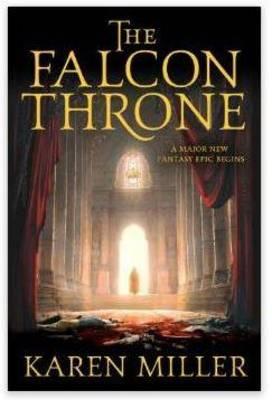 I received this book as a review copy from the publisher.
I am sad to announce that I abandoned this book. Mostly for “it’s me not you” reasons – although not entirely…
1. I’m really not in an epic fantasy kinda zone at the moment – and “at the moment” has lasted for a few years now (albeit with a few exceptions – though not many). So that counts against it for me – but for anyone who’s really in that mood, I think this is probably a good option. It’s certainly epic (in a good way!).
2. I’m not really a – argh, I don’t like the term – grimdark fan. And I’m pretty sure this counts as such. Others have compared it to A Song of Fire and Ice, and while I’ve only seen the show not read the books that sounds like the right sort of comparison. So the style is really not for me. I don’t mind bad things happening to characters, but there’s something about unrelenting unpleasantness – especially before I care about any of the characters – that frustrates and bores and annoys me. So that’s a style issue that is my problem, not the book’s.
Then there’s the style thing that I had an issue with, and it’s the way sex in general and women on occasion are described. I’m not a complete prude, although I guess I’m closer to that end of the spectrum than not, but there’s something about descriptions like “he’d have had the little wagtail pinned against a wall long since” (64) or “Aside from a writhing woman pinned on his cock, was there anything better in the world than a lance in his hand, a grand horse between his legs, and a man before him a handful of heartbeats from defeat?” (15) that leave me not just cold, but actively uncomfortable. As for the women – I got to about page 90, and most women by this stage are dead, useless, or conniving. The wet-nurse clearly has gumption and I hope she’s allowed agency and smarts, but that’s about it.
So there it is. Not a book for me. I am sad because it’s an Australian female author… but not sad because it’s an epic series I don’t have to get invested in so that saves me some time… but sad because I really don’t like abandoning books.
Indistinguishable from Magic
Sometimes when people talk about an author’s work being ‘raw’, it’s as if they think words just appear on the page and there’s no mediation whatsoever. That these words, ideas, thoughts had been flying across the savannah just minutes before the author brought them down with a flying leap to serve them up still warm for the reader. I’m not silly enough to think that – and even if I were, Catherynne Valente’s excoriating essay against people who think authors are just the conduit for some muse (“she  wrote it but…”) would have made me rethink my position.
When I say that much of Valente’s work, as presented in Indistinguishable from Magic (provided to Galactic Suburbia for review by Mad Norwegian Press) is raw I mean that she has not hidden her emotions, she has not hidden herself, from the world while writing these essays.
(One presumes. It could all be a very elaborate persona, with a very detailed background and crafted voice. Y’know, I wouldn’t put that past her – she certainly has the mad writerly skillz to accomplish such a feat. And if that’s the case, well, more power to her.)
The essays collected here are variously from Valente’s blog, speeches, and a few other sources. They’re arranged into categories: pop culture and genre; writing and publishing; gender, race, and storytelling; fairy tales, myth and the future; and “Life on Earth: An Amateur’s Guide.” And they showcase the brilliant variety of Valente’s interests passions: Persephone and Doctor Who (… possibly not so much of an antithesis there…), fairy tales, equality in all manner of things, Jane Eyre (see, Tansy? she’s on MY side), poetry, and Single Male Programmer Types managing to have sex (trust me, it’s very a very funny essay).
The pop culture musings range between 2003 and 2011. Valente’s writing is beguiling enough I actually read the entirety of the first essay, which is about Buffy and Angel, despite having watched maybe three episodes of the two shows combined. Her comments on what the show meant to 20-somethings nonetheless resonated – and that pretty much set the tone for the rest of the collection. I’m also not a big Trek fan, and have watched very little DS9, but her musings on what the station would have been like with social media? Priceless. More seriously – no, it’s all serious; more academically, her essay on why World War 2 and the Nazis keeps on popping up in comics and other fantastic culture is deeply insightful.
I read about half of the essays on writing and publishing; not being in the game myself means that I don’t really have the emotional attachment to the issues necessary to connect with much of what she writes here. That said, the first essay – the one about writing actually being hard work – is a glorious piece of writing; her explanation of her love of the term metal makes me itch to use the word more; and her utter dismantling of the argument that ‘traditional publishing is dead = a good thing’ is brilliant.
Valente is wonderfully, evocatively, angry and sincere and honest and passionate and conciliatory and clinical in her essays about gender and race and why those things matter in storytelling. “The Story of Us” skewers very neatly the whole ‘but why does it matter?’ complaint – and matches nicely with Pam Noles’ “Shame,” which I read in a Tiptree Anthology. She gets dangerously personal in “Confessions of a Fat Girl” – dangerous to herself, I would guess, because of potential backlash (I really, really hope she didn’t get any); dangerous to some readers because of how it might make some squirm at their reaction; dangerous to other readers because it might just call out their own troubles, and make them confront them.
All the essays up to this point have been easy to read – delightful to read. Some have shown Valente’s academic training. With the essays on fairy tales and folklore, though, she gets her academia on. Katabasis in Alice in Wonderland, The Wizard of Oz, and The Nutcracker? Why fantasy keeps going back to the medieval (“Dragon Bad, Sword Pretty”)? The purpose of Persephone, and her multiple faces? Oh yes.
Finally, the last set are more whimsical as a group – they don’t really have a collective theme, aside from ‘some thoughts on living in the world’. Her reflections on why people love apocalyptic literature are fascinating; her frustration at being of a generation told to live as well as their parents without the means to it revealing; and her reflections on Cleveland surprisingly moving. Her essay on her love of the anchorite idea just sings, as does her discussion of “Two Kinds of Love.”
I read this not quite in a sitting, but with nothing else around it. It certainly works like that. It would also work beautifully as a collection to dip in and out of – none of the pieces are very long, after all. There is so much going for Valente’s writing – for those who are writers, for those interested in fantasy and folklore, for those interested in the world in general. And even if you’ve been a faithful reader of Valente’s blog, Rules for Anchorites, I would suggest this is still a great collection because reading these essays in this order, with essays from elsewhere to add depth and piquancy – it just works.
Tooth and Claw
Tooth and Claw is, by its own admission, a modern attempt at writing a Victorian novel. As it opens, the patriarch is dying, and the family have gathered. Soon enough there is a squabble over the inheritance: there’s not much wealth left, and the eldest two children are already established, so the younger three are meant to get the lion’s share to help them out. But the brother-in-law decides he disagrees with the interpretation of the will, and takes more than what the younger son, in particular, thinks is fair. He then begins court proceedings to deal with it. (The blurb on my copy calls this a search for “greedy remuneration,” but I thoroughly disagree with this interpretation.)
The family is gently-born, but with little wealth and a fairly small estate this isn’t overly much use. The younger son is struggling to make his way in the corporate world, and could use all the help he can get. His older brother is established as a parson in a good living, with a fairly generous benefactress, a wife, and some children; the older sister is married, with children and expecting more. The situation is of course most desperate for the two younger sisters. Without significant dowries, attracting suitable (and nice) husbands is going to be more difficult than pleasant… and it’s made more difficult for the older one when an unwanted suitor very nearly ruins her completely.
The story revolves mostly around the three younger siblings, although the older brother gets an occasional look-in. The sisters are parcelled off to their older siblings with hopes of finding suitors or at least not being too much in the way; the younger son goes back to his city life, and the things he’d rather his family not talk about.
… all right, all right. Those in the know are amused and eye-roll-y by this stage, everyone else is confused.
Everything I’ve written so far is true. But all of the characters? They’re dragons.
Yes. Dragons. Scales, claws, eating raw meat, flying, concerned about polishing their scales, sleeping on gold, breathing fire if they’re lucky, dragons. And it works. Walton takes some of the ideas of the Victorian novel and makes them real; her take on the blushing bride is brilliant. Her vision of menial dragons is perhaps the most shocking aspect – that their wings are tied down, such that they can never fly. This is a wonderful visual of the reality of life for many ‘in service’.
Also, dragons eat each other.
This is a great, fun story. It’s light-hearted overall with a serious social message (a few, really; perhaps closer to Gaskell than Austen?). The characters are approachable, the plot plays out nicely – it’s a delight to read.
Alanna #2: In the Hand of the Goddess
A while back, I read Alanna: the First Adventure. I said at that time that I would read the rest of the quartet at some point, but I wasn’t in a screaming hurry. Then the other day on Galactic Suburbia, Tansy announced that she was commencing a re-read. Well, I couldn’t let her re-read beat my initial read, could I? What if she said spoilery things?? So, I went out and borrowed the next three. And read them…
SPOILERS

So. The second book. First off, let’s talk about this cover. It’s from the 2011 re-release, and it is less than awesome. Her horse’s name is Moonlight, fercryinoutloud. At least she’s got a sword and is dressed in squire-ish clothes. Secondly, let’s talk about where I found it: in the junior section of the library. Not the YA section; the junior section. I can maybe see the first book fitting there, but not the entire series. I found that weird before I read them, and then as I read the casual attitude towards sex – the sex isn’t explicit, in the slightest, but it is very clearly present – I was even more astonished. Also, the killing of people with swords, which again isn’t the most graphic violence but still, not sure you’d want a ten year old reading it. Thirdly, the title… well, it makes sense in some ways, but it doesn’t inspire me and in fact makes me roll my eyes. I would not pick this up based on the title. (Of course I would already have been put off by the cover of this particular edition.)
Anyway. The story picks up with Alanna now being squire to Jonathan, the prince, who knows that she’s actually a girl. The story essentially covers her progression towards becoming a knight. It covers three or four years in 240 pages. Sometimes you blink and it’s a year later. Some writers carry that off with aplomb – mostly I’m thinking of Ursula le Guin here I think – but I’m not entirely convinced of it by Pierce. Over that time, Alanna acquires a cat, Faithful (many of the names that appear in this series I am entirely unimpressed by); a lover, in Jonathan; and of course becomes a knight. And, in a very rapid turn of events, she kills her nemesis, Duke Roger. That particular bit happened so fast my head was spinning.
Alanna grows up, as she needs to, and generally that’s well done. She frets about things fairly convincingly. It was good to see that Pierce allowed Alanna’s friends to accept her being a girl relatively easily; that she had proved herself enough that it was straightforward for them to still see her as a knight.
Battle scenes aren’t dwelt on, which I appreciated. The aftermath, though, is not ignored; Alanna throws up after her first real skirmish, the patching up of soldiers is shown in as detail as the battle itself – which isn’t glorified – and when Alanna isn’t able to fight, she goes off and helps the healers. I like how practical Alanna is; I like that the reality is shown, although of course Alanna is Super Gifted in every area necessary (which sometimes does get a bit wearing).
Jonathan is a bit boring. I was surprised when he and Alanna fell into bed together relatively easily; later, there is a suggestion that this diminishes Alanna’s virtue in some eyes, but she doesn’t worry about it at this stage. I can’t help wondering about the power issues of a prince sleeping with a vassal – although of course this has always happened in history – but also the rather weird situation of a knight sleeping with his squire… although of course this may well have happened in history….
As a rogue, George of course is more interesting. I’m a bit impatient with love triangles though.
Really, this book gets through things extraordinarily fast.
You can get In the Hand of the Goddess from Fishpond.
The Gates of Noon
Probably spoilers for Chase the Morning.
Ah Stephen. Forgotten the Spiral, really? At least it didn’t happen immediately… still, it shouldn’t be a surprise that your brain couldn’t cope with the weirdness for very long. Too much career, too many one-night stands, to enjoy.
Until it reaches in to grab you again.
 In Chase, a lot of Stephen’s hollowness seems to stem from his long-ago break-up with the lovely Jacquie. Here, Stephen has got himself – and his company – involved in a project to ship the cargo of a charity irrigation system to Bali precisely because of her name. But the project is dogged by malign forces, it seems, such that they cannot organise to move it any closer to Bali than Bangkok. And with a little bit of pushing from external forces, Stephen Fisher – the Hollow Man, defeater of nasty forces last time he ventured into the Spiral – manages to find his way out of the Core again, and sets up a rather unusual method by which to deliver his cargo. It involves an ancient steamer, a seven-foot tattooed Maori, and an outlandishly mixed crew. Also another magician-type, although Ape is nothing like Le Stryge, which is about the best that Stephen can hope for. Cue adventures.
As with Chase, many of the awesome things I remembered are indeed still present. I love Rohan’s descriptions of battles, and also his evocation of sailing – be it on seas or stranger tides. The very idea is still utterly captivating – sailing into the dawn or dusk, into the clouds! – as is the idea that places have shadows. Actually, perhaps they’re closer to Platonic ideals, since they capture what is and was and will be; the essential nature of a place, even if never actually existed anywhere but in the imagination of very many people. And the idea of moving out into the Spiral as somehow refining people, as well as places, is also a wonderful one for story.
Also as with Chase, there are a couple of things that bugged me, and the main one was Stephen and his hang-ups. While the first book was mostly all “woe, I am a hollow man!”, this book is replete with “woe, I done wrong by Jacquie!” – which he did, right enough, but I could have done with a little bit less breast-beating. He does, true enough, make some attempts at restitution – and he was pretty nasty, so maybe I should cut him some slack as his conscience actually teaches him a lesson. But I didn’t have to be subjected to everything going through his head every time; it could have been indicated with a sentence or two, easily enough, especially the fourth or fifth or tenth time.
Also, bit of eye-rolling casual sexism. Irked me. It mostly does all right on the not-racist front – which, given it’s set largely in South-East Asia, is a relief. There are some bits where people’s mannerisms or characteristics are referred to as ‘oriental,’ at which I cringed a little, but on reflection those things are not usually coded negatively so… yeh, not sure what I think about that. But the inherent desire of the book is to balance tradition and ‘progress’, and I cannot fault that.
The other thing I cannot fault, and found also in Chase, is the very suggestion that there must be something MORE. More than career, more than sex-as-an-end, more than selfishness. Stephen finds that in action, but also in helping others; Mall and Jyp and others find it in becoming, and doing, what they are meant to be. It’s a worthy aspiration.
Is it very different from Chase? Well, the intention of the adventure is different, and Stephen doesn’t have to go through all the rooky, learning-to-be-on-the-Spiral stuff, so things happen a bit more immediately. There’s more sexual tension; there’s also more at stake, which I think made it work as a sequel. If it had been yet another “save that girl!!”, I am unlikely to have bothered. Plus, quite different places and different villains, which is great.
The Suck Fairy has been kind.
Megan Whalen Turner’s The Thief
I picked this up because someone – maybe Tansy? – was appalled that I’d never read any Megan Whalen Turner. So here we go. (Slightly spoiler-y but not very.)
This is definitely aimed at a YA audience (ish), and I think I would have adored it if I’ve read it a little younger. That said, I enjoyed it more than the first couple of pages suggested I might.
 The book opens with a thief, Gen, in prison. He’s pulled out of his cell and taken for an interview with the king’s magus – head scholar, not magician, so an interesting choice of words there – because the magus wants to use his particular talents for a very specific mission. It’s a rahter intriguing beginning because it’s unclear how the reader should feel about Gen: clearly he’s a thief, so that’s bad; but he’s an engaging narrator, which is ambivalence-making; the magus isn’t that nice and the king is a bully, so that makes Gen look good. There’s also a question over Gen’s abilities, since lots of people are taunting him for the boasts he made before his capture, and clearly he’s been in jail for ages, so does that make him a bad thief? On the other hand, the fact that he’s going to be used by the magus is an indication of his skill, so… yeh, lots of ambivalence here. I like well-constructed ambivalence.
Turner keeps Gen an engaging character for the length of the novel. Various bits and pieces come out about his past, and his sense of self, and all of these go to construct an intriguing and likeable man. I had to stop after the first chapter or two and re-read some sections because I half-wondered whether Gen was going to turn out to be female… that would have been really awesome, but alas no. (There’s only two female characters, I think, who get any real airtime, and that not much.) I was really, really impressed with the twist at the end… I had been fully expecting a fairly straightforward ending, and would have been fine with that – although quite what could have been done with Gen when they got back I don’t know, maybe just allowed to slip away? Anyway, the way such a major revelation actually worked in perfectly with what had gone before? Genius. The magus is a bit fickle, especially in his attitude towards Gen but also towards his two students, and I could never quite figure out whether he was meant to be thawing out over the course of the journey or if he was indeed this mercurial, sometimes-ill-sometimes-even tempered teacher that everyone had to be careful of. Overall not entirely convinced. Of the others on the journey – I don’t feel that they were quite rounded out enough for me to care that much. Interestingly, Gen is big enough to basically plug that lack. There are other characters here and there but none that are memorable.
The plot, obviously, is that of a quest – go find this ancient artefact which could have ramifications on… stuff. Along the way there’s politics and mythology and personality clashes, and a lot of walking and some adventures. It’s fun and well-paced – the walking doesn’t drag (heh), the discussions the characters have enliven things nicely, and the conclusion packs a really brilliant punch. I ploughed through this very easily and with great enthusiasm.
So I liked the characters, and the plot was fun. The world is another aspect that made me ambivalent. The author’s note vindicated my feeling from the opening chapters that this was definitely heavily influenced by Greece, and its ancient (and semi-mythologised) past. However I was weirded out by scrolls and books in the same library – which I know must have happened, but it’s still weird – and Turner only notes that Gutenberg did movable type in 1445 in the author’s note, just to give context I guess. So it’s kinda real-world ancient, kinda medieval, kinda… not. That aspect bugged me a little but when they got into the countryside it wasn’t such a problem. For the world itself – I was impressed to see the levels of the politics discussed, which makes me wonder actually at my tagging it YA although it did get to be a Newbery Honor Book. I liked the Canterbury Tales-esque aspect of telling stories to each other, although these were of mythology not everyday life, and that these myths were clearly inspired by Greek tales but made wholly Turner’s own by twists and details; there was some discussion about how much the gods affect everyday life, although not much. In all it was quite a comfortable world, I guess.
This is the beginning of a series; I will definitely be looking out for the rest of them. You can buy a shiny new copy over at Fishpond.

 Randomly Yours, Alex