Smellink verra nize indeed
 Hoo boy. I have been looking forward to this ever since I got to interview the Foglios for Galactic Suburbia way back at Aussiecon4, when they announced they’d been given a deal with Night Shade Books for the novels.
Actually, in some ways I have been looking forward to this for even longer: I first read about Agatha Clay in Girl Genius vol 9, the Hugo-nominated (and winning!) graphic novel. I had never heard of it before I got it in the Hugo packet, and… well… it was love. Pure, sweet, love. I read the entirety of vol 9; bought the ebook of vol 1; then discovered that you could just read the whole lot online, one page at a time. So I did that. One volume is one year’s worth of comics, and pages come out regular as clockwork every Monday, Wednesday, and Friday, so… yeh. You figure out how much reading that was.
Yes, I know. I lot. But I love it. It’s got Romance! Adventure! Mad Science!! And this is the sans-illustration novelisation of, I think, the first three volumes of the graphic version. So yes yes, I’ve read the story before. But this is a different version. It’s like… the novelisation of a movie. Only better.
Officially, the Foglios – wife&husband team Kaja and Phil – call this ‘Gaslamp Fantasy’. Which is different from steampunk, and I can sort of see how but I can’t always explain. I think, basically, that with steampunk things are meant to make sense, in the same way that good SF makes sense in a scientific way (sorta). Fantasy, though – fantasy gets to cheat outrageously, when it wants to, by wiggling its fingers and saying ta-DA! And as long as it does it in an entertaining enough way, it’s fine. I know, I know – I’m exaggerating ridiculously here, and the genre purists will pull me up for it. Whatever. This is gaslamp fantasy because it’s kinda the European nineteenth century, but at the same time it’s really not, and there are serious mad scientists running around, mostly with The Spark. A Spark is like someone with The Knack: whatever they want to make, whatever they fix, it Just. Works. Although most Sparks end up going nuts or being crushed by their creations.
There are numerous things I love about this series. Firstly, the characters. The main character is Agatha: a sometimes-bumbling, sometimes-competent wannabe mechanic. In the graphic novel, especially, she’s wonderful because she’s this voluptuous woman unaware of her own looks and perfectly capable of looking after herself, thanks very much. The rest of the cast, as appearing in the novel, are also great: both men and women, good and bad and somewhere in between, and – something that only occurred to me in reading it rather than looking at the pictures, which is a bit crazy – a wide ethnic mix, too. Black people, Jewish people, white people, Chinese people, the marvellous Bangladesh DuPree… not to mention all the slightly non-human types, too. And a talking cat. We love talking cats. Most of all, we love the Jagerkin. The Jagerkin inspired my title, because that’s how they talk: with the most outrageous faux-German accents you could possibly imagine (having heard Phil do his impersonation, I understand the inspiration now). They are crazy, they are mischievous, they love their hats, and they sometimes look like this:

They also have a propensity for lusting after entirely inappropriate women.
I love the plot, too. Sure you could roll your eyes at yet another story about a poor orphan girl who discovers something amazing about herself, but you know what? Who cares! It’s fun! Agatha makes it worthwhile! There’s a reason those stories get written so often. And here, along with the self-discovery stuff, there’s some serious mad science, a one-km-long dirigible, lots of explosions, and a touch of romance.
I bought the hardcover version, because the trade paperback isn’t out until August and that’s waaaay too long to wait (and it’s not very expensive anyway). It’s a lovely little production, with nice paper and cool cover art. My one gripe, and I’m a bit sad about it, is that there are some editing issues. There are a few spelling mistakes (‘access’ for ‘assess’), and someone really doesn’t like semi-colons – which would be fine if they used periods in their place, but mostly they used commas, and that just really, really, grated.
Is it original? Not if you’ve read the comic, no. I have no idea what it would be like to read this cold; I imagine there are some bits that might be a little confusing, but I can’t be sure. But did I enjoy it? Hell yes. And I will certainly be buying the second one (Agatha H and the Clockwork Princess) and third (title still TBA), because I am that much of a fangirl. Wheee!
The Outsiders
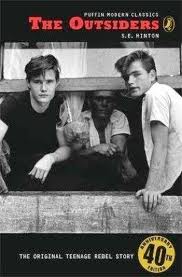 I’ve heard about this book for half my life, I guess, but I never got around to reading it because it just didn’t sound like my sort of book. Actually, I think for most of that time I was confusing it with another – possibly also by Hinton? – because I thought it was about cowboys….
Anyway, I finally read it. In an afternoon. The impetus is that I have to teach it this year and I’m glad that I read it well ahead of time, because I’m not ashamed to say that there were tears when I got to the end. Tears of sadness and tears of appreciation at the beauty of the story.
What can I say about it? I love Ponyboy, I think he’s awesome and I’ve probably taught kids like him; tough background but doing his best. I know I went to school with kids like him… and a lot of them didn’t get themselves out of the hole, sadly. His relationship with his brothers is fascinating – I read a review somewhere that was highly critical of some of the language used, questioning whether a 20-something boy would call his kid brother ‘honey’, but I’m not going to assume that I know how slang worked 40 years ago so I’m going to let that slide. I think what I appreciated most was Pony’s growing awareness of what his brothers were like as people, and how that affects their relationships; I presume that’s one of the things the curriculum wants students to consider for themselves and their own families. And the fact that there is a range of families portrayed, and that the group of boys effectively act as a family for one another, is intriguing and should also get students thinking, I guess.
Clearly one of the big messages the school will want students to consider is risk-taking behaviour and its consequences. And that’s fair enough, and I have no doubt that we will have discussions about whether Pony ought to have turned up for the big rumble, whether that was peer pressure, etc. But I hope we also have discussions about the class structure of Socs vs Greasers and how that might be reflected in our school, or not, and whether Socs really did have a tough life as well. Because those are some awfully important things to consider.
I was stunned when I realised that this was written by a seventeen-year-old. For me, it doesn’t have the feel of a debut novel, and it really doesn’t have the feel of teenage writing. Quite astonishing.
My sister describes the film as “a whole bag of sexy,” and looking at the cast I can see why: Estevez, Cruise, Swaze, Macchio, Lowe… but I still don’t think I’ll watch it. I don’t think I could stand it.
Surface Detail
 I got Surface Detail from my brother for Christmas; that is, I bought it, and he gets less $$ than he was going to for his Christmas/birthday present (it’s a long story). I wrapped it up and wrote the nicest note from him to me and everything, which apparently was a bit weird, according to the rest of the family (he wasn’t there)….
Anyway, I was very excited to finally have it in my hands. A new Culture novel! The world should rejoice! And this is one of the biggest ones yet, I think, at 627 pages. I’m way too much of a fangirl to give this a particularly critical review, but…
I have a really bad memory but I think this is one of the bigger casts that Banks has followed in detail, which contributes to its size. There are certainly some privileged characters, but most of those introduced do get some detail and resolution. They’re a good mix, too; mostly pan-human, but a few not, and to my utter delight a seriously warped AI whose avatar goes by name of Demeisen and whose attitude towards war, while reprehensible, was one of such unfeigned delight that I couldn’t help but adore him. In a reproving manner of course. I think the AIs, and the ships they’re encased in, are by and large my favourite part of any Culture novel. Not that Banks appears to feel any restrictions with his human characters, but with the AIs there are really no limits to the craziness he can put out there, and does. I think my other favourite character is the one who, if any deserve the name, is the main protagonist: Lededje Y’breq. She dies in the first chapter. Then, of course, she comes back.
Dying is, in fact, the focus of this entire book. I think someone who later becomes a main character is dead or dying in each of the first four chapters, and it kinda keeps happening. That’s because Banks decided to address one of the oldest issues in this book: whether there is a heaven or a hell. And the answer is, definitively, Yes There Is: because we made them. As virtual environments. Now the question becomes, should there be hells (heavens seem to be fine)? When it’s people just like us making them and deciding you go there? … which, in a place like the galaxy Banks gives us, naturally leads to war. That’s right people, war is hell and hell means war. Or something.
It is, of course, an awesome book. The scale is enormous; there have been a few Culture novels mostly restricted to one planet, but this is not one of them – it zooms all over the galaxy, faster than the speed of light. The plot, as mentioned, follows several different people or groups, some of whom end up tangling together and some of whom stay separate; the plot has an appropriate number of twists and surprises that I really didn’t see coming, such that I stayed utterly glued to the page the whole way through. And the language – well, it’s just swoon-worthy in parts. The speech from that dreadful avatar about why it likes war? Majestic. The descriptions of places? Concise yet evocative; I almost couldn’t read the descriptions of Hell.
Read it! You know you want to!
Fireship/Mother and Child
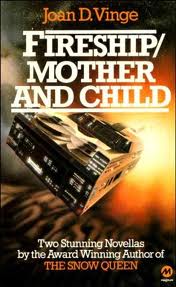 I love the idea of the novella double. Twelfth Planet Press is doing ones in the style of the old Ace doubles – different authors, back to back and upside down – and I really enjoyed the Tiptree/Russ double I read a few months ago. This one is different because it has two novellas by the same author, both of which had previously appeared in different venues. And the two stories are really quite different.
“Fireship” has the feel of a proto-cyberpunk story, to me, in that its emphasis is on a man/machine meld, and the action revolves around hacking a computer. The secondary characters are, sadly, largely two-dimensional and boring; they are there for plot resolution and really that’s it. The main character though… he is fascinating. MILD SPOILER! Ethan Ring is a gestalt: his personality is only created when a very ordinary man jacks into a superlogical supercomputer. Vinge posits the result as being entirely human in reactions and emotions, but lifted up by the computer’s abilities. Perhaps the most interesting dialogue is the internal, when human/machine/gestalt very occasionally interact. This is a really interesting take on the cyborg, and one that I’m not sure has been explored as much as it could be (if I’m wrong, tell me in the comments!). The other wonderful aspect of the story is the setting, Mars. We get intriguing glimpses of what it’s like to be on the colonised world – and it’s definitely got the feel of a colony – and some touching moments, like when the rains come and people rejoice. Additionally, there are some hints of some really interesting politics. Written in the late 1970s, it imagines politics basically being split between the US and “the Arabic states,” with Russia and China largely out of the picture.
Overall, “Fireship” is a quick read, with a fairly basic plot and ordinary characters. It’s worth reading to think about Ethan and what Vinge is saying about cyborg possibilities.
“Mother and Child” is an entirely different proposition. In three stages, the story is gradually told of a world struck by a terrible plague and suffering the consequences. The point of view gradually gets broader: at first, we see from a village smith’s perspective; then from a king’s; then, eventually – SPOILER! – from the point of view of an alien, tasked with dealing with the world and its inhabitants (reminiscent of le Guin’s Hainish cycle and Iain M Banks’ Culture, to an extent).
I’m somewhat conflicted about how it represents the main female character. On the one hand, the narrative is never from her point of view: it’s from that of her husband and then two abductors. On the other hand, she is entirely central – as the title points out – and is certainly shown as having agency: she picks her husband, and she actively decides on the fate of her child, and ultimately the fate of her world.
One of the most fascinating things about the story is its emphasis on the body. The plague has changed people, and it took me a while to realise just how much; revealing it would be too much of a spoiler, so I’ll just say that when they talk about having second sight, it’s not what you immediately think – and probably not what you thought just then, either.
I think “Mother and Child” is better written than “Fireship” and stays interesting more consistently. It certainly has better pace, perhaps because the three sections were really quite different from one another. I think I will read more Vinge, although I don’t think I will be racing out to get my hands on all her stuff.
The Killing Thing
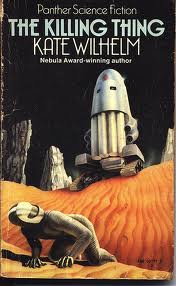 I went looking for The Clewiston Test at my local secondhand shop, but the only Kate Wilhelm I found was this one. It was short, and inexpensive, so I decided to give it a go.
On the face of it, this is a story about a man and a robot, the latter trying to kill the former, on a desert planet. At the start I thought it was going to be one of those novels that would have worked better as a short story – even at only 142 pages, I wasn’t sure the whole being-chased thing was going to have legs (ha, ha). That was before the man, Trace, started having flashbacks… and everything changed. The flashbacks filled in his own back story and that of the robot, giving a much larger context than I had anticipated. Interestingly, Wilhelm also gives the robot its own flashbacks, which disrupts the readers’ instinct to identify solely with the human protagonist. This is a brilliantly written piece : sparse details, appropriate to the subject matter, with Wilhelm deftly conveying the increasingly feverish experiences of Trace frighteningly well. She also does a fascinating thing in creating layers throughout the book: Trace revisits several key moments several times, and each time some new nuance is revealed to the reader, eventually building up to a full understanding of just what is going on.
The emphasis throughout the book is on the robot as a ‘logic box’ – its portrayal throughout is quite a different one from those found more recently, I think. The narrative only skirts around the issue of whether the robot is sentient, and what might be done if it is. Rather than dealing with this — and this is a slight SPOILER — Wilhelm is more interested in slowly, subtly, and cunningly making the reader aware of the fact that, being the well-trained soldier that he is, Trace himself can more than adequately be described as nothing more than a logic box. When I finally realised what Wilhelm was doing there, I both couldn’t believe I hadn’t picked up on it sooner and was terribly impressed with how skilfully she’d pulled it together.
The other really fascinating thing going on in this novel is its discussion of colonisation and the attitudes that colonisers bring to new places. In this case, it’s on a galactic scale, but the attitudes and issues and words and problems are all completely identifiable from the last century or two right here – and I do mean here, in Australia, as well as in the wider world. Some of the words she puts into the colonised’s mouths are uncomfortably familiar, which I’m sure is the point, and impressed me given the time at which it was written; I hadn’t thought those sorts of things were being articulated in the 1960s.
I had initially worried that the book would glorify war and the military, and it seems to indicate such a stance in the first few pages. However, by the end the book it’s clear that Wilhelm is indicting both war and the apparatus that supports militaristic attitudes, and when I realised that it was written in 1967 – well, it seems clear to me that this is an anti-war, anti-Vietnam piece. Perhaps that accounts for its lack of awards; I find it hard to believe it didn’t get any. This is a really, really, really good book.
Death Most Definite
 (By Trent Jamieson)
Anthropomorphising death is not a new idea; humans have been doing it for thousands of years. Perhaps my favourite, and one of the more famous modern examples, is Terry Pratchett’s Death, astride his white horse Binky. ‘Death’ has often been characterised as a single individual, either solely responsible for the actual death of every person (much like Santa visiting every kid), or as some sort of observer, making sure your death goes according to plan. Trent Jamieson takes a different approach, by taking and developing the idea of the psychopomp.
Psychopomps act somewhat like the ferryman Charon: not responsible for death itself, they are rather charged with ensuring the soul makes it to the afterlife. This role has often been seen as a supernatural one, with the psychopomps themselves feared as bringers of death. Jamieson’s trick, and one that works very nicely, is to make psychopomps basically ordinary humans, who happen to have a somewhat unusual job. And this is one aspect that makes Death Most Definite an amusing novel to read: being a psychopomp is just that. A job. Complete with bureaucracy, office politics, bad Christmas parties, and the potential for aggressive takeovers.
Our narrator is Steve, a Pomp who joined the business because it’s what people in his family do (with the exception of the Black Sheep, that is. I love the idea of the black sheep being the ones who want ordinary lives). He’s not bad at his job, which essentially consists of being a conduit for souls to reach the afterlife (they actually go through his body, in some sense), and keeping an eye out for Stirrers – nasty critters from the Other Side, who are capable of inhabiting a dead body and must be sent back, lest they start to take over the world. But he doesn’t love it, and he doesn’t really have the social nous to deal effectively with office politics. Things start to go badly for him when he sees a dead girl in a food court who doesn’t appear to want pomping – and who then tells him to start running. Right before someone starts shooting at him. These things should not happen; and he should most definitely not be checking out the dead girl, and finding that she is decidedly hot.
The plot follows Steve discovering that all is not well at Mortmax (which is a great name), the company that employs the Pomps. In fact, things go very bad, with all sorts of unscheduled deaths taking place and office politics getting decidedly unpleasant. Steve must figure out what is going on, not get killed himself, cope with being one of the few Pomps left to do their work… and eventually take a stand to save the world (his bit of it, anyway).
Steve is an engaging and amusing narrator. He’s self-deprecating, which adds a nice light wit to the tone of the novel without turning into an attempt at a seriously comedic book – attempts that too often fall flat. He’s agreeably individual – tall, gangly, moping for an old girlfriend, and into scrapbooking – without coming across as The Only One With A Destiny. He’s ordinary, and so are his workmates, which helps make the business of being a pomp also seem quite ordinary.
The other main character is Lissa, fellow Pomp and recently dead. She’s feisty and determined, not prone to damsel-in-distress mode. She and Steve share some marvellous banter – it felt quite realistic. Because the novel is from Steve’s point of view, however, we don’t learn nearly as much about Lissa as we do about Steve, which was a little disappointing. As a result, she’s less well-developed and complex than him. This is not to say she’s stereotyped, though – she’s not, and there are hints at depth which will hopefully be more fully explored in the next two novels (Managing Death and The Business of Death).
One of the more unexpected aspects of the novel is the fact that it is largely set in Brisbane. Brisbane is not exactly renowned as a place to set urban fantasy (which I think this is, although I’m not a great categoriser). I don’t know the city at all, but from the descriptions of the streets, the shops, and the general layout I get the feeling that the book stays quite true to it. Such a setting – and the occasional foray into the Queensland hinterland – adds to the sense of ordinariness that permeates the book. I mean that in a good way, of course. Clearly the work of a psychopomp is not ordinary, and the nastiness that ensues throughout isn’t either – thankfully. But unlike some urban fantasy that makes the characters and places seem exotic and mysterious (which can be entertaining to read), I can well imagine meeting these people and walking these streets. It brings a sense of… proximity, I guess, that made me at least care all the more about what happened to Steve in particular.
This is Jamieson’s debut novel, which actually surprised me a bit; it doesn’t have that feel. It’s a fast-paced, engaging, and overall entertaining book. Although it’s the start of a trilogy, it is self-contained, for which HALLELUJAH. Of course it’s nice to know that there is more to find out, but it is also very nice to not be left in suspense at the end of a book when you don’t have the sequel sitting right next to you. Hopefully, Death Most Definite and its sequels do well, and there will be more Jamieson novels in the future. I read it in one sitting (well, with a break for dinner, but that hardly counts).
Zima Blue
 Published in the UK in I think 2009, this is a collection of some of Alastair Reynolds’ short stories from 1991 through to 2007. I’d read a couple, but not many, so I enjoyed it immensely, even though there were a few stories that didn’t really rock my world. I won’t give a complete review here; suffice to say that I don’t think there are any Revelation Space stories here; there are some very near-future as well as some awesomely far-distant future stories; and mostly they’re great. Three stories in particular caught my attention, not least because they revolve around the same character: Merlin.
The stories are (in narrative chronological order) “Hideaway,” “Minla’s Flowers,” and “Merlin’s Gun.” I’d read the second, because it was written for Jonathan Strahan and Gardner Dozois’ most awesome anthology The New Space Opera. It remains my favourite; having the additional background provided by “Hideaway” makes it all the more fascinating. The sequence is one of Reynolds’ very, very far future histories. It begins with a group of humans in an enormous spaceship attempting to escape the Huskers, who have been systematically wiping humans from the galaxy. The group ends up hiding in a solar system, making various discoveries, and ultimately taking a drastic decision to escape annihilation. All except Merlin, who goes on and – in “Minla’s Flowers” – lands on a planet divided between two factions, and whose sun is (cosmologically speaking) going to be blown up any moment. Merlin gets involved, and the story follows the consequences of that. Finally, in “Merlin’s Gun,” Merlin finds the weapon he’s been seeking that will allow the humans to combat the Huskers, hopefully stopping the genocide. Of course, things are never quite that simple, and all sorts of interesting things are revealed.
I love the plots of these three stories, and my precis here does not do them justice. However, more than just the plots, it’s the ideas that I was intrigued by. Firstly, the vision Reynolds presents of galactic civilisation is a fascinating one. There are any number of far-future stories that imagine a basically unbroken chain of human existence, where humans just keep on building on what they already know, with few hiccups along the way. More rarely, someone writes of a pangalactic spread of humanity that hasn’t managed that continuity – as suggested by Isaac Asimov in Foundation, for example. In those sorts of stories, humans sometimes have an understanding of what they’ve lost, and sometimes not. The former is the case here, and is most vividly demonstrated by the fact that Merlin and his companions have no idea how to use the Waynet: a system of nearly-faster than light tunnels traversing the galaxy. This suggestion of galactic ups and downs is a really fascinating one. (Taken to extremes you get cargo-cult stories, which can be well done or can be painful.) I think it’s the most likely outcome, really. It does suggest a pessimism about human nature, of course, because usually the ‘downs’ are caused by wars.
Secondly, “Minla’s Flowers” deals really interestingly with issues of colonialism and the oft-accompanying attitude of paternalism. Merlin has a century to get Minla’s people up to speed on how to escape their doomed planet. But he doesn’t make them anything, or even give them all the answers. He provides what were probably intensely annoying, vague suggestions that lead to the development of atomic power. Merlin sleeps away most of the time, waking every couple of decades to provide further tidbits of information. Now, partly he acts this way because he himself doesn’t understand all of the technology he uses, for the reason outlined above. But partly he does it because he thinks that the people ought to do things for themselves. In general I’m in favour of that idea, I think, although it’s problematic when it would be easy enough to simply provide technology and supplies and instantly make things better. Both approaches have their problems, of course.
Finally, the character of Minla is a fascinating study in power. Meeting Merlin as a young girl, over the years she becomes the leader of her people and is shown as responsible for the actions they undertake. In the author notes, Reynolds says he was inspired in writing her by “a certain grocer’s daughter with ambitions to high office,” and it’s clear he had things like the Falklands War in mind when writing about her. The decisions she takes, particularly in relation to how the opposing faction is dealt with, are never suggested to be inevitable. Rather, they are precisely that: decisions, made deliberately, not forced by circumstances. I like that sort of dedication to your character, and I like that although she started off admirably she went downhill terribly – yet with a sort of terrible dignity.
The anthology in general is awesome. These stories are in the middle, and form a nice centrepiece.
The Quantum Thief
Sensory deprivation tanks are weird things. They remove all sensory inputs from the inhabitant, who is left just… floating… presumably so that they can concentrate on just thinking.

The first couple of chapters of The Quantum Thief (by Hannu Rajaniemi) are the complete opposite of a sensory deprivation tank. Within just a few pages, the narrator dies and comes back to life, confronts a copy of himself, bemoans being in prison, is rescued by a woman having hallucinations, and discovers that he has been rescued in order to do what he does best: steal something. Descriptions are vivid, and I had the feeling of being swept along – like there was no time to lose, everything has to happen fast so get on with it! – an effect that never let up over the whole 330 pages.
The book switches perspective several times, which adds to the hectic feel. The main narrator – the only character whose perspective we actually share – is Jean le Flambeur, master thief. After being rescued by Miele (whose story is quite hazy, one of my few issues with the book as a whole) to undertake a theft, they travel to Mars, where Jean begins to remember things long forgotten that threaten to undermine… everything. I quite liked Jean; he’s from the urbane, amusing thief mould, with enough complexity that he never feels like a stereotype. In Jean’s story there are elements of the classic caper, like The Italian Job: we like the thief, and although we know stealing is wrong we’re still basically cheering him on. I enjoyed finding out more of his back-story, which deepened his complexity without changing the basics of who he is.
The other perspective that dominates the book is that of Isidore, a student moonlighting as a detective. His sections of the book have a detective noir feel that nicely complements Jean’s story. Isidore is commissioned to investigate a crime that hasn’t happened yet, which brings him into contact with all sorts of interesting people. And along with his semi-professional life, the reader is also brought into his personal life, made particularly difficult by the fact that he is dating a girl from the zoku colony – and zoku don’t usually mix with native Martians. Difficulties, of course, ensue. Again, I really liked Isidore. I was a bit concerned that he would turn out to be a naïve boy-wonder, but thankfully he’s a much better constructed character than that.
As a native of Mars, the reader gets a more intimate understanding of the place through Isidore than is possible from Jean’s (and Miele’s) tourist perspective; and a weird place it is, too. Isidore lives in a city floating above the surface of the planet; a city where rather than money, the inhabitants trade in time. (Gives a whole new meaning to the phrase time-poor.) Once your time is up, you become a Quiet for some unexplained period of time: physically changed into whatever sort of machine is required for the city’s maintenance, from an Atlas supporting the whole place to merely a personal servant. And then you get changed back, but of course the experience can’t help but have altered you. The other fascinating feature of Martian society is the privacy aspect. Everyone has a gevulot: essentially a privacy screen with different levels, allowing you to do everything from be visible to absolutely everyone, to completely invisible, with shades in between. In light of current concerns over personal privacy, this is an intriguing idea – as is the idea of choosing how much of your information is available to the people you meet. Quite the reverse of Facebook then.
The plot, essentially, revolves around the theft that Jean is to undertake, which isn’t actually revealed for quite some time. Weaved through this, though, are at least two love stories, a political discussion, several explorations of the self, and a bucketload of really cool and mind-blowing technology. So it’s not a simple caper-on-Mars story. In fact it’s not a simple anything; this is definitely not the book to give someone who has never read any science fiction. There is a lot of science in this book; it expects at least a passing knowledge of quantum mechanics and entanglement theory, as well as other bits and pieces. And it’s one of those books where many disparate parts only come together at the end – if you’re not aware of how that style works, this could be a very annoying book.
Rajaniemi has had numerous short stories published, but this is his debut novel. There has been a lot of hype about it being the best debut of 2010, and indeed one of the best science fiction books of 2010, period. For a debut, it is fantastic, but I am not convinced about it being one of the best books of the year. It’s certainly very good: the characters are mostly multi-faceted and well-developed, the plot is well-paced, and his vision of Mars is wonderfully imaginative. However, as I said before, I was disappointed that Miele is not more fully explained – there are tantalising hints about her background, but not enough to really come to grips with her motivations. Given that she is a fairly major character, this is a flaw. My other problem is with the conclusion. It bugged me. A lot. I felt that it came out of nowhere, and that it did not add to the plot. It was a disappointing note on which to end. As is this.
Bold as Love
It’s Women in SF week over at Torque Control, and they’re posting the top ten SF books written by women over the last decade. Coming in at #10 is Bold as Love, by Gwyneth Jones, which I read a few weeks ago and have been meaning to blog about… so it seems an opportune time.
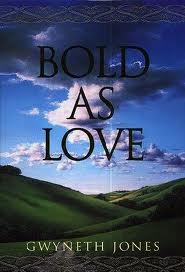
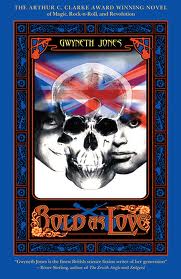
This is the book that, infamously, Tansy threw across the room when she got to the end and discovered it wasn’t a standalone novel. And I can understand that; I was halfway through it before she told me it was this one, and I too had just assumed it would stand alone. Truthfully, I think it could: there’s a huge messy pile of unresolved issues by the end of the book, but it’s done in such a way that actually I don’t feel a burning need to go find the next FOUR BOOKS. Well… that’s kind of a lie. I really really want to know what happens to my guys, but it’s a delicious sense of anticipation, not a burning MUST HAVE RESOLUTION NOW GETOUTOFMYWAY feeling.
Anyway. I was amazed to discover the book was only written in 2001; I thought it would prove to be much older. As Torque Control point out, it feels like it’s rooted in 1971 – the music, the festivals, etc. At the same time there are definite aspects that make it very modern – and those are mostly the same aspects which, when I thought about them carefully, contribute to the science fictional feel. (More on that later.) So it’s set at some time in the near future when the United Kingdom is splintering into separate countries, and a music festival has been organised to mark Dissolution. From this, essentially, come the main players in the novel – all musicians of one stripe or another – who end up being involved in politics. This seemingly-natural transition was, for me, the one aspect that didn’t sit comfortably. Perhaps it’s because I’m not very aware of the counter-culture movement in the UK (or Australia for that matter), and maybe they have, or could be imagined in the near future to have, this sort of political clout. It’s a minor quibble, though; after all, it’s sf/fantasy, and sometimes they require a bit of a leap.
Sf/fantasy? Well. Yes. When Tansy mentioned that it’s part of a series, she also mentioned that the fantastic elements become more pronounced over the series, and I can already see areas in which that can happen. But it is also definitely science fictional: there’s advanced technology in some areas, for example, and anyway it’s set in the future. I know that’s not a hard&fast guarantee of sf – just look at Michael Chadbourn – but it’s still there. In fact I think it’s one of the most fascinating meta-aspects of the book: it’s so genre, but… why does it have that feel? I don’t know, and I’m slowly coming to the realisation that actually, I don’t care about classifications so much. It’s a GOOD BOOK.
The plot, then, revolves around what happens to England (mostly) after Dissolution. There are social issues – such as the impact of a large Muslim minority; environmental issues – mostly around sustainability – which also tie into technological ideas; political issues – exactly what would happen if you put a bunch of counter-cultural musicians in a position of power? – and lots&lots of personal issues. After all, even when society is collapsing around you, in reality the thing that’s most likely to concern individuals is Does s/he like me? Who are my friends? What’s going to happen to me?
This is actually the first Gwyneth Jones book I’ve managed to get through, of two attempted: I gave up on Escape Plans pretty early on. And she is nasty to her characters! I don’t think there’s a single undamaged person in the entire ensemble. Thing is, the damage doesn’t make you want to cry for them, usually; instead, it turns them into quite hard characters, who would be utterly contemptuous of anyone even thinking of being sympathetic. Fiorinda is the sort of woman (girl, really, she’s a teenager – at least in years) who would fascinate me in real life but probably repel at the same time: she’s cynical and hard, and I’d be way too soft for her. She makes for an intriguing, and contradictory, main character. The main two male characters essentially revolve around her. I love Sage: he’s totally anarchic and narcissistic, while also being tender and considerate and generally awesome – plus his stage shows sound like they’d blow your head off. And Ax… well. He’s Mick Jagger and Jim Morrisson and David Bowie. And Bono and Bob Geldof too. I really really liked him, but I think Sage is still my favourite because he’s a bit more… human. And he’d hate me for saying it.
It’s a marvellous book. It deals with gender issues, social issues, and political issues. It wraps all of those things into the equivalent of the most awesome three-day music festival in the mud; you can’t let go, you can’t go home, you have to see it through. I have two copies (by accident) and I’m seriously thinking about keeping both of them.
Brightness Falls from the Air
One of the most interesting things about this book as an object is that nowhere (that I could find) does it mention that James Tiptree Jr is actually Alice Sheldon. Neither, though, is there any personal pronoun used for the author. This is really only interesting when you know something about the history of Tiptree, I guess, but it is revealing. It came out in 1985, which puts it only a couple of years before Tiptree’s death and several after s/he had been ‘outed’ as Alice Sheldon. So was the publisher trying to cash in on the Tiptree name and people now knowing the ‘truth’? Was it Sheldon/Tiptree’s decision? I’d be fascinated to know.
Going in, I thought this would have some of the terribly interesting gender discussions that many of Tiptree’s short stories have, and that – combined of course with the reality of Tiptree’s life – led to the Wiscon award for gender-bending in SF/fantasy being named after her. However, it’s not there. This isn’t to say anything against the story itself, which I’ll get to, but it was something of a surprise for me. There are awesome female characters; a female in command of a base, who is never questioned by the males under her, and a bunch of other women playing vastly different roles from one another – very few of the female characters or their dialogue had me cringing, which is laudable. There’s a homosexual relationship that’s neither more nor less obvious than the hetero ones… and everyone is referred to by the same honorific…. hmm. Ok. Maybe it actually is quite gender-subversive, or at least was for 1985.
Mild spoilers
There is a certain attitude in books and films that I – no doubt derivatively – refer to as the Agatha Christie Vibe. A group of people get together somewhere nice, mostly unknown to each other, and you just know that something very bad is going to happen. Brightness Falls from the Air, by James Tiptree Jr, is strong in that vibe. A planet where few humans live in order to monitor (in a good way) the indigenous sentients is about to experience a phenomenal cosmic event, and a select few tourists get to land for the show. Hello, sinister vibe.
I’ll admit, somewhat guiltily now, that I went into this book not entirely sure that I was going to enjoy it, but figuring it would be worthwhile because yo, it’s Tiptree, right? Yes, well. This is one of the best action-SF books I’ve read in a long, long time. The characters are awesome, the plot is skilfully drawn and brilliantly brought together, the worldbuilding is exquisite, and the issues it addresses – because there are some – are relevant and not overdone. Also, the writing: I could Not. Put. It. Down.
Whoever would have thought that a book which includes kiddie p0rn could have me waxing so lyrical?
Yeh. Kiddie p0rn. When I realised what was going on I was initially horrified – and, honestly, still am. It’s not a major focus of the book, but I have to put it out there, as I imagine it was picked up by contemporary reviewers. So: there’s a group of four teenagers who, with their manager, are among the tourists who arrive on the planet. It’s clear from the outset that they are TV-equivalent stars. But it’s only maybe a third of the way through that you discover there’s a sexual element to their stardom, and that there has been for a number of years. There are a number of fascinating things about this element, which account for why it didn’t immediately make me want to throw the book across the room. For a start, the manager is not the one exploiting them – he’s sympathetic, and looks after them as well as he can. For another, they’re mostly doing p0rn with each other; there’s a vague suggestion that they have been in such situations with adults, but it’s unclear. The main thing that makes this… not acceptable, because it is still horrendous, and Tiptree never suggests that it’s a good thing, but… easier to read about, is the adolescents themselves. They don’t suggest it’s a wonderful life; they’re pragmatic about their careers; and it’s never actually a central element of the story. I don’t think I’ve explained this at all well, to be honest, but all I can say is: despite its presence, I am not hesitating to recommend the book.
So, the characters. They’re marvellously entertaining. There’s an aloof one, a slightly crazy one, the teens, an on-the-surface pleasant one, sensible and earnest ones – and all of them, basically, are given interesting backgrounds, sound motives for all of their actions, complex and intriguing interactions with everyone else, and individuality. Seriously, Tiptree was a master at characterisation. There’s maybe one character who doesn’t get much explanation overall, but that’s not bad in such a large ensemble.
The plot? As I said, there’s an Agatha Christie vibe: something is clearly going to go disastrously wrong. And it does… in fact, several things do. I anticipated one of them, but the other major plot point was totally unexpected – in a good way: it made perfect sense, and upon revelation I could see where Tiptree had been leading up to it by stealth. And the two disasters weave around one another, without tripping the other up. One is an intensely personal disaster, while the other is on a more mercenary level, which is really nice; they deal with different issues and allow Tiptree to explore different reactions, emotions, and all that stuff.
Finally, there’s a really interesting element of, essentially, post-colonial critique, particularly at the very end. I have no idea whether Tiptree was into literary theory – I should hurry up and read that bio I guess – but I know post-colonialism was starting to be discussed at around the time the book was published. There are aliens on this planet, and they were terribly abused by humans in the past. Now, humans have taken it on themselves to try and rectify that… but of course, that’s still a colonial, paternalistic attitude, assuming the aliens are completely incapable of looking after themselves. Towards the end, then, there’s a suggestion of how this could change. It’s neat.
It should be clear that I adored this book, of course. It’s brilliantly paced, full of awesome characters, deals with meaty issues without getting moralistic, ponderous, or annoying, and the plot is just wonderful.

 Randomly Yours, Alex