Troubletwisters: a review

I am a long-time fan of both Garth Nix and Sean Williams (more so the latter’s SF than fantasy), so the idea of a collaboration between the two – aimed at children – is exciting indeed. And I was fortunate enough to hear Sean Williams speak about the act of collaboration at Natcon50, where he discussed the different things that each brought to the writing: that (I think!) Williams wrote the first rough draft, then Nix added bits and changed bits, and sent it back again… and so on. I was particularly amused to hear that the two got into some serious brinksmanship over who could be the most gross, since they are both little boys at heart, so I intrigued to read and discover what this looked like in practice. (The answer: they do indeed manage to be quite gross. I am not a fan of rats or cockroaches.)
Troubletwisters harks very strongly to the classics of fantasy written for younger readers. The main characters are twins: Jaide and Jack. (In talking about the story, Williams admitted that he has long been intrigued by twins and their use in fiction. As I see it, it’s almost like you’re getting a character for free – and it means that you always have the opportunity for your characters to discuss things, disagree about things, or be worried about someone.) Their father is away a lot, and they know nothing about his side of the family… until a disaster means that they have to go and stay with their mysterious paternal grandmother, where they begin to learn about some strange abilities. These plot devices could have felt hackneyed and stale, being by no means original; instead they feel familiar, but by no means comfortable. Williams and Nix use the twins as a means of exploring different reactions to scenarios and individuals, and there are indications that the two will have different experiences of their abilities that will be explored in later books of the series (there will be another four). The trope of leaving home and going to an alien place is as old as fiction itself; it can be, and is used here as, the catalyst for self-discovery and learning about the world. The strange relative and slightly intimidating new environment – Grandma X and her weird house – are perfect for the target age-group: visiting unknown relatives can be a very scary thing indeed.
The plot moves quickly: the twins arrive at their Grandma’s house and soon things start to go wrong. Additionally, weird things happen when they are around: a sign their mother can’t see, a freak whirlwind, talking cats…. There is, of course, a reason for this – it’s their nature – and the narrative is largely concerned with the pair beginning to learn about their abilities, and what it means to use them. Of course, they can’t simply do this is peace and quiet. Instead, they are confronted with a rather nasty villain, and it’s in dealing with this villain and its impact on their environment that they really start to learn about what it means to be “troubletwisters”. While the twins are allowed some breathing space – Williams and Nix don’t pretend 12-year-olds can simply go on throughout the night – the main action takes place over only three or four days, so it does feel a bit relentless. Since this is certainly how it feels for Jaide and Jack, that’s a perfectly reasonable feeling for the reader.
As with Nix’s Keys to the Kingdom series, which shares a certain tone with Troubletwisters, it’s unclear what country this book is set in. Grandma X lives in Portland – but not the one you’ve heard of. Reading as an Australian, I could well believe that this was set on the Victorian coast. Having visited the UK, I can imagine it set there, too, and I imagine that setting it in America would be as easy for readers there. This ubiquity is no doubt good for getting international readers; it also gives the book a certain Everyplace vibe. This could happen to anyone, anywhere.
I have two, fairly minor, quibbles with this book. The first is the naming of the twins. I quite like the names Jaide and Jack… but those names are short for Jaidith and Jackaran. These names simply do not work to my ear – Jackaran in particular seems too complicated, and I am not a huge fan of made-up names in a real-world context. I really hope that there is an explanation for the names in later books. On the same topic, but in the opposite direction, I was disappointed by the lack of originality in naming the villain (which I won’t reveal here). It seemed too mundane for something that so threatening.
Overall, then, this is a marvellous opening to what promises to be a very interesting new children’s fantasy series. It sets up the main characters as attractive and interesting, although not without their problems, as well as introducing some supporting characters who will no doubt go on to be important (did I mention the talking cats?). There is clearly a problem to be resolved – what to do about the villain – as well as a quest, in learning to use and control their abilities. Plus, of course, there’s the issue of their slightly fractured family, which will no doubt continue to be an issue that the twins have to deal with. I have faith in the two authors that this series will continue to be enjoyable, without being predictable.
Deep State: a review

Dagmar Shaw is a game designer, but her games are way more interesting than any MMORPG that exists today. I never entirely came to grips with what Alternate Reality Games actually entail, but it has players follow a story, interpret clues online, and it sometimes has real-world connections. The story opens with Dagmar Shaw designing a James Bond movie tin-in game that sees some players going to Turkey to actually follow some of the action in real life, while tens of thousands of others follow the video and other media Dagmar and her employees upload to the web. She runs a successful game, and is then recruited by a US – ah – security specialist to do some interesting things in Turkey. Which she does. Things do not go entirely to plan, not unexpectedly.
It’s interesting coming to Deep State after having read The Dervish House. Both are set in Turkey, but that’s about where the similarities end. The plots are entirely different, and Deep State isn’t as futuristic as Dervish House. More interestingly, where McDonald made almost all of his characters Turkish, and events happen exclusively in Istanbul with little reference to the outside world, Williams has only a few Turkish characters, and the plot revolves around foreigners getting themselves involved in Turkish politics. Williams does seem to know Istanbul, but he doesn’t evince quite the same love for the country as McDonald; and Turkey is not of the same fundamental importance to Williams as it was to McDonald. Deep State could as easily be set almost anywhere but Western Europe, I think. Turkey, although quite well realised, is not irreplaceable.
This is, it turns out, the second book about the main character here, Dagmar. She has a few flashbacks to the events of the first, This is Not a Game, and there are a few aspects of her character that are not entirely explicable but would be, I think, with knowledge of earlier events. However, it does stand alone fairly well.
The story is well-paced. The opening, with the James Bond game, is as exciting as it should be. There are lulls in the action for character development, the action is spread over a few different characters, and it wraps up nicely. I enjoyed the politics, although I’m not au fait enough with the current Turkish situation to know whether it is completely believable or not. The characters are not the most well-developed I’ve ever read, but they were more than sufficient to carry the plot. Dagmar herself is quite complex enough to be interesting; she had a difficult childhood and still suffers from the aftereffects of the events of the first book. These make her more than simply another game designer, as well as more than simply a cipher. Her boss is appropriately mysterious, while the members of her team are varied enough to provide interesting interactions. I really enjoyed the snippets of online discussion that were included; it was a nice touch. Overall the book could have done with a few more female characters; given that most of them are computer-types of one sort or another, there’s not even the (weak and laughable) excuse of needing men to do the action stuff. There were, I think, only three female characters, and one of them was almost incidental. This was my main disappointment with the novel.
Aside from the plot and the characters, the really cool part of the book – and one that, I must admit, I probably didn’t appreciate as fully as I might have – was the tech side. The creation of the ARG by Dagmar and her team, the way in which they manipulate video, the technology they use to keep track of everything: very, very cool.
Deep State is immensely enjoyable. I have put the first book on my to-read list, and expect that there will be a third at some time which I will definitely be seeking out.
This time it’s Brasyl
 I fell madly in love with Ian McDonald with Dervish House, so I pounced when I found Brasyl at the bookshop the other day. Given his other novel is Cyberabad Days, he’s an author who is clearly very keen to explore non-traditional settings for SF written in English – in a way that, as far as I can tell, is as true to those non-Anglo locales as he can be.
(NB: isn’t the cover a riot? There’s a mask, and a lizard, and tail feathers, and stars, and circuitry, and a butterfly…)
As with Dervish House, I am uncomfortable with making sweeping assertions that this book does not take an inherently white/colonial perspective, because I just don’t know – I’m a naive Anglo and I’ve never been anywhere near South America. However, as with the other book, I can confidently say that it feels sympathetic: it’s not simply showing good bits or bad bits or exotic bits, but gives the flavour of a genuine society; and it’s not simply set in Brazil because that’s a good selling point (I don’t even know if it would be). Brazil is absolutely integral to the story, and set anywhere else this would be a very different book. The ethnic mix of the population, the cultural results of that mix – especially the language – the history of colonisation and, in one narrative stream especially, the fact of the Amazon itself are all entirely necessary. And the result is that, perhaps especially to a foreigner like myself, an enchanting and sometimes repellant society with intriguing familiarities and disturbing incongruities.
On the topic of location, one of the marvellous things McDonald does in his worlds is make them contained – they are all that is required. The Rio of 2006 and the Sao Paulo of 2032 are all that is necessary for the stories to proceed. No foreigners, no other locales, are required for an elaborate and intricate story. The only other time other countries are mentioned, basically, is in talking of the soccer teams who have beaten or been beaten by Brazil. (The section set earlier in time does have some foreigners, but we only know them once they get to Brazil.) That I noticed this insularity is perhaps indicative of my earlier reading, in particular, often having involved characters who go to exotic locations to have their adventures, but rarely interact with the locals (except perhaps to sleep with; Clive Cussler, I am looking particularly at you).
Brasyl has eight sections and three separate storylines following through them. In each section, the contemporary story – set in 2006 – comes first. Next the reader is taken to 2033, and then finally to the 1730s. Each storyline is, on the surface, quite different, although there are similar themes bubbling along under the surface, and there are occasional, intriguing, cross-over references. In 2006, we follow Marcelina, a hard-living and hard-nosed TV producer for a TV channel known for making outrageous programmes. Her life isn’t an easy one; fads and trends rule, careers are made or broken on the whim of the ratings, and the effort to keep up with Society requires enormous energy and grit. And the occasional back-stab. Existence goes on as normal, until suddenly it doesn’t, and Marcelina discovers someone is messing with her life. And things do indeed get messy. Marcelina is a fascinating character. She’s good at her job, which makes her quite unpleasant much of the time. The reader is allowed occasional insights into her mind: her love of capoeira, the martial arts/dance; the way she interacts with her real and her “alt dot” families; the way she views everything as potential TV. However, we are never allowed very close to her; she remains essentially unknowable – as she is to most of those around her. I loved reading her story, but I didn’t feel as… empathic as I might have. Interestingly, for all that it’s set in 2006, I have no idea how true to the Rio of today this story is; the city, the TV, the telenovelas, the obsession with fashion all sound entirely plausible, but could as easily be that slightly exaggerated ‘tomorrow’ that McDonald does so nicely in Dervish House and the 2030s part here.
The 2030s narrative follows Edson, budding entrepreneur, who accidentally gets involved with some rogue quantum-computer scientists. In many ways, this story helps to explain some of what is going on in the other two, and why these seemingly disparate stories appear here together, because quantum mechanics and quantum entanglement are at its heart. Edson’s interactions with quantum theorists allow McDonals to posit multiverse theories and explore the repercussions of the idea that the multiverse might in fact be a quantum computer. The info-dumps are skilfully places, always in an appropriate context, an ever so heavy that they detract from the narrative itself. Edson is a more approachable and likeable character than Marcelina; he’s more innocent, despite his background, and more open, despite the difficulties of his life. While he shares a “seize any chance that comes along” attitude with Marcelina, he seems to do so with more… joy, really, and less malice. We also see Edson fall in love, and I think that has a humanising impact. Edson’s story revolved around the trouble he gets into thanks to quantum computation, but really it’s all about relationships: with his family, his neighbourhood as a whole, the bewitching female scientist and the his long-time male lover. The futuristic elements of this section are subtle and believable, epitomised by the Angels of Perpetual Surveillance keeping track of everything and everyone via RFIDs, which I can well imagine some politicians leaping at; and I-shades, which are exactly what they sound like. I think Edson may have been my favourite character.
In many ways I found the eighteenth-century plot the most confronting of all. Still set in Brazil, this is a time of European conquest – military and cultural. It follows Luis Quinn, a Jesuit sent on a quest straight from the pages of Heart of Darkness, and Robert Falcon, a French scientist. There are crazed Europeans and slave raids, dreams of building in the jungle and mysterious tribes, and over it all the immense, imponderable bulk of the Amazon rainforest that, by the 21st century, barely plays a part. I really enjoyed this section, despite its unrelenting acknowledgement of the horrible actions undertaken by Europeans, and it did require some faith that McDonald would actually connect it to the other two narratives. Quinn, on a most difficult task, is the sort of man the Jesuits wanted: deeply committed to his God and to the task at hand. Falcon is the classic 18th century opponent: Christian, but foremost a scientist, obsessed with calculations and the natural world. Together they discover some brutal truths both about the jungle and the actions of the other Europeans in the area.
All three narratives do indeed have links, although they really only become obvious towards the end. There are some similarities in theme that tie them together – trust, friendship, quest, and Brazil, most obviously. I would recommend each story on its own merits even if they didn’t coincide, to be honest. It’s a wonderfully written book, with intriguing characters and a really marvellous sense of place.
Nightsiders
 Nightsiders is the first anthology of the Twelve Planets series, a set of twelve collections being put out by Alisa Krasnostein at Twelfth Planet Press. Each of the collections will consist of four short stories. This one, by Sue Isle, features stories that all deal with the same place and similar issues: a near-future Perth, a city ruined by an almost complete lack of water, infrastructure damaged by bombs some time ago, and largely deserted in the Evacuation.
It should be said up front that I am friends with the editor, Alisa, although I do not know the author.
As a package, this is a nice little book. It’s 138 pages of narrative (with a short introduction from Marianne de Pierres), and given that’s split over four stories it’s the sort of book you can consume in one sitting or over several. I’m not a huge fan of the colour, but it is certainly appropriate given how much time is spent in the stories talking about the near-desert nature of Perth.
The first story is “The Painted Girl,” and follows Kyra and Nerina as they come into the city for the first time ever in Kyra’s experience; they’ve been wandering from place to place, never setting down roots. Kyra ends up with the Drainers, a name which is never fully explained, and learns something of the ways of this weird new place she’s been brought to. As an opening to the collection it works well, because the reader too is new to this near-future city, and has to come to grips with the lengths people go to to get and conserve water, the lack of basic amenities, and the fundamental changes which have happened in Perth, of all places.
The title “Nation of the Night” does not reflect the nature of the second story in the slightest. However, the story itself is fascinating, and I think the strongest of the collection. It deals with multiple issues with an elegance that makes reading the prose very easy indeed. Here, we follow the experiences of Ash – biologically female, psychologically male – as he heads East for surgery to resolve his conflicted nature. In Melbourne – described as intimately and recognisably for me, a Melbournian, as I am sure Perth is for natives of that place – Ash discovers that things over that way aren’t that much better, in many ways, than they are back home. The individuals Ash meets are vividly, if briefly, described, but it’s really the landscape and geography that stand out in this story; the changes wrought on a city that has taken in millions of refugees are as stark as those wrought on the city from whence all but a few thousand have fled. The story is not without problems – for all the talk of how difficult it will be for Ash to get to and from Melbourne, it feels quite easily achieved. However, as an investigation into gender identity, attitudes towards refugees, East/West relations in Australia, and the impact of climate change, this is a remarkable story.
Third comes “Paper Dragons,” which initially appeared in the ezine Shiny, also produced by Krasnostein. For all that I know entertainment has been a basic, perhaps essential, part of human civilisation since the earliest examples we have, I still found it slightly unbelievable that a community struggling as much as the Perth one appears to be would be able and willing to support a troupe of players who appear to do little else but rehearse and perform. Perhaps I’m too much of a pragmatist. I enjoyed the new characters introduced here, and the fact that Ash reappears in a different role, but I also didn’t really understand quite what the point overall was – of post-Evacuation teenagers staging an excerpt from a pre-Evac TV show, and its impact on the older people in the community. However, overall it allows yet more insight into how Perth society operates; the often brutally pragmatic choices that need to be made, and the suppression to some extent of ‘finer feelings’ that find at least a partial outlet in the theatre.
Finally, the collection closes with “The Schoolteacher’s Tale.” Here, a character referred to in other stories – Elizabeth Wakeling, teacher to generations of post-Evac Perth residents – gets a voice of her own. As a teacher myself, this story struck a chord with me, with its discussion of what learning would be necessary for generations growing up in a society like this. Elizabeth was delightfully curmudgeonly – as the oldest person in the area, and the only teacher, she’s entitled to it – but also pragmatic and willing to be flexible. Appropriately, as the collection opened with a confused young woman entering Perth, this story closes the collection with a determined old woman leaving it, with clear and specific plans in mind.
Across the four stories Isle portrays a striking, not-quite post-apocalyptic world that’s not quite believable, but not quite foreign enough to dismiss out of hand. The society she portrays in Perth is ethnically mixed, pragmatic, fiercely independent, and built on cunning. Most of those traits are ones that Western Australians would probably claim today, as well. I’m uncomfortable with the idea that the eastern seaboard would abandon the western so completely, but with Isle’s portrayal of Melbourne it becomes all too possible. Overall, Nightsiders is an intriguing collection, and it left me wondering whether Isle plans to return to the world in a novel – it certainly feels like it would be sustainable. And if this is the standard of the rest of the Twelve Planets series, I cannot wait for the next eleven.
Contact
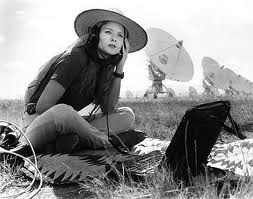 I watched Contact many years ago – possibly even at the cinema – and I read the book, too. I don’t remember the book very clearly, although I do remember thinking it was better than the film (what a surprise). I had fond memories of the movie, so when we decided to watch it again recently, I was a little apprehensive that the Suck Fairy might have visited.
I still really enjoyed it. The opening sequence is still simply marvellous; I utterly adore the perspective given to our Little Blue Dot, of course very appropriate given it was written by Sagan.
Jodie Foster… didn’t do much for me. To be honest I’ve never really understood the hype about her. I’ve never seen any of her early roles, to my knowledge, so maybe I just don’t have the context. But here – well, she’s good, but I certainly don’t see it as a role that no other actress could possibly fill. That said I do really like her character. I love how strong Ellie is, how determined she is to get her science done, that she listens to the radio waves herself rather than leaving it all to the computers. I also really appreciated that there’s really only one character who doesn’t take her seriously as a scientist, and that’s David Drumlin, whom I have called all sorts of rude names because of his treatment of her. His arrogance and sexism are aspects of his characters; they’re not meant to be taken seriously, as reflecting the sensible world. (Also, Tom Skerrit is brilliant.)
The rest of the cast is mostly good. I love William Fichtner: for his cameo in The West Wing as the judge who gets to be Glenn Close’s foil and plays with Toby’s mind, his bit part in The Dark Knight – he’s wonderful. And he’s great as Kent; the being blind is interesting and not over-played, and for me just seemed part of the diversity of characters. Yes, it’s played on to get the “ooh he has super hearing” thing, but it doesn’t feel overdone. David Morse is good in his cameo as Ellie’s dad… and then there’s Matthew McConaughey.
I like Palmer, McConaughey’s character, in theory. I really really like that the religious issue is a fundamental one in the movie, even though I don’t entirely agree with how it was handled; and even though I find it irritating that Palmer, as apparently the President’s go-to man on religion, ignores one of the big moral precepts of Christianity that helps set Christians apart from others in society (that whole no-sex-before-marriage thing). But I think he’s interesting, and I think he provides an interesting contrast to Ellie: for all he’s equally intent, he’s more relaxed than her, and they have some great discussions about evidence and faith. The Palmer character and his interactions with Ellie does, however, provide one of the things which most grieved me about the movie. He admits that he screwed up her chances to do the thing she most wants to do in the entire world not simply for religious reasons (which, actually, I liked – having to make the decision between your lover and your feelings of faithfulness towards the spiritual majority of the world), but for selfish reasons? Seriously? And our heroine still likes him? Pfft.
As a movie, I think it still holds up. The tech etc don’t feel like they’ve dated much, society doesn’t feel like it’s changed that much, and the look of it is still contemporary. Overall I was relieved, and pleased. Contact is still very watchable.
Doomsday Book: the sf and the medieval
 This is the April book for the Women in SF Book Club. I’ve been trying to read each book a month ahead of time, here at the start of the year, because I just know I’ll fall behind at some point… and those who know me know that I am nothing if not a completionist and a perfectionist. It’s a failing. Eh.
I’ve never read a Connie Willis. I know, I know; another failing. Anyway, I picked this up from the library without knowing anything about it. The first thing I thought was OMG THIS IS HUGE (669 pages, to be exact). The second was HEY, this is actually a medieval book! I didn’t realise that… and it made me a bit wary, to be honest. I’ve just finished a masters in medieval history, and while that by no means makes me an expert in the time, it does make me wary when I don’t know how expert authors are, and whether I can trust them or not. I knew a few of my friends – especially Tansy – thought she was a wonderful author, so I wasn’t entirely dubious, but… you know…
So, I began. And to be honest, the first chapter did not work for me. I don’t mind being thrown into a world headfirst, but this was a bit nuts. And I’m not sure why, but none of the characters were immediately engaging, so I neither knew who they were nor (immediately) cared to find out. I was worried that this was going to be another book to struggle through so that I could an informed and scathing commentary when the Book Club came around (which is what will happen with Darkship Thieves tonight…ETA: now!).
But I kept reading.
At the end of the first chapter, Mr Dunworthy has seen his star pupil, Kivrin, sent off to the Middle Ages via a time machine (basically). In the second chapter, Dunworthy and his friends go off to the pub, concerned but trying to be positive about Kivrin’s chances; there’s some worry over how the whole event has been organised. And all of a sudden… I cared. I don’t know why. I can’t pinpoint a moment when the people began to matter, or when I began to be engaged with the individuals and their concerns. But I think it was in this second chapter, with the minutiae of life in Oxford; and then the third chapter, with Kivrin recalling how she got the gig to be sent back in time and then waking up in the Middle Ages. And the description of the environment, Kivrin’s reactions to it… it grabbed me by the scruff of the neck and forced me to keep reading. And keep reading. And I read the 669 pages in two days.
Some spoilers.
I really, really enjoyed the book. Obviously.
I initially expected that after the sending-back-in-time experience, there would be occasional flash-forwards to Dunworthy, but that mostly the book would be focussed on the medieval. I was wrong, of course. I’m not positive, but I think the book is almost evenly split between the near-future (from our perspective; it’s set in 2055, or so) and the past. I think I may actually have enjoyed the near-future section more than the medieval. It is riveting because there’s an illness – an influenza, perhaps the most obvious modern corollary of plague – rapidly taking hold of Oxford. When I first read the book I thought it was a much more recent publication than it actually is (1992) because of the way it imagines a population dealing with disease; it feels exactly like a book written post-swine flu. At any rate, it’s fascinating because although the disease is taking over the city, Willis is most interested in a couple of individuals and how they go about trying to ignore the disease and carry on with life – and, particularly, trying to figure out what has happened to Kivrin 700 years in the past. I enjoyed Dunworthy, and sympathised with his attempts at dealing with bureaucracy, and his concern for his student – although quite why he was just so concerned was unclear, and in fact a couple of times it made me a leedle uncomfortable, because it almost skirted the bounds of propriety. (Maybe that’s just me….)
The other reason I liked the near-future sections was for their utterly normal feel. The futuristic elements were quite muted: “the net”, whereby Kivrin was sent back in time (and others, too – it’s regarded as nearly normal); some aspects of government, such as the quarantine measures; and a few medical things that hardly warrant much attention. But it would be easy enough to ignore those, and read it as set in our contemporary world. It’s very believable and enjoyable.
Of the medieval sections I was, as mentioned above, more suspicious. I was beyond annoyed, by the way, with my copy of the book, which says on the front “Kivrin wanted to study the Black Death, not live it…” because actually NO, she was not interested in the Black Death, and by the way SPOILER!! since she only realises that she’s in the 1340s – twenty-odd years off the time she was expecting – MORE THAN HALFWAY THROUGH. Gah.
Anyway, I was pleasantly surprised with the medieval village Willis created. She didn’t try to do too much: staying in one village, with a fairly small number of people, and not really getting into the politics or anything was sensible on many levels, not least of which was allowing the reader to get to know and care about a smaller number of characters. I liked that Kivrin’s interpreting software didn’t work perfectly and that there were many surprises, large and small, about the realities of medieval life – things that historians do squabble about. Kivrin as a character didn’t really do much for me; she was likeable, and I sympathised when things went badly, but I didn’t ever entirely identify with her. Of the others, the only one for whom I felt much sympathy was the priest, Roche. The others were not developed enough for me to desperately want to understand. Perhaps the most telling part of my reading experience was that when the book flicked to the 21st century, I wasn’t that impatient to return to the 14th.
Tansy warned me that I would cry because of this book (actually, she told me to buy a box of tissues). I understand why she said this. However, I did not cry. There are probably a few reasons for this. The first might be that I was warned; the second may be that I am cold-hearted, as several people suggested! But third, and perhaps most to the point: I am a medieval historian. I know the reality of the Black Death. Nothing that happened to Kivrin, nothing that she experienced, was a revelation to me; there was no surprise in any of the events nor in people’s attitudes. I felt most sadness at some of the events in the near future. And fourth, I was also prevented from bawling because I read it too fast. I had to read it fast because I had to know what happened, but it meant that I didn’t form the emotional bond with the characters that I might have with a more leisurely read-through. Not that I’m regretting it; I thoroughly enjoyed the book and had enough of an emotional connection that I certainly regretted deaths and rejoiced at survivals. It’s also possible there’s a fifth reason that I didn’t cry: that Willis didn’t give me enough of the characters to make me want to cry. I think this is probably most true of the medieval characters; at least, they’re the ones I felt least attached to. I was closest to tears when I found that Dr Mary had died; that it happened while Dunworthy was unconscious, and that young nephew Colin has been so stoic through it all, was closest to being heart-breaking.
I think I understand why people rave about Willis. I have Blackout/All Clear on my to-read list, and it will definitely stay there… but it won’t get bumped up to must-read-or-will-cry level.
Arks are by definition redeeming
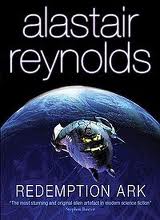 Look, it’s a Revelation Space novel. Seriously. This is not going to be a bad review.
Redemption Ark sort of takes up where Revelation Space leaves off, but uses quite a number of different characters to present the narrative. Where the Conjoiners were just another group of weirdos in the first book, here two of the main points of view are from Conjoiners – who end up having quite different takes on the events. There are a couple of familiar characters, happily – who have changed in some ways quite substantially, but of course in many ways stay the same – as well as some other new ones, including one of the most ‘normal’ characters Reynolds has used to present action in any of the Rev Space books.
The narrative? Revelation Space hinted at Inhibitors, a machine race of some sort tasked with inhibiting the development of fleshy sentience into the wider galaxy; Dan Sylveste, in his arrogance, rang their bell. <i>Redemption Ark</i> – along with a lot of side-stories – addresses how the people of Resurgam, as well as some other concerned galactic citizens, might deal with this particular threat to their existence. Actually, it’s worse than that, since most of the people on Resurgam have absolutely no idea what is going on. It’s the other people – with mixed motives – who have to take action on their behalf. Enter two very different Conjoiners, some hyperpigs, and ordinary space-faring citizens, and the race is on to decide who is going to get the weapons that alone might have a chance of dealing with that rather intimidating threat.
I love this stuff.
As I said, there are a lot of sub-plots going on. There’s the whole back-story of the Conjoiners (more on them later), there’s the sad story of Antoinette and how she ends up involved in all of this, there’s those recurring characters and what’s happened to them between books as well as what they’re doing now (se me avoiding spoilers?), as well as an update on Resurgam and Chasm City. It’s this depth, this chunkiness, that all manages to make sense and add to the overall story, that I adore about these books. If you stripped all this possibly-extraneous material out you’d have maybe a 250-300 page book (rather than 650-odd pages), and it would probably be quite good, but… it would be missing the marvellous detail, the feel of it being a messy and oh-so-real society, that I love.
The characters are of course a wonderful part of that messiness. The Conjoiners, it turns out, are a society created by one Galliana in an attempt to bring humanity ever closer to one another – by being conjoined by a neural network that allows people to communicate essentially telepathically, and see things that other people are projecting, and even read further into others’ minds than simply their surface thoughts. The idea was to create a transparent, and presumably egalitarian, society. It’s a lovely utopian vision, and there are of course dark hints that way back when it was being established – on Mars, 400 years prior to the book – that it caused wars with those afraid of that vision. I know I’ve read about that back story, somewhere; it might have been one of Reynolds’ short stories. In Redemption Ark the Conjoiners are represented primarily to the reader through Clavain – an early, somewhat unwilling recruit – and the paradoxically ambitious Skade. These two characters are developed thoroughly and, actually, quite messily; their motivations don’t always make immediate sense, they are conflicted, and they make horrendous decisions in the heat of battle. I love Clavain; I respect Skade but I would definitely want to keep her at arms’ length. Preferably someone else’s arms.
There are other new characters. Antoinette Bax, ship-owner and budding transporter, is the fairly naive and hapless everywoman (along with her partner Xavier) who gets dragged along almost against her will. She’s one of the few sections I think could have been excised without the overall narrative losing much complexity and wonderfulness (did I mention I love this novel?). Then there’s Scorpio, a hyperpig. The pigs get mentioned in Chasm City, but they don’t play much of a part; their backstory is fleshed out a little more here, but we still have to wait for another story – I think The Prefect? and one or two shorts – to get much detail. Still, the idea that a new intelligent species could have arisen out of human/pig experiments aimed at making human organ replacement easier is fascinating.
It’s a great book. There’s tension on a galactic scale, and on a personal level; there’s technology, and overcoming its limits in potentially dangerous ways; there are cameos from earlier books; there is witty dialogue, and hinted-at dark pasts, and just wonderful writing too. #fangirl
Wave your tentacles in the air
 I LOVED this book.
Major disclaimer: I am no fan of Lovecraft. That is, I have never read any of the Cthulhu texts. I had a friend in high school who really got into them, but… yeh. My aversion to horror goes waaaay back, baby. So if there are clever and/or snide references to Lovecraftian characters, ideas, or themes, they swam right over my head.
Anyway.
I had no real idea about what this book would entail, except:
1. Tansy abandoned it for apparent lack of tentacle smut;
2. The other two books by Mieville I have read (Perdido St Station and The City & the City) I have adored;
3. There would be tentacles of some sort, even if it wasn’t smut.So I had few real expectations, except that I was hoping it would be as engagingly written as his other work. On this level, I was certainly fulfilled.
Mieville’s writing style really, really appeals to me. It’s not overtly fancy and obtusely “literary” – by which I mean that snide insinuation that the author is using fancy, opaque words for no good reason; rather, I know the words he uses, and they make sense, and they tell a story. But there is SOMETHING in the construction, something in the sentences he puts together, that is utterly enchanting. He is a delight to read. This particularly applies to his dialogue. Mieville captures the essence of different characters through their words with each other; he has a talent for the rhythm of conversation, without falling into annoying attempts at getting all the slang and dropped letters in there.
My delight at the dialogue brings me to one of the really interesting aspects of Kraken. In many ways, this feels like a snarky, conflicted, love-letter to London. As a big fan of the Natural History Museum I was way more pleased than I ought to have been to see how big a role that place played. And I really enjoyed Mieville’s imagining of London as the great Heresiopolis, with its own Londonmancers looking after it, and having a really distinct and important character in the book. In theory the narrative could have been set anywhere near the coast, but Mieville makes it a convincingly London story.
The narrative? Well, it’s not the most original aspect of the novel. It boils down to an approaching Armageddon and what can possibly be done about it. There is a somewhat hapless curator, a possibly obsessive Kraken devotee, some snarky coppers, and a whole raft of Big Bad Guys all running around getting in each other’s way. There’s a twist at the very end that I didn’t see coming – but then, I rarely do, unless they are glaringly obvious. It almost all takes place in London, and from memory it takes place over a relatively short period of time, too – maybe a couple of weeks. It’s all sparked off by a giant squid specimen going missing in a rather… fantastic… manner. Things go downhill for our heroes from there, until the whole world is nearly devoured by fire. OH NOES. While I’ve read end-of-the-world stories before, it didn’t matter much. I was genuinely unsure, on and off for the whole novel, about whether or how Mieville could redeem the world from the edge of the abyss (I’m not spoiling by saying whether he does or not!)
One of the few niggling problems I had was with the female characters (surely that’s not a surprise to anyone). There were only three women of any significance, and their significance isn’t large. There’s a female copper, who I will admit to being very fond of; she has an extremely foul mouth, a short temper, and a way of figuring things out. There’s Marge (short of Marginalia…), who I initially thought was going to be totally wet but turned out to have… not “hidden reserves,” but a determination that refused to be defused, even when ostensibly the reason for keeping on going had faded. She’s cool. And there’s a Londonmancer, too, who becomes significant towards the end, but she doesn’t have that much of a role. So… yeh. Coulda had more chicks.
Overall, this was a rollicking adventure, probably more like Perdido than The City but really nothing like either of them. I don’t think it’s as good as either of them, because the narrative isn’t quite as clever. But it’s possibly more fun – depending on what you’re looking for in your genre-reading.
Under the Poppy
 This is the second book I read as part of my guest stint on The Writer and the Critic. I’d never heard of Koja before, and all I had to go on was Kirstyn’s raving and Mondy’s disgust. Good times.
Looking around on GoodReads it’s clear that this book evokes strong reactions both ways in many people. And I too am riven by indecision about it. The writing is absolutely exquisite; Koja is a mistress of the evocative phrase, the perfect description. It’s a delight to read her prose. This delight may be the only thing that got me through the whole book, and even then I skimmed chunks of the last hundred pages or so. Because, sadly, the plot could not carry me, and the characters weren’t especially engaging either.
Some spoilers… but not very many.
The novel begins in a brothel in an unnamed town, probably at the tail end of the 19th century, somewhere in Europe. It’s owned by Decca and Rupert – not a couple – and as well as whores, Under the Poppy is proud to stage erotic dramas. Real-life drama occurs when Decca’s brother Istvan turns up, unearthing old hurts and catalysing all sorts of other problems. There’s a war in the offing, so there are soldiers in town, and some rather unsavoury characters who may be involved in the war in more ways than one….
In theory, the plot could have been very interesting: love and personal hurt and betrayal in a time of war can have a lot going for it. And the fact that the novel is set in NoTime, and NoRealPlace, lends a lovely note of the surreal which is aided by the surreality of the Poppy’s dramatic presentations, and Istvan’s puppets. Sadly, though, the very subtlety that was quite engaging eventually made me very impatient. Very few issues were ever resolved (until the end, where perhaps too much was tied up too nicely for the general tone of the story (contrary, aren’t I?)), very little of any character’s background was ever fully fleshed out, and while I’m all for mystique there’s a line where mystique becomes so opaque as to be ridiculous. For me, Koja crossed that line.
This mystique affected both the plot and the characters. I enjoyed the technique of third-person narrative interspersed with first-person recollections of the past, or commentary on the current situation; that was very well done. However, there wasn’t quite enough back story for me to ever fully connect with the characters. And one of the main characters for whom I felt a great deal of sympathy – Decca – ends up being treated so poorly by Koja that I couldn’t help but feel offended on her behalf. Yes, Istvan and Rupert are incredibly complex and fascinating characters; but neither of them is very sympathetic (to my mind), and their tantrums got a bit wearing after a while. Unlike someone whose review I read (I don’t recall where), Rupert and Istvan will never be among my Top Romantic Pairs of All Time. I rolled my eyes at them too many times.
It wasn’t all bad, of course. The mystery of when and where was enough to drive me slightly wild, trying to figure out whether any of the events had genuine historical counterparts. Deeper than that, though, was what Koja was doing with Istvan’s puppets. The parallels between Istvan’s use of them in precipitating events and reactions in his audience, and the use to which Istvan himself was put (and others, too), was clever, subtle, and rather pointed I thought (in a good way).
Am I glad I read it? No, not really. The plot fell just short of engaging, although as I said the prose was swoon-worthy; and, although the sex wasn’t usually that graphic, it was just graphic or suggestive enough that it crossed out of my comfort zone.
Shakespeare, sex, and drugs
 I read this because it was the book picked by Mondy for March’s Writer and the Critic podcast, on which I was the guest (which is full of spoilers for the book). It’s kinda my sort of book… and kinda really not.
I am a Shakespeare Fan. I love me some Bard. Not the comedies, though; I love the tragedies and the histories. Oh, and Much Ado, but that’s a whole ‘nother story (one involving Kenneth and Emma and Ben Elton and Michael Keaton and Keanu…). So, a book that alternates chapters about Will Shakespeare Greenberg, aspiring Masters student at UCal, with the late-teen years of William Shakespeare in Stratford-upon-Avon, is in theory a very appealing one to me. And Winfield clearly knows (or got to know) his Shakespeare: there are allusions, and direct quotes, in I think every single chapter – and they all seemed effortless, too. I enjoyed the development of sixteenth-century Stratford. I’m not entirely convinced by man-whore Shakespeare, but I see the point from a narrative point of view, and it’s not a completely ridiculous suggestion. Overall it was a reasonably interesting portrayal of his early adulthood.
On the other hand, there was Will Greenberg. A book published in 2008 choosing the mid-1980s as its setting is kinda weird, although I understand why: Winfield was drawing (perhaps tenuous) connections between the persecution of Catholics by Elizabeth with the crackdown on drugs by the Reagan administration. The portrayal of a Masters student of literature was hugely stereotypical, sadly – although again I see the point from a narrative point of view, especially in terms of the drug use. It doesn’t help the view of Arts students in general though, and the idea that marvellous ideas come in a flash of lightning or drug overdose is just annoying and unhelpful. It may be that I am a prude, but I got bored by the descriptions of drug use and the explicit sexual content; it got in the way of telling the story.
So… not really my thing, actually. Certainly well written, in the early modern bits in particular; as a former history/lit student myself I found the brief discussion of literary theory, especially the bagging of New Historicism, pretty funny (I am a big fan of Stephen Greenblatt, one of the original proponents). But the characters weren’t that engaging and the story wasn’t that compelling.


