Left-Wing Ladies
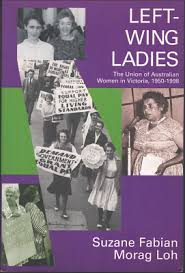
I received this book as a gift for speaking at a meeting quite some months ago, and I’ve only just got around to reading it – not from lack of interest, but just… you know. Life.
So! It’s quite short, at only 177 pages, and it’s very readable. There are a lot of acronyms, so it’s a good thing there’s a list of them at the start of the book. It probably helps to have a bit of knowledge about Australian, and particularly Victorian, history from 1950-2000, but honestly it wouldn’t matter if you knew nothing. It’s based on a lot of archival research – someone has clearly been very conscientious at keeping minutes, pamphlets, letters etc – and some oral history interviews as well.
I knew a very small amount about the Union of Australian Women before diving into this: that they existed, in the first place, which is probably more than most people my age. I had come across them in my anti-Vietnam War research, as there were several women in both Save Our Sons and UAW, and they kept getting discussed in passing with regard to other actions around peace and women’s stuff. What I did not know was the extraordinary breadth of issues that the UAW took on, nor anything about their internal politics.
For me, the most interesting aspect is what the women in the UWA worked towards. They started out as an explicitly working-class organisation, and saw themselves as more aligned with unions than anyone else; there’s a really interesting discussion about being concerned with wages not keeping up with price hikes, rather than being concerned with salaries, which I think is a difference that doesn’t get discussed so much these days. When you add that concern for class difference to the fact that in Victoria, in particular, the UWA had Aboriginal members and worked to support ideas like land rights – well before that was popular – and that they printed their information in languages other than English and worked to support migrant women workers: I rather think these women – many of whom would not have described themselves as feminist! – were expressing intersectional feminism decades before it was being discussed in those terms. Which is not to say they were always on the cutting edge of women’s issues; the book points out how members reacted to discussions of prostitutes as workers, for instance, and the early reluctance of UWA to support ease of abortion access. On both topics, though, the UWA did come around to supporting women broadly.
One of the things I can’t get over is that so many of the things they were agitating for from the 1950s on are still relevant today. Pay equity (although at least that’s now legislated…). Accessible childcare. The problem of the price of goods rising faster than wages. Aboriginal rights. Environmental issues. Safety for women and children. And their number one issue, across five decades: peace.
The internal political situation is an important aspect, if not quite as gripping. As with so many organisations like this, there was much external discussion about whether they were merely a front for the Communist Party. And it’s true that many early members were members of both, and that the CPA contributed to the UWA and may have had a hand in guiding it. They were also associated with international socialist organisations for several decades, and the Australian issues brought about by the Sino-Soviet split showed themselves in the UWA too. But it’s clear that the UWA was never just a Communist organisation.
The Victorian branch of the UWA was the last one in existence. It has basically folded now: in 2021 they announced that their remaining funds would be used to fund activities for “the leadership, training and rights of Aboriginal and Torres Strait Islander women, girls, non-binary and gender diverse young people.” I can’t help but be a bit sad that I will never experience the UWA, although I have met some women who were themselves members.


