The Hunger of Those Who Built It
Read courtesy of the publisher, Stelliform Press. It’s out in September; you can preorder it now.
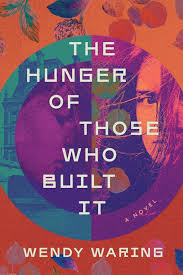
Wendy Waring does an intriguing narrative thing in this novel. The first 60 or so pages alternate between Lou, who has managed to infiltrate The Oxbow – an exclusive and exclusionary colony, basically, set up in the middle of a crumbling Paris – and Diane, Lou’s aunt, Green architect/designer and largely responsible for The Oxbow.
Then all of a sudden we get a timeshift: back 16 years, before The Oxbow exists. Diane is offered a job in Paris, creating vertical farms and helping to green part of the city, at the same time growing food for the inhabitants. It’s a world where in theory, at least, technology is greening, and so some aspects of early-21st-century urban life can change – massive highways, for instance. But, as Diane slowly learns, there are still privileged groups seeking to keep all the good stuff to themselves.
Basically, the majority of the novel is following Diane as she learns how her dream gets turned into the gated community of The Oxbow.
So on one level, it’s a story of a woman watching her dreams get manipulated and changed away from her vision. And it’s powerful for that: how hopeful intentions can be subverted, how good plans can be made to go astray, and so on. How corporations can destroy individual hopes. And, as well, there are some intriguing ideas for how cities might indeed change – for good; this is being advertised as solarpunk, after all.
The novel is not only about ambition and technology and urban infrastructure, and the big picture, though. It’s also focused squarely on the smaller picture: Diane wants to go to Paris because she is seeking reconnection with her sister, from whom she has been estranged for many years. There are many reasons for their separation; some familial, others political and philosophical. None of them have easy solutions, and Diane is frequently conflicted about her own as well as her sister’s attitudes. What I liked about Waring’s story is how very real it feels. Siblings are exactly those people who know how best to get under your skin, and who are also (often, not always) the people you want to be drawn back to.
I have one quibble with the story: an event in Diane’s history turns out to be very different from how she understood it, which has serious ramifications, many of which are part of the point of the story. But one consequence, about the dating of other events, doesn’t seem ever to be addressed, which is unfortunately something I really struggled to reconcile.
However! All up, I very much enjoyed this novel. It’s well written – I devoured it – and Waring balances the macro, urban issues with the micro, personal issues beautifully. They each feel as important as the other.
As a debut, I am deeply impressed, and hope that we can expect more of the same in future from Waring.


