Writing masculinity
What better anthology to read at a largely testosterone-fuelled event like a 24 hour bike race than one intending to discuss masculinity? And so it was that I read c0ck, edited by Keith Stevenson and Andrew Macrae.
ETA: I have been reminded that the best way to pronounce the title is with a Scottish accent – “cawwwk” – and then it doesn’t sound nearly so rude.
I got into the Australian sf scene just after this anthology came out in 2006, and despite hearing good things about it and seeing it for sale at numerous cos, I only got around to buying it at WorldCon this year. I feel that I am now a bona fide member of the scene. I read it in a day – it’s only 130-odd pages long, and I’d already read the longest piece in it earlier in the week. Lying in my sleeping bag, my brain started analysing my reactions, and I couldn’t go to sleep until I wrote this:
Taken individually, many of these stories are just sf/f/horrow; quite good, mostly, but not necessarily exceptional in the issues of ideologies they present. However, being collected in this anthology – with such a provocative title – means they create something of a gestalt: they become a sum greater than their parts, forcing the reader to acknowledge and consider the particular modes and methods of characterisation utilised (if, that is, you follow the type of reading suggested by the editors). As a collection, these stories interrogate ways of being male (and, conversely, female) that are possible, acceptable, or viable. The very idea of what it means to be a man is questioned and investigated. In 137 pages, these authors use sf in particular in ways that to me are exactly what the genre should be about: they tell engaging, sometimes creepy, stories, all with quite different characters, and they suggest ways of thinking about ourselves and society that might, hopefully, lead to change in those ways of thinking.
Yes, I get a bit pompous late at night. Anyway, I primarily bought the anthology because of Paul Haines’ Ditmar-winning “The Devil in Mr Pussy (or How I Found God inside my Wife),” which was exactly as creepy and shudder-inducing and brilliantly written as I have come to expect from the man. One of the things I really like about Haines is he in some ways so domestic a writer – most of the stuff I’ve read is set in suburbia, with normal people as the characters – that it is intensely believable and, therefore, intensely horrific. In this case, a couple move into a new house and are trying to have a baby. He’s also trying to write, and ends up taking the cat’s antidepressants. Weird, weird things happen. This was a well-deserved Ditmar win.
I liked most of the other stories in the anthology. Cat Sparks’ “The Jarrah Run” was another favourite, set on an alien world, and kinda interrogating the idea of the knight errant, and “Honeymoon” by Adam Browne and John Dixon was also excellent, with a clever take on suitors fighting for the hand of the maiden. All up, I think the collection basically succeeds in its aims. If nothing else, I was forced to ask of each story what it was saying about masculinity, whether that was realistic or stereotypical, whether I subscribed to that idea or not, and the implications of all of those. There’s violence, and control issues, and sex (lots of sex), helplessness, frustration, and a variety of relationships with women and other men. I’m pleased to have finally read it; I think it’s a really interesting part of the Aussie spec fic scene of the last few years.
A revolutionary feminist
The idea of being a revolutionary feminist isn’t exactly a ground-breaking one. However, in this context, it is, because the woman I’m referring to is Inessa Armand.
Never heard of her? What a surprise.
Have you heard the one about how V.I. Lenin, married but childless, had a lover who was kinda involved in the Bolshevik party?
That would be Inessa. Except that she almost certainly wasn’t his lover, but she was deeply, thoughtfully, and passionately committed to the Bolshevik party.
There are very few books, it seems, that look at the role of women in the Russian Revolution. There have been a few books written about Aleksandra Kollontai, which I’m keen to get my hands on – but for Westerners especially, she’s a ‘fun’ topic because she spouted all sorts of daring philosophies like ‘free love’ and that abortions ought to be legal. I also have a book on my pile to read that collates the reminiscences of women from the early Soviet era. But, really, compared to the number of books on Lenin and Stalin and Tolstoy, let alone the minutiae of aspects of the Revolution, women get short shrift.
R.C Elwood confronted this in 1996 when he wrote about Armand. He is very open about how he came to write the book, which I like: he’d been struck by some seeming inconsistencies around what little was written about her, he suggested one of his students write a thesis on her, and then… essentially his imagination was captured. One of the problems that he faced is that almost none of her writing has been published. While you can go read almost every little note or letter that Mighty Lenin ever committed to paper, not so for Armand. While it appears that she started several articles, most never got published – and the fault for that appears to lie with Lenin, who was dismissive of her work. And while she probably wrote many letters to Lenin, given the 130+ that he is known to have written to her, they have neither been collected nor published (or hadn’t to 1996; I haven’t seen any evidence of them, anyway).
Elwood’s is a well written, and well structured, biography. (It might seem obvious how to structure a biography, but within standard chronology I have read some truly confusing stuff.) He tells Armand’s story in a straightforward manner, and didn’t seem to me to be making too many leaps of intuition. He also incorporates a fair amount of history about the situation in pre-revolutionary Russia, and the immediate after-effects of the October Revolution; as with Lenin, Armand wasn’t actually in the country for the February one. Sadly, for Armand herself and in thinking about how she might have continued to influence affairs, she died in 1920 – while the Civil War was still going, before War Communism was repealed and the NEP introduced. Thinking about it though, this might almost have been a good thing, since she didn’t have to face Stalin’s rise to power.
My one quibble is Elwood’s use of the term ‘feminist’. He never theorises what he actually means by that, and whether he is using the term in a modern or a contemporary way. He doesn’t spend much time – and none early on – discussing what was obviously a problem for the Bolsheviks: that most women who identified as feminist at this time were doing so from a bourgeois perspective. Consequently, there were real problems for women who identified both as Marxist and feminist, since Marxists said women’s issues were a class problem, not a gender one. Anyway, this leads to some sections where it sounds like Armand evolved from feminism to Marxism, which I would take issue with and I’m not sure was Elwood’s intention.
There are lots of things to like about this book, but perhaps my favourite is the chapter focussing on the historiography of the notion that Armand was Lenin’s lover. Elwood details what he reconstruct of the earliest suggestions of such a relationship, then looks at the actual evidence, and points out all the flaws and inconsistencies. Of course, as he acknowledges, it is a possibility he was wrong; they (with Lenin’s wife Krupskaia) did spend a lot of time in the same places, and they did write to each other a lot. But the weight of the evidence at the moment says they were not involved like that. Apparently you actually could be female and have an impact on politics other than through your sex life. Who knew?
Women of Other Worlds
Helen Merrick and Tess Williams had the chance to attend WisCon 20 in 1996. This book, which they co-edited, sprang directly from that experience. It’s a thick book – well over 400 pages – filled with fiction, poetry, and a variety of non-fiction pieces: some critical essays on authors or particular works, some collected correspondence, a few along the lines of memoirs. I haven’t read the whole lot yet, but the pieces I haven’t read are those that relate to work I’m unfamiliar with. So there are a couple relating to Lois McMaster Bujold, for example, which I’ll read when I’ve finally caught up with the world and read her stuff.
A complete review of the book would be… extensive, to say the least. But there are a few pieces that especially made me think. For a start, there were a few pieces of fiction that I didn’t really like. That’s an odd place to start a discussion of the collection, perhaps, but it was an important thing for me to realise and come to grips with. Part of me expects to always like everything in a particular set: all feminist SF, for example, or everything by Ursula le Guin… even everything SF, period. (This account for my dismay at not enjoying Terminal World by Alastair Reynolds as much as I had hoped, given my love of everything else he’s written.) So to discover that I didn’t like everything chosen by Merrick and Williams for inclusion was interesting, and gave me pause, and was ultimately quite useful in helping me think through my attitudes. There was much fiction I did like, of course, and one of those in particular was “Home by the Sea,” by Elisabeth Vonarburg. It’s a marvellous tale about struggling with identity, and family, and personal history, in the context of a vague environmental disaster. Kelley Eskridge’s “And Salome Danced” is also a brilliant piece, creepy and lush and subtle. Showing just how useful the internet has become in facilitating criticism, it’s followed by a essay comprising email correspondence from the Fem-SF list about that story, allowing for all sorts of interesting comparison and discussion.
As an anthology relating to WisCon, there are of course a couple of pieces relating to James Tiptree Jr, although – not unexpectedly – they’re neither straight biography nor criticism. There’s an excerpt from one of the cookbooks put out to raise money for the eponymous award, which is hilarious and sounds delicious and makes me want to buy the book, and Pat Murphy’s reminiscences about how the award got started. And Justine Larbalestier contributes an essay on “Alice James Raccoona Tiptree Davey Hastings Bradley Sheldon Jr”, and the stories told about that collection of identities, that makes me itch to go read the bio sitting on my shelf.
Judith Merrill, to whom the anthology is dedicated, finishes the anthology, with an excerpt from her memoirs, and a reflection on the compiling of the same. She had been a Guest of Honour at the con, and died before the anthology was completed. It’s another bio that I really must get my hands on, because she sounds like a most amazing woman, especially in the context of her time but really for all time. I’ve read hardly any of her work, and I’ve tried looking for one of her novels (Shadow on the Hearth), but she seems to be totally out print, which is tragic.
What Merrick and Williams show in this book is how different sorts of writing can work together to give an impression of a community, all its different aspects and ways of relating and divergences. It’s my sort of book; good fiction, good criticism, humour and an attempt to understand the world, or bits of it anyway.
Pitch Black
I’m fairly sure that we watched Chronicles of Riddick at the movies one summer when it was unbearably hot outside. It looked exactly like our sort of thing: futuristic sets, awesome action/fighting sequences… excellent. Then we discovered that Riddick had had a previous outing, so of course it was a no-brainer: we had to find Pitch Black.
They are, of course, remarkably different movies. Pitch Black was made on a very tight budget, with a limited amount of time, in the Australian outback, and falls squarely into the SF/horror bracket. Chronicles had way more money and time – Diesel was a much bigger name three years later – and it is a much more lavish, grandiose film, that’s far more mainstream SF. And you can watch Chronicles without the benefit of Pitch Black, which is a remarkable achievement in a sequel.
But I’m not here to talk about Chronicles; that can wait. We re-watched Pitch Black a couple of days ago, so I thought I’d take the opportunity to muse on a couple of points.
Spoilers ahoy!
I love the anti-hero, and Riddick is close to the ultimate anti-hero. You really don’t know whether he’ll help the other survivors; the only reason I didn’t think he’d go for Johns’ plan is because he loathes Johns more than anyone else. I like that he is just human – frighteningly fast, strong, and quick-thinking, but he has no superpowers. Diesel sure knows how to deliver a line, too, which is one of the things that stops this film being way too grim for my liking.
The supporting cast is largely enjoyable. I love Claudia Black, so I’m always sad when she dies way too early. Radha Mitchell is nicely complex as the navigator trying to redeem herself, and it’s totally gutting that she doesn’t get to leave. Riddick’s one human moment comes with that stricken “not for me”. Paris P. Ogilvie is hilarious, and allows for a nice lightening of the mood; the Imam is an interesting choice for moral compass/unintimidated person. I wonder if he was only possible before the Sept 11 attacks? Perhaps becoming more feasible now…. I love Johns’ character because he alone has any real development – from apparent hero through to junkie bounty hunter, willing to sacrifice companions to save his own sorry butt. Plus, Cole Hauser is cool. And Jack – well, the kid certainly adds an interesting twist when he’s revealed to be a she. The implication that it’s bad enough that a boy would shave his head and enthuse about being a killer, but that for a girl to do so is that much more troubling, is fascinating.
I enjoy the cinematography and setting every time I watch it. There are just enough weird-ass camera shots that it has a less-than-mainstream feel to it, but not enough that I actually feel queasy. And the lighting is immensely effective. It’s overdone, but I think that’s part of its effectiveness. It’s so other, so alien, that the three suns thing feels like it fits right in. The whole eclipse-every-22-years thing? Totally terrifying. And I don’t know how many times I’ve seen this movie, but those damned monsters manage to scare me every single time: I forget when they’re going to appear, and then BAM – shriek! They’re utterly absurd, but they’re very clever.
Pitch Black remains a movie I will always enjoy re-watching.
I [heart] disaster movies
I avoided 2012 when it was at the cinema, because I figured it wasn’t going to be worth wasting my money on it there. However, if you saw it at the cinema and haven’t bothered to rewatch, let me suggest that you get the DVD and watch the special features, especially the one about the ‘science’ behind the movie: it is so, so worth it.
The scare-quotes around ‘science’ in that last sentence ought to tell you a bit about what I thought of this movie.
I have gradually come to the realisation that I am a total sucker for disaster movies. Natural or manmade, it’s all good: from Poseidon Adventure to Dante’s Peak, Inferno to Core, I just love them. Consequently, I really enjoyed 2012. But there’s no way I’m going to pretend that it was actually a good movie.
Some spoilers ahead!
For a start, I really enjoyed Chiwetel Ejiofor. I liked having a smart black man as a lead character, I liked having a sensible geography geek as a lead character, and I always enjoy a good moral scientist v immoral politician stoush. On which note, Oliver Platt was excellent as the politician, and his development from fairly sensible if somewhat (and necessarily) ruthless through to being entirely obsessed with his plan was very well played.
From my memory of the ads, I had thought that John Cusack was the main character, so I was surprised that Ejiofor’s character got quite so much play. I quite like Cusack as an actor, although this role was very different for him – and the whole SF-author-as-character thing generally has me rolling my eyes. His relationship with his family developed in somewhat unexpected ways, for which i was grateful; I had been anticipating a typical overblown Hollywood family – the reason why I won’t watch Deep Impact again, but watch Armageddon frequently. There was a bit of the divorced-parents stereotype playing out with the kids, but actually I thought the son in particular was quite a complex little character, with his angst towards the dad and love of the step-dad and wanting his dad to actually like the step-dad. I figured that someone would end up being sacrificed, one of the men, and I honestly wasn’t quite sure which it would be – and I was a little disappointed when it was step-dad. It would have been a much more interesting movie if they’d allowed step-dad to stay with the family, and also made it much more poignant that Ejiofor had brought Cusack’s book with him. But, you know, they didn’t. (Of course the much edgier version would have seen the two blokes get it on, but that was never going to happen.)
The plot… yeh. It actually had one, which was fun. I thought that the time jumps needed to be done a bit more obviously, because I was confused when they were talking about having prepared for this over years when it was only 10 minutes ago! I liked the split between national response and family response – I thought it was a pretty good split, time-wise. Having read Stephen Baxter’s Flood, when they first started talking about arks I was expecting spaceships, which would have been very, very interesting – and much more complex about how many people they could save. When I finally (eventually, much later than I ought to have) realised they were talking about floating ships… well, ok. It meant they could save more people, which was all nice and touchy-feely. And I had had several thoughts about how the movie could end, and managed to be a little surprised by the conclusion. It was something of a cop-out – especially Our Hero’s dad still being alive on the resort ship – but it was a nice (if admittedly tacky) touch to have them go back to Africa.
I enjoyed the effects. Some nice, utterly ridiculous scenes with the cars and the planes escaping from various encroaching disasters – they actually managed to be engrossing! I was gripped! One or two of the waves managed to not be entirely CGI-looking, which is an achievement.
So. 2012. Glad I didn’t see it at the movies, thoroughly enjoyable on a Saturday afternoon.
The Two of Them
I could say that I read this book, by Joanna Russ, to continue my education into feminist sf. That would partly be true. It does, however, make it sound like my reading of it was like adding bran to my muesli; something I felt I ought to do. And initially, there might have been a smidgeon of this in my thinking: I’d heard about The Female Man, for example, but hadn’t read it until last year. And it was so… amazing, and confronting, and challenging, that I realised I had to read more Russ to keep experiencing that. While also getting the chance to educate myself. It’s the same thing I get with reading history: I love the knowledge, and I love knowing it too.
The Two of Them is quite different from The Female Man. It’s a much more conventional narrative, in that it generally keeps to the same point of view throughout and has a generally straightforward timeline. There is some leaping between past and future, but that’s not exactly radical.
That said, there are some glimpses of the Russ I was expecting from The Female Man. There are instances of the author speaking to the audience, questioning her own narrative – not just her techniques, but the structure of the narrative itself. And this only happens towards the end of the story, so all of a sudden the reader is struck both with the fact of the story being a construction, and that the narrator may not be entirely trustworthy. That’s quite disconcerting.
The story revolves around a woman who was a teen in the US in the 1950s. She ends up working for a shadowy organisation that is never fully explained (which reminded me of the company in Iain Banks’ Transition, to the extent that I wonder whether he was influenced by it), and finds herself on a planet that is clearly based on the idea of a Muslim world. There, she meets a young girl who wants to be a poet, but only men are allowed to be. (Incidentally, it was at that point I got a weird feeling of deja vous. Flicking to the front of the books, I discovered a note thanking Suzette Haden Elgin for allowing Russ to use the characters from her short story “For the Sake of Grace” – I know I’ve read, sometime, in an anthology I can’t remember the name of. This is a fascinating example of intertextuality.)
The story moves into an exploration of issues concerning colonisation – does she have a right to interfere with how this planet’s society works? – and, of course, patriarchy and paternalism and coming face to face with the unconscious sexism that she’s been living with for years. Russ develops this particularly well, because the reader too is largely unaware of the sexism: it’s not like those stories where the characters are oblivious but the reader is shouting in rage. The discovery, the revelation, of how her personal relationships have been functioning is as surprising, and horrifying, and I guess depressing to the reader (well, this reader anyway) as for her.
Tied in with this meaty, crunchy (hi Tansy) exploration of issues, there’s also a scifi/adventure story. The SF element isn’t especially overt: there are space ships, and maybe time travel, but they’re just a part of the book’s reality – they don’t rate a great detailed explanation, because they don’t matter, in the same way that a toaster or a radio don’t rate explanation in a mainstream novel. It’s also short, at around 180 pages.
I can’t wait to read the essays on this novel in on Joanna Russ, which I’ve had sitting on my shelf for ages. I’m sure there are all sorts of issues and hints and allusions that I’ve missed, because they were specific to Russ’ context. This is the other thing I love about Russ’ writing: it allows for multiple re-readings, because it’s so complex – as well as being a great read.
Tor double
Twelfth Planet Press has started doing some novella doubles, which I really like. It’s a clever idea, not least since the idea of just buying a novella – or a novelette – sometimes feels like a bit of a waste of time, depending on how much it is and who the author is. But with two novella, back to back, you feel like you’re getting a better deal.
TPP is not original in this idea, of course, and does not claim to be. Ace Books did doubles years ago and, I discovered recently, so did Tor. I discovered this because, in browsing Better World Books I found a double of Joanna Russ (whose work I’ve been meaning to read more of) with James Tiptree Jr (ditto)! How awesome is that! And, of course, the idea of the great feminist critic and author matched with Tiptree, the revelation of whom as Alice Sheldon totally rocked the sf world and who is now remembered through an award honouring gender exploration and disruption – well, it’s just perfect. It would only have been made more awesome if the double had been published before Tiptree was revealed as Sheldon, but alas that was not the case.
Tiptree’s story is “Houston, Houston, Do You Read?” (glaringly announced as a Hugo and Nebula Award Winner on the front). I could tell you what story it really reminded me of, but then I’d totally spoil it for you. At any rate, three astronauts are on a solar mission and when they come back around to the Earth side, things are… different. Houston doesn’t answer, but someone else does. This story does what my favourite stories do: with an awesome sf story, its focus is on the people – their reactions, their attitudes, their problems. The astronauts are appropriately different from one another such that a range of reactions can be explored, but they don’t feel like ciphers; Tiptree deftly sets them up as individuals. I believe this story first came out when Tiptree’s true identity was unknown; all I can say is, Seriously? Did people think that he was an awesome feminist man? Or did they just not see the feminism?
Russ’ story is totally different. Called “Souls” (and glaringly announced as a Hugo Winner), I was quite dubious about it, reading the cover quote: “The Vikings thought the pickings would be easy – but the Abbess was more than she seemed!” Urgh; tacky. Anyway, I was interested to see where Russ could take a medieval-ish story, and hey – I’m a bit of sucker for Vikings stories, usually to see how bad they are. This one is told from the point of view of a young boy who follows the Abbess, Radegunde around, and who is consequently on hand when a bunch of Vikings come marauding. I had hoped that the story was going to be set on Lindisfarne, having been there last year, but it wasn’t identified as such. Again, I shan’t give away any of the story; suffice it to say that it was definitely worth reading. Again, it’s a fascinating study of humanity, and the variety of reactions that people can have in difficult situations. For me, one of the really interesting aspects was the religion. I’m guessing Russ is an atheist, and she said some things that made me a trifle uncomfortable, but said some really insightful things at the same time – about Christianity in general, and about its status in the historical context. (I also really, really liked that the narrator was hoping that the Vikings would have horns on their helmets, and then notes that Vikings never actually did that.)
This double? Totally worth it. And there a number of others listed in the cover… I wonder how book stores categorise these: under which author?
Feminism(s), sf, fandom and the cabal
The Secret Feminist Cabal: A Cultural History of Science Fiction Feminisms
Helen Merrick
Aqueduct Press, 2009
“… what kind of self-respecting cabal would openly advertise its ‘secret’ existence through websites and conventions, identify its members through the wearing of garish temporary tattoos, and fund itself by the sale of home-baked chocolate chip cookies?” (p1)
I did not grow up considering myself a feminist; I have no idea whether my mother would identify as a feminist or not. That said, I grew up in the ’80s with a younger brother and there was never a time at which I felt that I could not do exactly the same things as my brother, if I wanted to, so I know (now) that I benefited from second-wave feminism – and from liberal, caring parents. I was regarded as a feminist by at least some people by the time I was in my late teens (looking at you, high school teachers), probably because I was loud and everyone loves a stereotype. It’s only been over the last decade (my twenties) that I have consciously thought of myself as a feminist. And it’s only been in the last couple of years that I have consciously sought out feminist books, feminist perspectives on historical issues, and really come to grips with the idea that feminism is not a singularity.
All of this is by way of contextualising my reading of The Secret Feminist Cabal, a marvellous book that has challenged the way I think about science fiction, fandom, and feminism. Merrick had me from her Preface, where she describes her journey towards writing the book in ways that resonated deeply with me, from the nerdy adolescent to the discovery of feminism and the dismay that many female acquaintances not only do not share our love of science fiction, they are completely mystified by it. Having only recently discovered the niche community that is sf fandom, the fact that so much of this book is concerned with expressions of feminism within that community – and how they impacted on sf broadly – was the icing on the cake.
Merrick begins by examining the very idea ‘feminist sf’, defining which – much like attempting to define sf by itself – is like the proverbial attempt by blind women at describing an elephant. She approaches it by discussing the multiplicities that are the reality of the genre, which is indicative of the approach she takes in the book overall and an incredible relief for those of us who are sick of being told THIS IS THIS and if you don’t fit, get lost. She also gives some space to justifying the use of literary criticism on science fiction, tackling that persistent and derogatory argument that science fiction doesn’t count as literature. While accepting that sf and popular fiction generally have an ambivalent position, as far as literary critics – including feminists – are concerned, Merrick makes no apology for using their tools. The rest of the introduction lays the groundwork for the book: what feminist fiction is or can be, the potentially problematic nature of feminist genre writing, and the ongoing divide that exists between mainstream criticism and feminist sf criticism. I particularly enjoyed that while Merrick engaged with these issues, at no point does her discussion become a polemic against those who have disagreed. Rather, she situates her investigation within the ‘grand conversation’ of feminist sf, and demonstrates constructive ways in which that can be extended to mainstream criticism – to the advantage of both.
I was forced to stare into space for some minutes when I read the opening to chapter 2. Merrick quotes from a letter written in 1938 wherein an sf reader opines that: “[a] woman’s place is not in anything scientific. Of course the odd female now and then invents something useful in the way that every now and then amongst the millions of black crows a white one is found” (p34). If nothing else, this book has made me grateful for the changes that have occurred over the last century, such that I have never been personally confronted with such a statement. This chapter provides an overview of the ‘invasion’ of women, sex, and feminism into sf, with a fascinating if horrifying look at the arguments of the 1920s and 30s for and against women being allowed into the genre. (She makes the point that of course women were already there, both as authors and readers, and that it’s hugely problematic when those foremothers are written out of history, as happens too often.) The 1960s and 70s saw some changes to the field, and the disputes that attended this period of ‘sexual revolution’ make for fascinating – if, again, horrifying – reading. My favourite section is that on Joanna Russ writing letters and criticism and the way such respected names as Philip K. Dick and Poul Anderson responded to her and her comments. I love the fact that what now generally appears on blogs as a long and convoluted comment-thread then featured in magazines, albeit at the mercy of the editor. This chapter alone is worth its weight in cookies for outlining the milieu in which both male and female sf writers and fans existed for so much of the twentieth century – an invaluable resource for a newbie like myself.
The third chapter takes up one strand mentioned in the second and runs with it: the idea of ‘femmefans’. The fact that female fans were distinguished by a separate moniker goes some way to revealing how they were regarded, at least by some males of the community. It’s almost heartbreaking to read of the letters written to pulps such as Amazing Stories by women who imagine themselves as the only female readers of such stories – another reason I love the future that is blogdom. What I particularly love about this chapter is its uncovering of specific women involved with sf fandom, in many and varied ways. Instead of making generalisations about readers and contributors to zines, Merrick goes out of her way to trace named individuals and outline their experience within the scene. Appropriately, there is a section on Australian women, who seem to be even more hidden from view than their American or British sisters.
The development of specifically feminist criticism of sf is discussed in chapter 4, with a fair amount of space given to Joanna Russ, as one of the progenitrices of formal feminist criticism and the name to which many others felt themselves to be responding. Merrick chronicles the rise of feminist fanzines in the 1970s, and the impact these had on writers and fans, as well as the increasing numbers of feminist anthologies being produced. The chapter moves through to the 1980s and ’90s, noting trends and struggles as feminists of those times attempted to define themselves as well as understand their histories. As with the previous chapter, Merrick provides copious accounts of individuals here, and an extensive reading list of both criticism and fiction.
Bouncing back to fandom, chapter 5 examines the development of feminist fandom concurrent with the development of feminist criticism of chapter 4. Again going for the intensely personal stories to illustrate a broad, diverse narrative, Merrick weaves a story of female fans and their involvement in the fannish community from the 1960s to the 2000s. The feminist fanzines sound like an amazing community to have been involved in. Her discussion of the place of Marion Zimmer Bradley in this community – beginning as a fan, becoming a well-known writer, and causing all sorts of controversy over her (at least early) non-identification as a feminist – is enthralling, and beautifully illustrates the axiom that the personal is always already political. The chapter ends with a discussion of how WisCon (a feminist sf convention) and the Tiptree Awards were established.
The last two chapters of Cabal “examine how recognition of the cultural work of sf feminisms filters out into other critical communities,” and as a consequence have a heavier, more literary-critical, feel, which may make them more opaque to some readers than the first five chapters. Chapter 6 deals with sf feminim’s response to cyberpunk, a 1980s sf movement that some saw as eclipsing or superseding the feminist sf fiction of the 1970s. Merrick connects this with theorist Donna Haraway’s call for feminists to consider the cyborg as a way of considering the fundamental issue of what it means to be human. The movement also connects with a growing sub-genre of cultural studies, that examining techno-science and cyberculture. A feminist take on these issues is an intriguing one, especially in its observation that much cyberpunk is opposed to the material, the body – and how problematic that can be.
Interestingly, Merrick takes her discussion in what feels like quite a different, although still relevant, direction for her last chapter: the connection of feminist sf with science itself, and how feminism is and can be in dialogue with that discipline. She suggests very strongly that sf feminisms can and should play a vital role in dialogues negotiating the interplay of science, nature, and culture, and gives examples of a number of ways in which this has already occurred productively.
Finally, Merrick has a provocative conclusion. She addresses new challenges such as those posed by queer theory and postcolonialism, and where or how feminism might still fit in. Along with a consideration, appropriately enough, of what the Tiptree Award has taught us since its inception, Merrick considers the question of whether the science fiction field is ‘beyond’ questions of gender. She argues that feminism – as long as it remains the challenging and diverse field it has been until now – still has a great deal to offer science fiction writers and readers.
A critical work based in a deep-seated love of the genre, Cabal is a testament to the enduring impact of women, feminism, and fandom on the fractured behemoth that is science fiction. 2010 saw it shortlisted on the Hugo ballot for Best Related Work, and win the fan-voted William Atheling award for best critical work. These are well-deserved honours. I hope coming generations of both writers and fans will make use of the cornucopia of references Merrick has gathered, both to understand the history of the field and because most of them make for wonderful reading.
Godlike Machines
I got to read a review copy of Godlike Machines a while back, and fell totally in love with it. It’s finally, finally, been published, so I get to talk about it!!
I am so in love with Big Dumb Objects. And Small Dumb Objects. And grand, time-spanning, galaxy-sweeping space opera. Godlike Machines was, basically, written for me.
The opening story is “Troika,” by Alastair Reynolds. Told be a cosmonaut to an old woman, Nesha, it details humanity’s reaction to an astonishing object appearing in our solar system – the Matryoshka. Reynolds has delicate character development, gripping plot development, and an all-too-real visualisation of near-future Earth. This story made me sigh with pure pleasure. A novella, it could easily be a full-length novel; in some ways it reminded me of Clarke’s Rama sequence. I have nothing bad to say about the characters, or the narration, or the climax. This one goes straight to the pool room of All Time Favourites.
Stephen Baxter’s “Return to Titan” was perhaps not as infatuation-producing as I have not yet read any of the Xeelee sequence; but it’s still a good yarn, about going to Titan – obviously; the reasons for doing that and the weird things the explorers discover. The characters were intriguing, and not very likable overall.
Cory Doctorow’s “There’s a Great Big Beautiful Tomorrow” seemed a bit aimless, after the first two which have such strong, driving, and relentless plots; still the characterisation is a marvel, and some of the ideas are breath-taking.
Having recently read “A Map of the Mines of Barnath,” I was immensely pleased to read “A Glimpse of the Marvelous Structure” by Sean Williams. This one goes up alongside “Troika,” for my money; the characters are drawn sparsely but believably; the plot unfolds gently, relentlessly, and suprisingly; and – and – I just loved it!
How can you make a story about a BDO sad and poignant?? Robert Reed manages it in “Alone,” but I’m still a bit bemused. This is another story going straight to my favourites list… a machine on an enormous ship, alone for enormous swathes of time: would it want to know its provenance? Is it possible to be self-contained to such an extreme, for any sentient? *sigh* it’s just wonderful.
And finally, Greg Egan’s “Hot Rock” is yet another take on what exactly a godlike machine could be. In this case, it’s a planet. Explorers from two different worlds come together to a wandering planet, which – despite having no sun – still manages to be balmy and atmospheric. Once again interacting with aliens is the theme of the day; managing your own prejudices and expectations, and figuring out how to make the best of a situation for everyone involved. In this case, it was the action that pulled me along; the characters are interesting enough, but not quite at the same level as Alone or Reynolds’ cosmonaut.
Basically, this anthology has ruined me for space opera for a while. It will be hard for anyone else to compete.
Racial stereotyping and plot development: the Belgariad, book 2
Tehani and I continue our re-read of David Eddings’ The Belgariad. Tehani’s got it over here, if you’d like to read the comments she gets; there are more spoilers ahead!
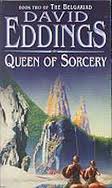
Queen of Sorcery: Book 2 of the Belgariad
David Eddings
Me
I’ve never figured out whether the title refers to Polgara or Salmissra, but that’s ok. Maybe it’s both of them.
Tehani
I reckon Polgara. Salmissra is a queen, but not a sorcerer really is she?
Me
But she’d like to be… and Polgara’s not a queen. Maybe it’s an amalgam of both of them??
One of the really interesting things about the Belgariad when I think about the stereotypes is that not only are the people stereotypes, but so are the nations. I think the Sendars are probably meant to be British: solid farmer-types, a mixture of every other race, practical and polite. The Nyissans – well, I’m fairly sure they’re meant to be the Egyptians: snakes, hot weather … and, I dunno, maybe the stereotypes of using poison? Y’know, I like the Nyissans. They’re so different from all the other cultural groups. And the countryside itself is also different – horribly represented, so far as I’m concerned, child of the tropics that I am, but nonetheless: I like it. The Chereks are Vikings. I haven’t figured out who the Drasnians are, but the Tolnedrans are Romans: they like building roads, they are inherently merchants, oh and they have legionnaires. And an Emperor.
Tehani
I actually wrote a mini-thesis on this when I was at uni! It was called “Representations of reality in fantasy fiction” or some such (much edited and published in an issue of Andromeda Spaceways some years ago!). Fun fact: my very first forays on the Internet were researching this topic, which gives you some idea how long ago that was… There’s a lot more on it in today’s digital world, and Wikipedia gave me this. Which tells us that Drasnians are kind of Western Russians with a twist of Renaissance Italians!
It’s an interesting thing Eddings did here, because by making the “evil” characters analogous to nations such as Egypt and the Middle East, it casts a social commentary of the time. Of course, Eddings might turn around and tell you it’s all completely unintentional, as Tolkien tried to claim of his own worldbuilding…
Me
Ooh, interesting! I’d have loved to write something like that!
All of this makes me think about the Brotherhood of Sorcerers, and it makes me wonder if they’re a little microcosm of ancient Greece – and Athens specifically. You know: philosophy, thinking more deeply than everyone around them… Belgarath as Socrates, maybe? Beldin as Diogenes, the original Cynic who lived in a tub on the streets? And … does that maybe make Belzedar Xenophon, going off to serve with both the Spartans and the Persians? Does that make the Angaraks Persians?? I’ve always considered the Angaraks to be Generic Racially Stereotyped Asians (GRSA) – after all, it was written in America, in the “eee Yellow Peril!!” ’80s. Maybe I’m just reading way too much into this.
Tehani
Wow, you’re good! The articles DOES suggest the Angaraks are Persians (with a hint of China in the worldbuilding). Well done!
Me
So, yes: the Angaraks. Often described as having slanted eyes, I recall, adding to the GRSA feel. I could start speculating on what nationality each of the sub-groups was meant to be based on, but that way leads to buying into some frightful racism, I think. I have always felt sorry for the Thulls, being roundly loathed by everyone.
On to the plot.
I think Garion getting kidnapped by Salmissra is about the most interesting thing to happen in these first two books. She is cool: the very idea of her is cool. A woman picked at childhood, trained to become exactly like the original Salmissra, and fed so many drugs to keep her looking young that weird things happen to her system. A genuine hedonist, someone so totally and utterly self-obsessed that the entire world basically revolves around her – at least within the palace. Hmm, sounds like a particularly misogynistic Roman way of thinking about Cleoptara…. Anyway, there are flunkies who make everything work, and Sadi is another reason why I like Salmissra. He is the consummate politician; in fact, he is basically the Nyissan Sir Humphrey, and there’s a certain glory in that.
Tehani
Sadi doesn’t get as big a showing here as he does later in the books though, right? He plays a much bigger role in other books in the series, and I didn’t realise that he was really only a bit player in this one. Which is in itself kind of cool, because it makes you realise that Eddings really was clever at utilising his established players.
Me
Yeh – I think I love Sadi here remembering what he becomes. He’s like an awesome, possibly-evil possibly-good (does that make him chaotic??) vizier.
When Garion is kidnapped, we also get two awesome appearances, with Polgara being Most Awesome and Terrifying, and Barak turning into Big Scary BearMan. They scare the crap out of all the Nyissans in the palace, and get the boy back. Hurrah. And the queen gets turned into a snake. That is cool.
One of the other major events of this book, and which has ongoing repercussions, is that Garion finally realises that he too possesses the ability to use the Will and the Word, and the first time he consciously exercises it is to kill someone. There are all sorts of things to be said about this occurrence, but one of the big ones is: there is no external judgement for what he does. Yes, he keeps beating himself up about it, but eventually that just goes away. Yes, Chamdar was a dreadful enemy. But still, the fact that Polgara is able to fool everyone about who actually did the deed (and later, when it’s revealed Garion can do magic, no one bothers to dig this story up), and that it doesn’t have ongoing repercussions? There’s one of the biggest indications that these are seriously fluffy fantasy books. Despite the fact that burning to death is a horrible, horrible way to go.
Tehani
That’s a really good point – throughout the books, there’s little consequence for the frequent death dealing and maiming. Yes, Garion is distressed by what happened, just as Durnik expressed his horror over killing a man in the first book, but they kind of just … get over it? Get used to it? I understand that it’s the medieval setting thing, and the brutality of life blah blah, but it’s also a little bit, hmmm, privileged? As in, because they are on the side of might and right, there are no consequences? Maybe I’m off base with that…
Me
No, I think you’re right on track. It is might is right, when right is might. And Belgarath, Garion et al are inherently good and therefore their actions are inherently good. Very privileged and problematic.
We have some more fun characters in this book. Greldik: The most stupendous ship’s captain in the history of narrative, with the possible exception of Odysseus. Always drunk, but always willing to take the crazy option and get through. Mandorallen: the ridiculous, most stereotyped – consciously stereotyped – knight since Don Quixote. (Actually, I only just thought of that. I’ve not read Cervantes, but I know a little about him. Mandorallen isn’t totally deluded, but maybe he’s what Quixote wanted to be?). It was really when Mandorallen got going – and Barak too – that I realised something quite remarkable about this series: it is so bloodthirsty. Limbs go flying, people get their throats cut, and there is general mayhem every few pages. And there’s no “oh, no one really got hurt.” No, people die, all over the place – and it’s not just Murgos, that dastardly race. Random Arendians frequently die, people who get in Polgara et al’s way frequently die, and there is a remarkable lack of scruples about death more generally.
Then we have Hettar, one of the less stereotyped characters. Not in his taciturn, “You killed my father, prepare to die!!!” attitude, but in terms of being the Sha-Dar, and communicating with horses. Again, being good with animals is nothing new, but I think Eddings gives it an interesting twist. And the fact that it is most definitely not linked to magic is also interesting; in other books, Belgarath would have been snooping in Hettar’s mind to figure out if he was somehow using the Will and the Word. But not here. Of the other members of the band – Lelldorin gets remarkably little airtime, really, for all that he’s meant to be Garion’s bosom-buddy. Durnik just hangs around in the background. And then there’s Ce’Nedra.
Ce’Nedra may be the most difficult character in this entire series for me to deal with. She’s so awful, so stereotyped, such a little princess – she drives me nuts! But… even this early on, she starts to show some interesting character traits. The fact that she is so manipulative is actually kind of interesting, as is the way she plays some of the other (male) characters. And her attitude towards Garion does actually have some complexity, which is nice. I remember her improving as the series goes on.
Tehani
Regarding the characters, I was reminded early in this book that one of Eddings’ real gifts is writing characters – we’re bombarded with a huge cast in this series, but each of them is quite unique, which makes them easily identifiable and great to read. And while they may be stereotypical, as we’ve noted already, they are actually still multi-dimensional and their characters have growth. Sometimes it’s an unfolding of personality which is actually due to backstory (such as for Polgara, Belgarath and Silk), others is actual new growth, as for Garion, Ce’Nedra and Durnik. Even bit characters, such as those random legionnaires or castle guards that the band come across and generally intimidate into submission have their part to play and do it well!
Me
Sadly, this book ends on a very frustrating note, for me. Barak is going to kill himself because he’s the BearMan and he finds that unbearably humiliating. Fair enough. Then Polgara tells him he’s going to have a son, and he decides that’s worth living for. Fair enough. But. BUT. There are so many things wrong here. Firstly, he has two daughters already: aren’t they worth living for? I wish I could see this as Eddings’ take on a character like Barak, but he’s already shown him to be the doting father of the two girls. Maybe it’s the surprise that there’s a third on the way that made him remember his family? … yeh, I doubt it. And then there’s how his wife Merel got pregnant. The suggestion is very, very strong that Barak forced his wife to have sex with him, when they met in Val Alorn. And he gets rewarded with a child – a son, no less. This makes me angry and sad by turns.
Nonetheless, I choose to continue.
Tehani
I totally didn’t notice Barak with the son thing when I was younger – I guess it wasn’t on my radar at all. But I sure did this time around, and yes, it’s a pretty backward idea. However, I think I disagree on the Merel thing. The way Merel is written in the last book suggests to me that she actually does like/love Barak, but it still hooked on the situation of their marriage. She is supportive of him when it counts, which speaks volumes. And, well, Polgara did have words with her… It is a lazy plot device though, I agree.
And I too continue – the books are getting a little fatter as they go on and the cast of characters continues to grow. I find myself looking for the breaks in the books that indicate the initial trilogy The Belgariad was supposed to be! And thoroughly enjoying the ride.

 Randomly Yours, Alex