The Incandescent, Emily Tesh

I had absolutely no idea what this book was about before I started reading it. I had pre-ordered it months ago purely on the basis of “Emily Tesh”. That’s how much I loved Some Desperate Glory: Tesh has become an insta-buy.
So then I discovered that it’s a school story, with the focus on one of the teachers; and that it’s modern, and a fantasy. Very different from Some Desperate Glory! Which is not a problem – but intriguing.
TL;DR I adored this book. Like, a lot.
The school bit: I was a teacher for a fair while. Not in a private school, not in a private boarding school, and not in a British private boarding school. And yet, this book was so clearly written by someone who was a teacher. The notes about no one getting on the wrong side of the office staff. About respecting the groundskeepers. About how experienced teachers view new teachers, and why teachers even do the job… and that’s all before the actual teaching, and the teacher-student interactions. I loved it. And it’s all necessary and appropriate for the story, too.
The fantasy side: this is a world where magic-users can access the demonic plane and make use of their power to do… well, magic. There’s also other ways of doing magic but that’s the focus here. The main character teaches invocation, and is an acknowledged expert in her field. Some of her students are remarkably strong and intuitive. You can probably start to anticipate some of the ways things might go wrong.
There’s also romance: it’s a significant thread throughout, although more along Han-Leia lines (important but not actually driving the narrative) than Wesley-Buttercup lines. It’s real and powerful and deeply believable.
Tesh writes beautifully, I wouldn’t change a thing, and I know that I’ll be re-reading this novel. And I’m sorry if you’ve got a lot on your plate, Emily, but please can you write more novels?
The Baker’s Book
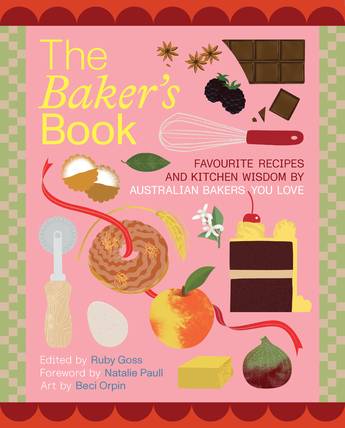
I received this book from the publisher, Murdoch Books, at no cost. It’s out now; RRP$45.
I am remiss in reviewing this book! My excuses are a) being away for a couple of weeks, and b) finding opportunities to bake things when there’s not many people around.
I am not particularly an aficionado of the Australian baking scene. In fact, I think there might be only one place mentioned in here that I know (more on that later). Thus I do not know whether this is a representative, or interesting, or eclectic set of bakers. I can guess that they are, based on recipes, but I don’t know for sure. What I can judge, though, are those recipes, and I can say: it’s a fascinating selection. There are easy things and quite hard things; ingredients I’ve never used, and equipment I won’t bother owning, and takes on old favourites. There are savoury recipes but mostly sweet, and recipes for different occasions. There are also personal reflections from the bakers: about their personal journeys, or perceptions of baking, and often how those things relate to life in general. It’s a really nicely constructed book, both in contents and in physical appearance.
Recipes I have made:
Continue reading →The River has Roots, Amal El-Mohtar

I read this courtesy of NetGalley and the publisher. It’s out now!
This was simultaneously very sweet and very biting.
It’s a delight to read, and it will have you clutching at whatever you’re sitting or lying on whilst doing so.
It’s set kind of-ish in our world and also in Arcadia, which might be Faerie. It’s about sisters and love of all kinds, loyalty and spite, riddles and justice and fidelity and rivers.
The River Liss is a character, and I love them.
The willows are characters, too, in a more understated way. I’m Australian so willows don’t play a huge role in my botanical experience – but I’ve read enough European folklore to understand why they feature here.
This novella is completely captivating, like everything El-Mohtar writes, and I want to gently throw it at everyone so they read it and get to enjoy it with me.
Esperance, by Adam Oyebanji

Read courtesy of NetGalley and the publisher. It’s out in May.
Starts as a police procedural, which is fine by me – I love them: Chicago cops turn up to investigate a death, the cause of death is very weird, and how it was managed is baffling. Cops hear about a similar murder a long way across the country…
Meanwhile, someone has just arrived in England – we don’t know where from – and talks like someone from a bad 1930s film. She meets a grifter, they fall into some trouble together, and of course their paths eventually cross the paths of the American cops. And I can’t tell you why or how without going into some of the key revelations, the discovery which was a massive part of why I enjoyed this novel so much.
I spent a lot of this novel not really sure who the traveller was, where they were from, and what their purpose would turn out to be. Sometimes this sort of suspense is really annoying, but not here: although their overall intention was mysterious, Oyebanji still managed to create a character who was fascinating and appealing enough that I wanted to keep hanging out with them. He also does some very clever things with the American cops, I think, although as a white Australian I’m really not in a position to fully comment on that.
The book is fantastic. There’s wonderful characters, excellent interactions between them, and an intriguing and compelling mystery. It covers racism, mammoth questions like what justice really is or looks like – and is a standalone story. Highly recommended.
Beast, by Jade Linwood
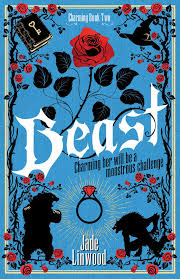
I read this courtesy of the publisher and NetGalley. It’s out in June, in Australia.
This was a lot of fun.
I haven’t read the first book, Charming, which presumably introduces the titular prince and the variety of ladies he has rescued. Fortunately, there was enough backstory provided – and without it being super info-dump-y – that that wasn’t too much of a problem; I picked up fairly quickly that Charming is every Prince Charming, that he’s therefore regarded as a conman and a rogue by the rescuees who have now banded together, and that there’s also some sort of curse on Charming himself, organised by Mephistopheles, that the ladies need to work with Charming to break. Which is all well and good until Charming gets pulled into yet another curse – the focus of this novel, which is of course the Beauty and the Beast one. And it’s gender-swapped, with Charming as the Beauty and a woman as the Beast.
It’s interesting to read a flipped B&B, especially when it’s primarily from the man’s perspective (now I want to read a flipped version from the woman’s perspective). Because of the sort of story this is, Charming never finds Beast particularly offensive, and indeed appreciates many of her qualities from early on. The novel does acknowledge that other men have not been as generous, with some reduced to gibbering wrecks because they’re incapable of seeing past the idea of a very large furry bipedal ‘animal’ coming towards them while inside a house. There’s no great interrogation here or psychoanalytical discussion of what it means to have been transformed; that’s not what this novel wants to do. But there is commentary on Beast having to use a tankard rather than a wine glass, and not wanting to eat in front of potential suitors, and a few other notes that compare how a well-bred lady of the pseudo-medieval society would be expected to look and behave compared with how she looks now.
Other fairy tales also get a look-in here, in particular Red Riding Hood and Hansel & Gretel; they are likewise fractured in really fascinating ways. Linwood seems to have had a lot of fun playing with all of these stories and thinking about how to make recognisable and yet just a bit other. (Red’s hanging out with werewolves; Gretel is traumatised from her childhood – and not by a witch – and now protects herself with bears.)
Fast-paced in a good way, easy to read, some delightful characters: this book was great.
Bean there, done that: Patriot Games (1992)
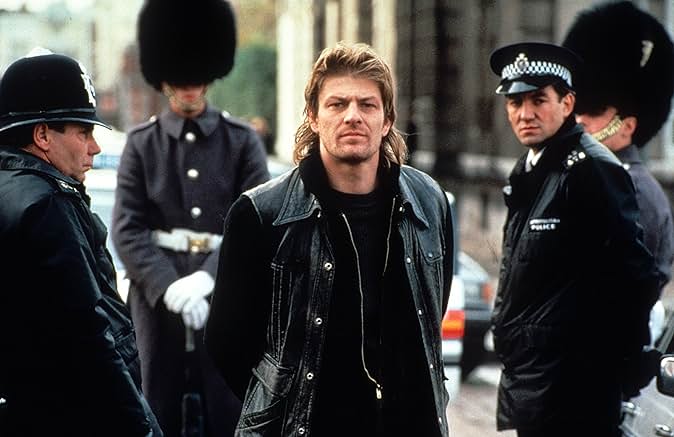
I do adore a Jack Ryan movie (usually).
I love the way this film opens with talking about Russia (it’s 1992!!) – especially given The Hunt for the Red October – and then… BAIT AND SWITCH!
OK, this is going to focus on Sean Bean, I swear.
- I have no idea whether his Irish accent sounds real to the Irish ear, but it’s convincing enough to me.
- THE HAIR.
- Oops, Jack killed Sean’s younger brother. That’s not going to end well.
- How convenient that his character’s name is also Sean (Miller).
- He’s so young! (Huh; he’s 32 in this film, so… yeh ok, I’m old).
- Bean does angry very well.
- They didn’t make him cut his hair in jail? What sort of establishment is this??
- The blue and yellow jumpsuit does nothing good for Bean’s complexion.
- Although my, he is awfully skinny.
- He also does Terrifyingly Feral very well.
- [Eee, James Earl Jones!]
- He finally gets a haircut on the ship… I think it’s an improvement.
- It’s definitely an improvement. Little bit of a crewcut along the bottom of the head – not an undercut, far more military than that.
- [Eek, Samuel L Jackson! Had completely forgotten he was in this film. Also so young… about 43 years old…]
- Bean doesn’t really exhibit much range in this film: he’s angry, or upset, or frustrated, or… yeh that’s about all, actually.
- Movies just don’t do those fades between cut-scenes in the same way any more. More’s the shame.
- Yikes, disaffected IRA training in the desert… with vaguely Arabic types… oh, early 1990s, you were such a time.
- The conclusion feels rather cliched today – the royal at Jack’s house (as if), the navy buddy is there as well, the lights go out and the baddies make use of night vision (in the middle of a lightning storm, really?)… but I really like the speed boat chase: it may not look particularly realistic, but it is still pretty awesome. Also, over a lot faster than similar denouements in other, later, films.
- Bean’s death, impaled on a boat implement of some sort, is vicious.
Bean Verdict: Unquestionably A Bad Guy (slightly ameliorated by the dead brother aspect, but he was already involved in violence before that).
Movies: 1. Beans dead: 1.
Mary Darling, by Pat Murphy
Read courtesy of NetGalley and the publisher, it’s out in May.
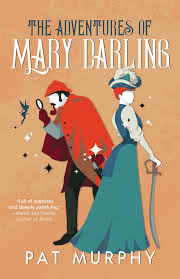
The Peter Pan/Sherlock Holmes mash-up I didn’t know I needed.
I’m a big fan of taking old stories – especially well-loved ones – and either putting women in, or re-telling the women’s stories to give them more agency, or just flat-out actually making them a character rather than sexy (or maternal) lampshades. Here, Murphy gives life to Mary Darling: wife to George, mother to Wendy, John, and Michael – and previous inhabitant of Neverland, courtesy of Peter Pan. She grew up in Cooktown, Qld; is the niece of Dr John Watson; and is generally awesome.
The story is partly Mary’s story, as she goes off to find her own children – recognising all the signs, as she does, of a Peter Pan abduction – and partly Watson’s story, as he (along with Holmes) follow in Mary’s wake to try and find Neverland. Along the way there are adventures, including other Victorian lady adventurers, and brothel-keepers, and several pirates. There’s also flashbacks to Mary’s childhood, as well as to the experiences of various members of the party: Sam, a South-Sea Islander friend from Mary’s childhood; some of the pirates; the people who become known as Princess Tiger-Lily and her family; and George Darling himself.
Murphy has made Barrie’s (and Conan Doyle’s) much richer by restoring the women and people of colour who would really have existed in London, let alone the rest of the world, to the story. She’s also written a zippy tale of adventure and family and identity that kept me completely enthralled.
Holmes does not come out of this story very well. Nor does Peter Pan. I was naturally reminded of AC Wise’s Wendy, Darling, which is a very different book but likewise asks questions about exactly who, or what, Peter Pan could possibly be.
This was brilliant. Loved all of it.
Middle Eastern Feasts
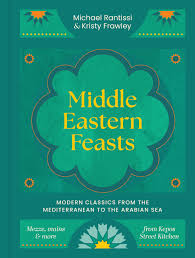
This book was sent by the publisher, Murdoch, at no cost. It’s available now (RRP $39.99).
I can imagine someone telling me that I have enough Middle Eastern cookbooks in my life. They would be wrong.
I have never heard of Kepos Street Kitchen, presumably because I am not a Sydney-sider, so I have no connection with the recipes in this book that are apparently iconic at that restaurant. But that makes no difference in actually browsing and enjoying these recipes, so don’t let that put you off. There is a delicious range of recipes to try, and pretty much all of them are approachable.
Chapters in the book include Brunch, Mezzo, Salads, Feasting, and Dessert. So that was already a good start.
Recipes I have tried:
- Zucchini, sujuk and labneh omelette: I subbed in locally made chorizo for the sujuk. I think this is more like a frittata than an omelette (it’s finished in the oven) and it was fantastic.
- Bourekas (Middle Eastern sausage rolls): I was intrigued by this idea. Uncooked mince with some flavourings, rolled in strips of puff pastry and then curled into snails: magnificent.
- White bean dip: very easy, very tasty.
- Green beans with goat’s cheese, almonds, and lemon: the perfect way to serve beans. No notes.
- Za’atar pita bread: I love making bread, and I love za’atar, so this was always going to be a good choice. The pita recipe is very easy.
- Yemenite pan roti: my one failure. I’m not sure whether it was my fault – maybe the weather was too humid? – but I did also find the instructions a bit hard to follow. Stretching the dough was not as straightforward as it sounded from the instructions, and it wasn’t clear how the folding was actually meant to work. The roti tasted fine but they didn’t have the layers that they should have. I may try this again at some point when I have the nerve.
- White bean and sumac salad: delicious. Any opportunity to use sumac is a good thing.
- Broad bean, tomato, and cumin seed salad: without doubt the greatest discovery from this entire book. I grow broad beans every year and am always looking for new ways to use them. Why the title doesn’t also include the preserved lemon which I think is the star is beyond me. I will be making this salad a lot.
- Hot-smoked salmon and potato salad: another salad I have already made several times. Also includes boiled eggs, olives, sukkah and parsley. The perfect summer salad.
- Chicken chermoula: it’s just a recipe for chermoula, which is then used as a marinade but it was still pretty good. I also used the chermoula for prawns which was delicious too.
- Persian meringue cake: I had no idea how this would turn out, and the answer was “unbelievably delicious.” I made halvah to go in it (because I had been wanting to try making it for ages); it ended up too crumbly and so you couldn’t taste it. The recipe calls for a white chocolate glaze and even I, with my insatiable sweet tooth, think that would be a gigantic step too far. When the cake already includes halvah, dates, rosewater and nuts – in a meringue cake – adding white chocolate seems… irresponsible. But I will be making this cake again, oh yes.
This is a delightful cookbook. It’s not particularly breaking new ground, but it does have some delightful flavour combinations, and I am not sad to have it in my library.
The Return
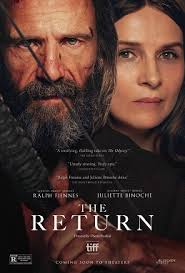
I am a complete sucker for Greek myth films. And even more, I am an utter sucker for films that take bits that have been done less often, and which do so with nuance and a modern sensibility while still keeping true to the original. Nearly impossible? For sure.
The Return manages this with aplomb.
(Spoilers, I guess? If you can spoil a 3000 year old story? Although there are some changes to the ‘original’, which I will discuss.)
The film doesn’t try to cover all of Odysseus’ wanderings – and Troy is covered in a single sentence in the brief introduction. Instead, it opens with Odysseus washed ashore on Ithaka, and Penelope besieged by the suitors. It really only covers a few days – exactly how long is unclear, because Odysseus may have spent a few days in Eummaeus’ cottage, recovering his strength. The narrative moves between several strands. There’s Odysseus, coming to understand what has happened to his island, and Penelope, often at her loom, agonising over what to do and how to look after her sons. Interestingly, there’s quite a focus on the suitors, especially Antinous (the least objectionable on the surface, but shown to be very complex and with a horrible side) and a couple of others, like Pisander (who I spent the whole film trying to place – he was Ricky September in that weird episode of Doctor Who, “Dot and Bubble”). And there’s also Telemachus… and, look. He’s never been a favourite. Ever. I was terrified we’d be subjected to a whole section of him going off and visiting Helen and Menelaus, but thankfully we’re spared that.
This is not an action film. There is action: suitors chasing Telemachus, a couple of fights, and a particularly brutal killing of the suitors. The film is far more interested in conversation, though: discussing what happened at Troy – and whether the Greeks were heroes or not; discussing what Penelope should do; discussing what Telemachus should do; mourning the events on Ithaka.
This is a film that takes Odysseus’ experiences at war seriously, and the reality that a decade of fighting will change a man – and that two decades away from his wife and son will change their relationship. It asks very honestly whether Odysseus can ever truly come home, and how his family can now relate to him. It does not paint Odysseus as a hero, nor laud his accomplishments at Troy. Overwhelmingly, he is tired. He mourns the last two decades; he is remorseful of some of his actions, and fears the future. He’s not yet bitter and angry but you can see it’s a possible outcome.
One of the really interesting changes is that of the “maids” – and I find this particularly intriguing in light of the discussion around them over the last few years, with Emily Wilson’s translation finally making it painfully clear that these women are slaves, not just servants. The choice is to make them almost absent. A few are shown sleeping with (literally and, er, metaphorically) some suitors, but that’s all: no sense of whether they are being compelled, and also no sense of whether all of the women shown are actually members of the household. I guess this is one way to avoid the ‘necessity’ of killing them all at the end.
This is a great film. I appreciate the way it takes Odysseus’ agony seriously. It doesn’t do quite as well with Penelope – it’s not particularly informed by Atwood’s Penelopiad or Claire North’s Songs of Penelope series – but it does give her some agency. Overall, it is an excellent entrant into the halls of Greek myth-inspired films.
Macbeth: the start of a project
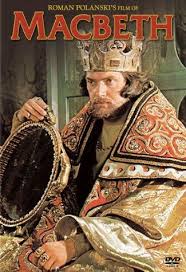
I have loved the play ever since I encountered it. I have seen many versions since then – several on stage (a memorable one at Melbourne Uni, performed in the round, with costuming to make it classic leathers-n-chains punk gangs), and several on film. Now I embark on an endeavour to watch as many versions I can find…
It’s a lot about Lady Macbeth – she is so active and yet she’s not allowed to be powerful without being punished. I’m also fascinated by the way it portrays power. And then the text around it is fascinating too: the utter misuse of history that it represents (yo, English propaganda!); the way that aspects of Lord of the Rings (the Huorns going to the Hornburg/Ents going to Isengard, and the Witch King being killed by a hobbit and a woman) are apparently speaking to Tolkien’s annoyance with the play (the forest coming to Dunsinane; no man of woman born…) – and its many appearances in popular culture.
So: here go.
1971: Polanski / Finch.
The 1971 Polanski Macbeth is my ur-text for the play. We watched it in Year 11 English, and it has coloured my view of the play irrevocably. (This was 1995 and of course I had no idea of anything about Roman Polanski at the time.) Francesca Annis is what I most remember – even more than Jon Finch – because her Lady M was so fierce and then so completely undone.
The weird sisters:
- First appearance;
- Maiden/mother/crone styling.
- Entirely physical – no sense that they are magical
- The maiden flashes her genitals!
- Second appearance:
- A cave full of naked women, all contributing to the cauldron.
- Macbeth drinks their concoction and then has weird hallucinations. – it’s not clear whether they have done magic or just given him really trippy drugs.
Macbeth:
- You really don’t get a sense that Macbeth is very impressive at the start: we don’t see him fighting, just immediately confused by witches.
- He’s conflicted right from the start – even in front of his men. Distracted, rather than decisive.
- Malcolm and Macbeth suspicious of each other from the start.
- His haircut is doing him no favours.
- After the coronation, when he’s dealing with the murderers, is when Macbeth starts to show some determination (being bloody, bold, and resolute…).
- His behaviour is verging on manic.
- Macbeth dreams of Banquo and Fleance killing him, after he sends the murderers for them.
- By the time he’s told that the English and Malcolm are coming, he’s becoming cruel and rash.
Lady Macbeth:
- In the first shot, we marvel at the HAIR. And the CLEAN DRESS.
- She is excited to see Macbeth – and he to see her: they are shown to be in love.
- She suggests murder – to Macbeth’s complete surprise.
- Uses tears to manipulate Macbeth into assassination.
- She has a potion to hand already that will drug Duncan’s servants.
- She is already freaked out while Macbeth is doing the deed. And she never recovers the composure she had at the start.
- Lady Macbeth falls asleep doing embroidery – first sign that she does anything so ladylike. And she has her first hallucination of bloody palms: her behaviour is very distracted.
- Re-reading the first letter: hair in disarray, can’t read for tears.
- We do not see her fall, but hear the cry of the nurse at finding her.

 Randomly Yours, Alex