Olympus Inc novels

Kate Healey says that the Olympus Inc books are finished (for now??) so I felt I should write a brief note about them.
Take Greek mythology. Bring it into the modern world. Remove the supernatural. And remove all of the coercion and ick-ness from the love stories, while keeping (and often revealing) the ick-ness of many of the other relationships. This gives you the basic premise of the Olympus Inc stories.
The first set revolve around Olympus Inc, a publishing powerhouse, and the people who work there. The very first novel makes the Hades/Persephone story an actual delight, and you may be able to imagine just how very weird that is. It also shows up Demeter as basically a monster, and as far as I’m concerned this is now canon. We then get Aphrodite and Hephaestus, and Hera and… well. Spoilers. Around them are Odysseus and Penelope (who actually appear in an adorable prequel novella), Hermes, Hestia, and a bunch of other hilarious nods that you will get if you’re deep into the mythology and otherwise work perfectly well as side characters. You can read these novels as pure (adorable) romance novels, of course, but being able to shriek “I see what you did there, Healey!!” was a large part of the joy for me.

The second set of stories are, I think, a taller order: Healey takes three of the Trojan women and gives them happily ever afters. Which is honestly a big call, and it works incredibly well. Cassie, Xena, and Laodice all famously came to bad ends in the myths, but Healey takes their stories and writes wonderful romances.
All of these books are very, very readable. The characters are a delight and the romances make sense. They do all include some distressing things – mention of abuse, for instance, and disability-shaming, and so on. Healey deals with all of these with compassion and makes it very clear that they are Not OK.
You can find information about the books over at Kate Healey’s website.
To Ride a Rising Storm
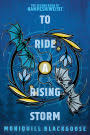
I read this courtesy NetGalley and the publisher, Del Rey. I’m really sorry: it’s not out until January 2026.
There’s a social media joke that does the rounds occasionally, where an author is asked to explain their work in the most boring way possible. So: small fellow goes on long journey, loses family heirloom (LotR). If Moniquill Blackgoose played this game, she’d say something like “young woman goes to boarding house, makes some friends and enemies.”
It’s silly because of course there’s more to it than that. Superficially, that’s what this book – and the first in the series, To Shape A Dragon’s Breath – is about: a girl bonds with a dragon and must therefore go to a dragoneer boarding school to learn what it means to be a dragoneer. So far, so somewhat recognisable. But the world is an alternate one where Vikings took over in what we would call Britain; the story is set in what we would call North America, but it’s very different in a lot of ways. Like, for instance, the presence of dragons, and the fact that amongst other things their breath can be “shaped” in order to do some intriguing (al)chemical things. So Anequs has to go learn about all of that. But she’s not Anglish, or from another European background; she’s a “nackie” – one of the Indigenous folk of the area – and, in one of the very familiar turns Blackgoose employs, she and her people have in no way been embraced by the colonisers.
All of this is what happens in the first book. As with many boarding school books, this second one is in the second year of school – Anequs is 16, her dragon Kasaqua is big enough to ride but not fly, and society is starting to come to turns with two nackie dragoneers. The book is concerned with both personal and political issues – although Anequs, as with many in a position like hers, would recognise “the personal is political” as being a lived reality. So Anequs must navigate friendships that don’t always make sense and people who don’t rate her abilities and Anglish expectations of how she will comport herself, and what is respectable. At the same time, there is a growing group of people in wider society who are unhappy with how their state is being governed (ie too leniently for their tastes), and Anequs becomes something of a symbol they can oppose.
As with the first book, this one is easy to read: the pacing is perfect, the conversations are believable, the characters are engaging. There are parts where I was very angry about what was being said and done, and I’m not going to lie: it feels like a particularly apropos moment for this novel to be coming out. Highly recommended.
City of Dancing Gargoyles

I read this because Ian Mond told me to. I mean, not personally or directly, but he definitely recommended it within my hearing, and I took that to heart. I am very, very glad that I did.
This is not a linear narrative. As I was reading, I was trying to figure out what it reminded me of, and I finally realised: it’s Christopher Priest’s The Islanders. It’s not identical, but there’s a similarity in the way it tells a story through vignettes and moments. It’s got a bit more traditional story-telling thrown in there than the Priest, I’ll admit, but the comparison is still valid. Especially since I loved both.
The book is set at some point in the future – not too far future, there are no galactic empires; but also not quite tomorrow (sometime early in the 2100s-ish). Something… odd… has happened in the USA (insert joke here and then move on); something alchemical, perhaps. Previously inert things have been affected – built things, and natural things. The title gives you a suggestion of one way things have been changed. There are also towns where trees shoot guns, and a city where chocolates glare at you, where books fret, where blankets cringe and candles sob. Why? Absolutely no idea. Part of the story is told in communications between Meena Gupta and Joseph Evans to their boss, Manfred Himmelblau, as they go exploring and reporting on these places. Part of it is the experience of M and E – two gargoyles searching for their place in this new world. And part of it is about Dolores and her mother Rose, who are likewise looking for safety and community.
It’s a beautiful book. It’s about identity, and dealing with change and opposition and the weird, and finding community. It’s somehow also about the things that are already remarkable in our world by imagining how things might go really (really weird). An utter delight.
You can get it from the publisher.
The Green Man series

I’ve been aware of this series for a few years, but never got around to reading them. Then I found out that Cheryl, of Wizard’s Tower Press, was going to have a table at WorldCon in Glasgow – where I would also be present – and I knew it was finally time to give it a go. I picked up the first book – Actual Paper! – and read it in early September. In a day. And then I bought the next two ebooks… and I read them pretty quickly… and then I caved to the inevitable and bought books 4, 5 and 6 in ebooks, knowing that this was a series I would be consuming in entirety.
All of which is pretty convincing evidence that I am loving this series. Another indication: I am very glad there’s a 7th book coming out this year.
The series follows Dan Mackmain, son of a dryad mother and human father; a carpenter by trade, who moves around following jobs (until he gets ongoing work a couple books in). Having greenwood blood, he can see things ordinary humans can’t – like boggarts and hobs, and dryads and nereids in their natural form, black shucks and wood woses: basically the things out of British folklore. He also seems to have been singled out by the Green Man as the go-to human for when bad things are happening either to, or because of, those folk: murder, mayhem, and other inconveniences. Over the course of the six books he has developed connections across Britain both with actual mythical creatures (dryads, mermaids, nereids, swan maids) and with humans who are either like him (offspring of human/not human couples) or who, somehow, have knowledge of that other world. Together, they basically act to make the world safer whenever issues arise.
The series is set in the here and now, which was clear from the technology, but I don’t think McKenna ever actually specified a year in the early books. Which means she could just have kept writing as if it were 2019 forever. Or she could have chosen to make this a completely alternate world. Instead, the fourth book – which came out in 2021 – talks explicitly about Covid, lockdowns, social distancing… it’s all there. I think it might be only the second book I’ve read (after John Scalzi’s Kaiju Preservation Society) which includes the plague. And that’s largely on me, and the sort of books I read (I do not regret this fact); but it still made it quite remarkable to read, and something I really valued. The other thing I continue to find intriguing across the books is the amount of mundanity that McKenna includes – and I mean this in a good way. Characters are in a cafe; they read the menu, they order, they eat, they pay. There’s a great deal of observed everyday-ness that makes the whole story feel real.
I have no idea whether the stories across these books are building to some grand finale – there have been some hints that maybe some of the otherworldly types are becoming restless, because of something stirring – or whether this is going to be an ongoing crime series as Dan needs to deal with yet another unexpectedly real creature (I don’t know my British folklore well enough to know what hasn’t been included yet, but I’m sure the Celtic fringes in particular will have a lot to offer). I think I would like to see some grand denouement… but who am I kidding, I can totally imagine reading several more of these books even if there isn’t.
The Green Man series is immensely fun: a fast-paced mystery/crime element with a delightful dose of folklore, characters who are generally charming and enjoyable to be around, and engaging writing that means I’ve read pretty much every book in a day. Highly recommended.
History in Flames: the Destruction and Survival of Medieval Manuscripts

Read via NetGalley. It’s out in August 2024.
This book is highly engaging, thoughtful, sometimes depressing, and overall wonderful.
It’s also occasionally snarky. To whit: “On 19 July 1870 France declared war on Prussia (this was a time when states still officially declared war).”
One of the things that people who have never studied history don’t really think about is just how much we don’t know about the past. And that that lack is not for want of trying, but because the sources simply aren’t available. And that sometimes, that lack isn’t because people in the past didn’t bother to record it, but because the sources have been “lost”. Sometimes “lost” means the sources succumbed to time and the environment; sometimes folks re-used the medium for other purposes (binding other books, or for bullet casings – which makes me weep). And sometimes, as in the focus of this book, they are destroyed when humans destroy archives and libraries during military campaigns. The examples are from France, Ireland, Italy and Germany – he is frank, in the introduction, about the focus being narrowly European and medieval; that’s his area, after all.
The book starts with an overview of how we know what we know – a good reminder for the expert, an easy intro for the novice. It then uses one of the most famous European examples of how narrowly some of our information has avoided being lost: the manuscript of Beowulf, whose story gives me nightmares every time I read it (one manuscript, nearly lost several times… we were THIS CLOSE to not having Grendel and Grendel’s mother and MY GOODNESS imagine how different European literature would be).
The meat of the book is in four chapters that focus on four specific case studies – four instances of the military destroying archives or libraries. In two cases, Bartlett focuses on one significant object that was lost in the destruction, as a specific example of what we used to have; in the other two, he focuses on the entire oeuvre that was destroyed, and what that means for our knowledge of an era. So each chapter has an explanation of why folks were fighting, and why the specific place (Dublin, Chartres) was affected; then discusses what was in the library/archive – how and when it was made, why it was important, how it got to be in that place. And then the process of destruction (being blown up from the inside; bombs dropping from above).
All of that is what I expected from the title, and the overview. What I had overlooked is that the subtitle also says “and Survival”. So each chapter also includes how scholars tried to save the information otherwise lost: finding examples of transcripts, lithographs, and photographs of the now-destroyed work; finding copies of letters and so on in other archives; and so on. Within the horror, therefore, at losing an enormous swathe of Irish medieval history or the largest Mappa Mundi, there is a small amount of joy and gratitude at how people tried to mitigate the loss. And that makes me very thankful.
This is an excellent book for the reader who has a keen interest in medieval history; for those interested in the construction of knowledge; and for those with a broad general interest in history. I loved it.
The Knife and the Serpent, Tim Pratt
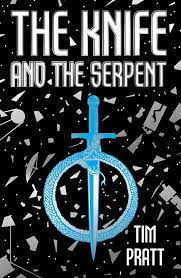
I read this courtesy of NetGalley and the publisher. It’s out in a week! (Mid-June 2024.)
My first Tim Pratt novel! And yes, I can see why he’s so popular. This novel is a wild ride.
There are two points of view in the novel, which start off separate and then – inevitably – become intertwined. The first is Glenn, whose story begins with the sentence “This is how I found out my girlfriend is a champion of Nigh-Space.” Glenn is having a perfectly normal life when he hooks up with Vivian – Vivy – and finds himself falling in love, getting matching tattoos, and having the best kinky sex of his life; the dom/sub relationship is, he points out, important for understanding how they interact over the rest of the epic tale he’s telling. Which involves learning that there are multiple planes of existence, there are groups who would like to extend their control over as many as possible, and that Vivy works for one of the groups attempting to just let planets get on with being themselves, rather than ruthlessly colonised.
The second is Tamsin, who gets home one day to a weird business card stuck in her door, and then finds out that her grandmother has been murdered. With no other family around, Tamsin is responsible for dealing with the estate; when she gets to her grandmother’s house, things go very peculiar, to the point where she learns – from her embarrassing ex-boyfriend no less – that she is not actually from Earth but from a planet on an adjoining plane, and there are people who would like to use the door that allows such travel thankyouverymuch. She herself goes through the door, back to her original home, where her family – originally one of the ruling families on their planet – had been eliminated when she was a baby. You might be able to guess where it goes from here.
Eventually the two stories coincide, there are some battles and a fair bit of sneaking, a snarky spaceship compelled to wear a human suit for a while, trust issues are revealed and discussed, people’s true natures are revealed, and so on.
This book is a lot of fun. I had been very worried that this would turn out to be the start of a series – it so easily could be! There are so many planets and potential enemies! – but no, it’s a standalone, and while I think it did wrap up a bit quickly, it was also quite a satisfying conclusion. All in all, definitely worth reading.
The Seven Wonders of the Ancient World

I received this book to review at no cost, from the publisher Hachette. It’s out now (trade paperback, $34.99).
As someone who has been keen on ancient history since forever, of course I was intrigued by a new book on the seven ancient wonders. And I’ve also read other work by Hughes, and enjoyed it, so that made me doubly intrigued.
Before I get into the book: of course there is controversy over this list. Hughes acknowledges that, and goes into quite a lot of detail about how the ‘canonical’ list came about – the first surviving mention of such a list, why lists were made, what other ‘wonders’ appeared on such lists in the ancient world of Greece and Rome, as well as what other monuments could be put on such a list were it made today. I appreciated this aspect a lot: it would have been easy to simply run with “the list everyone knows” (where ‘everyone’ is… you know), but she doesn’t. She puts it in context, and that’s an excellent thing.
In fact, context is the aspect of this book that I enjoyed the most. For each of the Wonders, Hughes discusses the geographical context – then and now; and the political, social, and religious contexts that enabled them to be made. This is pretty much what I was hoping for without realising it. And then she also talks about how people have reacted to, and riffed on, each of the Wonders since their construction, which is also a hugely important aspect of their continuing existence on the list.
- The Pyramids: the discussion of the exploration inside, by modern archaeologists, was particularly fascinating.
- The Hanging Gardens of Babylon: the discussion of whether they even existed, and if so where, and what ‘hanging’ actually meant, was intriguing.
- Temple of Artemis: I had no idea how big the structure was.
- Statue of Olympia: I had NO idea how big this allegedly was.
- Mausoleum of Halikarnassos: NOT HELLENIC! Did not know that.
- Colossus of Rhodes: also had no idea how big it allegedly was, nor the discussion around its placement.
The Practice, the Horizon, and the Chain
Read via NetGalley and the publisher, Tordotcom. It’s out in April 2024.
To be honest I don’t even know where to start with reviewing this novella.
To say that it’s breathtaking is insufficient. I can say that it should be on every single award ballot for this year, but that only tells you how much I admired it.
I could try and explain how it explores ideas of slavery, and the experience of the enslaved; ideas of control, and social hierarchy; about human resilience and human evil. Draw connections with Ursula K Le Guin’s “The Ones who Walk Away from Omelas,” and probably a slew of stories that connect to the Atlantic slave trade and which I haven’t read (mostly because I’m Australian).
There are odes to be written to the lyricism of Samatar’s prose, but I don’t myself have the words to express that. Entire creative writing classes would benefit from reading this, and sitting with it, and gently prying at why it works the way it does.
I could give you an outline? There’s a fleet of space ships, and they’re mining asteroids, and mining is dreadful work so you know who you get to do the dreadful work? People that you don’t call enslaved but who are indeed enslaved. There’s an entire hierarchy around who’s doing the mining in the hold, and who’s a guard and who’s not a guard, and the people at the top have convinced themselves there’s not REALLY a hierarchy it’s just the way things need to be. Sometimes someone from the Hold is brought out of the Hold, and then has to learn how to be outside of the Hold… and then someone starts to see through the system, and maybe has a way to change things.
The outline doesn’t convey how powerful the story is.
I should add: the main characters are never named.
Just… everyone should read this. It’s not long, so there’s no excuse! But it will stay in your head, and it will punch you in the guts. In the good way.
The Quiet Revolution of Caroline Herschel

I’ve read a bit about Caroline Herschel, often in the context of “here are women who did important things in science who don’t get enough recognition.” She was one of those women who helped a man get lots of science done – in her case, her brother William: she was his assistant for much of his observing life, writing down his observations and helping with his frankly unwieldy telescopes, as well as keeping house for him for many years until he married – and then his wife had money so they had more servants. All of those things are immensely important and often get overlooked; no one is able to do science on the scale of William Herschel, or Robert Boyle, or Charles Darwin, without an immense amount of assistance: usually either female, lower class, or both. Hence why that assistance is often overlooked, because the European narrative in particular is much happier with the ‘great man’ theory.
To leave Caroline’s story at that, though, is to do her an immense disservice. She was an astronomer in her own right, discovering eight comets (two of which she wasn’t the official discoverer, because someone else got there first, but she didn’t know about that when she found them). She also contributed observations to William’s immense catalogue of the ‘nebulous’ stars. In the late 1700s, most people assumed that that ‘cloudy’ or nebulous patches in the sky were simply stars that contemporary telescopes couldn’t resolve. William used the largest telescopes of the time to realise that actually, some of those areas actually couldn’t be resolved – they really did look cloudy – and suggested that maybe some of those areas were where stars were born. (He also discovered Uranus – the first planet to have been discovered by a human, rather than seen naked-eye, which is what shot him to fame.) Caroline personally observed and described some of the Herschel catalogue.
And then there’s the other scientific tasks she undertook, which might be easy to skim over because they don’t seem that sexy. She worked for years on a massive index and catalogue of stars, using the main one available in English: double checking for errors, making it systematic, and so on. Not glamorous, requiring hours of probably boring labour, required a great deal of knowledge – what an amazing contribution to astronomy.
Anyway, the biography: is not entirely what I was expecting! It focuses largely on a decade in the middle of Caroline’s life, her most scientifically productive – and a decade for which she destroyed her dairy entires and never discussed in either of the two memoirs she produced later in life. There’s a lot of speculation for why this might be; most people conclude that it’s because she wrote some bitchy stuff about her new sister-in-law and that this didn’t fit her self-image as meek, self-effacing, and doing everything for family. It’s a fascinating question and one that will almost certainly never be resolved. So Winterburn has used letters, information from journals, and references in other places to reconstruct those lost years, and in doing so to highlight just how phenomenal Caroline was as a scientist. While she wasn’t the first women to be paid to do science – lots of other women were doing ‘science’, it just wasn’t usually called that – she was the first English woman to have a royal pension for doing science, and that’s very damn impressive.
There are oddly repetitive bits throughout the book, where Winterburn repeats ideas or phrases that have just been laid out a paragraph or two earlier; and the book can’t solely concentrate on the one decade, because the reader needs greater context for Caroline’s life – so it’s not without flaws. There’s also a frankly odd emphasis on the events of the French Revolution; while it certainly had a huge impact on some of the people Caroline and her brother corresponded with, it didn’t actually seem to have a direct impact of Caroline, living in England – she wasn’t obviously a supporter of either Burke or Paine (anti or pro the revolution), so I was confused by how many ink was spent discussing those foreign events. Nevertheless, overall I really enjoyed this, and am immensely pleased to know more about Caroline. To the point where I’m considering the so-called Herschel 400 as an observing list.
Flavour, by Sabrina Ghayour
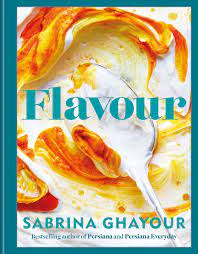
This book was sent to me by the publisher, Hachette, at no cost. It’s out now, RRP $45.
I have reviewed three of Ghayour’s previous cookbooks, and own all of them. I am confident to say that if I was only allowed to own one writer’s cookbooks, I would be incredibly sad AND I would choose Sabrina Ghayour.
As with all of her books, this one is laid out beautifully and the accompanying pictures are appropriately mouth-watering. Few of the recipes have really extensive ingredient lists; Ghayour is definitely in favour of simplicity and being straightforward. Where there is a longer list, it’s generally herbs and spices, most of which I would regard as accessible in Australia. There are a few points where there’s a translation necessary for Australian audiences – I believe pul biber is usually sold as Aleppo pepper here; and when Ghayour calls for “four preserved lemons”, she does not mean four of the my one-doesn’t-fit-in-your-palm homemade preserved lemons. Ghayour has continued here something I’ve loved from the last couple of books: a suggestion or two of what you might serve with the present recipe – a salad to go with a meat dish, for instance. I love that she has given thought to which flavours complement one another.
The chapters include Salads; Little bites and Savoury treats; Meat, poultry, Fish and Seafood; Vegetables and Pulses; Pasta, Noodles and Grains; and Sweet. Recipes are clearly marked Vegetarian and Vegan.
Things I have made:
- Dried Lime and Spice Marinated Lamb chops – I used steak, because I just cannot be having with chops. I had never blitzed dried limes before but they are a flavour BOMB and this was absolutely delicious.
- Lamb, Dried Fig and Preserved Lemon Tagine – going on high rotation. Love a good casserole, and the flavours are fresh and unctuous.
- Crispy Sticky Harissa Lamb – also delicious. Honey, rose harissa (I bought some because of Ghayour, and it’s great!), rice vinegar, soy and cornflour for the sauce.
- Pan-fried Salmon with Barberry Butter – I have barberries because of a meatball recipe or two, but this is another excellent way to use them.
- Root Vegetable, Chickpea, Feta and Barberry Tart – O.M.G. This was amazing. I think we ate it for three? four? meals in the week. Filo pastry, parsnip, carrot (I didn’t use celeriac – I don’t think it’s that accessible here). This is AMAZING and I LOVED IT. SO EASY.
- Creamy Spiced Sausage Pasta – the creaminess is from mascarpone, which I was surprised by and it was really good. You get the sausage out of its casing, which is always the best way to use it, and then it’s tomato and spice and the mascarpone.
- Harissa, Tahini and Lamb Spaghetti – another to go in high rotation. I was surprised by the harissa and tahini together, but it was brilliant.
- Mushroom Spaghetti with Creamy Pistachio and Garlic Sauce – yes, I know, it’s boring but this is another banger. The creaminess is from tahini again, and it works amazingly with the pistachio. I added some snow peas and asparagus, because I have an abundance, and used noodles instead of spaghetti because I had none.
I haven’t made any of the sweets yet, but I am eyeing off a few; and there are several other recipes that I already know I want to make. This is a great cookbook.

 Randomly Yours, Alex