The Arrows of Time
The time has finally come.
I have finally finished Greg Egan’s Orthogonal trilogy.
There really ought to be a fanfare for such an announcement.
The other books: Clockwork Rocket and Eternal Flame. Spoilers for these two naturally follow.

At the start of his one, Egan himself has written that you just won’t really get this book without the previous two. I don’t think I’ve ever come across the third book in a trilogy that said that so bluntly, and I really appreciate it. Because it is SO true: if you don’t understand how light and time work in this universe (and look, I don’t understand it, but I get how it’s different from ours), let alone the society and what the folks are doing on this mountain-turned-spaceship, you will be so lost you’ll end up in Antarctica instead of Bali.
As the second book was a few generations after the third, so here. The ship is sailing happily through the universe, and folks are still working on how to save the homeworld. Not that everyone especially wants to save the homeworld, from which they are now several generations distant – and will never see themselves anyway. So, classic generation ship angst, really. That’s one issue. Then, there’s what turns out to be a logical consequence of the bizarre universe Egan has set up where light travels at different speeds and some parts are orthogonal to others: that time is affected, too. Specifically, that it should be possible to set a receiver for messages from the future.
Because that couldn’t possibly turn out badly.
So now there are two issues dividing the crew of the Peerless. And just to add to the problems, while the earlier issue about children has been solved – the females no longer need to either die to become their children, or starve to prevent that from happening, and they’re not overpopulating – there are some people who aren’t happy with the solution: especially some brothers who don’t want to be compelled to care for their sister’s children. So life is definitely not rainbows (which they’ve never seen) and roses (which they don’t grow).
I love that Egan tackles such weighty topics as democracy, needs of the few vs needs of the many, the importance of choice, the place of parenthood, and so on – all in a book that literally has vector diagrams in it as it explores the outcomes of a thought experiment in physics.
From a narrative point of view, the most gripping part is when four people travel to an orthogonal world to see whether it would be habitable. Again, this is an exploration of the consequences of ‘orthogonality’; time is literally going in the opposite for this world from how it is experienced by the travellers, so what could that possibly look like? What does that, what can that, mean for free will? (A whole bunch of headaches is the answer. Mostly metaphorically.) This bit is also a deeper exploration of the characters, as they interact only with each other, in very trying circumstances.
As with the other two books, I admit that I skimmed bits of the physics explanations. Including the diagrams. I read it well enough to get the point Egan is making, but I would in no way attempt to explain it.
I have a couple of thoughts that are spoilers, so don’t read the rest if that’s a problem… but if you’ve read the first two, I think you definitely need to see how the story plays out.
Mission Critical
 As a rule, I really enjoy Strahan’s anthologies, and this one intrigued me: the stories of when things go wrong. These are small stories and large, set in our near space and a very long way away – in time as well as space – and stories where not everything ends up well. You already know something is going to go wrong.
I didn’t love every story in the book; it’s an anthology, so that’s no surprise. To my own surprise I did not love the Greg Egan story that starts it: it was fine, but it didn’t have quite the… flair… that I like from his work usually. Ah well. There were plenty of stories I did love. Linda Nagata’s was in the vein of AI-gone-wrong, and I really enjoyed the characterisation. Gregory Feeley’s is set on Mars, like Nagata’s, with a completely different set of problems and hints at a whole bunch of background issues that intrigued me. Possibly not one to read if you’re feeling sensitive about children in danger. Going way off into the distance, temporally and spatially, Tobias S Buckell sets up a really intriguing society and a problem that verges on a “Cold Equations” scenario. I loved the characters a lot, and would absolutely read a novel or three set in this place.
Despite what the Goodreads page says, this book does not have an Alastair Reynolds story. To my disappointment, as you can imagine. There is, however, a Yoon Ha Lee story, and these days that pretty nearly makes me as happy. And “The Empty Gun” absolutely delivers in cold hard explosive story that I could not hope to guess the ending of. Same goes for Peter F Hamilton’s story. I’ve read only a few things by him, and it’s been a bit hit and miss – I think because he often verges on, or is outright, horror – but this one, set in our solar system but many, many years away, is amazing: the changes to humanity necessary for survival, the uncomfortable conception of maternity, and the outrageous version of a bad roadtrip. The final story, by Peter Watts, is a fairly uncomfortable place to end the anthology – it absolutely works, but it’s a grim view of the future, and one that feels if not plausible then at least imaginable.
This is a highly enjoyable anthology with a good range of stories; I’ve only covered maybe half of them here. The theme is broad enough that you’d almost not know that the authors were writing to a theme, except for all the time things go wrong. Many of the stories are long enough that they get to develop their worlds and characters a bit more than in a short-short. Definitely one to read if you’re after some wide-ranging SF.
The Gate to Women’s Country
 I’ve heard of Tepper as one of the early-ish feminist SF authors who got quite a lot of attention. This came out in 1988, so not early at all, but nonetheless it’s one whose name seems to kinda float around in the ether as an example of feminist writing. It’s been sitting on my shelf for ages, so I figured I should give it a go.
Set some time in the future, on Earth, this is largely an exploration of a society through one character’s life. There are a few significant events, but most of them are daily-life-level, rather than world or even community-level: it’s intentionally small scale, I think, to explore the issues on Tepper’s mind rather than to present an epic narrative.
This is a very complicated book to think about. Firstly, although it’s only mentioned in passing this is a deeply homophobic book. I don’t think there’s any mention of female same-sex relationships, and male homosexuality is regarded as an illness that needs to be cured; men who want to sleep with other men are deeply suspect.
Secondly, it’s an example of that sub-genre where women and men live largely segregated lives. The women are mostly in towns, while many of the men live outside the town walls in a garrison. There are exceptions: the men who return to the towns, through ‘the gate to women’s country’, and why they choose this and how the other men regard them is one of the key aspects that’s explored through the story – eventually, anyway. I don’t think Tepper is advocating for this segregation as a real way to live, but it’s an interesting thought experiment.
Thirdly, the narrative structure isn’t linear. It largely follows Stavia, and her experiences both as a child and as woman; a large part of this is about how childhood experiences influence her as an adult (the child is the mother of the woman, etc etc). This isn’t too complicated, but it is occasionally confusing, since there’s no textual indication at the start of the chapter or whatever to indicate which time the chapter is in. It does become evident pretty quickly, but it’s still something to be aware of.
Fourthly, there’s the Iphigenia at Ilium aspect. This is probably the strangest bit. The book is set some centuries after some sort of disaster has killed a massive proportion of the population and devastated the environment. Lots has been lost, but somehow a variation of The Trojan Women has survived, and become so important that it’s staged every year. I can see some of the thematic similarities that Tepper is trying to convey – Achilles’ ghost is basically laughed at, and it seems to try and remind the women that there are problems with warriors and senseless violence, or something like that? Perhaps I missed something deeper, because overall it just didn’t make sense to me.
Lastly, one of the big revelations towards the end is a major spoiler, so if you don’t want that, look away now…
Ysabel, by Guy Gavriel Kay
 This is my first GGK and… I really don’t know what to make of it.
I mostly really liked it as I read, although there were some odd narrative quirks – like the omniscient narrator occasionally breaking in with prescient predictions about a character later reflecting on something as the end of childhood – that didn’t seem to have pay-off or point in the narrative. But those things aside I largely enjoyed the story as a whole… until the very end when something very weird and out of place happened that made me feel a bit ick about the whole thing.
Anyway, before that: Ned is in France with his photographer dad; meets another visiting American and has a weird encounter with a dude which then leads to more weird encounters and a progressively weirder journey around bits of France. There’s a love triangle ranging over enormous sweeps of time, eternal enmity, races against the clock, family secrets and family discoveries, and some slightly dubious mashing of history.
In general, I found the story generally enjoyable. I’ve no idea how accurate the geography of France is; apparently it was written while Kay was there, so hopefully there wasn’t too much licence taken? Overall the characters were interesting and plausible enough, and the pacing generally wasn’t too bad. It’s not a book to think too much about, though; the history aspect in particular is a bit silly and there are a few narrative holes that made me shake my head.
Also I hate the title. And I’m a bit bemused about it winning the 2008 World Fantasy Award for Best Novel. I don’t recognise the other nominees, but this … seems like an odd choice.
The big thing that irks me, though… (spoiler…)
This is how you lose the time war
 Some people I respect were raving about this, and I like both El-Mohtar and Gladstone’s work separately, so I thought I’d give it a go. Bought it on my day off (e-copies really are very useful) and made a start on it.
And then I finished it. In one sitting.
I think it’s a novella… but still. Yes. I inhaled it. It’s brilliant. It’s about time travel and two rival versions of human history.
Why are you still reading? Just go buy it already.
If you’re still reading and you’re not convinced: two very different views of how human history should play out are in competition across time, and across the multiverse – or strands, as our narrators call them, which means that you get all sorts of symbolism along the lines of braids and so on. Very clever; I like it a lot. Our people go upstream and downstream and across strands and they’re always looking to make their version come out on top, and thwart their opponents.
And then Red and Blue start to communicate. And then (I’m sorry) things start to unravel.
The story is fabulous, the ideas are enthralling and rich and wonderful. The characters are always somewhat opaque but honestly that fits so well with what’s going on and with who and what they are, that it was fine.
The one thing that some readers might find off-putting is the language: I saw someone describe it as ‘baroque’ and that’s probably fair; it’s extravagant and ornate and rich and luscious, sometimes whimsical and playful, full of symbolism, and occasionally meandering. I loved it; it’s the sort of prose that will definitely reward re-reading, and a slower read, in order to really mull over the weight of the words.
Straight to my ‘possible Hugos’ list for next year.
Hexarchate Stories
 I am a huge fan of the Machineries of Empire series, which apparently I haven’t reviewed here and that’s a terrible oversight. So I was very excited to finally get this, and dive into the back story of the empire in general and Jedao specifically, and Cheris too. Many of the stories are quite short snippets, which I found intriguing, and they definitely add to the overall character development.
And then I got to “Glass Cannon”, at the end. And then I realised that it was basically a continuation of the final novel. So then I had to stop, about 5 pages in, and go back to the start… so I’ve read the whole trilogy again in the last week. And it’s still amazing and breathtaking and heartwrenching.
(Massive spoilers below…) Continue reading →
Green Earth
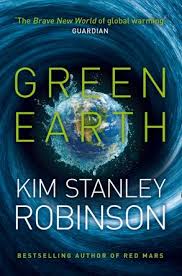 I remember when the the Science in the Capital books came out; I was unconvinced about whether I could face a near-future story about climate change. So I did nothing about reading them. Then I recently discovered that the books had been released as an omnibus edition, and I figured – why not. And the introduction to this edition reveals that it’s a director’s cut – and not in the way that Raymond E Feist did his version of Magician: in this case Robinson has actually cut extraneous material, for a variety of reasons, and I’m quite impressed by that whole process.
So anyway, now I have read the trilogy-that’s-really-one-long-book. And it must be said that it’s rare for me to finish a book where I kinda loathe the main character.
The book opens in a style that suggests the story will be told through a variety of voices. Each chapter opens with some extended comment on science or politics or global events, and then the chapter proceeds with different characters going about their everyday lives – which frequently interact with each other, and with making science- and climate-related decisions. There’s Anna, a scientist at the National Science Foundation; Frank, a visiting scientist at the NSF; Charlie, Anna’s husband and advisor to a senator, who works from home and is mostly caring for his youngest son; Leo, a scientist in a small biotech startup lab; and a couple of others. As it went on, though, there was somewhat less of this multi-focused approach.
It was intriguing to read a book that paired the domestic, sometimes banal, frequently humdrum lives of its characters – in the office, or the home, or the lab – with important scientific discoveries or crucial policy decisions. Like in real life. The conversations often looked really odd on paper… until I listened to them properly in my head, and then they sounded like just normal conversations. Zagging in odd directions, incomplete sentences, and so on. Robinson has often captured actual life with true verisimilitude, and I mostly enjoyed it.
However, the character that I initially liked the least is the one who ends up having most of the narrative. This is Frank. He has what I regard as a poor attitude to science, and an even worse one towards women. If I had realised that this was going to be largely Frank’s narrative, I may not have kept going. In fact it’s possible that if I had been reading this as three separate books, I would not have picked up the second after the first.
Now, I have little objection to abandoning a book – I mean I hate doing it, but I will, because life is too short to read crap books. So why didn’t I abandon this book? Because I did want to know what would happen to the other characters. And because I was truly interested in where Robinson would go both in destroying the world through climate change, and suggesting possible ways of dealing with it.
Was it worth it? I still didn’t like Frank. In fact I got really impatient with him, and his whole personal storyline seemed pretty weird and actually beside the point for the overall story… and this sense is growing the more I think about it. However, as a way of thinking about how science might help the world deal with the repercussions of climate change, it’s certainly an intriguing novel. And like many of Robinson’s books, ultimately hopeful. (Perhaps too hopeful?) So I don’t regret reading it. For a reader who is interested in both politics and science, I expect this would hit a lot of buttons (unless you’re very over the ‘America saves the world’ narrative, which this leans into pretty heavily, so be warned).
Sadly, Robinson made yet another odd statement about an Australian animal (he implied there’s not that many black swans in Red Moon). This time, a character comes across an animal dead in the snow: it’s a wombat, and then there’s mention of warm-weather critters needing to be looked after.

From here; I’ve seen wombats in the snow a lot, so… nah. Not so much.
The Biographer’s Tale
 I have never read anything by AS Byatt. I have heard of her… but I think I always assumed she was a bit too “literary” for my tastes, which in my head means snobby and convoluted kinda-real-life and not that interesting. I saw this book in a second hand book shop and thought – maybe I should give it a go; biography is an interesting topic and the blurb sounded a bit intriguing.
Plus, cool cover.
Up to about the halfway point, I was utterly charmed. Besotted, even. Phineas Nanson (I was a bit disappointed when I discovered the narrator was a man; I’d forgotten that from the blurb) has decided to give up his study in postmodern literary theory, because it doesn’t mean anything to him anymore. But that means he needs something new to study. A supervisor gives him three volumes of biography by Scholes Destry-Scholes; Nanson has an arrogant literary theorist aversion to biography. However, he is hooked by the charm of Destry-Scholes’ writing, and proceeds to attempt a biography of the biographer.
At this point, I thought there were going to be intriguing and possibly convoluted layers upon layers of biography. And there were: Nanson finds excerpts of other, possible, biographies written by Destry-Scholes but unpublished, and there are extended (and I mean a few dozen pages) included in the novel. These excerpts are a bit weird, and their subjects not immediately identified; there are certainly some themes that recur.
Nanson goes on to research the subjects of these incomplete biographies, and of course finds himself in increasing levels of abstraction from his purported subject, the biographer. All of which is quite wonderful to read – including his finding a part-time job at a travel agency who specialise in odd, literary- or art- or otherwise abstrusely-themed holidays for discerning characters.
It was all going so well.
(Spoilers from here, I guess? If you really want to give it a go yourself?)
And then it became a story of a man who ends up having a relationship with two different women at the same time.
I mean, yes, there was discussion about how this attempt at a biography had actually become an autobiography and he has angst about that as a literary form, and then discusses how he surprisingly likes writing for its own sake, and he gives up on Destry-Scholes… but yes, this became a not-yet-middle-aged (I assume) man and his sexual relationships and there was no musing on whether it was right to have two partners simultaneously and did his partners deserve to know about the other or… anything of that sort of moral relationship nature. No. It was just all about him and his experience.
And so I got really quite disappointed. More than I probably would have been if I hadn’t been so delighted by the first half.
Factfulness
 It’s hard for me to adequately convey how amazing this book is, and the extent to which I think every privileged person in the “Western world” (a fraught term, I know, and one that’s even fraught-er after reading this) ought to read the book.
The Bill and Melinda Gates Foundation offered a free copy to every US graduate at any level in 2018. So that’s one measure of how important a book it is.
“Ten reasons we’re wrong about the world – and why things are better than you think” is the subtitle and an excellent summary of the entire book. If you think you know the world and don’t need your mindset readjusted, go here: http://forms.gapminder.org/s3/test-2018 . Then come back. I’ll wait.
Did you do really poorly? If you stayed on the site and looked around, you’ll know that so do the vast majority of people who take the test. In fact, humans tend to do worse than random, which is a most ridiculous idea regarding facts about the world.
Some of the most important things I got out of this book:
- The idea of data being therapy. Hans would have said he’s not an optimist – he’s not “looking on the bright side”. He looks at data. He’s not making assumptions about the world, he’s looking at what the world is actually like. And things are not as bad as we apparently think they are.
- Which leads me to “bad and better”. Of course things in the world are not perfect; he’s not suggesting they are, nor is he suggesting that things like war in Syria ought to be ignored. However, on a global scale, things are better today than they were in the past – and better than you think they are. His metaphor for this idea is the premature baby doing well in ICU: after a few days, are things better? Yes. Are things still dicey? Yes. Two things at the same time: bad and better. This, for me, is immensely reassuring as a phrase – I can be concerned about Syria, or Yemen, or whatever else, and still know that for most people around the world, things are better than they used to be.
- How to think about statistics. It’s all well and good to give me today’s stats… but how do they compare to last year, and last decade? This is a question I don’t ask often enough and ought to do more of.
- Populations statistics don’t necessarily move in straight lines.
- A comparison of where “developing” countries (a phrase that Hans loathes, for reasons outlined in the book) are today compared with “developed” countries (same caveat) in the past – how much faster, for instance, the fifty countries of sub-Saharan Africa have reduced their child mortality rates than Sweden ever did (p171; he often uses Sweden as an exemplar).
Of course, I am coming at this as a long-time Hans devotee (although some people in my circle are even bigger fans…). The Magic Washing Machine was a revolutionary way for me to think about wealth and time and work. In Qatar, he discussed the connection between religion and babies… and the fact that there isn’t one: it’s about girls’ education. And then there’s his brilliant 200 countries in 200 years, which makes even my data-dubious heart glow. And then there’s the fact that Hans died in 2017, while the book was nearing completion. I cried while I read the introduction, because in my head it was Hans’ lovely Swedish accent reading it and I knew he was gone and honestly that just felt heartbreaking.
Even if you don’t usually read non-fiction, I think you would do well to read this. If you are in business, or have some sort of connection to policy-making in government or an NGO or banking, you should read this. If you know someone in those areas, this would make a most ideal gift for any reason whatsoever. This book should become ubiquitous on shelves, and it should be ubiquitous when we talk about how to keep improving the world.
Robots vs Fairies
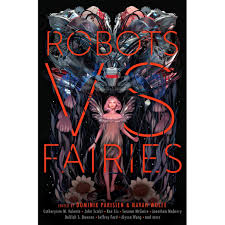 I am reminded, perhaps obviously, of Zombies vs Unicorns, the Justine Larbalestier and Holly Black anthology from several years ago. It’s the same sort of idea: which trope is better? Which sort of close-to-but-not-human species can authors have the most fun with, do most with, and so on? But more than zombies and unicorns, the authors in this anthology make powerful statements in their afterwords for why both robots and fairies can and do have such enduring power in our narratives. They are like us, but unlike. Robots are made by us; fairies live in parallel; both can be imagined to have legitimate grievances with humanity; both can potentially blend into humanity… and so on. Max Gladstone suggests robots are the future, and fairies are our roots.
So there’s a lot to explore in an anthology inviting authors to choose one of these archetypal features of our speculative fiction.
What surprised and amused me the most in this set of stories was the number of times authors decided to play with both. Seanan McGuire starts the ball rolling, and Catherynne M Valente finishes it; along the way, there are a couple of variations on Pinocchio that I didn’t always pick up – it’s not a significant story for me – as well as A Midsummer Night’s Dream; and other ruminations on how robots and fairies might be seen to fade into one another, one way or another. I really, really liked this aspect.
In fact, I liked this anthology in general. The stories are generally very well written, and there’s a marvellous balance of fun and heart-wrenching or somewhat horrifying, as well as often having significant points to make about humanity and how we interact with our world. McGuire’s views on theme parks were great fun to read; Ken Liu’s story on automation was chilling and brilliantly written (unsurprisingly). Sarah Gailey also contributed a supremely chilling story that I really wasn’t prepared for, and Madeline Ashby’s was haunting and lovely, and Maria Dahvana Headley got me with a rocknroll and fairies story that was always going to push my buttons.
Themed anthologies can be a fraught business. This one gets it right.

 Randomly Yours, Alex