Babylon’s Ashes
In theory it took me months to read this, because I read the prologue… and then I put it down. Then I read the first two chapters… and then I put it down. And I read like 30 other books and then I finally picked it up and read it. This is no reflection on the book or the series; I’ve been waiting for this book since I finished book 5. I think partly this was a concern that the book would be too much; that after the events of book 5, how could things POSSIBLY go well for my beloved characters? And there’s an intensity to Corey’s writing, too, that I just didn’t feel ready for at the start of this year.
But I finally got over all of that and I read it and of course it’s fantastic and by golly I want book 7 yesterday. I had wondered how on earth the series could be continued… but now it’s clear. Well, as clear as the combined minds that make James Corey can ever be to someone out here.
(Spoilers for the first five books, I guess)
Things I continue to love about this series:
- the focus on little, domestic things in the midst of solar-system wide disaster. The image of Avasarala applying a ‘homeopathic’ level of rouge is priceless. Also the details of life on the Roci and the various stations and asteroids. Plus…
- the focus on characters and relationships. Holden’s vague concerns about having Clarissa on board: make so much sense, and he tries so hard to deal with it and it’s so sweet amidst all the political wrangling. Bobbie, and where she might ever fit in. Every single thing damned about Avasarala. Also Amos.
- the widening perspective. There are more character perspectives in this book than previous ones, as has been the trend. So we get a much wider view of what’s going on; motivations and consequences, reactions and individual concerns. They matter, even when the solar system is threatened.
- just… the writing. It is so very easy to read. This is the sort of thing I would like to read all the time please.
This book is, of course, not an entirely easy or pleasant book. Terrible, terrible things happen. I was constantly worried, at the back of my mind, that THIS would be the book where Corey decided to screw up the crew of the Roci. Of course that nearly happened in the last book, and I had a lot of trouble dealing with my darlings all being in different places; maybe that was a softening up to deal with one of them… leaving? Dying? And then of course there’s the worries about the solar system, and Earth as a whole being devastated, and the Belt being in huge difficulties too… so while it’s not quite apocalypse level (well, aside from Earth, but there’s not so much focus on that in this volume), this is still not a book to read if you’re feeling particularly fragile. That said, it is still a great story, and of course the point of the whole series is human endurance and dealing with enormous difficulties.
I love this series.
New York 2140
 This book was sent to me by the publisher, Hachette, at no cost. It’s out now; RRP $29.99 (480 pages).
I adored Kim Stanley Robinson’s 2312 and after reading this I have an overwhelming itch to go read it again. Partly because this reminded of that earlier work, and partly because it reminded me just how very good Robinson can be (as I thought of 2312).
As the name suggests, the book opens in 2140, and is set almost entirely in New York. There’s been catastrophic sea level rise, due to melting polar ice mostly, and of course this has had a huge impact on coastal towns. While Manhattan isn’t quite an exemplar for all coastal cities, it does provide an intriguing setting for such a book – and of course New York is, as the narrative acknowledges, a very particular and, perhaps, unique city in terms of how inhabitants and others around the world relate to it. Sydney probably wouldn’t get you quite such a response.
Things I loved about this book:
- The different narrative points of view. Each one is clearly different from the others, with a unique voice and style: told from the first or third person; mostly through dialogue or action; individuals or pairs. I love this as a method of conveying a multitude of perspectives, both moving the narrative forward and allowing the reader to meet, identify with, and consider different sorts of people.
- Speaking of, I adore “that citizen”. That citizen gets their own chapter in each section and is basically there to explain the history of the world up to this point, and how New York and the USA work, and comment on aspects of New York’s social and cultural history. They are deeply knowledgeable and deeply cynical and deeply aware of the narrative they are a part of. To whit:
-
People sometimes say no one saw it coming, but no, wrong: they did. Paleoclimatologists looked at the modern situation and saw CO2 levels screaming up… and they searched the geological record for the best analogs to this unprecedented event, and they said, Whoa. They said, Holy shit. People! they said. Sea level rise! … They put it in bumper sticker terms: massive sea level rise sure to follow our unprecedented release of CO2! They published their papers… a few canny and deeply thoughtful sci-fi writers wrote up lurid accounts of such an eventuality, and the rest of civilisation went on torching the planet like a Burning Man pyromasterpiece. (p140)
Seriously. I alternately giggled and sighed reading a lot of that citizen‘s accounts. They also make snarky comments about surveillance states, growing throughout the 21st century, when being called “a police state… would have been aspirational” (p207) and the capabilities of industry to make drastic adjustments when it’s financially necessary. They are also deeply unimpressed by people who dismiss “info-dumps” in narratives while, of course, demonstrating exactly how to do them in splendid, self-aware, and necessary ways.
- Speaking of being self-aware, and something else that made me recall 2312, is what I guess might be Tuckerisation. One of the characers is Inspector Gen Octaviasdottir. Which I thought was nice, until I got to this description: “Tall black woman, as tall as he was, rather massive, with a sharp look and a reserved manner” (p29) – and then I realised who Robinson was tipping the hat too, and … I was moved. I know some don’t love this, but when it’s done in such a way that both people who get the reference appreciate it and it doesn’t prevent those who don’t see it from appreciating the story… well. I enjoy it. Robinson also has “delanydens” – places where there was lots of “intergender” and “indeterminate gender” and where “it was best not to look too closely at what was happening in the corners” (p183) – so again, don’t know who Delany is? doesn’t really impact on your understanding of the context. And another of my favourites: “russrage” – “at the ugly cynicism of whoever or whatever it was doing” the things that made people unsafe (p273). Of course I’m lucky to get these; I haven’t read any Calvino so “calvinocity” doesn’t have that extra layer for me.
- While the background of the narrative is the massive changes that have happened in New York and indeed continue to happen in the novel, a lot of the story is actually pretty small scale… dare I say, domestic. It felt like there was as much attention given to the antics of two young boys and their friendship with an old man, and the beginnings and difficulties of love, as to the possible relocation of polar bears and massive system defrauding. I really, really like this. Robinson suggests that even as places change around us, humanity adapts and remains fundamentally the same.
- It’s remarkably optimistic: that humanity can adapt and cope with the difficulties we face – yes they’re our fault, as a species, but we can keep going and maybe, maybe, make things better. Or at least not worse. And individuals can still have worthwhile lives amidst the problems. That’s pretty important.
- I just love the writing. It’s smooth and elegant and… readable. I really, really, really enjoyed this book. Yes, it has gone on my “Possible Hugos 2018” list.
Delirium Brief
This book was sent to me by the publisher, Tor.com, at no cost. It’s out in July 2017.
 The Laundry, which has several novels about it now, is a secret government agency that’s a bit like the Men in Black but more high-tech because the Scary Things in the Night are often accessed via maths and/or technology. Computers may well summon extra dimensional beasties. Bob Howard started as a tech guy who fell into the Laundry accidentally and now he’s a fairly significant player in the organisation, although still a bit hapless sometimes. In this novel, someone from Outside (of the world) is trying to take over via minions and the very 21st century method of privatising government operations.
There’s unlikely alliances, dastardly deeds, unfortunate deaths, spy craft, domestic difficulties, desperate last-minute decisions, and some rather silly jokes. There’s also exasperation at the short-sightedness of governments and some deeply unpleasant actions on the part of the villains.
I’ve read a couple of the Laundry Files books and short stories in the past. When I first read them, I didn’t realise that they’re kinda Lovecraftian… because I am no connoisseur of Lovecraft. So that’s the first thing to know: if you like Lovcraftian stuff (with humour) and you haven’t read this series, you probably want to check it out.
If you loathe Lovecraft and all his derivatives, just stop reading now; it’s fine. This isn’t for you.
Not sure? Well that’s where I fit too. I wouldn’t deliberately read a Lovecraft homage, but – obviously – I read this. In terms of horror, it’s not so horrible. I mean bad things happen but the levels of violence aren’t any different from a lot of science fiction or fantasy. And there’s no creeping horror here – that is, I didn’t ever get tense and worried about what was around the corner, which is what puts me off a lot of horror. (I don’t enjoy being scared.) And you definitely don’t have to know anything about Lovecraft to read the book, since I have a passing knowledge of some names from his books and that is it.
Prior knowledge of the Laundry Files is useful for reading this, but not completely necessary; there are a few ‘as you know, Bob’ bits that basically fill in details of how the agency works. It does flow directly on from the previous book, which I haven’t read, but I managed to be going on with it.
It definitely kept me entertained, occasionally grossed me out, and half made me wonder if I shouldn’t go back and read more of the earlier ones…
Fledgling
 I had read that this was Butler’s vampire-cum-courtroom drama, and had also been given a hint that the opening section might make the reader be all WHOA WTH NOOOO. And it would have, so I’m glad I had a bit of context, which I’ll give below as a wee spoiler that might help some readers. This is, though, a Butler book, and in no way is this JUST a vampire or courtroom drama – not that either of those would have been bad. But the book also deals with racism, justice, and family in intriguing and sometimes uncomfortable ways. Also, unsurprisingly given Butler’s interest in anthropology, with vampire myth and ‘logical’ ways for vampires to actually exist.
So here’s the spoiler:
at the start, the focus character can’t remember anything and is eventually found walking along a road by a young man, in his early 20s. There’s immediately a sexual connection… and then we find out that our character is young. Like, looks ten or eleven.
End spoiler
And it’s squicky even with the anticipation, and I can’t help but wonder what was in Butler’s head: did she want to use this to challenge assumptions about appearance, or about black sexuality (because our character, Renee/Shori, is black), or… ? I don’t know. And it’s intriguing because it’s Butler and I trust her, BUT.
Anyway. There’s are similarities here between the Xenogenesis and Patternist novels. They deal with miscegenation and the ramifications of that – for the individual who is ‘mixed’ and for the society around them, seeing the benefits and drawbacks. They all deal with the Outsider in our midst, and that the notion of the Outsider takes on a multitude of forms within each of those books – sex, race, species, ability. And they also all present different ways of compromising, different motivations for compromise, and different consequences of it too. Butler isn’t interested in making life easy for her characters or for her readers. She wants us to THINK. She probably wants us to be horrified, too, and forced to think through that horror.
This won’t be my favourite Butler; I don’t think it’s quite as well written as some of her other work. Goodness the ideas and challenges are magnificent, though, and with so little published work from her I’m pretty happy to read whatever I can get my hands on.
Blue Moon Rising
 I love this book a lot. I love the characters and the way Green plays with conventions – a prince riding a unicorn, a princess who is willing to fight, the brutal realities of being a second son in a royal house, some insightful passing comments about the danger of being too focussed on being a good warrior. I like the way betrayal and treason are explored, and how making compromises isn’t an inherently bad thing, and that peasants get a moment in the sun, and that not everything can get fixed but life goes on and can be fine. This was a comfort re-read and it absolutely worked and I am reassured that sometimes the suck fairy doesn’t visit.
Also I love the goblins.
But now I wonder about revisiting the entire Deathstalker series and that might get out of hand.
Paper
 I have loved everything I’ve read by Mark Kurlansky. So when I was in a small bookshop in a small town and saw a new book from him, I was pretty stoked. I half considered buying it as an e-version, partly because OH THE IRONY, but then my darling fawned her how pretty it is (and it really is very pretty, with rough-edged paper and all), so I bought the bard-back. Supporting small book shops for the win.
Tragically, I am disappointed.
I was trying to pin down exactly why the book didn’t work, and halfway through I realised: each paragraph felt like an extended dot point. Like he had all of these great ideas and fascinating points, mostly connected to paper, but… couldn’t quite nail the flow and structure. There are weird disjointed bits that entirely lack in connection, there are some fascinating bits about language and so on that aren’t clearly tied to paper, and… well. Disappointed.
I appreciated his discussion of the technological fallacy: that tech happens and then society follows. Rather, he argues, society creates a demand and THEN technology follows, playing catch up: why else is so much money spent on market research? So I liked that bit. However, as someone has pointed out to me, Kurlansky is entirely too linear in his perspective on the relationship between change and society. Civilisation just isn’t like that.
More serious than the lack of sequencing, though, were a few points where he was just… kinda wrong. For instance: he suggests that some people credit Ada Lovelace with inventing computers, and then reveals that actually she was inspired by Charles Babbage. And, uh, no. She invented the first computer language, and it’s no secret she worked with Babbage! … so this makes me a little concerned when he’s discussing those bits of history that I don’t actually have knowledge of. Because… can I trust him?
I gave it a four over on Goodreads because the ideas and the history really are fascinating, but the book itself as a piece of text ought to get a three.
River of Teeth
 This novella was sent to me by the publisher at no expense. It will be on sale at Tor.com on May 23.
HIPPOS. Hippos, folks. There need to be more hippos in my literature.
The foreword states that the American Congress debated importing hippos at the start of the 20th century, to resolve a meat shortage. I have no idea whether this is true. I presume it is; the foreword says it is. I could google it… but I choose not to, and live in the world where I believe that America actually considered ranching hippos. Because that’s way more fun than not.
And what’s even more fun than living in that world is this, Sarah Gailey’s debut. (Seriously? debut? kick. ass.) It’s an alternative history (which means it’s definitely not true, despite some recent definitions of ‘alternative’), pushing the date of hippo-introduction back half a century and imagining the consequences of actually hippo-ranching. Like cowboys riding hippos, and hippos going feral, and breeding hippos for stealth to help deal with the ones being raised for meat.
I’m just going to stop here for a moment and consider eating hippo-meat. Because… I dunno, the Anglo-Celt of my heritage just wants to gag.
Anyway, this is a crazy romp filled with wonderful characters and, as the name suggests, a whole lot of hippo-teeth-gnashing. Winslow Remington Houndstooth, putative lead and leader, is filled with desires for revenge and does his own share of teeth-gnashing. He rides Ruby: black, sleek, fast and deadly. Wonderful as he is, I adore Regina Archambault more: “Nobody ever suspects the fat lady”… who pickpockets and breaks hearts and helps save the day. She rides Rosa: three thousand pounds of albino hippo. Hero is also wonderful, and all about blowing stuff up (always the way to my heart), and the rest of the team fills out nicely. There’s a good villain (or two, or three…), so that’s the character side all sorted. There’s explosions, and card games, and feral hippos that are happy to eat people; romance, confusion, and a lot of crankiness and snark. OH THE SNARK.
You’ll want to get your mitts on this one, folks. It’s just way too much fun to miss out on.
Cooked, by Michael Pollan
 This book was recommended to me by the sourdough baker whose course I took. It turned out that I had already one of Pollan’s books – The Botany of Desire, which was awesome and looked at various plants in light of the general idea of desire. (My biggest take away message: the Agricultural Revolution was the grasses using humanity to destroy the trees. Also that all edible apples are clones.)
This book is Pollan’s attempt to learn more about cooking, having looked at the gardening and the eating side for a long time. He divides the book into four sections: Fire, Water, Air, Earth. Or, basically: barbecue, braise, bread, and fermenting. Continue reading →
Proof of Concept
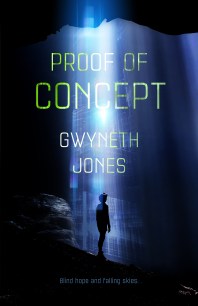 This novella was sent to me by the publisher, Tor.com, at no cost. It will be out on 11 April, 2017.
Um. Wow. No seriously. Terrifying and amazing and absolutely captivating.
Jones is saying a lot about modern society in this novella and most of it isn’t very nice. She’s also presenting a compelling story and believable characters and… this is yet more evidence that novellas are a fantastic length for stories.
There’s been a lot of discussion recently about how facebook mediates news and how people who only get their news from facebook can end up in an echo-chamber, essentially, with their own opinions endlessly reflected back to them. Jones presents GAM: Global Audience Mediation. An avatar, the AI of GAM, asks questions for news broadcasts – it’s “the statistical sum of… real-time responses” from the global audience (4). It’s crowd-sourced journalism, where presumably minority views and questions get drowned out in the fantastically huge audience. No room for dissenting voices then. Then there’s the broadcasts of the VLDMT (Very Long Duration Mission Training) – in theory Earth 2-like training situations for people who might go on interstellar missions, but effectively ending up like reality tv – Big Brother in extremis.
And this isn’t even really what the story is about. They’re just creepy incidental issues that Jones throws in to show that this is a real and believable future story. I love Gwyneth Jones.
What the story is actually about is getting off Earth as the population and climactic situation gets progressively worse and worse. There are two solutions being proposed: the VLDMT people imagine a space ship, while Margrethe Patel is working on a method of hyperspatial travel that shifts within 4D information space. (Happily, Jones is not Greg Egan, so there’s no vector diagrams to attempt to understand.) The two groups come together when an enormous abyss is discovered under Poland and it appears to offer a place to practise for both groups. They need complete isolation from the rest of the planet, and things go from there…
Did I mention that the focal character, Kir, has an AI in her head? Yeh. There’s a huge amount going on here.
I loved Kir and how she faces the various problems – like annoying people and difficult work – that confront her. I was gutted by how Jones imagines this possible future, and I was enthralled by what she imagines as solutions. If you like science fiction you need to read this story. When it’s available.
The Light that gets Lost
This book was sent to me by the publisher, Bloomsbury Children’s, at no cost. It’s on sale now; RRP $19.99.
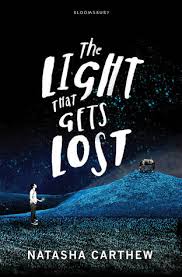
The promo material that comes with this says it’s for 12+ years. Me, I wouldn’t give this to a 12 year old that you wouldn’t give Lord of the Flies to – and I’m guessing that’s most of them. It’s been a while since I read Lord of the Flies but there are definite overtones of that scenario in Carthew’s book, especially in the second half. I rather feel a kid would need to be a bit robust to read and enjoy this, because it’s certainly not all rainbows and cupcakes. I know dystopia is (was) all the rage but this feels a bit closer to home than that…
The set up sees Trey, as a small child, hiding in a cupboard while his parents are murdered. What a cheery opening, right? And then the story skips forward eight years and Trey is getting himself into a farm camp for juvenile criminals, in theory intended to train the adolescents in useful skills but in reality more like forced labour. Trey has willingly gone there in order to try and find the man responsible for his parents’ deaths. Which is a bit messed up I think.
There are some really interesting ideas here, but for me some of the better ones are the ideas that get mentioned and then lost. It becomes clear int he second half that society outside of the camp isn’t exactly the society of Britain (I think) in 2016… but exactly what’s going on and how it got there is never explored. It’s just mentioned in passing, almost for no reason, and then ploop… disappears. The entire set up of the farm isn’t explored or explained in that much detail, so it just sort of… exists… as a place for things to happen.
The main focus of the story is friendship and revenge. Friendship in this kind of environment is always going to be a bit fraught, what with sadistic overseers and bullies and a system aimed at breaking kids down. The friendship between Trey and a boy in his bunk room, Lamby, is believable enough but I didn’t always buy the friendship between Trey and Kay, a girl with whom he ends up doing farm work. It might have been a bit more believable if there had been other female characters with whom we got to see Kay interacting, or even Trey interacting with them.
The revenge aspect drives the initial part of the plot and again I didn’t entirely buy the eight year old boy turning into an adolescent so driven by revenge that it’s as if there’s a demon under his skin. This idea of a demon gets a few mentions – including on the back cover – but isn’t really explained; Trey occasionally talks to it but it’s not clear what we’re meant to think is going on. Maybe that’s left deliberately ambiguous but it didn’t work for me in this context. There is some resolution to this revenge plot but, again, it didn’t entirely work for me.
This all makes it sound like I hated the book, but I didn’t. I didn’t love it, but neither did I loathe it. Cart hew writes beautifully on a sentence level; the Financial Times apparently described her as using “vivid, imagistic language” and certainly a lot of the language is vivid. Some of the lacunae are obviously deliberate and evocative, which I liked, it just didn’t always sit well with the plot.

 Randomly Yours, Alex