Snuff
Way back when I was doing my undergrad degree, I did a subject called Popular Fiction. I was excited to be reading popular fiction and calling it work for uni! I was less excited when I got to the first tutorial to discover that, of about 20 of us, I think only 2 or 3 admitted to actually reading popular fiction regularly… everyone else said they were doing the subject “to know what other people read” (I paraphrase).* This made me a bit bullheaded. So did the lecturer insisting on differentiating between the reading/appreciating of literature, versus the consumption of popular fiction. This one still makes me angry, although I do wonder now how much the younger me missed nuances here; the lecturer was definitely cluey enough to understand Austen and Shakespeare as originating in the popular sphere. So perhaps I overreacted and/or misunderstood some aspect.
Anyway, over time I have come to terms with the fact that yes, actually, I am a consumer of popular culture, and that is OK. It does not make that culture bad, it does not mean that I am no appreciating it properly, etc etc. Basically I have grown up, and grown into my skin. So I am quite happy to say that hell yes I consume Terry Pratchett books. I devour them: I read them quickly, in concentrated blocks of time; they don’t require me to stop and worry over words or sentences that don’t make sense. That said, I tend to treat Literature (when I have to read it) in much the same way. At the very same time, though, as Anita Sarkeesian rightly insists, just because you enjoy a product of popular culture doesn’t mean it shouldn’t be critically analysed (again, I paraphrase).
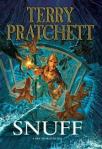
This is the long way round to saying “I read Snuff! It was awesome!”
… and dealt with some big issues in clever ways, as you would expect. (There are some spoilers below.)
Pratchett has dealt with racism, via speciesism, before: human reactions to werewolves, vampires, dwarves, trolls, zombies, etc etc – these have all been coded as racial. And, from memory, generally done well (I could be wrong there; it’s been a while). In Snuff Pratchett makes this the central issue, because the main problem revolves around goblins and whether they ought to be treated as sentient, sapient, creatures. For a long time they have been regarded as vermin, and many people have treated them in ways matching that perception. But now Sam Vimes and family are off for a Holiday, and there are Hints that all is not well in the bucolic surrounds he finds himself in. Not least the difficulty of understanding crockett, and having to confront horses.
I’ve had to think carefully about the way Pratchett portrays the goblins. One of the crescendo moments is a goblin, Tears of the Mushroom, playing the harp for a huge crowd in Ankh-Morpok. That is, a member of a subjected race, wearing ‘civilised’ clothes, goes to the heart of civilisation and plays an instrument that is coded as approaching the zenith of musical accomplishment, and there impresses the (civilised) bigwigs. This could all be seen as uncomfortably close to recreating the classic idea of the western civilising mission.
… Except. Except that the goblins have already been shown, very clearly, to have their own culture and don’t need ‘civilising’. They have a rich language, evidenced clearly by their names (Tears of the Mushroom!); they make art (some of which is so precious that humans who regard the goblins as little better than animals will steal it); they care for one another and about justice. They are wretches in that they are wretched – through no fault of their own. And Tears of the Mushroom plays her own composition, and is in no way dismayed by the audience before her. By the time Tears of the Mushroom plays, the reader should be so convinced about the sentience and sapience of the goblins that any of the characters doubting it should cause serious eye-rolling. Many of the human characters are also convinced early on, which is also intended to convince the audience, just in case you missed all of the other very obvious signs.
Thus what Pratchett is doing is showing, to some extent, an example of the old westernising/civilising mission – there’s no doubt that’s what Miss Beadle is doing, whatever her intentions – and then… not entirely sending it up, but certainly undermining it, and definitely showing that is is quite unnecessary for the sake of the goblins themselves. Although maybe it’s necessary for the acknowledged-as-civilised, to make them realise what they are doing to this race.
There are other issues under examination here too. The place of landed gentry and inherited titles (written after all by Sir Pratchett), with a lovely sneaky homage to Jane Austen; and how a copper manages to love both his work and his family. Pratchett has delved into Sam Vimes’ head a few times in the recent books and I think his ideas about policing etc are utterly intriguing. I especially loved here the abstracted notion of the Street as something that stays with people like Vimes, and helps him to be who he is.
I love the Discworld. I think the books are, as a whole, getting better. I wish I thought there were many more to come.
*I was also less excited about having a Jackie Collins novel on the booklist. In three years of English at uni, this is one of the few books I just did not read.**
** One of the others was Charles Darwin’s Voyage of the Beagle.***
*** I also didn’t finish James Joyce’s Ulysses. Peh; bad taste in the mouth.
Ancillary Justice
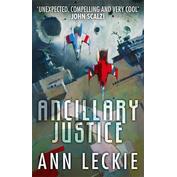 Firstly: OMG I loved this book so very much.
Secondly: a real review. There are some spoilers, but nothing too major. I promise you will still have your breath stolen by many of the events in the book.
So, let me get “the gender thing” out of the way first. I debated leaving this ’til last, because it’s what a lot of other people are apparently fixated on… but for that very reason, it seemed disingenuous of me not to engage. Thus: the narrator of the story, Breq, is from a culture that does not use gendered pronouns. When Breq is dealing with cultures that do use gendered pronouns, there are language problems – troubling enough that it causes Breq quite some stress. And when Breq is thinking/speaking to the audience, rather than rendering pronouns as ‘it’, Leckie has opted for ‘she’. This, obviously, presents some rather intriguing aspects. Except for a few times when Breq is corrected, the reader actually has no idea whether the other characters presented are male or female. I don’t actually think we know whether Breq‘s body is female or male, hence my hesitance to use a pronoun (Breq would use ‘she’ and roll her eyes at me). Why is this interesting? Well, we don’t know whether the leaders have boobs or balls. We don’t know whether the soldiers dying having tits or testes, and we don’t know which the person who ordered those deaths has, either.* And I think this probably changes the way the reader reacts, at least in some instances. More intimately, we have no idea whether the physical and otherwise personal relationships presented are hetero or homo, which is relevant if it matters to you; at any rate the lack of knowledge is surprising, occasionally frustrating, always intriguing. And when any or all of the people might be women, you’re left with the conclusion that women are actually capable of doing/being all of the positions presented – up to and including leading a galaxy-spanning society. Who knew? In the lack of gendered pronouns Leckie is making a call that gender doesn’t matter – except that in choosing ‘she’, this is somewhat undercut.
Look, I’m not actually a gender studies scholar. Probably there are other things that Leckie is doing that I didn’t really pick up on. But as a way of unbalancing the reader that works perfectly within the context of the novel, it’s a brilliant choice; and it also does that thing that great SF should do: it forced me to reconsider my own world.
On to other things: and speaking of unbalancing the reader that works perfectly within the context of the novel, what is with the gloves?? This is a brilliantly clever, and devastating, move on Leckie’s part. Breq comes from the Radchaai, and within the Radchaai everyone wears gloves. If you don’t wear gloves, you are regarded with horror. Why? It’s never explained. It’s like a man getting around in a Jane Austen novel not wearing a shirt; it’s clearly the wrong thing to do, but it’s not going to get him arrested – and Austen wouldn’t bother to explain why it’s a problem because surely you understand? Sheer. Brilliance.
Ancillary Justice does not follow a neat linear narrative. There is a chronological thread – it follows Breq as she (all right, I give up; it’s just easier, ok? and it’s what she would use) searches for something she needs, in an effort to right a wrong. Along the way she encounters someone rather unexpected, who brings a whole pile of unlooked for problems. Alongside and around that thread, the reader lives through the memories of what has brought Breq to this path. The main thing to know, in order to understand what’s going on (and this is on the back cover, so it’s not a spoiler), is that Breq wasn’t always Breq. Until twenty years ago, the body known as Breq was an ancillary of the AI controlling the Justice of Toren, a massive ship of the Radchaai involved in annexing and subduing planets – ostensibly for their own, but mostly for the Radchaai, good. Thus Breq’s memories are mostly those of a few-thousand-year-old artificial intelligence. And being an ancillary means that her body is human, and was co-opted for… duty? inhabitation? use? by the AI.
This issue of ancillaries is one that the book is not obsessed by, but does deal with seriously via several of the characters who respond poorly to the very idea of them. I liked that the story didn’t develop into something too preachy, but I also appreciated that having raised such a frankly horrifying idea, Leckie did not simply leave it as a necessary-but-evil, or evidence-the-Radchaai-are-dreadful, sign. Instead, it’s as complicated an issue as the annexations themselves, because they really do bring benefits to the planets colonised – as other colonisations have – but whether that’s worth all the pain and bloodshed… well. That’s something we’re still processing, to some extent.**
The blurb of my copy paints this as predominantly a revenge story, and I get where that’s coming from. But it lacks nuance, too. Breq is indeed looking for revenge. But she’s also looking for answers – to questions about events in her past, questions about the Radchaai itself, questions about how she can, should, exist as this solitary body rather than as a near-omnipotent (in a constrained space) being. Therefore even if the novel were purely focussed around her, it’s more complicated than just “rargh I get you for what you done to me!” But, of course, as the above demonstrates this is a far more nuanced and complex novel than that. It touches on issues of colonisation, and of gender; it looks at what it means to inhabit a body, as well as to inhabit a planet. And it looks at how religion is co-opted for different purposes, too.
The inclusion of religion startled me, and – when I got over that – made me very happy. It’s something I’ve complained about in the past, here and on Galactic Suburbia: the lack of religion, treated seriously, in science fiction. Seriously people: do you think that just because humanity lives beyond the Earth, they’re going to somehow move beyond a desire for an explanation beyond what science can provide? I don’t think so. Leckie’s inclusion of religion, and the exploration of how religion and colonisation work together, was welcome and clever and shows how much thought she has put into this universe.
This next bit is for those who’ve read Iain M Banks’ Culture novels. I can’t help but assume that at least part of this novel is in dialogue with the Culture. There’s the fact that AIs are in charge of ships and stations, and interact with their human inhabitants. I know that this happens in other stories, but there was something that made me feel a distinct connection to the Culture Minds. That said, these AIs are not really like the Culture Minds. For a start, they’re not meant to have personalities at all. And there’s a very clear point in the story where Breq reflects on the fact that the ships don’t really talk to each other any more; they’re too old, and they’re bored by each other. This is in complete contrast to Banks’ positively verbose Minds, who can usually hardly keep their traps shut. Then, of course, there’s the use of ancillaries – actual bodies – instead of drones, which is… interesting. And reflective of the fact that the Radchaai is a far more problematic society than the Culture, and possibly reflective of the way such a human society is more likely to act (aggressively, rather than with the amused benevolence characteristic of the Culture). It’s entirely possible that Leckie has never read Banks, I guess, but for me this works really nicely in conversation with a series of books that I also adore.
Finally, then: this is what I want my SF to be like from now on. Smart; fast-paced; intriguing characters; believable world. And intellectual depth for added joy.
*I do understand this is reductionist; I’m going for effect here. Additionally, there doesn’t seem to be an indication of these societies going in for large-scale, Culture-esque body shaping, so it seems to me that these crude indicators would still be considered relevant by Breq’s contemporaries.
**I mean on a global scale, not an individual scale. Please don’t yell at me for defending colonisation, because I’m certainly not; I’m an historian, I know and agree with most of your points.
You can get Ancillary Justice from Fishpond. This book was provided to me by the publisher at no cost.
Menial: Skilled Labor in SF
Reviewing an anthology is always a bit more difficult than reviewing a novel. So is rating it. Does one poor story deserve to bring down the entire anthology? Should I mention every single story?
 I gave this anthology a 5-star rating on Goodreads. I did not do this because every single story blew me away; they didn’t, although I don’t remember any story that I loathed, which is impressive in its own right. Partly I was predisposed to being impressed by the anthology because of the theme: the menial. That is, no heirs-misplaced-at-birth, no admirals or planetary governors or princesses starring here; instead, it’s the miners, the sewerage workers, the grunts who feature. Not to say that the stories don’t feature action or adventure – they do – but largely it’s action that happens in the course of everyday work, and often because of accidents: the sorts of things that you’d really rather didn’t happen. The anthology points out the dignity in the menial tasks, as well as acknowledging the sheer back-breaking work that’s likely to still be necessary in the future; it points out the importance of the menial while remembering the danger. And even though the menial workers shine in the stories, it’s clear that for most of them, this isn’t going to lead to a huge change in fortunes. It’s part of a day’s work, or it’s not but it’s not enough to propel them out of drudgery – or indeed it’s something that leads to them getting fired and the consequent uncertainty of unemployment.
This anthology shows that good SF can be escapist in letting the reader escape from their own immediate situation, but can simultaneously speak to the reader who is unlikely to be a spaceship pilot or lead an army, but may well have a dead-end job that they hate. It can provide ways to imagine a different world but also reassure and comfort that even people in crappy jobs can actually have interesting lives, and do interesting things – something much SF ignores.
This anthology imagines a range of possible futures. They’re mostly fairly far future, and involve space travel of some sort; some have humanity spread far and wide, others are a bit more restricted. Because of its focus on the working class, there is less emphasis on the political or military than one often finds in SF, because really, when you’re scraping to get food on the table who has time to worry about the expansion of the empire? Many of these stories are united in their focus on the nitty-gritty details, those details that make up the everyday. Some of them are very familiar, some are familiar but in foreign contexts, whilst others are utterly alien. And the best stories make this work in clever and occasionally utterly bemusing ways.
I was initially dubious about the possibility of making an entire anthology based on the concept of skilled labour; not because I thought the concept was boring but because I wasn’t sure how there could be enough variety within that to keep having different stories. This is because I am not an author. There is, of course, infinite variety in the stories you can tell from the menial perspective – because there’s an infinite variety of stories to tell about humanity.
You can get Menial from Fishpond.
Han Solo
What can I say, I’m one of those people who thinks that Solo is really the star of the Star Wars movies; I was very annoyed that eps1-3 didn’t make a reference to him, even something as small as ‘here’s this kid I’m teaching to be a smuggler…’.
Anyway, a friend was cleaning out her house of books and I became the recipient of a Rather Large Bag of Star Wars novels… and I have finally dipped my toe in. I started here partly because SOLO, and partly because of this article about the author, AC Crispin, having recently died. And I had no idea that AC = Ann.

So. Solo.
Look, this is not a novel that was ever going to win literary prizes. The prose is a bit clunky, some of the characters are a bit stock, and yes the overall plot is a bit hackneyed. BUT! But.
a) It’s SOLO. Who doesn’t want to know how the galaxy’s most loveable rogue got to where he is? Who doesn’t want to know why someone so rough on the outside actually has such a soft smooshy inside? (Much like a tauntaun…). Plus, how did he GET that tough exterior? How did he and Chewbacca find each other, and what about the Millennium Falcon? These are questions I really want an answer to. So, I’ll read the novels.
b) It expands the Star Wars universe. I think one reason why I really like the idea of the enormous number of tie-in novels is that they’re all set in the same universe, but they don’t concentrate on just one bit. The Zahn novels didn’t; this one novel takes the reader to a few different planets, and while most of them are (as far as I recall) referenced in the original movies, this book looks at them from a rather different perspective – and it still works. It’s a lot grubbier, mostly. Yes Solo is a smuggler in the movies, yes Tatooine is the planet-futherest-from-the-bright-centre-of-the-galaxy – but really you don’t see much of the seamier side of the planets, let alone of the empire as an Evil Empire. Contrariwise, Crispin sets a lot of her story in the criminal underground, or on a slave plantation. Some people are nice, some are downright rotters.
c) Gratuitous Star Wars references. Sure Solo’s miff-ed-ness at being called scruffy got a bit tired after a while, but still – funny.
d) It takes Star Wars stuff but it makes it different. There’s an elderly Wookee woman that Solo’s friends with, and there are clear parallels to Chewbacca (also with his non-human companion Muuurgh) – but it’s not identical. There’s a romantic interest and again, parallels to Leia but by no means identical, and indeed provides some rather thought-provoking points on why Solo reacts the way he does to Leia (abandonment issues). Links to the Hutts, being a pilot, etc – all of these essential elements are there, but Crispin does interesting enough things with them that it’s by no means ‘young Solo just imitates old Solo.’ And that’s cool.
Thus this novel was definitely light entertainment. It’s light because it doesn’t require an enormous investment of time or thought-process from the reader – although it does raise genuine issues and does not simply ignore them. It’s entertainment because there are pirates, and smugglers, and chases, and Han Solo.
Adventures of Alyx
No, I did not misspell my own name (although someone at work did yesterday…) – Joanna Russ called her character Alyx, and I have finally read the collection of four short stories + one novella about said adventurer.
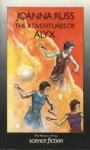
The thing you have to know about Alyx is that although the name stays the same, and some aspects of the character remain the same, trying to establish an internal chronology for these stories is likely to bust your brain. It doesn’t work, and it doesn’t have to work. Maybe it’s the same woman, maybe she’s a time traveller, maybe the name lends certain characteristics (like Julias in Tansy Rayner Roberts’ Love and Romanpunk) … or maybe Russ is playing, and it actually doesn’t matter. Although once you accept that it doesn’t necessarily work, making connections is a lot of fun.
These stories are different genre, with different approaches to narrative – what makes a narrative – so don’t go in expecting a cohesive whole. Of course, it is a whole in that Russ is doing confronting things with her female character: making her the lead, and not making romance important, and exploring reactions to women. That’s still a bold thing to do, and my edition of these stories was published in 1983; they originally came out between 1967 and 1970. I really wish I was alive to experience Russ As She Happened. And it makes me wonder who, if anyone, fills a similar niche today – and whether I am completely missing their stuff, for whatever reason.
I feel like a barbarian myself to admit that I did not love the first two stories. In fact, it took me ages to get through this slim volume because I was so not in love with the first one, and then the second, that I was worried I wouldn’t enjoy the rest. I persevered though, partly from an admittedly perverse desire to be able to say that I had read it, and partly because I knew that the stories changed up so I was hoping that I would come across stories more to my taste later on. And I did. Some of what comes below is my analysis of my own reactions to the stories, rather than a pure review. This might be dismissed as navel gazing; for me, it’s a way of working out how I work with Joanna Russ, such a powerful influence over what I’m interested in.
“Bluestocking” begins in a very self-deprecating way – “This is the tale of a voyage that is on interest only as it concerns the doings of one small, gray-eyed woman.” Not a great start? It gets subversive within moments, though, suggesting that the first man was created from the sixth finger of the left hand of the first woman… but our lady, Alyx, has all six fingers. Alyx is a pickpocket; she gets hired to look after a spoiled young woman. Then there are adventures, of a sort. There’s travelling, and bickering, and a sword fight. It is also supremely brief. I’m not sure whether it was that aspect that most didn’t work for me, but it certainly contributed – I found this story quite frustrating, with all its lacunae and its teasing and… something. “I Thought she was Afeard till she stroked by Beard” worked similarly on me. In this case, Alyx escapes an unhappy marriage; gets on board a ship and has a complex relationship with the captain; and is frustrated by the place of women in the world. I think it’s clever, but for mine there’s just not enough.
I should say at this point that there is more going on here than ‘just’ a narrative, especially in narrative connections; I know Russ is addressing Fritz Lieber, and others. I haven’t read any Lieber. Perhaps this is a fault in me, and the stories would be greatly improved with that background knowledge. But I know Terry Pratchett riffs off Lieber too, and I enjoy those stories; I know Mieville and Reynolds are riffing off others, but I still enjoy theirs too. So… perhaps it’s ok that I don’t enjoy all of Russ’ work? Maybe?
“The Barbarian” is a story that Gary Wolfe, in his essay in On Joanna Russ (… I think?? eep maybe I’m wrong…) suggests is the switch for Alyx between fantasy and SF, which is an intriguing way of seeing it. Here Alyx is again a crim-for-hire, but she doesn’t like what she’s hired to do and things go downhill from there. For me as a reader, though, things started going up. This story appealed more, although I’m not sure why. Maybe it’s a simpler story but with more flesh, more detail?
Then – next – oh, delight: “Picnic on Paradise.” This was originally published alone, as a novel; I guess it’s a novella, by today’s standards? 90 pages in my little pocketbook edition. Alyx, a Trans-Temporal Agent brought from the ancient Mediterranean world to both the future and a different planet. She’s being used to guide a disparate group of tourists across a war-ravaged planet, to keep them safe in the most horrific of circumstances: no access to their technology. There’s an incredibly profound moment at the start, where one of the women asks why Alyx is “covered up” – wearing clothes. So Alyx takes off her shift, therefore mimicking those around her, which group promptly have apoplexy. Alyx is confused, naturally; one of them says that she is wearing her history, which they are not used to. This goes a long way to demonstrating some of the rather large differences between Alyx and her charges. The story is a straightforward one of flight, and fighting for survival: getting lost, getting hungry, literally fighting (nature, each other, etc). It’s Russ, and having read We Who Are About To… I wasn’t surprised that things do not go according to plan, in a drastic way. One of the remarkable aspects is, of course, that the leader is a woman. Making the hard decisions, being contemptuous, fighting – being well-rounded. The tourists are a motley bunch: nuns, macho men, wannabe robots, high-society ladies. They too have their chance to be well-rounded, to interact especially with Alyx but also each other. This isn’t a fun story but it’s a great story, an intriguing one, and one I am so pleased to have read.
The final story in the set is a difficult one in terms of “Alyx canon,” the idea of which I rather suggest Russ would either have rolled her eyes or laughed at. Because Alyx probably isn’t in it. Her descendants might be, but if you read this by itself you wouldn’t have a clue about her. It’s also frustrating me because I know I have read it – “The Second Inquisition” – before, but I don’t know where. Some anthology, some time. Anyway… this too is science fiction, focussed on a young girl whose family is hosting a very odd stranger, who leads the girl in all sorts of directions: physically, introducing her to other, even more strange people; intellectually, introducing her to books and ideas she has never encountered; and culturally, challenging a whole bunch of assumptions within the family and society more broadly. There’s also questions about reality and imagination going on here that I think I missed the first time through. Intriguingly I think this gets a little close to the ‘galactic suburbia’ stories that Russ dismissed, since the focus is very much a suburban home with the occasional break-in of the science fictional. At any rate it certainly makes a challenging and difficult-in-a-good-way conclusion to the collection, because it doesn’t fit neatly into Alyx’s adventures. Which is as it should be, because Alyx – as a woman and as a character – doesn’t fit anywhere comfortably either. And she wouldn’t want to.
An Aura of Familiarity
I hadn’t heard of the Institute for the Future until I found out about the short anthology they put out recently, called An Aura of Familiarity: Visions from the Coming Age of Networked Matter. The point of it is to explore, in science fiction, the possibilities of a human future that is even more hyper-connected than it is today. I’m delighted by the idea of such an institute existing at all, and the fact that they are calling on creative types to offer their perspectives.
This is a lovely-looking book, even in digital format; the pictures throughout, contributed by Daniel Martin Diaz, are fascinating – I’d love prints of them.
Rudy Rucker starts the anthology with “Apricot Lane.” In this version of the networked future, every single item you buy has the ability to speak to your brain – and not just to advertise themselves, but telling you anything they feel like. Not only does this vision of connecting suggest hyperconnection with your belongings (and others’), but the lack of privacy suggested is also staggering. It’s a clever concept, and a horrendous one; I didn’t love the narrative itself though.
“Lich House,” by Warren Ellis, is horrifying in a different way: here, someone has managed to get into a house that ought to be impregnable, and attack the occupant. The ‘getting in’ has involved essentially killing the house, and most of the narrative is actually taken up with the dying of the house, in rather gruesome detail. So, it’s a clever idea – and again a clever vision of connection – but don’t read it for the narrative; it’s a vignette not a story.
Ramez Naam’s “Water” focuses particularly on the commodification of water, although other consumables are also networked and able to advertise directly to your brain (you can turn the ads off, but that costs a lot more). The opening of the story is, again, horrifying – showing how someone might massage the ads you receive to their benefit (this is of course not so far removed from your internet experience today). But the majority of the story is actually about how this networking might be manipulated for economic gain. This is the most interesting story of the first half of the anthology.
Madeline Ashby, the only woman in the anthology, contributes “Social Services” – and, again, showing a theme, this is an intensely creepy story. The networked matter is important to the story but not vital. The point, instead, is in how people manipulate one another and the consequences of that.
“From Beyond the Coming Age of Networked Matter,” by Bruce Sterling – one of the early lights of cyberpunk – takes the idea of networking matter to an extreme and vaguely Lovecraftian end. Disappointingly, it’s the least interesting story.
The final story is from Cory Doctorow. “By His Things will You Know Him” just pips “Water” as my favourite. It’s a close, deliberately claustrophobic story: a man whose estranged father, a hoarder, has recently died – and he has to deal with his effects. The funeral director introduces him to a new programme that will catalogue everything using clever new intelligent devices. Doctorow cleverly entwines the story of grief and the story of obsession; the idea of ‘networked matter’ is fundamental to the narrative but does not dominate, as in some of the others here. It’s a wonderful story that could easily appear in a different setting and still make sense.
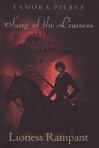
Alanna 4: Lioness Rampant
SPOILERS
Once again, let’s talk about that cover. It’s way too dark, for a start. Alanna is still not in armour, even though she becomes the king’s champion. The horse is still the wrong colour. The red glow makes sense, I guess, but… yeh. This really doesn’t work for me. The title basically works; it’s better than In the Hand of the Goddess at least.
And again: junior section of the library, people! Weird!
At last, a proper quest. I was beginning to wonder whether it would happen! We had two books of boarding school, one book of… I dunno how to characterise the third, actually. And then here, a quest. Not your average quest, of course, but a quest nonetheless. In fact, a road trip! Alanna learns of a Fabulous Jewel and decides that hey, this is exactly the sort of thing she should be adventuring after as a knight errant. Along the way she meets – and Takes Up With – one of the few men genuinely her match in fighting, Liam; plus a refugee princess, who she eventually matches with Jonathan to take that little problem off her hands; and when she gets back to her home, she helps to bring down a plot against Jonathan (now king), with the back-from-the-dead Roger at its heart. Plus she finally ends up with George, who’s been holding out so faithfully.
The quest angle was interesting, not least because it takes up less than half of the book. The Dominion Jewel does end up being fundamental to Jonathan keeping ahold of his kingdom (literally), but the trip is definitely more about the travel than the destination. Alanna’s relationship with Liam is perhaps the most fascinating of all her loves. For a start, Liam is terrified by her use of magic – so she knows right from the start that they won’t be a long term item (although I am mighty, might sad that he died). His knowing more about some aspects of fighting lends an interesting tone to their relationship, since it takes on a teacher/student aspect – it’s not overdone, though. Her frustration at his occasional desire to protect her comes through well, and not usually as an ‘I’m the strong man’ attitude but more of a ‘I love you so I want to protect you’ thing – which is quite reasonable, from his perspective, if frustrating from hers. And then finally we get female relationships, with Alanna relating to the princess Thayet and her bodyguard, Buri, on a fairly level playing field: Thayet actually outranks her, as no woman she has interacted with daily ever has; Buri is pretty nearly as good a warrior as her. And they manage to have occasionally spiky but generally very good friendships, based on mutual trust and equality. Hooray!
Oh, and she gets the jewel, by nearly defeating and then amusing an elemental being. Awesome. Off home then.
Alanna’s relationships with Jonathan and George have complicated, as they ought. Jonathan is willing to be chivalrous, but really knows that their marriage wouldn’t be awesome; plus, he’s smitten by Thayet, as Alanna was planning. Plus, being married to your Champion would just be awkward. George keeps on being the faithful one, and eventually that pays off. Awww.
Clothes play a rather interesting role in this story. I like that Alanna has a complicated relationship with clothes. It makes sense. I love that she is allowed to mash somewhat-feminine clothes with her status as a knight when she is presented to the court. Liam’s poor reaction to her being in a dress, because that doesn’t suit the box into which he wants to place her, is a wonderful exploration of identity and expectations. The resolute determination of showing that she can be feminine – and like feminine things – and that this does not detract from her status or fighting abilities is magnificent.
There are some things that are rushed, here, as they have been throughout. Alanna’s relationship with her brother Thom, in particular, is never fleshed out enough for my liking; Thom as a character is too distant and unrealised. We just have to accept that he’s become proud because of his power, but that he gets tricked by Delia into resurrecting Roger.. and then he finally gives in and is willing to accept help from his former teacher whom he previously seemed to despise. It’s all a bit of a mess, really, which is unfortunate because I think the twins’ relationship could have been a much more intriguing aspect of the story than it was allowed to be.
I am unconvinced by the conclusion, too. I am happy enough with her ending up with George, although it is just oh-so-convenient that he’s noble now (not to mention pardoned), so there’s no issue of her marrying below herself. However, the idea that she would immediately agree to have children after a year or two of marriage struck rather an off note for me. She’s just made him amend his suggestion that she settle down to going off roaming with him, and now she’s confirmed to near-immediate motherhood? Given the rather pointed bits about her knowing nothing about children – although she does learn – this just seems out of character. And it was an unfortunate way to end, too; I don’t really see why there had to be a discussion of children along with the discussion of marriage.
Overall, I am pleased to have read this quartet; I read the last three in about 24 hours. I may at some stage seek out the next set of books set in Tortall, but I’m (really) in no hurry. Pierce was doing some interesting things, here, but I’m too old and well-read to be as completely overwhelmed as I might have been in my teens. Still, I’d have no hesitation in shoving them down anyone else’s throat.
You can get Lioness Rampant from Fishpond.
Alanna #3: The Woman who Rides like a Man
SPOILERS

Soooo… let’s talk about that cover then. Can you spell Twilight? SERIOUSLY, PEOPLE. There is so much more to this story than a love triangle! And WHAT the heck is she WEARING?? Is there a Valley Girl in the desert that’s not mentioned? She’s a KNIGHT. She could at least be wearing a burnoose, given she spends a large amount of the story in the desert. But nooooo they have to make it look like this almost modern. You can pretty much ignore the sword in her hand, even! Urgh. Also, I wouldn’t go for either of these fellas.
Still, at least this is a better title than the second one. “Woman who rides like a man” is both directly relevant to the story and intriguing.
Also, found in the junior section. Really makes me think that the staff haven’t read it.
Alanna is now a knight, and like she has been saying for two novels, is off to seek whatever knights errant seek. Warmth in winter and some distance from both Jonathan and George, in this case, plus getting away from people who disapprove of boobs behind armour. She ends up in the desert that she visited in the first book, and stays with a tribe of the Bazhir. She accidentally becomes the tribe’s shaman because she kills the existing one; oops. She also becomes teacher to three young Gifted teens, one of whom dies, and she challenges notions like girls-can’t-d0-stuff. Meanwhile, she breaks up with Jonathan when he gets very high and mighty about her marrying him, is adopted by Sir Myles as his heir – so now she gets to have her own title because after all her brother inherits Trebond; and takes up with George, at last.
Again, a lot happens in a short novel. I think this one felt better paced overall – perhaps because now Alanna is a knight, which was the whole point of the first two, things can slow down a bit and events can happen kind of for their own sake, rather than to move Alanna along to that particular end. This also covers a shorter period of time, but still felt like there were important things going on.
Again, Alanna grows and changes. In particular her attitude towards being female comes out in fits and starts, and this really makes sense. After all, she’s hidden being a woman for so long – and put all of the potential trappings of femininity out of her mind for so long, disregarding them in her quest to be a knight and definitely seeing them as the lesser of her options – that it makes sense it would be hard to change. I think it does make sense that it might eventually start to be appealing, or at least provoke her curiosity; especially when her lover makes rude comments about not being feminine enough.
There are some problematic things in this novel – I wasn’t entirely comfortable with the characterisation of the Bazhir. However, Alanna’s stay with them does twist some conventions nicely; her very presence challenges some of their notions, and many of them show willing to change when shown that the alternative isn’t disastrous (mostly). I like that there is an insight into the women of the tribe; after all, Alanna is in that sometimes awkward, sometimes useful liminal space of female-knight: she inhabits both masculine and feminine sides. So she learns the magic and the fighting… and then she also learns weaving, and values that, seeing that the women have as much to offer as the men. I love that she is not actually very good at weaving when she starts.
I am intrigued again by the… I hesitate to use the word ‘casual’, because it makes her sound like she just sleeps with anyone, so let’s go with ‘straightforward’ attitude shown towards sex. She’s broken up with Jonathan; George again makes a move; she takes up with him. It’s more than pragmatic – after all George declared his love back in the other book; it’s not rebound sex; and she’s not hung up on the morality of it. This is definitely a different way of portraying such things from your average faux-medieval story.
I think this is my favourite of the four books. Alanna seems to get to be most herself with the Bazhir; she faces challenges and makes decisions like a knight would and should. And she faces the consequences squarely, occasionally with remorse as required. She’s growing into someone to genuinely admire.
You can get The Woman who Rides like a Man at Fishpond.
The Eternal Flame
The following will include spoilers for The Clockwork Rocket, which I discussed over here.
A universe where parts of the spectrum of light travel at different speeds. A race where mothers cannot exist. Vector diagrams. They’re overused, but I’ll use them anyway: Egan is nothing if not ambitious and audacious.
 A warning: the same issues that pertained to Clockwork crop up here. It is most definitely not a book that will work for everyone. You have to fall within a fairly specific range of readers: either someone who really enjoys thinking about physics and won’t be weirded out by the bizarre physics Egan is working through here; OR someone who is willing to skim over the vector diagrams and other physics-lecture bits, and just enjoy the story. Personally, I’m the latter. And the only reason I was willing and able to push through the physics was because I trust Egan to give me a really worthwhile story between, or around, it. I kind of imagined that I was listening to a really, really interesting person who occasionally meandered into talking about stuff I didn’t get, but was bound to get back to the good stuff eventually. And I was right.
The point of the Orthogonal series is to explore two central ideas: how the universe might be different if the speed of light isn’t constant; and how society might be different if mothers didn’t exist – or rather, they cease to exist at the point of childbirth. The story revolves around these two issues, and does so in occasionally remarkable ways. The physics aspect is very much an intellectual exercise; if there is commentary on modern science, aside from the obvious bureaucracy-getting-in-the-way, I missed it through not understanding enough of it. The biological/social aspect, though, includes a huge amount of commentary on modern Western gender relations, and it’s confronting, frightening, and sometimes scathing. I loved it.
Clockwork ended with a crew aboard the Peerless – a mountain launched into space – setting out with the objective of experimenting and thus hoping to find a solution to the probable destruction of their home world by an oncoming storm of meteors. This is only possible because of the different way light and time work in their universe; by moving away and then retuning home, much more time will have passed for them than on the planet. Because of the discoveries and attitudes, I’ve seen this book described as mirroring the Newtonian/seventeenth century European scientific revolution, which I think makes some sense but I wouldn’t push it too far. Along with the very pressing problem of saving the world, the crew carry in their bodies another issue – an issue that was only just being recognised as an issue: the fact that a mother’s flesh splits into her (usually four) children at ‘birth’. Mixing up the historical periods, this might be seen as somewhat comparable to the long period between Mary Wollstonecraft (late eighteenth century) and the suffrage movement of the early twentieth century (…. would that make Yalda both Ada Lovelace and Millicent Fawcett?? I 
 am loving this idea, daft as it is). Women are starting to think that there might be alternatives to simply living with their co and eventually becoming their children.*
To continue this intriguing historical comparison, Eternal Flame is scientifically moving into an Einstein/Hubble frame of thinking, and socially (I can’t believe the gall of this sentence) into the second-wave feminism of the 1970s (I wish there was an author in the story that I could tag as Joanna Russ, but there’s not). In physics, in particular, there are astounding discoveries being made about the properties of light and heat which are beginning to have profound ramifications for how they think about solving their problem (problems actually, since they also left their planet with no way of getting back with the solution…). Socially, the crew has pretty much always accepted women as being just as worthy in science and other jobs as their male counterparts – not least because many of the crew, especially in the sciences, were women. However, biology is still an issue. The original women used a drug, holin, in order to delay the onset of fission (birth). By this stage – three generations later – still use holin but are also basically starving themselves, for two reasons: both to delay birth, and in the hope that their fission will result in two, rather than four, children. Because the Peerless has experienced a population explosion, and they cannot support every pair becoming five. So (to get back to my comparison), the right of a woman to decide when to have children is one of the big issues – as it was with the introduction of the pill and the controversy over abortion (which I know is still ongoing).**
There are three narrative strands going on here, which frequently intersect but deal with different issues for the ship. I assume they’re meant to be of equal importance, but I’ll be honest and say the one that dealt the most with pretty full-on physics definitely took a bit of a backseat for me, even though I could see how vital it was to the story’s point. Carlo is investigating biology and fertility; both the fact that animals appear to exchange information somehow via infrared… something… and the fact that some animals seem to have adapted to biparous fission very easily. Tamara is an astronomer who observes a massive object outside in the void, and develops an audacious plan to use it somehow. Carla, a physicist, is investigating the properties of light and energy and challenging a lot of preconceived notions in the process.
The novel as a whole does involve a lot of physics-lecture stuff. There really are a lot of vector diagrams, and graphs demonstrating energy levels, and… other things. The biology doesn’t get quite the same treatment, perhaps because it’s not quite so radically different from our world. However, the science is not the be-all of the novel – if it had been I probably wouldn’t have persevered. There’s a bit of action, with an excursion out to the Object Tamara observed and some other dangerous moments for characters I had grown fond of. There’s some great character development, in particular as different people consider the biology issues for themselves and reflect on what it means for them individually and as a society; a few make very surprising decisions that are nonetheless entirely consistent. Being set on a spaceship, large as it is, means that the story is necessarily constrained; keeping the focus on three main protagonists helps with it not feeling claustrophobic but rather focussed, which is also aided by making them active in such different spheres. The physics and biology dominate, as discussed; there are also undercurrents of the frustrations of bureaucracy and the impact of history – after all, this is a generation of people working towards solving a problem for a world they have never known.
If you want to be read a science fiction series that will really challenge you scientifically while also (largely) being very readable, coming complete with a compelling storyline, this is it.
You can get The Eternal Flame at Fishpond.
*I’m well aware that this is grossly unfair and generalising to the women before Wollstonecraft, and in fact Egan does not make it nearly so clear-cut; as with real European history, there have always been women who bucked the trend in this world, too.
**I have no idea where Egan could go with this historical comparison for the next book. Still, it was fun while it lasted.***
***I’m not suggesting Egan did this deliberately. I’m quite sure he didn’t.
Death comes to Pemberley
 There’s a bit of hating going down for this book, I’ve noticed. Some people are dismissing it simply as fanfic which… yes, I can see that, especially if you don’t think that fanfic can possibly have any merits. But to suggest that this is fanfic and therefore unworthy of engaging with is just lazy.
Other people have dissed this because of its merits, or lack thereof. That, I am totally fine with.
I have read Pride and Prejudice. I have seen, and adored large chunks of, the BBC adaptation. I am not, however, an Austen fangirl. This is, I think, my very first PD James. So on neither count am I particularly invested. I read my mum’s copy; I read it partly to keep up with her, and partly because I was expecting exactly what I got: a bit of light entertainment, and one person’s suggestions for how life might have turned out for Lizzie and Lydia.
I did not expect the reaction I had against Wickham that was very, very strongly influenced by the Lizzie Bennett Diaries. There may have been metaphorical gnashing of teeth at the mention of his name.
Is this brilliant literature? No. There are huge chunks of info-dump where James appears to want to show off just how much she knows about 18th and 19th century law and policing. There is one hilarious bit where she manages to get in a little “America will grow up to be most awesome” message, which had me choosing between giggling and eye-rolling so hard I was going to fall off the couch.
Is this a fun read? I thought so. I had been misled somehow about who it was that died (spoiler! this is a murder mystery!), so that was a surprise. There were obvious tantalising clues dropped early on that I looked forward to having explained properly; some of them were resolved as I half-expected, others were quite different. There are a few different plot-lines woven throughout, which was nice, and it’s not entirely following Elizabeth – James gets to play a bit with Darcy, in particular, although I thought those sections were often the least interesting.
As an homage to Pride and Prejudice, it’s ok but not awesome. I think James does an all right job of capturing Elizabeth and Darcy as a couple; Lydia has turned into a mini-Mrs Bennett, and Jane is a smiling placeholder, nothing more. There are some reflections on other characters – Georgiana, Fitzwilliam (who has completely changed for me thanks to the Lizzie Bennett Diaries, and this version was consequently very weird), and even Wickham. There was one P&P character that James did a very, very clever thing with that I really didn’t see coming – she gets kudos for that, if nothing else.
Overall, a satisfactory murder mystery. Don’t read it pining for Austen; do read it for what it is, if that’s your thing.

 Randomly Yours, Alex