An Aura of Familiarity
I hadn’t heard of the Institute for the Future until I found out about the short anthology they put out recently, called An Aura of Familiarity: Visions from the Coming Age of Networked Matter. The point of it is to explore, in science fiction, the possibilities of a human future that is even more hyper-connected than it is today. I’m delighted by the idea of such an institute existing at all, and the fact that they are calling on creative types to offer their perspectives.
This is a lovely-looking book, even in digital format; the pictures throughout, contributed by Daniel Martin Diaz, are fascinating – I’d love prints of them.
Rudy Rucker starts the anthology with “Apricot Lane.” In this version of the networked future, every single item you buy has the ability to speak to your brain – and not just to advertise themselves, but telling you anything they feel like. Not only does this vision of connecting suggest hyperconnection with your belongings (and others’), but the lack of privacy suggested is also staggering. It’s a clever concept, and a horrendous one; I didn’t love the narrative itself though.
“Lich House,” by Warren Ellis, is horrifying in a different way: here, someone has managed to get into a house that ought to be impregnable, and attack the occupant. The ‘getting in’ has involved essentially killing the house, and most of the narrative is actually taken up with the dying of the house, in rather gruesome detail. So, it’s a clever idea – and again a clever vision of connection – but don’t read it for the narrative; it’s a vignette not a story.
Ramez Naam’s “Water” focuses particularly on the commodification of water, although other consumables are also networked and able to advertise directly to your brain (you can turn the ads off, but that costs a lot more). The opening of the story is, again, horrifying – showing how someone might massage the ads you receive to their benefit (this is of course not so far removed from your internet experience today). But the majority of the story is actually about how this networking might be manipulated for economic gain. This is the most interesting story of the first half of the anthology.
Madeline Ashby, the only woman in the anthology, contributes “Social Services” – and, again, showing a theme, this is an intensely creepy story. The networked matter is important to the story but not vital. The point, instead, is in how people manipulate one another and the consequences of that.
“From Beyond the Coming Age of Networked Matter,” by Bruce Sterling – one of the early lights of cyberpunk – takes the idea of networking matter to an extreme and vaguely Lovecraftian end. Disappointingly, it’s the least interesting story.
The final story is from Cory Doctorow. “By His Things will You Know Him” just pips “Water” as my favourite. It’s a close, deliberately claustrophobic story: a man whose estranged father, a hoarder, has recently died – and he has to deal with his effects. The funeral director introduces him to a new programme that will catalogue everything using clever new intelligent devices. Doctorow cleverly entwines the story of grief and the story of obsession; the idea of ‘networked matter’ is fundamental to the narrative but does not dominate, as in some of the others here. It’s a wonderful story that could easily appear in a different setting and still make sense.
Alanna 4: Lioness Rampant
SPOILERS
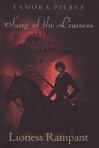
Once again, let’s talk about that cover. It’s way too dark, for a start. Alanna is still not in armour, even though she becomes the king’s champion. The horse is still the wrong colour. The red glow makes sense, I guess, but… yeh. This really doesn’t work for me. The title basically works; it’s better than In the Hand of the Goddess at least.
And again: junior section of the library, people! Weird!
At last, a proper quest. I was beginning to wonder whether it would happen! We had two books of boarding school, one book of… I dunno how to characterise the third, actually. And then here, a quest. Not your average quest, of course, but a quest nonetheless. In fact, a road trip! Alanna learns of a Fabulous Jewel and decides that hey, this is exactly the sort of thing she should be adventuring after as a knight errant. Along the way she meets – and Takes Up With – one of the few men genuinely her match in fighting, Liam; plus a refugee princess, who she eventually matches with Jonathan to take that little problem off her hands; and when she gets back to her home, she helps to bring down a plot against Jonathan (now king), with the back-from-the-dead Roger at its heart. Plus she finally ends up with George, who’s been holding out so faithfully.
The quest angle was interesting, not least because it takes up less than half of the book. The Dominion Jewel does end up being fundamental to Jonathan keeping ahold of his kingdom (literally), but the trip is definitely more about the travel than the destination. Alanna’s relationship with Liam is perhaps the most fascinating of all her loves. For a start, Liam is terrified by her use of magic – so she knows right from the start that they won’t be a long term item (although I am mighty, might sad that he died). His knowing more about some aspects of fighting lends an interesting tone to their relationship, since it takes on a teacher/student aspect – it’s not overdone, though. Her frustration at his occasional desire to protect her comes through well, and not usually as an ‘I’m the strong man’ attitude but more of a ‘I love you so I want to protect you’ thing – which is quite reasonable, from his perspective, if frustrating from hers. And then finally we get female relationships, with Alanna relating to the princess Thayet and her bodyguard, Buri, on a fairly level playing field: Thayet actually outranks her, as no woman she has interacted with daily ever has; Buri is pretty nearly as good a warrior as her. And they manage to have occasionally spiky but generally very good friendships, based on mutual trust and equality. Hooray!
Oh, and she gets the jewel, by nearly defeating and then amusing an elemental being. Awesome. Off home then.
Alanna’s relationships with Jonathan and George have complicated, as they ought. Jonathan is willing to be chivalrous, but really knows that their marriage wouldn’t be awesome; plus, he’s smitten by Thayet, as Alanna was planning. Plus, being married to your Champion would just be awkward. George keeps on being the faithful one, and eventually that pays off. Awww.
Clothes play a rather interesting role in this story. I like that Alanna has a complicated relationship with clothes. It makes sense. I love that she is allowed to mash somewhat-feminine clothes with her status as a knight when she is presented to the court. Liam’s poor reaction to her being in a dress, because that doesn’t suit the box into which he wants to place her, is a wonderful exploration of identity and expectations. The resolute determination of showing that she can be feminine – and like feminine things – and that this does not detract from her status or fighting abilities is magnificent.
There are some things that are rushed, here, as they have been throughout. Alanna’s relationship with her brother Thom, in particular, is never fleshed out enough for my liking; Thom as a character is too distant and unrealised. We just have to accept that he’s become proud because of his power, but that he gets tricked by Delia into resurrecting Roger.. and then he finally gives in and is willing to accept help from his former teacher whom he previously seemed to despise. It’s all a bit of a mess, really, which is unfortunate because I think the twins’ relationship could have been a much more intriguing aspect of the story than it was allowed to be.
I am unconvinced by the conclusion, too. I am happy enough with her ending up with George, although it is just oh-so-convenient that he’s noble now (not to mention pardoned), so there’s no issue of her marrying below herself. However, the idea that she would immediately agree to have children after a year or two of marriage struck rather an off note for me. She’s just made him amend his suggestion that she settle down to going off roaming with him, and now she’s confirmed to near-immediate motherhood? Given the rather pointed bits about her knowing nothing about children – although she does learn – this just seems out of character. And it was an unfortunate way to end, too; I don’t really see why there had to be a discussion of children along with the discussion of marriage.
Overall, I am pleased to have read this quartet; I read the last three in about 24 hours. I may at some stage seek out the next set of books set in Tortall, but I’m (really) in no hurry. Pierce was doing some interesting things, here, but I’m too old and well-read to be as completely overwhelmed as I might have been in my teens. Still, I’d have no hesitation in shoving them down anyone else’s throat.
You can get Lioness Rampant from Fishpond.
Alanna #3: The Woman who Rides like a Man
SPOILERS

Soooo… let’s talk about that cover then. Can you spell Twilight? SERIOUSLY, PEOPLE. There is so much more to this story than a love triangle! And WHAT the heck is she WEARING?? Is there a Valley Girl in the desert that’s not mentioned? She’s a KNIGHT. She could at least be wearing a burnoose, given she spends a large amount of the story in the desert. But nooooo they have to make it look like this almost modern. You can pretty much ignore the sword in her hand, even! Urgh. Also, I wouldn’t go for either of these fellas.
Still, at least this is a better title than the second one. “Woman who rides like a man” is both directly relevant to the story and intriguing.
Also, found in the junior section. Really makes me think that the staff haven’t read it.
Alanna is now a knight, and like she has been saying for two novels, is off to seek whatever knights errant seek. Warmth in winter and some distance from both Jonathan and George, in this case, plus getting away from people who disapprove of boobs behind armour. She ends up in the desert that she visited in the first book, and stays with a tribe of the Bazhir. She accidentally becomes the tribe’s shaman because she kills the existing one; oops. She also becomes teacher to three young Gifted teens, one of whom dies, and she challenges notions like girls-can’t-d0-stuff. Meanwhile, she breaks up with Jonathan when he gets very high and mighty about her marrying him, is adopted by Sir Myles as his heir – so now she gets to have her own title because after all her brother inherits Trebond; and takes up with George, at last.
Again, a lot happens in a short novel. I think this one felt better paced overall – perhaps because now Alanna is a knight, which was the whole point of the first two, things can slow down a bit and events can happen kind of for their own sake, rather than to move Alanna along to that particular end. This also covers a shorter period of time, but still felt like there were important things going on.
Again, Alanna grows and changes. In particular her attitude towards being female comes out in fits and starts, and this really makes sense. After all, she’s hidden being a woman for so long – and put all of the potential trappings of femininity out of her mind for so long, disregarding them in her quest to be a knight and definitely seeing them as the lesser of her options – that it makes sense it would be hard to change. I think it does make sense that it might eventually start to be appealing, or at least provoke her curiosity; especially when her lover makes rude comments about not being feminine enough.
There are some problematic things in this novel – I wasn’t entirely comfortable with the characterisation of the Bazhir. However, Alanna’s stay with them does twist some conventions nicely; her very presence challenges some of their notions, and many of them show willing to change when shown that the alternative isn’t disastrous (mostly). I like that there is an insight into the women of the tribe; after all, Alanna is in that sometimes awkward, sometimes useful liminal space of female-knight: she inhabits both masculine and feminine sides. So she learns the magic and the fighting… and then she also learns weaving, and values that, seeing that the women have as much to offer as the men. I love that she is not actually very good at weaving when she starts.
I am intrigued again by the… I hesitate to use the word ‘casual’, because it makes her sound like she just sleeps with anyone, so let’s go with ‘straightforward’ attitude shown towards sex. She’s broken up with Jonathan; George again makes a move; she takes up with him. It’s more than pragmatic – after all George declared his love back in the other book; it’s not rebound sex; and she’s not hung up on the morality of it. This is definitely a different way of portraying such things from your average faux-medieval story.
I think this is my favourite of the four books. Alanna seems to get to be most herself with the Bazhir; she faces challenges and makes decisions like a knight would and should. And she faces the consequences squarely, occasionally with remorse as required. She’s growing into someone to genuinely admire.
You can get The Woman who Rides like a Man at Fishpond.
The Eternal Flame
The following will include spoilers for The Clockwork Rocket, which I discussed over here.
A universe where parts of the spectrum of light travel at different speeds. A race where mothers cannot exist. Vector diagrams. They’re overused, but I’ll use them anyway: Egan is nothing if not ambitious and audacious.
 A warning: the same issues that pertained to Clockwork crop up here. It is most definitely not a book that will work for everyone. You have to fall within a fairly specific range of readers: either someone who really enjoys thinking about physics and won’t be weirded out by the bizarre physics Egan is working through here; OR someone who is willing to skim over the vector diagrams and other physics-lecture bits, and just enjoy the story. Personally, I’m the latter. And the only reason I was willing and able to push through the physics was because I trust Egan to give me a really worthwhile story between, or around, it. I kind of imagined that I was listening to a really, really interesting person who occasionally meandered into talking about stuff I didn’t get, but was bound to get back to the good stuff eventually. And I was right.
The point of the Orthogonal series is to explore two central ideas: how the universe might be different if the speed of light isn’t constant; and how society might be different if mothers didn’t exist – or rather, they cease to exist at the point of childbirth. The story revolves around these two issues, and does so in occasionally remarkable ways. The physics aspect is very much an intellectual exercise; if there is commentary on modern science, aside from the obvious bureaucracy-getting-in-the-way, I missed it through not understanding enough of it. The biological/social aspect, though, includes a huge amount of commentary on modern Western gender relations, and it’s confronting, frightening, and sometimes scathing. I loved it.
Clockwork ended with a crew aboard the Peerless – a mountain launched into space – setting out with the objective of experimenting and thus hoping to find a solution to the probable destruction of their home world by an oncoming storm of meteors. This is only possible because of the different way light and time work in their universe; by moving away and then retuning home, much more time will have passed for them than on the planet. Because of the discoveries and attitudes, I’ve seen this book described as mirroring the Newtonian/seventeenth century European scientific revolution, which I think makes some sense but I wouldn’t push it too far. Along with the very pressing problem of saving the world, the crew carry in their bodies another issue – an issue that was only just being recognised as an issue: the fact that a mother’s flesh splits into her (usually four) children at ‘birth’. Mixing up the historical periods, this might be seen as somewhat comparable to the long period between Mary Wollstonecraft (late eighteenth century) and the suffrage movement of the early twentieth century (…. would that make Yalda both Ada Lovelace and Millicent Fawcett?? I 
 am loving this idea, daft as it is). Women are starting to think that there might be alternatives to simply living with their co and eventually becoming their children.*
To continue this intriguing historical comparison, Eternal Flame is scientifically moving into an Einstein/Hubble frame of thinking, and socially (I can’t believe the gall of this sentence) into the second-wave feminism of the 1970s (I wish there was an author in the story that I could tag as Joanna Russ, but there’s not). In physics, in particular, there are astounding discoveries being made about the properties of light and heat which are beginning to have profound ramifications for how they think about solving their problem (problems actually, since they also left their planet with no way of getting back with the solution…). Socially, the crew has pretty much always accepted women as being just as worthy in science and other jobs as their male counterparts – not least because many of the crew, especially in the sciences, were women. However, biology is still an issue. The original women used a drug, holin, in order to delay the onset of fission (birth). By this stage – three generations later – still use holin but are also basically starving themselves, for two reasons: both to delay birth, and in the hope that their fission will result in two, rather than four, children. Because the Peerless has experienced a population explosion, and they cannot support every pair becoming five. So (to get back to my comparison), the right of a woman to decide when to have children is one of the big issues – as it was with the introduction of the pill and the controversy over abortion (which I know is still ongoing).**
There are three narrative strands going on here, which frequently intersect but deal with different issues for the ship. I assume they’re meant to be of equal importance, but I’ll be honest and say the one that dealt the most with pretty full-on physics definitely took a bit of a backseat for me, even though I could see how vital it was to the story’s point. Carlo is investigating biology and fertility; both the fact that animals appear to exchange information somehow via infrared… something… and the fact that some animals seem to have adapted to biparous fission very easily. Tamara is an astronomer who observes a massive object outside in the void, and develops an audacious plan to use it somehow. Carla, a physicist, is investigating the properties of light and energy and challenging a lot of preconceived notions in the process.
The novel as a whole does involve a lot of physics-lecture stuff. There really are a lot of vector diagrams, and graphs demonstrating energy levels, and… other things. The biology doesn’t get quite the same treatment, perhaps because it’s not quite so radically different from our world. However, the science is not the be-all of the novel – if it had been I probably wouldn’t have persevered. There’s a bit of action, with an excursion out to the Object Tamara observed and some other dangerous moments for characters I had grown fond of. There’s some great character development, in particular as different people consider the biology issues for themselves and reflect on what it means for them individually and as a society; a few make very surprising decisions that are nonetheless entirely consistent. Being set on a spaceship, large as it is, means that the story is necessarily constrained; keeping the focus on three main protagonists helps with it not feeling claustrophobic but rather focussed, which is also aided by making them active in such different spheres. The physics and biology dominate, as discussed; there are also undercurrents of the frustrations of bureaucracy and the impact of history – after all, this is a generation of people working towards solving a problem for a world they have never known.
If you want to be read a science fiction series that will really challenge you scientifically while also (largely) being very readable, coming complete with a compelling storyline, this is it.
You can get The Eternal Flame at Fishpond.
*I’m well aware that this is grossly unfair and generalising to the women before Wollstonecraft, and in fact Egan does not make it nearly so clear-cut; as with real European history, there have always been women who bucked the trend in this world, too.
**I have no idea where Egan could go with this historical comparison for the next book. Still, it was fun while it lasted.***
***I’m not suggesting Egan did this deliberately. I’m quite sure he didn’t.
Death comes to Pemberley
 There’s a bit of hating going down for this book, I’ve noticed. Some people are dismissing it simply as fanfic which… yes, I can see that, especially if you don’t think that fanfic can possibly have any merits. But to suggest that this is fanfic and therefore unworthy of engaging with is just lazy.
Other people have dissed this because of its merits, or lack thereof. That, I am totally fine with.
I have read Pride and Prejudice. I have seen, and adored large chunks of, the BBC adaptation. I am not, however, an Austen fangirl. This is, I think, my very first PD James. So on neither count am I particularly invested. I read my mum’s copy; I read it partly to keep up with her, and partly because I was expecting exactly what I got: a bit of light entertainment, and one person’s suggestions for how life might have turned out for Lizzie and Lydia.
I did not expect the reaction I had against Wickham that was very, very strongly influenced by the Lizzie Bennett Diaries. There may have been metaphorical gnashing of teeth at the mention of his name.
Is this brilliant literature? No. There are huge chunks of info-dump where James appears to want to show off just how much she knows about 18th and 19th century law and policing. There is one hilarious bit where she manages to get in a little “America will grow up to be most awesome” message, which had me choosing between giggling and eye-rolling so hard I was going to fall off the couch.
Is this a fun read? I thought so. I had been misled somehow about who it was that died (spoiler! this is a murder mystery!), so that was a surprise. There were obvious tantalising clues dropped early on that I looked forward to having explained properly; some of them were resolved as I half-expected, others were quite different. There are a few different plot-lines woven throughout, which was nice, and it’s not entirely following Elizabeth – James gets to play a bit with Darcy, in particular, although I thought those sections were often the least interesting.
As an homage to Pride and Prejudice, it’s ok but not awesome. I think James does an all right job of capturing Elizabeth and Darcy as a couple; Lydia has turned into a mini-Mrs Bennett, and Jane is a smiling placeholder, nothing more. There are some reflections on other characters – Georgiana, Fitzwilliam (who has completely changed for me thanks to the Lizzie Bennett Diaries, and this version was consequently very weird), and even Wickham. There was one P&P character that James did a very, very clever thing with that I really didn’t see coming – she gets kudos for that, if nothing else.
Overall, a satisfactory murder mystery. Don’t read it pining for Austen; do read it for what it is, if that’s your thing.
Abaddon’s Gate

HOOOORAAAAAAAAY.
(Some spoilers below for Leviathan Wakes and Caliban’s War. READ THEM.)
The last line of Caliban’s War was an absolute killer, because I read it when it was first published which meant that the next book was about a year away and GOODNESS ME it was a cliffhanger. So I preordered this as soon as I could and happily, it arrived about a week before I went on holidays. I very carefully put it on a shelf where it wasn’t tempting me to read it… and then this week, on holidays, I cracked it open and devoured it in one day. And it was worth the wait. Oh yes. Thank you, James Corey.*
At the end of Caliban’s War, the protomolecule has been doing weird things on Venus, the Mao-Kwik company has been busted for attempting to weaponise it, and Miller – who died, going with the protomolecule to Venus – has just appeared to James Holden, who has once again (somewhat accidentally) been fundamental to saving the universe (well, the solar system). The conclusion to the series has the protomolecule and its… construction project… out near Uranus’ orbit (it’s basically gone on its own little Grand Tour of the system… and now I’m imagining the Ring being made out of Lego. Oops). Earth and Mars are once again sitting in an uneasy truce with each other, with the Outer Planets Alliance (OPA) not sure where it fits. Meanwhile James Holden is almost happy with his crew (but we all know that won’t last)…. While some of the early story takes place on-planet (or moon), most of it happens on board space ships of varying sizes, which is a big change from the earlier two where Earth and Ganymede in particular played important roles. Much of it also happens a significant time-delay away from official decision-making bodies, highlighting the issues of merely light-speed communication when people are many light-hours apart.
As with the first two books, this is told from multiple perspectives. The only one that is continuous across the three is Holden, master of the Rocinante (and OH! I just GOT the name, in making sure I was spelling it correctly. Don Quixote’s horse!!) and generally known across the solar system as a truth-telling, occasionally annoying, bad-ass. I love Holden. He is far from perfect, but he does the very best he can by his crew – who have, as a group, come a delightfully long way from their dysfunctional beginnings in Leviathan. (They’re still somewhat dysfunctional as individuals, but they work exceptionally well as a team.) He’s finally it together properly with Naomi, he’s getting good above-board work to keep the ship flying (… hmmm. It now occurs to me that there are some distinct similarities between Holden and Malcolm Reynolds. Huh.), and he really is trying to leave his solar-system-shaking days behind him. Honest. The fact that Miller – ghost? or something? – keeps bugging him… well, that’s a sign he’d rather ignore. Pity we all know that’s not going to work.
There are three other narrative streams, and (as with the other books) they have distinctly different parts to play in the story. Melba – not her real name – has one driving ambition, and it is not a nice one. Hers is a really interesting exploration of how an individual impacts on wider events. Holden’s story does, too, except that the way he impacts on wider events is usually accidental – or at least begins that way, as he is driven to bigger events, all to get back to his nice comfortable leave-me-alone life. Melba, though, doesn’t really care what impact she has on other people as long as her goal is achieved. Her development over the novel is the greatest of any character – or perhaps it just seems that way as the reader gets deeper into her head over the course of it.
Melba’s opposite in many ways is Anna, a Methodist minister who’s been out on a Jovian moon with her wife and daughter for two years. Let me say here that one of the most awesome things about this story is the way it takes religion seriously, and as a genuine force to be considered in medium-term science fiction. The religious figures are not perfect, and nor should they be – Corey is representing humanity in its fullness here. But Anna has conversations about the spiritual impact of the protomolecule’s existence, about what it means if there are aliens for those who hold to Christianity (are they fallen, like humanity? if so, does that mean that Christ died for them?) – and that’s fine, that’s acceptable. I can’t express how happy it makes me to see religion acknowledged like that. Anyway – Anna ends up on a ship heading out to the Ring. She gets to play a really important role on a personal level with a lot of people, but she herself basically stays the same over the course of the events.
Fourthly, and acting in some ways as Holden’s opposite, is Bull. An Earther in service to the OPA because of the charisma of its leader, Fred Johnson, Bull is on board the OPA ship going to investigate the Ring as security chief. I really like Bull. He is honest about himself and his limits, he tries hard to get the job done, and he’s willing to take the consequences when they’re in service to a worthwhile cause. It was a small event concerning Bull that brought a tear to my eye, which is not something I expected in a grandiose space tale like this one. Bull has a very tough job, especially as an Earther in charge of a largely Belter (that is, people from the asteroid belt, not from Earth or Mars) crew.
This issue of racism is an intriguing one throughout the series. I think (in my whitey-white way, I hope) that Corey* has done a very good job of showing the colonisation of the solar system as a multi-ethnic business; there are a few lines where someone is described along the lines of “if he was from Earth, he’d be [X]; here, he was a Belter.” The names are a delightful mash of multiple European, Asian, and African backgrounds (maybe South American as well, but I have less familiarity there and can’t be sure to pick it up). Sadly, but realistically, there is still xenophobia – and it’s based largely on where you were born. Planetary birth? You’re a duster, to a Belter. Born in the asteroids or on a moon? You’re a skinny, to an Earth- or Mars-born. And given the political situation – two wars between Earth and Mars, the Outer Planetary Alliance only recently (and that sketchily) graduating from terrorist organisation – place of birth can still be seen as having a significant impact on your politics and views on a range of important issues, like who gets to be boss of the inner solar system. I think Corey does a very good job of showing these issues in a sympathetic, not condemning but not condoning, manner.
This is a brilliant end to an exciting series. There is action, there is drama; there are explosions and chases, personal confrontations as well as planetary ones. Women and men both play important roles, the solar system is not white, and James Holden finally find out what the hell Miller wants with him.
You can get Abaddon’s Gate from Fishpond.
*Yes, I know that James Corey is actually two people.
Iain M Banks, The Hydrogen Sonata, and musings

I read this a long time ago now. It’s been sitting on my shelf at first glaring at me to review it, then looking at me sullenly, and more recently not even bothering to meet me eyes. The reason it’s taken me so long to write anything? I guess partly there was a lot I wanted to say – much of which I have now forgotten, to my chagrin, but it does kinda make a review easier to write. Partly, so many other people have written about it that what could I possibly offer? Not much, really. So why am I doing so now? Well, it was a review book so I would feel bad (… badder…) if I didn’t; and even if others have said these things more eloquently than I, at any rate I get some of my thoughts onto paper (… the screen…).
And now, well, Iain M Banks has died. I think Jonathan Strahan’s reflections say a lot; my own interactions are more recent, and don’t include any Iain Banks stuff (yet). So it feels both more pressing to record my thoughts, and less important. Anyway…
Many of the Culture novels talk about species which have Sublimed; moved on to another plane of existence, which isn’t heaven since it doesn’t exactly or necessarily involve death, but does mean that individuals or species no longer interact with the mundane, physical world. The suggestion is that Subliming is the apex of civilisation, what everyone should be aiming for personally and as a civilisation. As I write this I realise there’s a material/spiritual dichotomy going on here – not that Subliming is spiritual necessarily, but still that tension is present: that getting rid of the physical being is highly desirable. Interesting. This idea has never been the focus of a Culture novel… until now.
The Gzilt, as a collective, are going to Sublime. They’re doing the civilisation-level equivalent of writing their last will and testament, mostly attempting to leave their affairs in order, while some are having the end-of-the-world parties you expect if an asteroid is rapidly approaching. But of course, this is Banks. So things do not go smoothly; there is conflict over who will benefit from their departure (I’m reminded of a poem I read at school, “Where there’s a will there’s a sobbing relation”), and also over the very decision to Sublime. Not everything part of the narrative appears to impact of the Gzilt directly, at first – there are multiple narrative threads going on – but of course they all get tied up eventually. Mostly, quite nicely, and sometimes in wonderfully sneaky ways.
I know some people have complained that this is bloated; that it could have done with some editing. It’s 517 pages, in the trade paperback; probably it could have been shorter, but hello let me introduce you to Patrick Rothfuss or George RR Martin – Banks had nothing on them. Which is not to say that he should be left alone, just that it could be worse! And I will admit that actually? I don’t mind the bloat when it comes from the hand of someone like Banks. (I will out myself here to say that yes, I enjoyed the ridiculous length of Harry Potter and the Order of the Phoenix, and I loved The Wise Man’s Fear. Sue me.) I never once got bored with what Banks was spinning. As the narratives went weird places and the threads appeared to be going in disparate directions, I went along for the ride because I had great faith – which proved worthy – that Banks would reel it all in and everything would have a point. Of course he probably didn’t need all the side alleys. But… so what? Part of me wants to say “if you don’t want to read a long book, don’t read it.” That’s not an entirely useful point of view, I know. And there are some books where even I can see that long meandering sidetracks do indeed detract from the story. For me, this isn’t one of them.
Overall? Fans of the Culture should get on with reading it if they haven’t already. Fans of serious mind-bending SF who haven’t read any Culture could start here, but I would probably recommend Use of Weapons or one of the other earlier ones first. It’s probably also not a great jumping on point for someone who’s never read SF before, although for someone with enough willingness it would be a wild ride…
You can get The Hydrogen Sonata from Fishpond.
Without a Summer: the third Glamourist History
The following has spoilers for Shades of Milk and Honey and Glamour in Glass, I guess. Seriously, why haven’t you read them yet?

I read this quite a long time ago, and I have no real excuse for not having reviewed it earlier; it’s certainly no reflection on the story. Is it a good story? Yes. Does it fit in well with the other two Glamour novels? Yes. I think that this is the sort of book you don’t need to read the review of, if you’ve already read the others or like the idea of Jane Austen with magic (basically). Actually that’s not quite right… this one, in particular, is more like Elizabeth Gaskell with magic – and I say that having only watched film/TV versions of Gaskell, but given she’s described as Austen with ethics (that is, a more explicit examination of society and ethics than Austen), I feel I can make that claim. Because here Kowal does get into some discussion of class, in particular, and race as well.
The idea of a year ‘without a summer’ is actually based on fact; 1816 was a year that felt summer-less, because of the effects of volcanic ash from an eruption in the ‘East Indies’ as Kowal describes it. For the sake of the novel, Kowal introduces the idea of blaming this on coldmongers – people whose glamour is particularly attuned to making cold, so they get jobs doing things like keeping food or rooms cool. The story has both political aspects – which revolves especially around class – and personal aspects, which also revolves around class and race but also around family relationships.
The political: this is a time of Luddites, and issues of unemployment; tie in the cold, and fear of glamourists, and there’s a very dangerous situation brewing. It would be hard to talk about that without giving away some of the details whose revelation is part of the delight of the story, so I won’t. Suffice to say that the concerns Kowal raises fit perfectly into the period, and complement the personal issues going on for Jane and Vincent perfectly.
The personal: Jane and Vincent are faced with a number of issues to deal with, and to my delight not all of them are dealt with easily. The one that most struck me, by the end, was Jane’s relationship with her sister Melody. Pride and Prejudice hints at the difficulty of older and younger sisters relating, as does Sense and Sensibility – but these tend to show the older as being in the right, and the younger as needing to be tamed in some way. Kowal does very clever things here with that trope; Jane and Melody’s relationship is more realistic, and more painful, than in the Austens – and this makes the story the more uncomfortable and real as a result. Secondly, there’s the introduction of Vincent’s family. They’ve been less than shadows to this point; all that we’ve known is that Vincent has cut himself off in order to be a glamourist, and his family don’t approve – and that they’re from High Standing. They arrive with a vengeance here, and Kowal spares no mercy. Vincent definitely comes out of the whole thing as a more impressive man for overcoming the family issues that he was dealt.
Some of the other issues facing the pair mingle with the political. In particular, they are confronted by race issues, both because many of the coldmongers – whose problems they can hardly help themselves from being involved with, touching as it does on glamour more generally – are black, and because one of the families they end up heavily involved with are Irish. This may seem strange to those without knowledge of how the United Kingdom worked in the nineteenth century; but as Kowal points out in her afterword, at this time “the notion of ‘white’ excluded not only people of Anglo-African or Anglo-Indian descent but also Irish” (356). Some of Jane’s own prejudices are confronted, along with those of London at large – not comfortably, but I think, for the reader anyway (at least, this white reader; I won’t try to imagine how to read it as someone confronted with racism on a regular basis) in a sympathetic manner. That is, not that the racism is easy to read, but the confronting of it is more like what 21st century tolerant sensibilities would prefer.
I’m sure I had more to say when I originally read this, but – the characters remain engaging and delightful, Kowal continues to find genuine circumstances for them to interact with, and her style remains a delight to read. I’m not sure if I want more stories here; there would surely be a danger of Jane and Vincent turning into the unexpected epicentre of everything interesting in 19th-century England, which would end up being silly. And would insist on bringing up the issue of pregnancy and children… which might not be a bad thing, I just can’t think how it would be done. But then, I’m not an author. Maybe I should just Kowal to know what is best for her characters…
You can get Without a Summer from Fishpond.
Cloud Castles: the re-read
Spoilers for the first two books, Chase the Morning and Gates of Noon – although really, there’s three books, surely it’s no spoiler to say that Stephen survives and has further adventures?
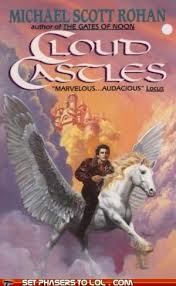 Stephen Fisher, no longer quite such the hollow man as previously; oh look, the brief love and forgiveness of his ex-girlfriend has worked not quite a miracle, but certainly wrought some change. Whodathunkit. When this novel opens, Stephen is in an intriguing position: he remembers the Spiral all the time when he’s in the Core, he’s deliberately had many adventures there – but his life in the Core isn’t harsh or empty enough to give it up. In fact, he’s now the head of his company and he’s got a brand new, very interesting project on the go. No on-going relationship, but still – he’s not the hollow, use-and-leave type that once was. Which is good, right?
The ultimate reveal is brilliantly constructed. Up to that point… well, the story threatens to feel a bit samey. In fact, it is: there’s challenge from the Spiral affecting Stephen’s life in the Core, and he goes out and faces it and there are ups and downs, and something Big from out near the Rim challenges Life As We Know It. All of these things happened in the previous novels, and they happen here too. But the great thing about Rohan’s writing is that it still manages to be interesting and thoroughly enjoyable. For instance, in the mythos he’s mined: there’s been voodoo; and Asian myth from Buddhism to Hindu to animism; and here, Rohan brings it back to Europe. In terms of action, the first two books were similar in involving ships; here, the focus shifts to the possibilities of air travel (AIRSHIPS!). And I swear Rohan must himself have taken up fencing between Gates of Noon and this book, because the fights seemed to get a whole lot more technical… which I kinda skimmed occasionally. And while some of the side characters are the same – really, who could ever get sick of Mall? Really? And there are new characters too: happily, to my mind, especially another woman, who gets a bit more fleshed out than Claire or Jacquie ever managed to be in the previous books.
Yes, there’s some annoying repetition with Stephen bemoaning his life – but Gates of Noon was definitely the worst for that, and his growing/filling up has largely curbed that. And yes, the portrayal of women is not always great – Stephen occasionally has a ‘private’ leer which the reader is privy to – but Mall gets to be Amazing. This could be problematic, because clearly it’s not realistic and it’s annoying if the only woman has to be so much better than any of the men to warrant any air time: but it does entirely fit the idea of Mall being over 400 years old, and moving outwards on the Spiral, and therefore – like Jyp is, to a lesser extent – becoming… clarified. And she’s not the only woman, which helps.
So I firmly believe these books deserve their space on my shelf.
The Golden Day: a review
I picked this book up at The Moat, a bar/restaurant slightly underneath the Victorian State Library. It has a shelf of books that can be taken by customers on the proviso that at some stage, you put one in yourself – although a further proviso is “No Dan Brown” (seriously it 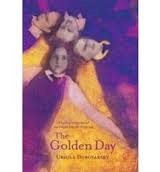 says that on the sign). Anyway I’d heard of Dubosarsky and never read any of her stuff, and the cover was immediately entrancing – look at that purple! and the gold is luminous!
There’s a little bit of Picnic at Hanging Rock around this book, which Dubosarsky herself acknowledges, as well as a lot of inspiration from art – especially that of Charles Blackman, whose paintings and drawings provide the chapter headings. It also, she says, draws on her own memories of being a Sydney schoolgirl.
Eleven little girls have a somewhat peculiar teacher, who takes them out of school down to the nearby gardens, to consider the world and attempt poetry and to listen to a gardener-cum-poet, Morgan. (It’s fair to say that there were a lot of alarm bells for me as a teacher with this book! The 60s were truly a different world…) But something happens – something unexpected and terrible, but probably not what you’re thinking: let me spoil this slightly and say nothing happens to the girls themselves, IT’S OK Tansy can read this if she hasn’t already.
While the ongoing repercussions of the Serious Event colour the entire book, Dubosarsky works other issues in, in the same way that such issues would probably be experienced by your average kid. It opens on the day Ronald Ryan is hanged (the last such event in Australia); the Vietnam War is ongoing. Closer to home, things are not entirely well in the homes of at least one of the girls, although exactly what is going on is never fleshed out; the reader sees glimpses in the way that a casual schoolfriend sees glimpses, only when they’re allowed or by accident.
It’s a very short book – 150 pages of well-spaced type. It’s a delightfully written book, with evocative descriptions of schoolrooms and gardens and slightly creepy creeks. Dubosarsky captures the innocence and bewilderment and childish cunning of children very nicely too; a student would have no trouble seeing themselves in this novel, in the attitudes and expectations of the schoolyard. It’s also potentially a frustrating book. It begins in 1967, with the girls about 10 years old; it covers about a fortnight in their lives, mostly in the schoolroom with occasional forays outside. It then jumps to one afternoon in 1975, with four of the girls sitting their final HSC exam, and a final intriguing addendum to their experience eight years earlier. The story is left ajar – not quite open, not quite closed… I guess this is fitting since the girls themselves are on the cusp of adulthood, so their lives at this point are liminal, balancing between two aspects.
The Golden Day is intriguing, and luminous like its cover; I have no doubt this will stay with me into the future. Especially when considering excursions.
You can buy The Golden Day at Fishpond.


