Where Time Winds Blow
I have been a fan of Robert Holdstock for a while, both for the Mythago Wood series and his Merlin/Jason and the Argonauts books, which I still haven’t finished… oops… I’ve had this book on my shelf for a very long time, and as part of my effort to deplete the TBR pile I’ve finally got around to it.
Interestingly, this reminded me of two books. Firstly, the idea of a planet with weird time distortions of course calls to mind Dan Simmons’ Hyperion Cantos; this came first, and I can’t help wondering about influence. Secondly, there’s also a similarity to Kress’ Steal Across the Sky, this time in its attitude toward the alien. Aliens were a means to an end for Kress, allowing her to explore different aspects of humanity or society; VanderZande’s World allows Holdstock to do the same. The people are there because of the time winds that rips ng things from the past and the future and deposits them in the present (and presumably other times as well, but let’s not think too hard about that)… but this oddity is mostly just a vehicle for Holdstock to explore humanity.
Humanity have settled on this world partly to explore, and learn to understand the time winds, and partly to colonise. The first is the focus of the story, although the second is touched on and is one of the most interesting issues. The main narrative focuses on a rifter – a man whose purpose is to investigate the stuff appearing after the time wind has blown through. His world starts to go a bit pear-shaped when a new recruit joins his team. Holdstock is interested in how people deal with stress, and how this impacts on relationships, and gradually reveals more of Leo’s life and issues. Of course, things aren’t even as normal-life complex as they initially appear, and Holdstock makes the issues of the past come through in such a way that makes complete sense with what has already been revealed.
Alongside this narrative, Holdstock gives tantalising hints at the world he imagines. It would be human-compatible, but its organic life creates pollens that are toxic. There are two responses to this issue (well, three, because there are also the people who don’t bother to try and settle there): the colonists who are hoping to eventually evolve to the point of unassisted survival; and the manchanged, colonists who have artificially intervened into themselves in order to live without assistance now. The hostility between them is barely examined, but adds depth to the overall narrative as well as depressing believability.
The one problem I had with this book was about the last 20 pages. They felt rushed and forced, and wrapped up an issue in a way that neither felt integral nor necessary. So that left a slightly sour taste in my mouth, which is unfortunate given I enjoyed the rest of it.
From Russia with Love
This review is part of Project Bond, wherein over the course of 2014 we watch all of the James Bond movies in production order.
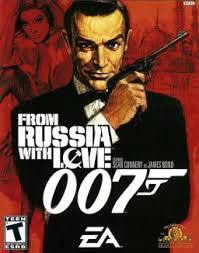 Summary: Bond is lured to Istanbul to help SPECTRE steal a Russian encryption machine. Also, there is bellydancing. And stroking of a cat.
Alex: I’ll start by talking about the gender stuff, because the representation of women’s sexuality is quite interesting in this movie. Two women throw themselves at Bond – which is not exceptional in the canon, but in Dr No Honey Rider was quite reticent and Sylvia wasn’t immediately ripping his pants off, so in 1963 there’s no precedent. Additionally, Kerim Bey – Our Man in Istanbul, and not an especially handsome one – has women dragging him off to bed, and two women in the gypsy camp have a fist-fight over who gets to marry the chief’s son (who as far as I can tell, is never seen). So women are sexual creatures, mostly; the only other woman we really see is Rosa Klebb, but she’s old so clearly she doesn’t count (sarcasm!), because she sure doesn’t do sexy. The young women 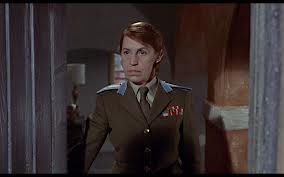 are passionate; in fact, they can barely contain themselves. Bond is generally happy to go along with it; while he doesn’t really initiate anything he does take over when he goes along with it. Bey seems to see pleasing his women as a chore (he actually sighs and says “back to the salt mine” when he agrees to canoodle with one), but has an endless number of sons and extols the virtues of big families. From this I guess we learn that women are ruled by their passions and men are ruled by cool intellect? Or something to that effect. Also, of course, in Bond we have an example of the Magical Penis trope (I really wanted to find a link to explain that, but it wasn’t obvious on TVTropes and NO WAY was I going to google it) – he turns Tatiana into a Good Woman through sex.
The mechanics: we get a prologue! In which Bond appears to be hunted and killed, but it all turns out to be a training exercise for Scary People. From which we learn that Bond is already a force to be reckoned with. There is also clear continuity with past movies: Bond is canoodling with Sylvia, the woman from the opening of Dr No, in his first scene here; and SPECTRE are very keen for Bond to be the agent they lure to Istanbul not least to take revenge for his killing of Dr No. Also, SPECTRE! Whose name is not explained in this film so if you weren’t paying attention the one time the acronym was explained in Dr No, sucks be to you.
I was intrigued by SPECTRE, actually. I had forgotten that the face of Number 1 is never shown: just his hand, stroking the white cat, thus spawning ever so many copycats (Baron von Greenback in Danger Mouse, Claw in Inspector Gadget, the villain in Austin Powers… who have I forgotten?). We don’t know his name, and it’s not given in the credits. SPECTRE as an organisation is clearly well-organised (they have a secret training base! Number 5 is a chess champion! They use live targets in training!), and the movie wants us to be aware of their power: it devotes the prologue and then the first maybe 10 minutes to them, showing them as focussed and driven. Conversely, when we finally do get to Bond, he’s relaxing on the banks of a river with a woman. Where Tatiana has just said she is willing to use Feminine Wiles to serve Mother Russia (she’s an unwitting agent of SPECTRE), Bond is using Masculine Wiles just to enjoy himself. A nice dichotomy is set up, which is somewhat undercut by Bond’s willingness to jump at M/Moneypenny’s orders… until Sylvia persuades him to stay just a little longer.
It should of course also be mentioned that this movie sees the introduction, albeit all too briefly, of Q – the eQuipment Officer. Who gives Bond some gadgets, but they are disappointingly low tech and there is a tragic lack of snark from him.
 Other things confirmed by this film: being Bond’s associate is a dangerous business, as Kerim Bey ends up dead. Hmmm… given Quarrel in the previous film, perhaps it’s only dangerous if you’re not white? OK, maybe two films isn’t quite enough to make this generalisation.
Things I did not know until I went to IMDB: Daniela Bianchi, who played Tatiana, was dubbed for this role because her English was so poor! But she was 1960’s Miss Rome so I guess that makes… no, it doesn’t make sense at all.
James: First a note to the editor, if the phrase ‘Magical Penis’ is used in another review my subscript notes will cease.
Alex: it’s a real trope! Happens all the time!!
James: Another tip of the hat to the negative restoration and transfer quality for the Blu Ray nerds. So much of this film has been filmed on location in Istanbul and it really shows, much less blue screen etc. Compared to future Bond the majority of the film centres around one city and few locations, the two embassies and some tourist highlights in Istanbul (The Blue Mosque, Basilica Cistern, Hagia Sophia and the Bazaar). One thing that doesn’t really make sense is that all film the good guys know the bad guys are lurking and yet they are so casual about security … For example on the train Bond tells Tatiana ‘Lock the door, I’ll knock three times’ as the bad guys walk up and down the corridor and occupy the cabin at the end of their carriage. I did enjoy that Bond marks the major villain who’s been stalking him all film by his choice of red wine with fish, and not a million other more obvious things he’s done. 2.5 Martinis (which curiously don’t feature in this film at all).
Lefebvre and the French Revolution

Just look at that cover. Does this look like a history book to you? No it does not. But this is the first volume in Georges Lefebvre’s outstanding history of the French Revolution. Rather than, as the cover suggests, a cook book.
This book is definitely not one for beginners. Lefebvre assumes some knowledge of both the Revolution itself and the the late 18th century in Europe more generally, and if you either have no knowledge or aren’t quick on your feet when dealing with names and politics – well, this will be a hard book to read. Me, I’m pretty good on the French side of things, and that’s the only way I managed to read this without feeling like a complete idiot. There’s also no glossary, so woe betide the reader that misses a term that was explained early on… or wasn’t explained at all and you’re just meant to understand it, but maybe don’t.
One of the most awesome aspects of the book is the very fact that it places the Revolution in its broader European context. I had no idea of the Austrian/Prussian/Russian machinations that were going on at the same time as they were posturing about and around France; the controversy over Poland in particular made me realise just how much I have always viewed the French Revolution in isolation. That is, I know that the American Revolution had an impact, and so on; but I had forgotten that of course those countries who eventually invaded had other things on their mind than just an annoying neighbour. This is a common failing of mine, I have realised. So Lefebvre’s insistence on providing a really broad context – much broader than I would have thought necessary, with the internal politicking of Pitt etc – makes this a quite remarkable part of revolutionary historiography.
The most annoying thing about this is that it is part one of two. And this translator did not, apparently, do part 2 – which incorporates the Terror, and Thermidor, and Danton being his most awesome. Still, Lefebvre does give a succinct overview of the issues leading to the Revolution, as well as description of the early years. Perhaps the most amusing aspect is that he appears not to like anyone. He doesn’t seem to like the proletariat (as he terms them), nor the peasants, and the bourgeoisie quite often come in for disapproval. And let’s not talk about the aristocracy. The other thing of note for those of us who’ve done history more recently and have been forced to deal with issues of historiography and the post-modern/post-structuralist turn is Lefebvre’s utter conviction that his interpretation of events is right. In fact, it’s not even a conviction – that would suggest it was something he had given thought to. No; this is just the facts, and that’s all there is. Which is very appealing, if a little dangerous in the 21st century.
The translation is superb; there was no point at which I thought that it was convoluted or messy.
Steal Across the Sky

There are interesting parallels between this and Mary Doria Russell’s The Sparrow. Both deal with humanity’s contact with aliens, and with the repercussions for humanity especially in the realm of religion. There are vast differences, of course – how contact is achieved, the type of people involved, and so on. I think Russell’s is better, overall; I appreciated the characters more, and I think it’s overall a more sober look at the repercussions for humanity. But I also think the two books are trying to do different things, and Kress has achieved something impressive in her novel.
Aliens have contacted humanity with the sole intention of Atoning for some crime they committed against us… ten thousand years ago. They don’t reveal what that crime is, nor how they intend to atone for it. Instead, they talk to anyone who can get the bandwidth to reach the moon, and set up a boring website asking for volunteers to act as Witnesses. Predictably, they get millions of applicants, of whom 21 are chosen to go to seven different planets – planets inhabited by the descendants of humanity kidnapped ten thousand years ago (cue Stargate music). This, however, is not the crime. Almost the first half of the novel focusses on Cam and Lucca, Witnesses sent to a binary planet system to live with their many-times-removed cousins in order to discover the thing that they will ‘know when they see it’, according to the Atoners. Intriguingly, numerous chapters are also given to one of those whom the Witnesses interact with, providing an at time painful glimpse into the arrogance and cluelessness of one Witness. Slight spoiler, which really isn’t: they discover the thing. They don’t really know it when they first see it. But, as the blurb promises – or threatens – the knowledge does change them, and at least some people back on Earth. The rest of the novel is working through the repercussions of that knowledge, this time largely switching focus to other Witnesses, and only occasionally returning to Cam and Lucca. And, similar to Kim Stanley Robinson so gloriously in 2312, chapters are punctuated with ephemera: conversation transcripts, Oprah interviews, advertisements, etc. These add a wonderful verisimilitude to the world that Kress imagines, only a decade away from now: many thing similar (yes, Oprah; also internet trolls); and some different. Kress throws in some lovely SF-ish moments – just enough to be incongruent, to remind the reader that this is not today.
What this book is not is an alien contact story. Yes, it deals with first contact, and yes the aliens are pivotal. But that’s exactly what they are: a pivot, a lever, a fulcrum. They are a point about which the plot revolves, but not the focus. They are almost completely opaque and don’t exist as characters at all. Rather, the focus is on humanity: how humans react, how humans interact. For an SF novel involving aliens and space travel this is a distinctly earthly novel. It’s also a bit depressing, but perhaps that’s a reflection of a near-future novel published in 2009. That’s not to say that it’s without hope, but… it’s not especially upbeat. Nonetheless, I did enjoy it overall. As mentioned above, Kress deals with the repercussions of the Witness discoveries on religion, as well as on other aspects of society. For this, and the fact that she treats religion seriously (even if it is only through Catholicism, which isn’t completely representative of Christianity let alone all religions on the planet… perhaps it is the most prevalent religion in the US, where it’s largely set? I don’t know), definite kudos. I still think Russell did it in a more nuanced manner, but it was also more of a focus for Russell than for Kress, who is writing a story that’s closer to thriller than philosophical treatise, whereas Russell is the opposite. And Kress does what I presume she set out to do: write an engaging, enjoyable, intriguing novel that combines off-beat characters – not all of whom are likeable – with a plot that keeps you flicking pages (I read it in a day…) and, cliches ahoy, a serious kicker at the end.
Steal Across the Sky can be bought at Fishpond.
Local suffrage history
This is quite impressive, for me: my mother bought me a book that I read before it got dust on it! (Think I’m exaggerating? See this review and this one for how I am a bad daughter.)
 Anyway, knowing that I am developing a keen interest in the history of women’s suffrage in Britain, Mum found me Burning to Get the Vote, a history of the suffrage campaign in Buckinghamshire.
There were two things that did not work for me in this book; one substantive, the other a niggle. The first is that I don’t know the area, and that definitely had an impact on my enjoyment. This is not really a reflection on the book itself, although a map would have gone some way to alleviating that issue and made it more accessible for non-Bucks readers, and especially non-UK readers. Instead it’s a reflection that probably, this history wasn’t imagined to have a general readership outside of the locality, and an academic one a bit more broadly. So I lived with that; I skimmed over the bits where Cartwright goes into detail about the actually location of various meetings – which is probably a delight to those people who know High Wycombe or Wendover or Aylesbury. The second, the niggle, is a style thing. There were a lot of commas that I felt were misused.
Those things aside, this volume has a lot going for it. Cartwright has clearly undertaken a monumental task in sifting through local newspapers to find references to suffrage (and anti-suffrage) activities in his area, as well as digging up minutes from meetings and some correspondence as well. This in itself I find fascinating: the suffragettes and suffragists (the terms, sometimes interchangeable, were often used to differentiate between militant and constitutional approaches) were often holding important enough meetings that they did feature in the media – despite not always getting big numbers to those meetings, and perhaps sometimes because of the opposition they met.
What this history does is set the national women’s suffrage campaign in a local context. So much of this story that gets popularly talked about is London, or perhaps Manchester, based – which is unsurprising because it’s where the Big Names (Pankhursts, Fawcett) were, and where a lot of the eye-catching activities (pilgrimages to Hyde Park, chaining to gates) occurred. But as I’m increasingly realising, this doesn’t cover the entire campaign. And how could it? Of course it is important to convince non-capital city residents of the righteousness of your cause! The leaders of the WSPU and other organisations all travelled around the country, drumming up support. They corresponded with the women (and men) organising local branches in small towns. Sometimes, they retreated to the countryside to recover from hunger strikes and force feeding. So this book should help Buckinghamshire people to understand their contribution to an important national movement, and it should make everyone else realise that history does occur in small towns, too. It should also be seen as a spur to people who are running similar campaigns at the moment. There is no doubt that many of the people (especially the women, I would suggest) who were involved in Buckinghamshire probably got quite disheartened over time; their numbers were never huge, the number of supporters was varied, there was active dislike and vitriol from the community… and it took a really long time. Cartwright believes that the first 20th century women’s suffrage meeting in the county was held in 1904 – although there was some action in the nineteenth century too; women got limited rights to vote in 1918 (over 30, married to a householder) and then voting rights on the same terms as men in 1928.
I liked that Cartwright went to some lengths to find out details about many of the women involved, which often involved finding their obituaries. I appreciated the extensive quotes – from newspapers largely – from the speeches made, and in debates with anti-suffrage campaigners. (The notion that the newspaper would quote so extensively from speakers is awesome.) And I also liked that he included a chapter on those anti-suffrage activities, to demonstrate the arguments that were being made and to show that the suffragists weren’t just battling indifference but serious opposition.
This book is not for the general reader – unless you’re from central Buckinghamshire, in which case definitely read it since you might be living in a house that was used for meetings! But it’s great if you want to see how local history can and should be interesting, or if you’re interested in suffrage history more generally. There is also a bonus for Australian readers: Muriel Matters, an Australian suffrage campaigner, worked quite a lot in the area and is mentioned several times.
Snuff
Way back when I was doing my undergrad degree, I did a subject called Popular Fiction. I was excited to be reading popular fiction and calling it work for uni! I was less excited when I got to the first tutorial to discover that, of about 20 of us, I think only 2 or 3 admitted to actually reading popular fiction regularly… everyone else said they were doing the subject “to know what other people read” (I paraphrase).* This made me a bit bullheaded. So did the lecturer insisting on differentiating between the reading/appreciating of literature, versus the consumption of popular fiction. This one still makes me angry, although I do wonder now how much the younger me missed nuances here; the lecturer was definitely cluey enough to understand Austen and Shakespeare as originating in the popular sphere. So perhaps I overreacted and/or misunderstood some aspect.
Anyway, over time I have come to terms with the fact that yes, actually, I am a consumer of popular culture, and that is OK. It does not make that culture bad, it does not mean that I am no appreciating it properly, etc etc. Basically I have grown up, and grown into my skin. So I am quite happy to say that hell yes I consume Terry Pratchett books. I devour them: I read them quickly, in concentrated blocks of time; they don’t require me to stop and worry over words or sentences that don’t make sense. That said, I tend to treat Literature (when I have to read it) in much the same way. At the very same time, though, as Anita Sarkeesian rightly insists, just because you enjoy a product of popular culture doesn’t mean it shouldn’t be critically analysed (again, I paraphrase).
This is the long way round to saying “I read Snuff! It was awesome!”
… and dealt with some big issues in clever ways, as you would expect. (There are some spoilers below.)
Pratchett has dealt with racism, via speciesism, before: human reactions to werewolves, vampires, dwarves, trolls, zombies, etc etc – these have all been coded as racial. And, from memory, generally done well (I could be wrong there; it’s been a while). In Snuff Pratchett makes this the central issue, because the main problem revolves around goblins and whether they ought to be treated as sentient, sapient, creatures. For a long time they have been regarded as vermin, and many people have treated them in ways matching that perception. But now Sam Vimes and family are off for a Holiday, and there are Hints that all is not well in the bucolic surrounds he finds himself in. Not least the difficulty of understanding crockett, and having to confront horses.
I’ve had to think carefully about the way Pratchett portrays the goblins. One of the crescendo moments is a goblin, Tears of the Mushroom, playing the harp for a huge crowd in Ankh-Morpok. That is, a member of a subjected race, wearing ‘civilised’ clothes, goes to the heart of civilisation and plays an instrument that is coded as approaching the zenith of musical accomplishment, and there impresses the (civilised) bigwigs. This could all be seen as uncomfortably close to recreating the classic idea of the western civilising mission.
… Except. Except that the goblins have already been shown, very clearly, to have their own culture and don’t need ‘civilising’. They have a rich language, evidenced clearly by their names (Tears of the Mushroom!); they make art (some of which is so precious that humans who regard the goblins as little better than animals will steal it); they care for one another and about justice. They are wretches in that they are wretched – through no fault of their own. And Tears of the Mushroom plays her own composition, and is in no way dismayed by the audience before her. By the time Tears of the Mushroom plays, the reader should be so convinced about the sentience and sapience of the goblins that any of the characters doubting it should cause serious eye-rolling. Many of the human characters are also convinced early on, which is also intended to convince the audience, just in case you missed all of the other very obvious signs.
Thus what Pratchett is doing is showing, to some extent, an example of the old westernising/civilising mission – there’s no doubt that’s what Miss Beadle is doing, whatever her intentions – and then… not entirely sending it up, but certainly undermining it, and definitely showing that is is quite unnecessary for the sake of the goblins themselves. Although maybe it’s necessary for the acknowledged-as-civilised, to make them realise what they are doing to this race.
There are other issues under examination here too. The place of landed gentry and inherited titles (written after all by Sir Pratchett), with a lovely sneaky homage to Jane Austen; and how a copper manages to love both his work and his family. Pratchett has delved into Sam Vimes’ head a few times in the recent books and I think his ideas about policing etc are utterly intriguing. I especially loved here the abstracted notion of the Street as something that stays with people like Vimes, and helps him to be who he is.
I love the Discworld. I think the books are, as a whole, getting better. I wish I thought there were many more to come.
*I was also less excited about having a Jackie Collins novel on the booklist. In three years of English at uni, this is one of the few books I just did not read.**
** One of the others was Charles Darwin’s Voyage of the Beagle.***
*** I also didn’t finish James Joyce’s Ulysses. Peh; bad taste in the mouth.
Ancillary Justice
 Firstly: OMG I loved this book so very much.
Secondly: a real review. There are some spoilers, but nothing too major. I promise you will still have your breath stolen by many of the events in the book.
So, let me get “the gender thing” out of the way first. I debated leaving this ’til last, because it’s what a lot of other people are apparently fixated on… but for that very reason, it seemed disingenuous of me not to engage. Thus: the narrator of the story, Breq, is from a culture that does not use gendered pronouns. When Breq is dealing with cultures that do use gendered pronouns, there are language problems – troubling enough that it causes Breq quite some stress. And when Breq is thinking/speaking to the audience, rather than rendering pronouns as ‘it’, Leckie has opted for ‘she’. This, obviously, presents some rather intriguing aspects. Except for a few times when Breq is corrected, the reader actually has no idea whether the other characters presented are male or female. I don’t actually think we know whether Breq‘s body is female or male, hence my hesitance to use a pronoun (Breq would use ‘she’ and roll her eyes at me). Why is this interesting? Well, we don’t know whether the leaders have boobs or balls. We don’t know whether the soldiers dying having tits or testes, and we don’t know which the person who ordered those deaths has, either.* And I think this probably changes the way the reader reacts, at least in some instances. More intimately, we have no idea whether the physical and otherwise personal relationships presented are hetero or homo, which is relevant if it matters to you; at any rate the lack of knowledge is surprising, occasionally frustrating, always intriguing. And when any or all of the people might be women, you’re left with the conclusion that women are actually capable of doing/being all of the positions presented – up to and including leading a galaxy-spanning society. Who knew? In the lack of gendered pronouns Leckie is making a call that gender doesn’t matter – except that in choosing ‘she’, this is somewhat undercut.
Look, I’m not actually a gender studies scholar. Probably there are other things that Leckie is doing that I didn’t really pick up on. But as a way of unbalancing the reader that works perfectly within the context of the novel, it’s a brilliant choice; and it also does that thing that great SF should do: it forced me to reconsider my own world.
On to other things: and speaking of unbalancing the reader that works perfectly within the context of the novel, what is with the gloves?? This is a brilliantly clever, and devastating, move on Leckie’s part. Breq comes from the Radchaai, and within the Radchaai everyone wears gloves. If you don’t wear gloves, you are regarded with horror. Why? It’s never explained. It’s like a man getting around in a Jane Austen novel not wearing a shirt; it’s clearly the wrong thing to do, but it’s not going to get him arrested – and Austen wouldn’t bother to explain why it’s a problem because surely you understand? Sheer. Brilliance.
Ancillary Justice does not follow a neat linear narrative. There is a chronological thread – it follows Breq as she (all right, I give up; it’s just easier, ok? and it’s what she would use) searches for something she needs, in an effort to right a wrong. Along the way she encounters someone rather unexpected, who brings a whole pile of unlooked for problems. Alongside and around that thread, the reader lives through the memories of what has brought Breq to this path. The main thing to know, in order to understand what’s going on (and this is on the back cover, so it’s not a spoiler), is that Breq wasn’t always Breq. Until twenty years ago, the body known as Breq was an ancillary of the AI controlling the Justice of Toren, a massive ship of the Radchaai involved in annexing and subduing planets – ostensibly for their own, but mostly for the Radchaai, good. Thus Breq’s memories are mostly those of a few-thousand-year-old artificial intelligence. And being an ancillary means that her body is human, and was co-opted for… duty? inhabitation? use? by the AI.
This issue of ancillaries is one that the book is not obsessed by, but does deal with seriously via several of the characters who respond poorly to the very idea of them. I liked that the story didn’t develop into something too preachy, but I also appreciated that having raised such a frankly horrifying idea, Leckie did not simply leave it as a necessary-but-evil, or evidence-the-Radchaai-are-dreadful, sign. Instead, it’s as complicated an issue as the annexations themselves, because they really do bring benefits to the planets colonised – as other colonisations have – but whether that’s worth all the pain and bloodshed… well. That’s something we’re still processing, to some extent.**
The blurb of my copy paints this as predominantly a revenge story, and I get where that’s coming from. But it lacks nuance, too. Breq is indeed looking for revenge. But she’s also looking for answers – to questions about events in her past, questions about the Radchaai itself, questions about how she can, should, exist as this solitary body rather than as a near-omnipotent (in a constrained space) being. Therefore even if the novel were purely focussed around her, it’s more complicated than just “rargh I get you for what you done to me!” But, of course, as the above demonstrates this is a far more nuanced and complex novel than that. It touches on issues of colonisation, and of gender; it looks at what it means to inhabit a body, as well as to inhabit a planet. And it looks at how religion is co-opted for different purposes, too.
The inclusion of religion startled me, and – when I got over that – made me very happy. It’s something I’ve complained about in the past, here and on Galactic Suburbia: the lack of religion, treated seriously, in science fiction. Seriously people: do you think that just because humanity lives beyond the Earth, they’re going to somehow move beyond a desire for an explanation beyond what science can provide? I don’t think so. Leckie’s inclusion of religion, and the exploration of how religion and colonisation work together, was welcome and clever and shows how much thought she has put into this universe.
This next bit is for those who’ve read Iain M Banks’ Culture novels. I can’t help but assume that at least part of this novel is in dialogue with the Culture. There’s the fact that AIs are in charge of ships and stations, and interact with their human inhabitants. I know that this happens in other stories, but there was something that made me feel a distinct connection to the Culture Minds. That said, these AIs are not really like the Culture Minds. For a start, they’re not meant to have personalities at all. And there’s a very clear point in the story where Breq reflects on the fact that the ships don’t really talk to each other any more; they’re too old, and they’re bored by each other. This is in complete contrast to Banks’ positively verbose Minds, who can usually hardly keep their traps shut. Then, of course, there’s the use of ancillaries – actual bodies – instead of drones, which is… interesting. And reflective of the fact that the Radchaai is a far more problematic society than the Culture, and possibly reflective of the way such a human society is more likely to act (aggressively, rather than with the amused benevolence characteristic of the Culture). It’s entirely possible that Leckie has never read Banks, I guess, but for me this works really nicely in conversation with a series of books that I also adore.
Finally, then: this is what I want my SF to be like from now on. Smart; fast-paced; intriguing characters; believable world. And intellectual depth for added joy.
*I do understand this is reductionist; I’m going for effect here. Additionally, there doesn’t seem to be an indication of these societies going in for large-scale, Culture-esque body shaping, so it seems to me that these crude indicators would still be considered relevant by Breq’s contemporaries.
**I mean on a global scale, not an individual scale. Please don’t yell at me for defending colonisation, because I’m certainly not; I’m an historian, I know and agree with most of your points.
You can get Ancillary Justice from Fishpond. This book was provided to me by the publisher at no cost.
Menial: Skilled Labor in SF
Reviewing an anthology is always a bit more difficult than reviewing a novel. So is rating it. Does one poor story deserve to bring down the entire anthology? Should I mention every single story?
 I gave this anthology a 5-star rating on Goodreads. I did not do this because every single story blew me away; they didn’t, although I don’t remember any story that I loathed, which is impressive in its own right. Partly I was predisposed to being impressed by the anthology because of the theme: the menial. That is, no heirs-misplaced-at-birth, no admirals or planetary governors or princesses starring here; instead, it’s the miners, the sewerage workers, the grunts who feature. Not to say that the stories don’t feature action or adventure – they do – but largely it’s action that happens in the course of everyday work, and often because of accidents: the sorts of things that you’d really rather didn’t happen. The anthology points out the dignity in the menial tasks, as well as acknowledging the sheer back-breaking work that’s likely to still be necessary in the future; it points out the importance of the menial while remembering the danger. And even though the menial workers shine in the stories, it’s clear that for most of them, this isn’t going to lead to a huge change in fortunes. It’s part of a day’s work, or it’s not but it’s not enough to propel them out of drudgery – or indeed it’s something that leads to them getting fired and the consequent uncertainty of unemployment.
This anthology shows that good SF can be escapist in letting the reader escape from their own immediate situation, but can simultaneously speak to the reader who is unlikely to be a spaceship pilot or lead an army, but may well have a dead-end job that they hate. It can provide ways to imagine a different world but also reassure and comfort that even people in crappy jobs can actually have interesting lives, and do interesting things – something much SF ignores.
This anthology imagines a range of possible futures. They’re mostly fairly far future, and involve space travel of some sort; some have humanity spread far and wide, others are a bit more restricted. Because of its focus on the working class, there is less emphasis on the political or military than one often finds in SF, because really, when you’re scraping to get food on the table who has time to worry about the expansion of the empire? Many of these stories are united in their focus on the nitty-gritty details, those details that make up the everyday. Some of them are very familiar, some are familiar but in foreign contexts, whilst others are utterly alien. And the best stories make this work in clever and occasionally utterly bemusing ways.
I was initially dubious about the possibility of making an entire anthology based on the concept of skilled labour; not because I thought the concept was boring but because I wasn’t sure how there could be enough variety within that to keep having different stories. This is because I am not an author. There is, of course, infinite variety in the stories you can tell from the menial perspective – because there’s an infinite variety of stories to tell about humanity.
You can get Menial from Fishpond.
Han Solo
What can I say, I’m one of those people who thinks that Solo is really the star of the Star Wars movies; I was very annoyed that eps1-3 didn’t make a reference to him, even something as small as ‘here’s this kid I’m teaching to be a smuggler…’.
Anyway, a friend was cleaning out her house of books and I became the recipient of a Rather Large Bag of Star Wars novels… and I have finally dipped my toe in. I started here partly because SOLO, and partly because of this article about the author, AC Crispin, having recently died. And I had no idea that AC = Ann.

So. Solo.
Look, this is not a novel that was ever going to win literary prizes. The prose is a bit clunky, some of the characters are a bit stock, and yes the overall plot is a bit hackneyed. BUT! But.
a) It’s SOLO. Who doesn’t want to know how the galaxy’s most loveable rogue got to where he is? Who doesn’t want to know why someone so rough on the outside actually has such a soft smooshy inside? (Much like a tauntaun…). Plus, how did he GET that tough exterior? How did he and Chewbacca find each other, and what about the Millennium Falcon? These are questions I really want an answer to. So, I’ll read the novels.
b) It expands the Star Wars universe. I think one reason why I really like the idea of the enormous number of tie-in novels is that they’re all set in the same universe, but they don’t concentrate on just one bit. The Zahn novels didn’t; this one novel takes the reader to a few different planets, and while most of them are (as far as I recall) referenced in the original movies, this book looks at them from a rather different perspective – and it still works. It’s a lot grubbier, mostly. Yes Solo is a smuggler in the movies, yes Tatooine is the planet-futherest-from-the-bright-centre-of-the-galaxy – but really you don’t see much of the seamier side of the planets, let alone of the empire as an Evil Empire. Contrariwise, Crispin sets a lot of her story in the criminal underground, or on a slave plantation. Some people are nice, some are downright rotters.
c) Gratuitous Star Wars references. Sure Solo’s miff-ed-ness at being called scruffy got a bit tired after a while, but still – funny.
d) It takes Star Wars stuff but it makes it different. There’s an elderly Wookee woman that Solo’s friends with, and there are clear parallels to Chewbacca (also with his non-human companion Muuurgh) – but it’s not identical. There’s a romantic interest and again, parallels to Leia but by no means identical, and indeed provides some rather thought-provoking points on why Solo reacts the way he does to Leia (abandonment issues). Links to the Hutts, being a pilot, etc – all of these essential elements are there, but Crispin does interesting enough things with them that it’s by no means ‘young Solo just imitates old Solo.’ And that’s cool.
Thus this novel was definitely light entertainment. It’s light because it doesn’t require an enormous investment of time or thought-process from the reader – although it does raise genuine issues and does not simply ignore them. It’s entertainment because there are pirates, and smugglers, and chases, and Han Solo.
Adventures of Alyx
No, I did not misspell my own name (although someone at work did yesterday…) – Joanna Russ called her character Alyx, and I have finally read the collection of four short stories + one novella about said adventurer.
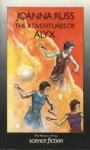
The thing you have to know about Alyx is that although the name stays the same, and some aspects of the character remain the same, trying to establish an internal chronology for these stories is likely to bust your brain. It doesn’t work, and it doesn’t have to work. Maybe it’s the same woman, maybe she’s a time traveller, maybe the name lends certain characteristics (like Julias in Tansy Rayner Roberts’ Love and Romanpunk) … or maybe Russ is playing, and it actually doesn’t matter. Although once you accept that it doesn’t necessarily work, making connections is a lot of fun.
These stories are different genre, with different approaches to narrative – what makes a narrative – so don’t go in expecting a cohesive whole. Of course, it is a whole in that Russ is doing confronting things with her female character: making her the lead, and not making romance important, and exploring reactions to women. That’s still a bold thing to do, and my edition of these stories was published in 1983; they originally came out between 1967 and 1970. I really wish I was alive to experience Russ As She Happened. And it makes me wonder who, if anyone, fills a similar niche today – and whether I am completely missing their stuff, for whatever reason.
I feel like a barbarian myself to admit that I did not love the first two stories. In fact, it took me ages to get through this slim volume because I was so not in love with the first one, and then the second, that I was worried I wouldn’t enjoy the rest. I persevered though, partly from an admittedly perverse desire to be able to say that I had read it, and partly because I knew that the stories changed up so I was hoping that I would come across stories more to my taste later on. And I did. Some of what comes below is my analysis of my own reactions to the stories, rather than a pure review. This might be dismissed as navel gazing; for me, it’s a way of working out how I work with Joanna Russ, such a powerful influence over what I’m interested in.
“Bluestocking” begins in a very self-deprecating way – “This is the tale of a voyage that is on interest only as it concerns the doings of one small, gray-eyed woman.” Not a great start? It gets subversive within moments, though, suggesting that the first man was created from the sixth finger of the left hand of the first woman… but our lady, Alyx, has all six fingers. Alyx is a pickpocket; she gets hired to look after a spoiled young woman. Then there are adventures, of a sort. There’s travelling, and bickering, and a sword fight. It is also supremely brief. I’m not sure whether it was that aspect that most didn’t work for me, but it certainly contributed – I found this story quite frustrating, with all its lacunae and its teasing and… something. “I Thought she was Afeard till she stroked by Beard” worked similarly on me. In this case, Alyx escapes an unhappy marriage; gets on board a ship and has a complex relationship with the captain; and is frustrated by the place of women in the world. I think it’s clever, but for mine there’s just not enough.
I should say at this point that there is more going on here than ‘just’ a narrative, especially in narrative connections; I know Russ is addressing Fritz Lieber, and others. I haven’t read any Lieber. Perhaps this is a fault in me, and the stories would be greatly improved with that background knowledge. But I know Terry Pratchett riffs off Lieber too, and I enjoy those stories; I know Mieville and Reynolds are riffing off others, but I still enjoy theirs too. So… perhaps it’s ok that I don’t enjoy all of Russ’ work? Maybe?
“The Barbarian” is a story that Gary Wolfe, in his essay in On Joanna Russ (… I think?? eep maybe I’m wrong…) suggests is the switch for Alyx between fantasy and SF, which is an intriguing way of seeing it. Here Alyx is again a crim-for-hire, but she doesn’t like what she’s hired to do and things go downhill from there. For me as a reader, though, things started going up. This story appealed more, although I’m not sure why. Maybe it’s a simpler story but with more flesh, more detail?
Then – next – oh, delight: “Picnic on Paradise.” This was originally published alone, as a novel; I guess it’s a novella, by today’s standards? 90 pages in my little pocketbook edition. Alyx, a Trans-Temporal Agent brought from the ancient Mediterranean world to both the future and a different planet. She’s being used to guide a disparate group of tourists across a war-ravaged planet, to keep them safe in the most horrific of circumstances: no access to their technology. There’s an incredibly profound moment at the start, where one of the women asks why Alyx is “covered up” – wearing clothes. So Alyx takes off her shift, therefore mimicking those around her, which group promptly have apoplexy. Alyx is confused, naturally; one of them says that she is wearing her history, which they are not used to. This goes a long way to demonstrating some of the rather large differences between Alyx and her charges. The story is a straightforward one of flight, and fighting for survival: getting lost, getting hungry, literally fighting (nature, each other, etc). It’s Russ, and having read We Who Are About To… I wasn’t surprised that things do not go according to plan, in a drastic way. One of the remarkable aspects is, of course, that the leader is a woman. Making the hard decisions, being contemptuous, fighting – being well-rounded. The tourists are a motley bunch: nuns, macho men, wannabe robots, high-society ladies. They too have their chance to be well-rounded, to interact especially with Alyx but also each other. This isn’t a fun story but it’s a great story, an intriguing one, and one I am so pleased to have read.
The final story in the set is a difficult one in terms of “Alyx canon,” the idea of which I rather suggest Russ would either have rolled her eyes or laughed at. Because Alyx probably isn’t in it. Her descendants might be, but if you read this by itself you wouldn’t have a clue about her. It’s also frustrating me because I know I have read it – “The Second Inquisition” – before, but I don’t know where. Some anthology, some time. Anyway… this too is science fiction, focussed on a young girl whose family is hosting a very odd stranger, who leads the girl in all sorts of directions: physically, introducing her to other, even more strange people; intellectually, introducing her to books and ideas she has never encountered; and culturally, challenging a whole bunch of assumptions within the family and society more broadly. There’s also questions about reality and imagination going on here that I think I missed the first time through. Intriguingly I think this gets a little close to the ‘galactic suburbia’ stories that Russ dismissed, since the focus is very much a suburban home with the occasional break-in of the science fictional. At any rate it certainly makes a challenging and difficult-in-a-good-way conclusion to the collection, because it doesn’t fit neatly into Alyx’s adventures. Which is as it should be, because Alyx – as a woman and as a character – doesn’t fit anywhere comfortably either. And she wouldn’t want to.


