Star Trek Picard
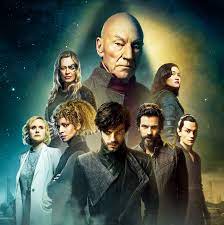
What, did you think I was kidding about leaping into Picard?
So… this was awfully lumpy.
(Spoilers ahead.)
Things I loved:
I love Raffi. I love that Picard’s arrogance is shown to have terrible consequences for those around him, I love that she is broken and that she is consciously trying to put herself back together again, I love that she has enormous emotional reserves for those around her and that she’s also very angry about everything that’s happened. I love how complex she is. I love that she is so badass.
I love Elnor. An Australian accent in space!?!?!?! I love that he gets to just… say whatever is in his mind, I love his mad skillz, I love the way he makes decisions. He’s just generally awesome.
I love Rios. I love his ridiculous 5-part holograms with their ludicrous accents. I love his skills, his development from wannabe mercenary to something else, I love his general attitude and his relationship with Raffi.
I love Seven. That she is not in a catsuit and that she continues to just generally be awesome. I love that she is shown to be complex, to have had a complex life since getting back to the Alpha Quadrant, and has learned some serious skills in snark.
I love old Riker and Troi. So cute. Less convinced by the kid, but whatever. I guess including them is basically just fanservice, but even I – as a not-massive TNG fan – enjoyed seeing them.
I really liked that it was actually Hugh, as the Director! Definitely fanservice there but it made even me happy. It’s a neat call-back and despite his fate, I’m glad we saw him.
I kinda liked Narek. I know, I KNOW, this shows terrible taste on my part. But… he’s an intriguing character! Mostly! Competing principles are compelling! Not that he deserves to be in the front of the image I’ve chosen, though: that really should be Soji.
I don’t mind Picard as a character. Look, I’ve seen a fair range of TNG; I don’t know all his complexities but I know enough. I think this does a good enough job of capturing the man – although I’m sure there are some people who are pissed that he’s shown to have epic levels of arrogance and selfishness (… I think they were obvious in the original show, personally). I quite liked that they showed him in his less than perfect humanity (ahahaha; little in-joke there). Having to deal with not everyone jumping at your beck and call – well, not immediately – made this just that bit different.
So there were good bits. I liked the idea of a captured Borg cube, I was intrigued by the idea of synthetics being banned, and there were some really great cinematic bits. But goodness the plot was just… lumpy. Also, the sound mixing was dreadful; there were lots of bits where I found the dialogue really hard to hear, and then explosions were LOUD.
Part of the problem is just how much is going on in the plot. Romulans and synthetics and Borg and secret police and people harvesting Borg and Picard having brain problems and… etc. I like a complex story, I really do, but this felt like a bunch of different plot lines that didn’t get properly woven together – like someone had LOTS OF IDEAS and they REALLY WANTED all of them to be in the show JUST IN CASE it didn’t get renewed. And yes it felt like it was happening in all-caps.
I didn’t mention Soji above. I liked her well enough? But she wasn’t my favourite character. And this made me sad. It should have been a show that was overwhelmingly, for the second half anyway, about her developing as a person when she discovers her life is a cover-up. But I don’t think she gets much character development, overall. I don’t know what could have been changed; I do know that I was left feeling like she wasn’t hugely different from when we first meet her, and that doesn’t make much sense.
When I first watched the credits, I thought it looked like Picard was being put together. And then there’s the stuff with Data, and then the vague intimation of a brain abnormality, and I had a wild assumption that Picard was himself going to turn out to be a synthetic – or had been replaced by one at some point. And then I shook my head and told myself not to be daft. And then the last ten minutes happened. Whoa.
Will I watch the next season? Of course; eventually. I don’t think I’ll be keeping Prime in anticipation, or getting it as soon as the first episode airs. But I am cautiously intrigued to see where it goes next, especially if Rios and Raffi stay on board (and what was that cutesy little hand-holding between Seven and Raffi?!).
Fugitive Telemetry
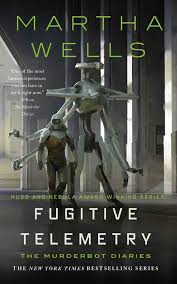
This book was provided by the publisher at no cost.
I’ll be honest – it would be hard for me to give a completely objective review of this novella, because basically Murderbot can do no wrong.
Important thing to note: I really don’t think it’s worth coming to this book as your first Murderbot experience. In the first place, reading all of Murderbot in chronological order is just such an enormously rewarding endeavour that why would you not? (I’m so embarrassed it took me until this year to tell my mother to read these stories.) Secondly, of course, this is the sixth book: there’s so much character development, and narrative, that is alluded to here – you’d be doing yourself a complete disservice.
So. Read Murderbot. Of course.
This story actually isn’t the the one I was expecting; I had thought we were getting Murderbot and ART hanging out being snarky. Not that I’m complaining! All Murderbot is good Murderbot. Instead, we’ve got Murderbot on Preservation Station, being Dr Mensah’s protection, and kinda accidentally ending up as part of a murder investigation team (which it totally didn’t do, and you know that’s true because if it had, it would have done a way better job of hiding the evidence). As usual with a Murderbot story, we get a sometimes-hilarious look at a Security Unit’s impression of human security measures (very poor), its intense dislike of human interactions, and a longing to just be left alone to (re)watch Sanctuary Moon (relatable). There’s snark, and the figuring out of whodunnit, and some grudging personal reflection that Murderbot would honestly rather do without. Also the odd fight and some relationship-building that eventually works out okay.
Murderbot continues to be one of the great AIs of modern fiction. Its deep commitment to keeping up with its preferred media, its irritation at human foibles, and its exasperated habit of looking out for hapless humans make it deeply relatable in a way that it would surely find deeply offensive. I would read Murderbot’s reviews of Sanctuary Moon, I would read Murderbot doing routine security patrols, and I would read Murderbot inter-bot snark until the cows come home.
Across the Green Grass Fields
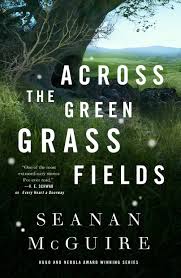
I have loved every book of the Wayward Children series to date. Some more (Down Among the Sticks and Bones), some a bit less (In An Absent Dream), but all together they’re just… a marvellous addition to my literary world.
Across the Green Grass Fields continues this. It’s not what I expected: it’s a standalone story, certainly fitting into the overall idea of the series but not into the narrative structure – there are no familiar characters or settings, although I hope they will recur. So that was a surprise, but also I shouldn’t have been that surprised at McGuire doing something different. It also means that a reader who hasn’t come across the series before can read it with no hesitation.
As a girl, I was convinced that the girl-world was largely divided between the horse-girls and the dolphin-girls. Neither was necessarily better, but it felt like they were distinct groups. (I was a dolphin-girl. Ask me how bitter I was to discover that marine biologists spend most of their time looking at plankton, not swimming with cetaceans.) Regan Lewis is a horse-girl, through and through. She loves horses more than she likes most people. She’s happy when she’s with them. Which is good, because like many girls she has to deal with unhappiness when she’s around so-called friends.
Reading that part of the story was a bit uncomfortable. I didn’t experience the total drama and tragedy that Regan does, but aspects were definitely familiar from my childhood, and I’m not at all interested in going back there thankyouverymuch. Anyone who says your school days are the best days is a liar or has a very bad memory. Or possibly a very lucky boy.
This is a Wayward Children story. I knew Regan would eventually find herself confronted with a door, and she would go through that door, and there would be an astonishing world on the other side. Given Regan’s passions, it’s unsurprising that her world is the Hooflands. Every mythological creature you can think of with variations of hooves: they live there. And everyone in Hooflands knows what humans are for…
One of the things that always makes McGuire’s writing powerful is the way she writes about “diverse characters”, and look I feel stupid even pointing to this because it should just be obvious that people with a variety of genders/ physical appearances/ sexualities/ etc etc etc should be represented in fiction, and presented as humans, but of course that’s still not the case. So knowing that McGuire does do that, and treats all of her protagonists the same, is refreshing.
This was not quite what I was expecting – I hadn’t realised it would be so standalone. I might have been a little less eager had I known that, to be honest. But it’s still a Wayward Children story: it’s beautifully written, it’s an engaging narrative, and the characters are ones I want to keep coming back to.
Dating Aphrodite

I found this book in a secondhand shop, in the travel writing section, when I was well in the mood for reading travel narratives. I figured a travel book that also discussed ancient history and mythology would be right up my alley. Unfortunately, the shop and the blurb are both a bit misleading: while Slattery does include some travel as part of the book, this is much more about having adventures in reading and thinking about ‘the ancient world’ rather than the travel itself. So that was one disappointment.
Overall, I think I mostly enjoyed the book. As that statement suggests, I am ambivalent – was while reading, still am. On the one hand, the cover irks me. It’s so … unnecessary. I assume part of the point is to make the mythology and history seem more real, vibrant, and let’s face it alluring, than might otherwise be supposed. But the original sculptor was already all about the male gaze and sexualising the statue; adding the tan lines feels gratuitous. And then there’s the fact that half her face is chopped off! There’s also the fact that Slattery’s whole purpose is to extol the benefits of reading ‘the classics’ and that access to such things should be available to all (in opposition to the old English-style curriculum where only toffy boys got access to Latin and Ancient Greek). In theory I have no problem with teaching about Stoicism and so on. But the problem starts when you then move further along that line and suggest it’s the only history worth knowing. Slattery doesn’t do that, but it’s a not hard to take his arguments and get to that point. It is, of course, largely male-dominated… unless you’re talking about Aphrodite, or throw in a brief reference to Sappho or Penelope.
I did not, though, hate the book. There were some really interesting bits! I liked the discussion of Apollo and Delphi and Pythia and Dionysus – although I feel Slattery missed an opportunity in not discussing the possible origins of Apollo and Dionysus, given Apollo is thought to have originated as an Eastern god, and Dionysus as more solidly home-grown ‘Greek’ (for all the problems with that word in the ancient world). The chapter about Ithaca was probably my favourite because it conformed most to what I was expecting, and wanting at the time: Slattery on Ithaca itself, and musing on The Odyssey, and the archaeological evidence for Odysseus on Ithaca, and how modern inhabitants feel about it.
I feel that this book probably only works for someone with at least some basic knowledge of Greek myth – although maybe I’m wrong, and Slattery explains things well enough for the complete novice. My knowledge of Stoicism and Epicurean ideas has never been that thorough and he does explain those in a way that I could understand.
As well, the book’s only 15 years old but I’m just not sure that it would get published today – in fact I was surprised to see that it came out in 2005, because it felt… older. And I think the lack of women has a lot to do with that. Plus, Slattery makes a case that the ancient Greek world had many things we value today – religious tolerance, being cosmopolitan, what he calls “Homeric impartiality” (the fact Hektor is the greatest hero in The Iliad despite not being Greek, and I am completely unconvinced about this demonstrating impartiality). Therefore, “we” can learn from the classics. I am unconvinced, even after reading the book, that that’s true. Partly because of the completely different contexts, and partly for vaguer feelings that this logic just doesn’t quite follow.
The Mermaid, the Witch, and the Sea

I’m really sad that I didn’t enjoy this more. In theory, the ideas are all great: mermaids as an extension of the Sea; the Sea as a larger-than-humans entity with real awareness; witches who tell stories; pirates; a feisty young noblewoman; genderfluid characters and multiple races and discussion of imperialism and colonialism!
Sadly, the execution does not quite match the ambition.
It felt like there were too many ellipses. Too many gaps where it seemed like the author skipped a step in the narrative – it was in her head but it didn’t make it to paper. I’m pretty sure there was at least one mention of the storm having passed, with no prior mention of the storm. And this applied to some of the characters and relationships, too. Evelyn and Flora are both pretty well-developed characters, but their relationship really isn’t. Mermaids are explained – how they exist – and this is probably my favourite part of the whole book; but witches aren’t, nor how their magic works (is it innate? can anyone learn? no idea).
Moving between Evelyn and Flora as POV characters was fine – it made the narrative much more interesting than just one perspective, given the context. But all of a sudden introducing new perspectives quite late in the story was just weird, and put me quite off balance; and not in a good way. One of them made sense, narratively; it could have been added much earlier and would have added interesting complexity to the whole thing. The other, though, felt utterly superfluous.
On a positive note, the issues brought up in the story are dealt with well, and that’s something I was impressed by. This is a world dominated by a Japanese-influenced culture (kimonos, etc); they have largely taken over the known world (this is another problem: there are these portentous ‘oooh, the Red Shore‘ comments, without much explanation of what that place is). The brutality of colonisation and imperialism are bluntly on display and are an essential part of the world – not gratuitously, but as reality.
Excellent ideas; I was engaged enough that I kept reading the whole thing; ultimately, not very satisfying.
The Gurkha and the Lord of Tuesday
I have a question. And that question is, what the heck was I doing this time last year that I didn’t rush out to get myself a copy of this novella? Because it really can’t have been that important. I didn’t even know what it was about! I just can’t quite get my head around that; what a failing on my part. Still, thanks to WorldCon and whoever mentioned it on a panel, I finally got my act together and I inhaled it pretty damn quickly.
At some unspecified point in the future – definitely a ways into the future, but not so far that humans are off colonising the far reaches of the galaxy – Melek Ahmar, the Lord of Mars, the Red King, the Lord of Tuesday, Most August Rajah of Djinn, wakes up. Turns out he has been asleep for a rather long time, and things have changed. Wandering through the Himalayas trying to figure out what’s going on, he comes across Bhan Gurung, a Gurkha living fairly contentedly, it seems, by himself in a cave. Melek Ahmar is disconcerted by Gurung’s lack of servility but makes use of his knowledge about the modern world – like the existence of nanobots, and that there is a city nearby, Kathmandu, which might be ripe for him to take over; after all, a great king like him needs subjects. Melek Ahmar and Gurung go to Kathmandu and… things progress from there. Poorly, for some people; certainly sideways for a number of them. It turns out Gurung has ulterior motives; and things aren’t quite what they seem in Kathmandu – although the fact that it is run by an AI, allocating karma rather than money as currency, isn’t a secret.
There’s a lot going on here. Melek Ahmar, the Lord of Tuesday, himself has a lot going on; all sorts of references to Greek and Egyptian and I think Hindu? mythology/ ancient history that make me long for a prequel story about the dastardly deeds of Ahmar’s youth. The slow unravelling of the story behind Kathmandu, and why the world runs with nanobots, is superbly paced and very exactly revealed, until it all finally slots into place. The same with Gurung and the revelation of his character, his story. And the story overall is a joy to read; a variety of characters and their interactions, a setting that’s sketched more than detailed but nonetheless brought to life, and a pace that keeps it all rolling along.
This is one heck of a story. I’ll be getting hold of the two other novels Hossain has out, and looking out for more.
Bone Silence
The first book was Revenger.
The second book was Shadow Captain.
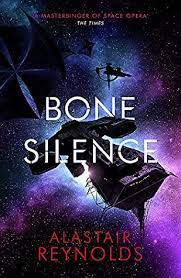
This is the third book.
I really like Alastair Reynolds’ work. I own all of his novels (except the Dr Who), and most of his chapbooks and collections. I have re-read several of them, and I get excited about new books.
But.
Um. I was bored by this book.
Like, I skimmed through paragraphs of description in the last third or so.
When I got to the end, I just felt a bit… numb. How had it come to this? How could I possibly not have loved this book?
Let me suggest some reasons:
- The book is too long. Maybe 1/3 too long. There are long, boring descriptions that add nothing to the sense of place or experience. There’s lots of time where nothing happens – and sometimes that can be fine; I will read Legolas and Aragon and Gimli running across Rohan endlessly – but these periods of waiting were… boring.
- The climax didn’t feel like it fit the book itself, or the trilogy overall. Actually I started feeling like this in the second book where all of a sudden we weren’t just off to save someone, but there was something weird going on with the whole civilisation – but that wasn’t something that was even foreshadowed earlier so it came as quite a surprise. And then this book is theoretically all about finding out the answers to those civilisation-wide issues, but there’s a whole lot of waaaaaiting… and then BAM here are (most of) the answers you were waiting for. Which were themselves a bit weird and didn’t feel like they fit the world-building to that point.
- Fura and Adrana, the sisters at the heart of the story: I didn’t really care. Maybe if I had re-read the first two books before getting into this one, I would have been more concerned with their welfare and fates. As it was, neither of them were particularly appealing as characters, and I didn’t feel very compelled to cheer for them.
- The writing style. It was already a bit grating in the first book, and it really wasn’t working for me by this stage. The trilogy is basically like Hornblower in space; the space ships use (light)sails to get around, and there are pirates and privateers and loot and boarding parties and such. The language reflects that idea of 18th-century nautical-ness, especially in conversation. And it got old.
So there we go. I haven’t always adored every Reynolds; the Poseidon’s Children books weren’t my favourite, but I still enjoyed them. Hopefully this book is a blip – maybe a case of the editor not editing as thoroughly as previously? Who knows. I will still be buying the new Reynolds, whenever that comes out; I’ll just be a bit more cautious in my enthusiasm, I suspect.
Murderbot #5
… whose proper name is Network Effect, but everyone just calls all these stories Murderbot, don’t they?
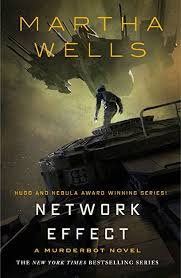
In case you’re late to this party: in 2017, a novella called All Systems Red came out and a lot of people went a bit nuts about a Security Unit robot who had hacked its governor module and was therefore under no one’s control, who kept doing its job because it didn’t know what alternatives there were – it just knew that sitting in one spot and watching media all day was going to land it in trouble. And thus, Murderbot. All Systems Red introduced Murderbot and its problems with humans (including that they keep trying to get themselves killed; Murderbot’s job is preventing that); its love of an epic drama called Sanctuary Moon; and a particular job that goes sideways because the galaxy it inhabitants is largely run by corporations, and the corps like to try and get away with everything. Security Units are used by other companies to try and prevent the other other companies from destroying or killing their stuff.
Artificial Condition, Rogue Protocol and Exit Strategy all followed, wth Murderbot trying to learn more of its own history, the possibilities for its future, and where it can access more media please and thank you except probably without the pleasantries.
If you haven’t read the four novellas yet, you want to stop reading here – partly because of spoilers and partly because seriously your life will be better for having read Murderbot why are you even still here? Ann Leckie says she loves Murderbot; NPR claimed “We are all a little bit Murderbot” and I have to say, right now: so true.
So that brings us to the novel, Network Effect. This picks up fairly soon after Exit Protocol; Murderbot is on Preservation, working for/with Dr Mensah and her family, and trying to figure out what it’s doing and what should come next. Well, it’s not actually on Preservation at the start of the novel; it’s with a survey team and we all know how well that tends to go. And that’s pretty much how it goes… and then things manage to get worse, right about when it shouldn’t. What a surprise. No wonder Murderbot despairs of humans.
Basically if you like the Murderbot novellas I don’t see any reason for you not to love the novel. It’s just… more. More snark from Murderbot, more hating on having emotions, more existential confusion about what it should be doing. Many, many more explosions and much drastic action and epic failures of plans (sometimes because of unforeseen events; sometimes because humans), opportunities for hating on the corporations, and conflicted feelings about the humans in its care responsibility.
I can only hope that Wells is interested in continuing to explore Murderbot’s developing sense of self, and their conflicted relationship with their risk assessment module. Murderbot isn’t human, has no desire to be human, and hates passing itself off as human even when that’s a security necessity. And there is no better way to explore the concept of humanity than through its interactions, its changes in response to stimuli, and its refusal to accept what’s right in front of its visual inputs.
Catfishing on CatNet

In 2016, Yoon Ha Lee introduced servitors who might have a mind of their own in Ninefox Gambit and then proceeded to develop them as a subplot, eventually introducing one who liked to re-cut its favourite media with better music. In 2017, Vina Jie-Min Prasad gave us Computron and its obsession with Hyperdimension Warp Record, and Martha Wells gave us Murderbot and its love of media.
In 2015, Naomi Kritzer had already given us the AI in “Cat Pictures, Please” who definitely doesn’t want to be evil and knows everything about you because you put your life on the internet and while it mostly likes looking at your cat pictures it also knows about your obsession with hentai, that you should buy this house over here, and that you really need a new job.
IN 2019, Kritzer produced Catfishing on CatNet which I finally got around to reading because it’s nominated for not-a-Hugo, the Lodestar Award for Best YA novel. And I am super pleased that I did finally get a chance to read it, because it was hugely enjoyable.
The novel follows the short story in that there is an AI, who is an occasional narrator; they do love cat pictures. Here, they’ve set up a social networking site that’s meant to be mostly about cat pictures but as always happens has become something more – not least thanks to the social engineering of the AI, who puts people in groups it thinks they will enjoy.
The focus, though, is on Steph. Steph is a teen who has moved around a lot because her mother is paranoid – and not without reason: Steph’s father was abusive, and her mother is determined not to be found by him. Steph has come up with coping mechanisms to deal with changing high schools a couple times a semester, sometimes; mostly it revolves around trying not to make friends. But at the new school, she starts making friends; and, of course, things do not go smoothly. For Steph, or for the cat-picture-loving AI.
There’s a lot to love about this novel. It’s fast-paced, which is unsurprising in a YA novel. It spends what feels like a nice amount of time setting up the school circumstances, as is appropriate for a YA story where that’s really the big deal for the main character; when things go wrong, they really go wrong and events move right along. There’s some excellent diversity – I can’t believe I still feel like this is something I need to say, and maybe it’s reflective of me being old and the target audience for this novel would just roll their eyes at me; whatever: there’s racial and gender and sexual diversity, and it’s an entirely natural part of the social landscape, as it should be. So is the commentary on the fact that there are racists and sexists and homophobes out there, but the kids kinda just… deal with it.
The AI is not the central character but its actions are central – without its interference/ help, events would unfold very differently. In the short story, the AI discusses how it has examined different moral and ethical codes, and frankly found them unhelpful in its own pursuit of correct action. That’s not explicitly in the novel, although there is some discussion of ethics; but the AI definitely does consider the rightness of its actions with regard to its human friends, and this conundrum – how best to act – informs a lot of what happens. And I love it, because of course these are the sorts of discussions we should be having.
The sequel to Catfishing is meant to be out soon. I’m very excited.
Middlegame
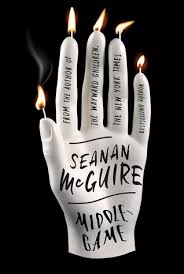
Received as part of the Hugo packet for 2020; Middlegame is up for Best Novel.
When a book is written with just enough information that I get a sense of where the plot’s going, and/or when the book is written beautifully, and I trust the author: then I really love a non-linear tale. This is not as non-linear as something like Kameron Hurley’s Light Brigade but it’s not exactly straightforward. I had absolutely no idea what it was about before charging on in, and that was quite a fun way to do it actually.
Alchemy in the 20th century; attempts to make universal forces incarnate in human children; somewhat gruesome violence, because the people doing the former two things are immoral and ruthless. Our central evil alchemist wants particularly to incarnate the ‘Doctrine of Ethos’, in two people – twins: one will be language, and the other will be maths. Which… there’s a lot in that. And the idea is that essentially those people will BE those things… eventually. When they are fully embodied.
Some of the novel is about the alchemists and their dastardly actions and what they want to achieve. Much of the novel, though, is about Roger and Dodger (yes there’s a reason for the names), and them growing up and how they interact with each other – or not. McGuire has said that it’s like a superhero origin story, which I can see; it’s a bildungsroman. How do you cope when you’re solving impossible maths problems at 9? When there’s a voice in your head that you’re pretty sure shouldn’t be there? And that’s on top of everything else about being a kid and being adopted and being a smart kid. Don’t even get me started about being a smart girl-kid whose smarts are in maths.
McGuire has said it took her a decade to get to the point where she felt capable of doing this story justice, and I can appreciate that. I’ve only read her InCryptid and Wayward Children series, which I adore – but they’re not as narratively complex as this, and I don’t get the sense that Toby Daye or the various Mira books are, either. To be able to hold all of what’s happening here in your head and make it actually make sense on paper would have to require a lot of work. And I think the prose is more wonderful, too. This is not to say that the other books are poorly written – not at all. This is more like Wayward Children than InCrytpid because that’s what the story calls for. There’s a… mythic? not-21st-century, perhaps more formal or timeless, feel to this story than the F1-paced InCrytpids.
The thing I really don’t get is why the Hand of Glory was chosen for the cover. Yes they make several appearances, but I wouldn’t have said that they are symbolic of the plot or even that they’re especially central to the narrative. It is, in fact, one reason why I hadn’t read the book before now; the cover really didn’t appeal – and when there are so many other books in the world, covers do actually make a difference sometimes.
I really enjoyed this. However, it’s up against Gideon the Ninth and A Memory Called Empire, and Light Brigade, and that’s just horrific competition.


