Snapshot: Nike Sulway
Nike Sulway is an author and academic. She is the author of several novels, including Rupetta, which—in 2014—was the first work by an Australian writer to win the James Tiptree, Jr Award. The award, founded in 1991 by Pat Murphy and Karen Joy Fowler, is an annual award for a work of “science fiction or fantasy that expands or explores our understanding of gender”. She teaches creative writing at the University of Southern Queensland, loves rabbits, chocolate and children. Not all for eating or cuddling.
1. Your novel Rupetta won the Tiptree Award and the Norma K Hemming Award this year – congratulations! It’s a grand novel about love and family and history and automatons – do you feel that it accomplished all that you hoped?
I’m very pleased and grateful to have received both of these awards. Among other things, they have helped the book to find more readers – or perhaps that should be the other way around (it has helped readers find the book!).
As a writer, I’m incredibly ambitious. Perhaps all writers are. Not in a worldly sense, but in terms of what I want to achieve in the works themselves. For me, every work exists in an ideal state … before I start writing. Writing is, in one sense, the process of dismantling the Ideal/dream version of the book, and instead creating its shadowy reflection. A kind of fall from the Platonic Ideal to the Shade. So, in that sense, nothing I’ve ever written is a perfect realisation of all the dreams I dreamed for that work. I can’t remember which writer said that that’s why you write the next thing: because you still have work to do, ambitions to realise.
I’m very proud of some of the things I achieved in Rupetta. I’m pleased with small things. I love little Perihan; I love the relationships between Henri and Miri, and between the Salt Lane Witches. I’m proud of the fact that love is central to this book about war and ambition; that the daily experiences of women are at the centre of the story. Its strong, strange, complex spine.
But, there’s always more work to do.
2. You’ve written books for children as well as for adults… which do you think is harder? And do you start with an audience in mind, or a story?
I think writing both for children, and for older readers, are incredibly complex and difficult tasks. I think in writing for children, you have to work hard not to be condescending or overly romantic about children, and childhood. Not to diminish your sense of who your readers are, or your characters. I have this little bit of something I wrote on my blog called ‘How to write a story for a child’ which begins: First, consider the child. That’s not as easy as it sounds! I think of writing as being about a particularly unusual and strangely intimate relationship between writer and reader. You have to be willing to encounter the other person as themselves, warts and all. I think building emotionally (and narratively) rewarding relationships is hard work! No matter who that relationship is with.
I start with … hmm … I start with an image, usually, and the image most often includes a character. With Rupetta, this was an image of a half-broken, half-repaired neglected piece of clockwork slowly decaying in a country barn. I’m trying to remember which comes first, but I think – for me – the two (readership and story) arrive together. Entwined.
3. Not all of your work has been speculative fiction. Do you anticipate writing more speculative fiction, or does the story idea dictate the genre?
When I sit down to write, I don’t really think of myself as working in a particular genre. Not exclusively, at least. I enjoy reading and writing speculative fiction; I enjoy reading and writing contemporary realist fiction, and picture books, and non-fiction. And the things I’m working on slide across all those boundaries, especially while I’m working on them.
I’m working on a trilogy at the moment, the first book of which is called The Orphan King. I’ve done a picture book version – no words – and a graphic novel version, and a textual version that draws a little on my reading of Henry James Turn of the Screw, in that whether you read it as speculative or realist depends on … well, depends on you. The text itself (the writer herself?) hasn’t yet decided. The final version will be a novel; if I think of it as belonging in a genre at all, I would like to think it is in the same little sub-genre/cross-genre field that Gary Wolfe uses to describe Karen Joy Fowler’s work. He said her stories are “trapdoor genre stories”; stories which they can be read as non-genre until that one moment when you realise this isn’t quite what it seems.
4. What Australian works have you loved recently?
I absolutely adore Lisa Jacobson’s The Sunlit Zone, which is a verse narrative set in a dystopian future. It is astonishingly beautiful, and moving, and strange.
Marie Williams’ memoir Green Vanilla Tea will never leave me. I was lucky enough to work with Marie on this book about her family, and particularly about what happened to her family when her young husband is diagnosed with a terminal illness, and dementia.
Finally, Melissa Lucashenko’s Mullumbimby is a work of grace, courage and humour by an Australian writer we should all be reading more often. If only she would write more!
5. Have recent changes in the publishing industry influenced the way you work? What do you think you will be writing in five years from now?
As a writer, I have a rather ambivalent relationship to the writing and publishing industry. I know a little bit about it, and I try to stay aware of what’s going on, but at the same time I don’t want to let the market unduly influence what I write. At least, not in a negative, limiting way. Plus, I think of ‘The Writing Industry’ as being a bit like the many-headed hydra, or at least of myself as being like one of the blind people who are asked to describe an elephant: what I think it is depends on which bits and pieces I get hold off on any particular day.
So, I’m not going to write a sparkly vampire erotic fan fiction in which lead characters are killed off at unexpected moments just because those are some aspects of some popular books right now.
I’m not going to lead the charge into hypertextual/hybrid forms of narrative, because I’m a writer, not a multi-platform artist. Though I would embrace working collaboratively with other artists/craftspeople across a range of mediums.
I can’t see myself pioneering a radical new form of storytelling cos, really, I like the old form. Words, in sentences, one after another, that somehow perform this magic trick of transforming into people, places, experiences and emotions.
I’m also, in the end, a bit of a romantic; I think stories and storytelling will endure, though perhaps the medium through which stories reach readers will change beyond recognition.
Five years from now, I’ll still be snuggled up in a comfy chair with a book of some kind, lost in some other world, with some people who never existed, and when I get up to make tea, I’ll stare out the window at the leaves all over my unraked lawn and wonder what on earth I’m going to write about next.

This interview was conducted as part of the 2014 Snapshot of Australian Speculative Fiction. We’ll be blogging interviews from 28 July to 10 August and archiving them at SF Signal. You can read interviews at:
Snapshot: Bruce Gillespie
Born 1947. First eleven years spent in the south-eastern suburb of Oakleigh, along with my Mum and Dad and two sisters, both younger than me. Various house moves took us to Melton (which then had 500 people) and Bacchus Marsh, even while I was gaining my BA and Diploma of Education at Melbourne University (1965–68). At the end of 1967 I met quite a few of the best-known SF fans in Melbourne, and joined fandom in 1968. I attempted to teach in Ararat (1969–70), before gaining a position in the Publications Branch of the Education Department (1971–3). After travelling overseas for five months (September 1973–January 1974), I decided to try a life of freelance editing, which I’ve been doing ever since. I met Elaine Cochrane in 1974, but we did not get together until 1978, and married in March 1979, about the time we moved into a house in Collingwood, along with five cats. We moved to Greensborough, a northwestern suburb, in 2005. We still have four cats.
1. You’ve been publishing SF Commentary since 1969, according to the all-knowing Wikipedia, and it’s been nominated for a Hugo Award three times. You’ve also published other fanzines over the years. What is it about publishing fanzines that you love?
In 1961, when I was in Form 3 (Year 9) at Oakleigh High School, my friend Ron Sheldon and I published 26 issues of 6-page duplicated magazine and sold it to fellow students. I did not know the term ‘fanzine’ then, but read about fanzines later in a column by Lin Carter in If. That’s what I wanted to do — publish a magazine in which I could write about anything I wanted and could send it to anybody in the world I chose. In 1966, I bought my first fanzine from the front counter of McGill’s Newsagency (run by Merv Binns, the organiser of the Melbourne SF Club, which was situated in a lane behind McGill’s). It was Australian Science Fiction Review, edited by John Bangsund. At last! In-depth articles about science fiction, plus literate humour from Bangsund and his correspondents. However, I did not write to John until I had finished my degree. I enclosed two articles I had written about the novels of Philip K. Dick. John asked me to visit him in Ferntree Gully. On that weekend in December 1967 I met many of the people who have remained important in my life, such as John Bangsund, Lee Harding, John Foyster, George Turner, Damien Broderick, Tony Thomas and Rob Gerrand.
I desperately wanted to begin publishing, but had no real income until I started teaching at the beginning of 1969. I typed, and John, Lee and Leigh Edmonds actually produced and posted the first issue of SF Commentary early that year. Although that first issue was one of the worst-looking fanzines of all time, it elicited an enormous letter response, including a letter from Philip Dick, my favourite author. I managed to buy a duplicator, produced 18 issues of SFC in two years, and in 1972 I gained my first Ditmar Award and Hugo nomination. SF Commentary itself has lapsed in production from time to time, but I have also produced such magazines as The Metaphysical Review (dealing with all my interests other than SF, and now replaced by Treasure), Steam Engine Time (co-edited with overseas friends, featuring longer articles about SF and fantasy), and *brg* for ANZAPA (Australian and New Zealand Amateur Publishing Association [of which he’s been the official editor for ten years – ed]) and its online version Scratch Pad.
To answer your original question: the main pleasure of publishing fanzines has been the pleasure of making something oneself, and receiving a huge amount of warm response, including letters of comment, magazines exchanged with mine, and articles and artwork. In later years, people began giving me prizes as well, including making me Fan Guest of Honour at Aussiecon 3 (1999) and giving me a trip to the west coast of USA (the Bring Bruce Bayside Fund in 2005). But even these awards are not as rewarding as the actual act of publication.
2. One of the fascinating things about your fanzines is the letters columns, wherein people appear to be having conversations that have lasted over many issues — and therefore, sometimes, over years. Have you made friends via letter columns? What is it about that venue that works for people?
I had very little self-confidence when I was a young man, and not much now. But my life was transformed when John Bangsund enjoyed the articles and reviews I sent him, and then many people responded by mail to the first issues of SF Commentary. At my first SF convention, Easter 1968, few people wanted to talk to me. At my second convention, Easter 1969, after SFC 1 had appeared, I was greeted at the door. I seemed to become a different person in print, somebody people wanted to meet. In turn, I could introduce my readers to each other. The conversation, a sort of slow-motion, in-depth version of the Internet, keeps going.
3. Do you anticipate keeping on with SF Commentary, and Treasure, into the future? Are there still things that you want to say?
The problems of producing SFC have always been practical. When I had the time to produce an issue, I did not have the money to print and post it, and when I had the money I did not have the time. These days the main brake on the print version of SF Commentary is Australia Post. Most of my most enthusiastic readers live overseas, but airmail postage has shot up greatly over recent years. To compensate, Bill Burns in America offers the website efanzines.com, where he will post issues of fanzines in PDF format for anybody to access. This has proved a lifesaver to me and many other fanzine editors who no longer have the income to print and post their zines. Until Australia Post makes it quite impossible to send out print copies and/or Bill Burns has to give up his website, I will keep going. Producing fanzines is what I do.
4. What Australian works have you loved recently?
There are not many Australian fanzines still being published. One of the best, Ethel the Aardvark, can only be read by members of the Melbourne SF Club. However, I can point to Chris Nelson’s Mumblings from Munchkinland (available both as a print and PDF version) as being the ideal small fanzine that covers a lot of ground, especially the history of fannish activity in Australia. Bill Wright is still publishing his Interstellar Ramjet Scoop on efanzines.com, and Van Ikin told me at Continuum that he has four issues of Science Fiction nearly finished.
The Australian fiction scene has expanded in the last 20 years, from a time between 1975 and 1985 when Cory & Collins (Paul Collins and Rowena Cory) and Norstrilia Press (Carey Handfield, Rob Gerrand and me) published most of the new Australian SF titles, two or three a year. The mainstream publishers are now not putting out many more SF and fantasy books than they did in the 1980s, but the new crop of small press publishers (beginning with Aphelion Books, and Eidolon and Aurealis magazines) now produce a huge quantity of fine books every year. The trouble is that very few of them are science fiction books (i.e. realistic books about the future). The switch to fantasy and horror titles was initially puzzling and disappointing to me, but has been justified by the quality of the writers who have emerged in the last 20 years. My own favourites include Kaaron Warren, Angela Slatter, Cat Sparks, Deb Baincotti, Rosaleen Love, Jack Dann and Rick Kennett. (Only two males? Who would have believed that in 1968, when Australia’s small number of working SF writers, all male, would huddle in one corner at conventions?) I feel left behind by the sheer quantity and quality of current fiction, and admire people like Nalini Haynes (Dark Matter) and you podcasters who try to keep up with the field.
5. Have recent changes in the publishing industry influenced the way you work? What do you think you will be publishing or reading in five years from now?
As I say, I can keep publishing while the physical means (either print or efanzines.com) remain available. I have no interest in changing to blog production, and indeed rarely access websites, blogs, or podcasts. It’s hard enough finding time to read the incoming emails each day. I don’t want to read books on a tablet or computer screen, so do my best to obtain physical copies (preferably hardback) of major new books. If new books appear only as e-books, I won’t be reading them. Not that I have any problem with lack of reading matter — our house is filled with books, many of them unread. And I have many great books to re-read, especially those by Philip K. Dick, Brian Aldiss, and Cordwainer Smith.
This interview was conducted as part of the 2014 Snapshot of Australian Speculative Fiction. We’ll be blogging interviews from 28 July to 10 August and archiving them at SF Signal. You can read interviews at:
Snapshot 2014
Snapshot has taken place four times in the past 10 years. In 2005, Ben Peek spent a frantic week interviewing 43 people in the Australian spec fic scene, and since then, it’s grown every time, now taking a team of interviewers working together to accomplish!
In the lead up to Worldcon in London, we will be blogging interviews for Snapshot 2014, conducted by Tsana Dolichva, Nick Evans, Stephanie Gunn, Kathryn Linge, Elanor Matton-Johnson, David McDonald, Helen Merrick, Jason Nahrung, Ben Payne, Tansy Rayner Roberts, Helen Stubbs, Katharine Stubbs, Tehani Wessely, Sean Wright and me. Last time we covered nearly 160 members of the Australian speculative fiction community with the Snapshot – can we top that this year?
To read the interviews hot off the press, check these blogs daily from July 28 to August 10, 2014, or look for the round up on SF Signal when it’s all done:
http://crankynick.livejournal.com/tag/2014snapshot
http://bookonaut.blogspot.com.au/search/label/2014snapshot
http://www.davidmcdonaldspage.com/tag/2014snapshot/
http://fablecroft.com.au/tag/2014snapshot
http://helenstubbs.wordpress.com/tag/2014snapshot/
http://jasonnahrung.com/tag/2014snapshot/
http://kathrynlinge.livejournal.com/tag/2014snapshot
http://mayakitten.livejournal.com/tag/2014snapshot
http://www.merwood.com.au/worldsend/tag/2014snapshot
https://randomalex.net/tag/2014snapshot/
http://stephaniegunn.com/tag/2014snapshot/
http://tansyrr.com/tansywp/tag/2014snapshot/
http://tsanasreads.blogspot.com/search/label/2014snapshot
http://ventureadlaxre.wordpress.com/tag/2014snapshot/
Diaspora, Greg Egan
The same caveat applies to this book as to every other Egan novel. If you are neither inherently fascinated by mathematics and physics taken past the bleeding edge, nor willing to tolerate possibly pages of physics discussion that you don’t get, then don’t read this novel. It’s not the book, it’s you – and that’s ok, it’s just not worth your while getting frustrated.
That said, if you’re willing to dive in, I think this is another of Egan’s awesome novels. Spoilers coming.
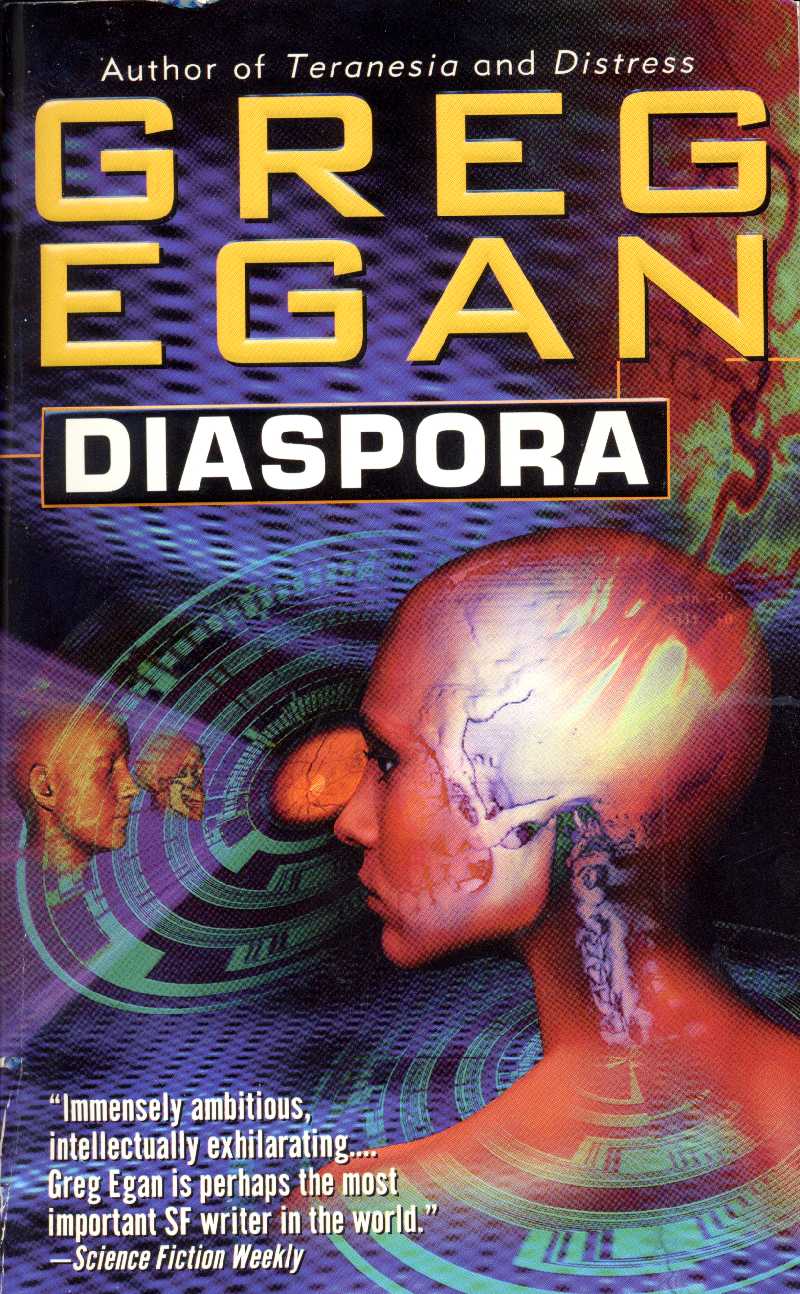 The premise is that at the end of the 30th century, there are some humans we would see as ‘normal’ – called fleshers here; there are more ‘people’ who inhabit the polises, which are basically massive computers – so yes, they’re virtual, from our current perspective. And there are also gleisners, who inhabit robot bodies. The plot is driven by the perspective of a couple of polis citizens; indeed it begins with the creation of an ‘orphan’, a citizen in a polis created with no input from any parental guidelines but by the polis itself, basically to test new possibilities. This orphan, who becomes Yatima, is a primary protagonist.
Some reviewers over on goodreads have been frustrated by the lack of fiction, or plot, in this story, and I can see where they’re coming from. However, there is a plot, and even if sometimes it takes something of a backseat to the ideas – well, that’s kinda the deal with an Egan story. But it’s not superfluous in any way. So what is it? Well, a gleisner astronomical survey indicates that two neutron stars are about to collapse into each other, several million years earlier than they ought to. They’re frighteningly close to the earth, and it does indeed do very bad things to the planet when the gamma rays etc get here. From this, eventually, there is a diaspora as people (broadly understood) attempt to understand this event and how to survive future ones and also, just Going Out into the universe as humanity has always dreamed of doing. Interesting things are discovered, of course.
This brings me to a rant about the blurb. It suggests that Yatima is searching for a world where no “acts of God” will occur. Um, no. If anyone is searching for that it’s Orlando, a flesher who goes into a polis after the catastrophe. But even that does absolutely no justice to anyone’s motivation. So… all I can think is that the blurber had no idea what to say about the book, and was told to focus on the plot (which they didn’t understand) rather than the ideas. This is my contempt you’re feeling right now.
And then there are the big questions Egan plays with. Some of these are things he’s actively working through over the novel, while others are things he simply takes for granted. For me, as always, his approach to gender is the most striking on a plot level. Because it’s one of the issues he simply takes for granted. Humanity living in a software-created virtual world? Why on earth would they keep to rigid binary (yes I know, all the caveats about it not actually being binary) understandings of gender? So most of the polis citizens are referred to as “ve” – and things happen to “ver” while belongings are “vis”, which is very neat. There are some who are gendered; Orlando, perhaps understandably, can’t shed his original gendered self perception; there are some polis-born citizens who also insist on it, and they’re regarded as frankly a bit weird. I adore this aspect.
The virtual nature of much of the story could lead to a complete divorcing from the physical, which is an issue I’ve been thinking a lot about since reading Nike Sulway’s Tiptree speech: the issue of divorcing matter and mind. However, I think Egan does a good job here of not doing so – and indeed of interrogating the issue. The polis inhabitants do still interact with matter, and it is important to them; there are discussions about the importance, or not, of interacting with the real and whether postulating crazy things like more dimensions than we can see or interact with is just offensive. Most polis citizens respect the material world even if they experience it differently from fleshers. And the diaspora, even if it takes places as (basically) flying computers, also interacts with the real and physical in important, fundamental and profound ways. So, go you, Egan, for not just going the lazy cyberpunk route.
Did I mention that this book takes place quite seriously over about two millennia, and then speeds up at the end to encompass even more time? What a head spin.
Some of the physics stuff he discusses: astronomy – especially the neutron star bits; extrasolar planets; alien life, including evolution and non-carbon-based possibilities; wormholes; quarks, leptons, fermions etc; and the possibility of other universes and how they would interact, or not, with the one we inhabit.
On that note, I can’t help but feel that this must to some extent be Egan’s answer to, or take, on Flatland. Indeed he references the idea of “flatland” at one stage. Because some of the characters are forced to interact with beings existing in 5 dimensions, and how are you going to do that? So that’s a really nice aspect for those who have read that somewhat obscure adventure into dimensional maths.
Some of the other ideas that Egan confronts: human evolution, both ‘natural’ and deliberate, and what that will mean for the various branches communicating with each other; the place of art and of mathematics; cloning, and its possibilities; parenthood and the nature of being an orphan; individuality and community.
I told you this was a dense, complex, and – I mean it – ambitious work, right? You can get it from Fishpond.
Bikes. In. Spaaaaace
This should be being talked about more.
 I came across Elly Blue courtesy of the Kickstarter folks featuring her in their weekly newsletter – as a result of which I now always take the time to at least skim that email, just in case there are other little nuggets of pure gold. Blue publishes a quarterly zine that focusses on “the feminist bicycle revolution,” and if that doesn’t sound awesome then I… have no other words. Taking the Lane looks at different aspects of cycling culture, and the original Bikes in Space was meant to be just a fiction edition of the zine. And then, from what I can tell from her website, it kinda grew. Such that this issue was published outside of the quarterly schedule (I believe), and as a book rather than as a zine. And there’s a third volume in the works.
It’s a cute little product – goes well with the Twelve Planets books; I don’t know who did the physical publishing but it feels nice and well-made. I love the cover! And the stories… well.
“Racing the Drones” is a nod to bike couriers everywhere, and the advantages they have over other forms of delivery. “The Sassy Chassis Lassies and the Devolution Revolution” makes comment on road etiquette – and the frequent lack of it from cars – as well as the freedom offered by bikes. “Winning is Everything” looks at a woman defying a male status quo, while “Grandma Takes Off” features a very awesome older lady. I have named my bicycle, so “Tabula Rasa” – about forming an emotional connection to your ride – worked for me; “Bikes to New Sarjun” is incomplete but takes up the idea of bicycles and charity and government intransigence. And Elly Blue herself addresses that bane of the cyclist’s life, butt-dialling.
“From an Interview with the Famed Roller Sara Zephyr Cain” is one of my absolute favourite stories. There is so much going on here, like hints at some sort of post-apocalyptic world, and tantalising ideas of genetic modification. But more profoundly, it’s a discussion about gender – choosing it, and dealing with people’s reactions to that. I’d love to hear what transwomen think of the story. Another of my favourites was “Midnight Ride,” which takes as its theme the freedom offered by cycling – and whether that can be inclusive (it is a little sentimental but/and I think it’s done nicely). And then there’s “The Bicycle Maker,” a lovely little story set well into the future, where humanity – at some point before they disappeared – delegated bicycle-making to a machine of some sort. And what’s that machine to do when there are no humans to ride its bikes?
But I don’t like bikes!
Tch. Come on. The bikes are always present, but they don’t necessarily play a huge role in the plot; sometimes they are simply there as transportation – although, of course, the use of bikes is often in itself a political statement. Which is part of the point of this anthology. Trust me, this is not a legit excuse.
You can buy this (and its predecessor, which I got as part of the Kickstarter and haven’t read yet) over here.
Secret Lives
L. Timmel Duchamp says that Love’s stories consist of “fairly plain words (and never very many of them),” in her introduction to this collection. That might sound like faint praise indeed, except that the rest of the introduction praises those same words’ “amazing, amusing magic” – and she’s right. It’s also why, when Alisa Krasnostein (of Twelfth Planet Press, who put this collection out – yes, fair dealing, she’s a friend) asked what I thought of it I had to pause, and think through my response. Which initially concerned her, I think, but my hesitation wasn’t about “how do I tell my friend I didn’t like the book?” but “how do I my feelings into words?” It was compounded by the fact that I read the collection in very fast time (two and a bit tram rides, to be exact) – it is only 80 pages long, in the cute little format that all of the Twelve Planets have come in.
 So what did I think? Well, most of the stories feel pretty easy to read, thanks to that simplicity of prose Duchamp identifies and the fact that there’s no padding in any of them. Most of them, though, are likely to sneak around to the back of your head and whack you one to make you realise that simplicity of prose is by no means the same as simplicity of purpose, or theme, or consequence.
“Secret Lives of Books” has the most straightforward narrative structure of the stories here. Ritchie is dying, and his books have always been of far more importance to him than human relationships. So, simple: after death, go live with the books. In the books. But as he whispers to his ex-wife Luisa: Books suck your blood. How will they respond to this invasion, and how will they react when their existence might be threatened? And when they find out about the internet? … A simple narrative, yes, but a provocative probing into our relationship with books and with other people, and with the concept of knowledge. I read once a (mostly tongue-in-cheek) suggestion that humanity was the weapon grasses like wheat utilised in order to fight the trees. I was reminded of that, here.
True fact: I have never heard of Kiddofspeed. Turns out this is a real thing, a website where Elena Filatova discussed riding a motorbike through the area around Chernobyl, post-disaster. In “Kiddofspeed” Love does a glorious job of interrogating the question of fact v fiction, and especially the question/issue of how the internet makes the casual reader’s understanding of the line between these two things so much harder. If it’s on the internet it’s true, right? If I say it is? (I’m put in mind of this article suggesting/explaining that Tom Cruise did not, actually, jump like a mad thing on Oprah’s couch – well, not how most of us “remember” him doing so, anyway.) Love also has a dig at some of the wilder “theories” about Chernobyl, and shoots them down in very few, scathing, words.
A qasida is “a form of lyric poetry from Arabia about the pain of lost love” – at least so says the prologue to the story of the same story, and coming straight after “Kiddofspeed” there is part of me that pauses and wonders whether the entire collection might be playing some sort of grand didactic prank… but surely not. (Right?) This story flicks between Bronnie, living now and with the knowledge that Mars-obsessed Del is lost, and Livia Wynne – general fixer for the British Empire in its last gasp, after the First World War. I could completely spoil the narrative (Del is on Mars) and not spoil the story. I haven’t, promise. (And because it’s on the internet….) Relationships, the quest for knowledge, the (im)possibility of cross-cultural understanding, the drive to go, the complexity of language: all of these are touched on, lightly but generally profoundly.
“The Kairos Moment” is probably my least favourite story. I don’t dislike it, it just doesn’t work for me like the others. ‘Kairos’ is the Greek term (apparently… who me, paranoid?) for a moment of something wonderful happening. The narrator theorises that music is one method by which to achieve a kairos moment, and proceeds – as part of her research (I just realised I’m assuming it’s a her – I don’t think it’s revealed) – to try and create one. It’s not entirely straightforward, nor entirely a healthy experience for some.
The final story is
The slut and the universe
or
The relations between feminism, global warming, global financial meltdown,
asteroid impact, the nuclear arms race and the mass extinction of species.
or
How feminism got to be both the root of all evils and the means of salvation from them.
It opens with “One upon a time, there will be a young girl who live with her family in the middle of the woods.” Can you tell this is my favourite story? Marysa lives with her mother and her grandmother. They argue about the clothes she wears, with the word ‘slut’ bandied around – “Not that they mean Marysa is a slut… [but that she] has chosen to dress like a slut, and therefore… people she meets… will treat her like a slut and TAKE ADVANTAGE” (68). A condemnation of slut-shaming in a page of prose, hell yes. And then they get on to the patriarchy and all of the things suggested in the multiple titles. With Gaia along to stir up the conversation a bit. The narrative is tenuous, true; there are hints of a world that has gone bad (worse than ours at the moment anyway), and the relationships between the three generations. The focus is absolutely on conversation and argument between the four. It’s a place for Love to set up ideas and be provocative and maybe even extreme, and I loved it.
This collection is awesome. You should buy it.
Moonraker
This review is part of Project Bond, wherein over the course of 2014 we watch all of the James Bond movies in production order.
Summary: in which, space. And Jaws. But no sharks.
 Alex: still not a fan of Moore. However, there were some parts of this film that I actually liked. It’s definitely better paced than the earlier Moores, and who doesn’t love a good giggle over the hilarity of 1970s space stations? It does, however, feature my least favourite Bond theme. Sorry Shirley, it does nothing for me.
The prologue introduces us to the shuttle, Moonraker, as it gets hijacked. We also see Bond encounter Jaws again, henchmanning for some random villain, and then they both end up out of a plane sans parachute. This section had some truly awesome cinematography, and the feature on the DVD about how it was shot is definitely worth watching.
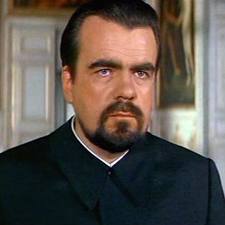 The shuttle was built by Drax Enterprises, and himself is pissed that the British lost his shuttle. So Bond is off to California to snoop around, see who might be responsible for it going missing. I WONDER WHO IT COULD BE? Oh wait, Drax is dressed almost entirely in black and speaks with a slight accent and in a monotone! Nothing suspicious here! No visible deformities, anyway, which is just about a first for this franchise. He does have two Lady Friends, one black and one white, who don’t speak; and two perfectly trained Dobermans; and a Generic Asian Servant. And yes, I really do think those three things can be listed as about equal, from the film’s perspective.
Drax graciously allows Bond to meet one of his chief scientists, Dr Goodhead. Who is, surprise! Female. Bond, condescending: “Are you training to be an astronaut?” Goodhead, I Am So Used To This Crap: “I’m fully trained, on loan from NASA.” What follows would be termed willy-waving if it were between two men, but because it’s between a man and a woman there’s the mandatory sexual frisson – from Bond anyway – as he tries to demonstrate to the woman WHO HAS AT LEAST ONE PHD that he knows as much as her. Because showing you’re smarter than her is a sure way into a woman’s pants. Or something. Still, hurrah for a competent female scientist! She may be my favourite woman from the Moore era yet, which still isn’t saying a whole lot because I didn’t love her. As an actress I found her boring and wooden; as a character she started off well but, as always, goes downhill after she (inevitably) succumbs to Bond’s irresistible charms. Not only does Bond have an ORGAN I CAN’T MENTION that turns women from evil to good, it also apparently saps the competency from them.
 Anyway. Bond chases Drax’s establishment to Venice – hello gondola chases – and has a tour through a glass museum, which as soon as it comes on screen you just KNOW is going to be the scene of a horridly destructive fight. And it was. Then Bond goes to Rio, as far as I can tell just so that he can sleep with the local MI5 contact and the film can showcase Carnevale. And then he and Goodhead, who have now teamed up because she’s actually CIA, are off down the Amazon and there find Castle Anthrax. Seriously. All the astronauts in training there are beautiful and lissom and – it turns out – paired to one another, because Drax’s goal is to sterilise the Earth and bring back his genetically perfect humans to Rule The World! They all end up in space, and eventually, after some pretty cool null-grav scenes, Bond escapes and destroys it.
Brief space rant now. It can’t be that far out in orbit because it doesn’t take that long to reach it in their shuttles. How did they avoid detection? Well, Drax has developed a cloaking device (basically) that prevents radar from detecting  them. Ta dah! … but wait – what about the astronomers?? This is pre- any space telescopes. It’s also a time when, I presume, the light pollution wasn’t nearly so bad as it is today. I can guarantee that amateur astronomers would have spotted it, let alone the pros. Heck, I’ve followed the ISS in a telescope by moving the scope manually, and you can see the shape quite easily. This space city is meant to be much bigger than the ISS.
/end rant
That issue aside, the end of the space city is actually the most terrifying part of the whole movie because US-trained space troops fly up to occupy it (once they know it’s there): they know how to fight in space, and they have laser guns. This is what the 1980s feared with discussion of the militarisation of space. And I can well understand the fear.
Weird moment: the code to get into a secret lab is the signature motif from Close Encounters of the Third Kind.
From a racial perspective: Generic Asian Servant gets to beat up Bond a bit, but of course can’t win. There are some non-white astronauts in Drax’s plan for perfecting humanity, so that’s awesome – but it is overwhelmingly white.
From a feminist perspective: Goodhead isn’t bad; she takes a while to succumb to Bond, and she is blunt about her lack of trust in him. She stays mostly competent when she’s allowed to demonstrate it. There are three other “Bond women.” He’s smooching one at the start, who then pulls a gun on him – hilarious, but she is then nowhere while the fight takes place, and given it’s on a plane that makes no sense. Then there’s Drax’s helicopter pilot. Bond kisses her, she responds with “You presume a great deal” – and then kisses him back. She dies. The Brazilian contact is attacked by Jaws in a clown outfit.
Jaws! How remiss of me not to mention: Jaws gets a girlfriend! Aww… they meet when he’s just finished destroying a cable car with Bond and Goodhead on board. They both end up on the space city, and Jaws actually helps Bond when he realises that neither he nor Braids meets Drax’s standards of human perfection. And he even gets to speak, which I’m sure meant that he had to take out the metal teeth.
 J
J ames: Classic movie poster – almost as awesome as the vintage Star Wars ones. It might be my favourite part though. The effects are improving as we move forwards in time too but like Alex I’m bored with Moore and ready to move on. More space, more lasers – I had never really noticed in the past how central space, orbital weapons and lasers are to Bond (and it’s not about to stop yet…). 2 Martinis.
North Wind
I did not manage to finish the book prior to this one, Gwyneth Jones’ White Queen. I am slightly surprised that I finished this one, in that light, but the structure of this novel is definitely easier to cope with, and I think the plot is slightly more straightforward too.
So in White Queen the aliens arrive and it turns out they’ve been living amongst for rather a long time. The world is a difficult place in which to live anyway – environmental stuff etc – and when the aliens finally decide to make contact there’s a conference on women happening … and for whatever reason, the aliens decide that that is the world government. Which means that all of a sudden (ok, I think it makes months or years) there is an actual real Sex War, at least partly because of the aliens. Stuff happens… etc.
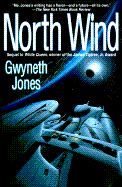 North Wind is told from two main viewpoints. Sid is a human liaison to the Aleutians – the aliens. Bella, also known as Goodlooking, or the librarian, is an invalid Aleutian. Their experiences of the world are very different: because of their expectations of gender, because of their expectations of humanity, because of their expectations of family and other social interactions. Their interactions with each other are immensely complicated for all of these same reasons, and because of the circumstances in which they find themselves.
This novel could have been relatively straightforward. It’s an attempt to figure out what is indeed a complex problem, but the actual events along the way are not that Byzantine.
Jones, however, was not interested in writing a relatively straightforward novel. And that’s perfectly fine; just don’t expect it to be one. Because Jones used this novel to explore concepts of gender, in particular, in detail and in complexity that you don’t often get in novel form. Not from widely popular novels that get nominated for the Clarke Award (in 1995) necessarily, anyway. The Aleutians have a very different concept of gender from most of humanity, and the intersection between the two species’ expectations and lived experiences highlight, in particular, humanity’s limitations.
I found this a difficult book to read partly because of the switching of pronouns, which takes some getting used to; partly because Jones uses narrative ellipses to imply things and sometimes I wasn’t fast enough on the uptake. Probably I missed some subtleties from not finishing White Queen (like the issue with Johnny, but that is eventually explained). It’s a clever book, and it’s an important book, and I want to say it’s an ambitious book but so often that phrase gets used in a condescending tone and I really don’t mean it like that. I really mean that Jones is doing ambitious and difficult and passionate things. But… I didn’t love it. I think it was too difficult for me. I won’t be rushing out for Phoenix Cafe, the third in the series. Which makes me a bit sad because I had intended to read all of Gwyneth Jones’ work, but I don’t have to like everything, I’ve decided.
Yet another book off the TBR shelf! Go me!
Hardwired
I don’t think I’ve read a Walter Jon Williams novel before. I’ve read some of his short stories, in anthologies, and generally loved them. Pretty sure I got this novel from Better World Books because it was in the bargain pile and I thought it would be an interesting enough place to start reading his work. Plus, I suspect I was in a cyberpunk zone.
ETA: No, I am stupid. Of course I have read other Williams books… This is Not a Game, AND Deep State, and The Fourth Wall. I can’t believe I forgot that.
It’s a good thing I have read other stuff by him in the past.
 It’s not a bad book. I did finish it. But it’s definitely not a great book, and I’ll be more circumspect in what I choose to read of his in future. Probably I will ask Jonathan for recommendations. A couple of reviewers over on Goodreads suggested that this was an example of style over substance, and that this was Williams trying to be William Gibson. The former I agreed with, by about halfway through; the second I disagree with, although I haven’t read Gibson’s complete cyberpunk oeuvre so perhaps I can’t entirely make that decision.
Style over substance: there are some lovely, almost lyrical passages in this novel. There are some amusing and clever descriptive passages. There are some that are just a bit silly, though, and seem like evidence either of Williams trying a bit too hard or the editor not trying hard enough.
William Gibson: keeping in mind it’s been a while since I read Neuromancer etc, I think there’s a different aesthetic at work here, and a different use for technology. Williams has tech for a purpose, and that’s why it exists. Even the character who loves the tech and most lives for it loves what it allows him to do, and feel – being a pilot. My memory of Gibson is that the technology is a bit more… pure is the wrong word, but perhaps abstract? Good for doing stuff, but that’s not it’s sole purpose. Those who are more familiar with Gibson, feel free to correct! (This reminds me that I really, really must read them again/finish the series (pl) that I have started…).
This is a world where orbital communities are doing nasty things to the dirt-siders, along the lines of controlling their economy and doling out important things like drugs (… the medicinal ones and the ‘medicinal’ ones). Well, I say ‘dirt-siders’; I really mean ‘people living in the former USA’, because as far as I can tell the rest of the world just doesn’t exist for this novel. Just a little thing those of us outside of the USA notice. Anyway, it’s the former USA because it’s all been divided up for various reasons that I’m sure have more resonance with people who have an actual grip on USAn geography and history (i.e. not me).
The novel is told from two perspectives: Cowboy is a pilot who lives to fly but has been grounded by the dangers of doing so – because he mostly flies on illicit ‘pony express’-type runs. Well, he’s been grounded, but he still gets to do his runs in a panzer. I was a bit dozy while reading the start because it took me ages to realise that meant he was crashing across continental US in a tank. The other perspective is provided by Sarah, whose childhood was seriously screwed up and who will do most anything to raise the serious money needed to get a better life, including radical body mods and very dangerous work. Cowboy and Sarah’s stories collide, mesh, separate and do reasonably interesting things. Intertwined throughout are advertisements for various companies – mostly for body mods or drugs – and the occasional news heading. I don’t think this is something invented by Williams, but when it’s done well (and I think it is here) I really like it as a style.
Cowboy and Sarah are both interesting enough, but I didn’t really engage with either of them. They were both too distant. Cowboy’s monomania about flying – even when it begins to get tempered by a developing conscience – prevented me from clicking with him. I thought he was pretty consistent, though, and could appreciate that. Sarah didn’t really work overall. Her concern for her brother, especially, felt out of place with the rest of her attitudes. I have no doubt it’s possible for a cynical, pessimistic person to care as deeply for a family member as Sarah is shown to – but I didn’t buy it here. Especially given what it ends up costing her.
The plot itself is fast-paced enough that I kept reading; there were some nice twists, although nothing completely unexpected. I don’t remember anything that made me want to throw the book away, so that’s faint praise but praise nonetheless. Not one I’m recommending to anyone but a hardcore Williams or cyberpunk fan.
A Pursuit of Miracles
I’ve had this book sitting on my shelf I think since AussieCon 4, in 2010. Oops. And I don’t think I realised it was a set of short stories, otherwise I probably would have read it earlier. Yup. Oops. Still – another book off the TBR pile!
So. George Turner. I’ve never read anything by Turner before. I’ve heard his name a bit, from those who were active in Australian SF in the 1980s, but… that’s not me. So now I get to actually have an opinion! And that opinion is… he’s not bad. Not my new favourite author, and perhaps the shorts aren’t his best work – hopefully someone will tell me? – but these are solidly intriguing, sometimes deeply engrossing, stories. The introduction has it right, too: many of his protagonists are quite aggressive, which gives the entire collection a certain pugnacious feel.
“A Pursuit of Miracles” is ostensibly about the experimental pursuit of telepathy. However this is really just am excuse to meditate on what might happen in and with a society that believes itself to be living in the Age of Miracles – that this might give scientists leeway to do what they like, such as experimenting on humans and calling them not humans. The discussion about how dreadful telepathy or telempathy would be is indeed insightful.
“Not in front of the children” is hilarious as a rumination on generational divide. The question about whether people would actually want to associate with previous generations if they were all alive at the same time is, again, insightful, and Turner is really very funny in suggesting how the generations would distinguish themselves. I can’t help bit wonder if Turner had grandchildren when he wrote this.
“Feedback” is the story I am most indifferent towards. A discussion of solipsism is not my thing, and the use of the term “Abo woman” stung.
No wait, “Shut the door when you go out.” This one I really didn’t care for.
“On the Nursery Floor” is the most intriguing from the point of view of form – a series of interviews with occasional journalistic interventions. The idea is one of investigating the consequence of meddling with intelligence. This is a more severe version of Brian Caswell’s Cage of Butterflies, and very clever.
“In a Petrie Dish Upstairs” is, of the stories that seem at least vaguely plausible (I exclude “Feedback” and “Shut the door”), the least sensible. The idea that three generations – fewer, in fact – would be enough to change a society separated by distance if not entirely psychologically is unlikely. Obviously it’s a thought experiment to some degree, but that timing aspect got to me. The other bits, though – how women might be considered, the politics, the concept of Ethics, the change in language – were clever enough to make it worth reading.
“Generation Gap” is silly.
The final story uses a few different narrators – including an astonishing but, on reflection, entirely believable reversal – to tell a story that, in close up, is about the destruction of a family and one boy’s bid not to slide into ignominy. On a larger scale, this is a terrifying view of the implications of climate change on society, and it’s very, very ugly. A fine conclusion to the collection.

 Randomly Yours, Alex