Crowd funding
1. Twelfth Planet Press is running a Pozible campaign to get a new anthology off the ground. Edited by Alisa Krasnostein (one of the voices of Galactic Suburbia; the other one, Tansy, is already writing her story…) and Julia Rios, this is a really awesome anthology: the idea is that (to quote them):
The main characters in Kaleidoscope stories will be part of the QUILTBAG, neuro-diverse, disabled, from non-Western cultures, people of color, or in some other way not the typical straight, white, cis-gendered, able-bodied characters we see all over the place.
Please consider contributing if you can – and either way, spread the word! I’m tardy in posting this, so there’s just 12 days to go (closes 31 October), and they’re not quite halfway yet. Halfway to what? $12000 will allow them to pay pro-rates AND publish the book AND do all the other rewards stuff. That’s not a lot for a whole lot of brilliant. If you need more convincing, they’ve already got three names to the anthology: Ken Liu (!!!), Sofia Samatar, and Jim C Hines. Magnificent.
2. A Kickstarter that I backed ages ago is now live! Mothership: Tales from Afrofuturism and Beyond (that link takes you to Fishpond) is an anthology that does just what it says; wrenches the future from overly white, American hands and puts it into more ethnically diverse ones. My copy came with a mixtape, and when George Clinton’s dulcet tones announced “ah-good evening” as the first track… well, I admit that I squealed a little with joy. Watch this space for a review!
Galactic Suburbia 89
 In which we recommend books to buy as presents, books we love, books we made, and basically BOOKS BOOKS BOOKS. You can get us from iTunes or at Galactic Suburbia.
Alisa’s picks: 2012; Trucksong; A Trifle Dead; Rosaleen Love’s Twelve Planets collection; the entire Twelve Planets suite (get them while they look the same! especially Love & Romanpunk)
Alex’s picks: Temeraire by Naomi Novik; Ocean at the End of the Lane by Neil Gaiman; Shades of Milk and Honey by Mary Robinette Kowal; Left Hand of Darkness by Ursula Le Guin; House of Suns by Alistair Reynolds
Tansy’s picks: Glitter and Mayhem; Chicks Unravel Time; The Wife in Space; The Worst Witch books by Jill Murphy; Creature Court trilogy (Power and Majesty)
Culture Consumed:
Alex: Reap the Wild Wind, Julie Czerneda; Ocean at the End of the Lane, Neil Gaiman
Tansy: Flying Higher eds by Michael Damian Thomas & Shira Lipkin [download free from Smashwords], Doctor Who: Prisoners of Time 1-4, Supurbia by Grace Randolph, Elizabeth Sladen the Autobiography, The She-Hulk Diaries by Marta Acosta
Alisa: Glamour in Glass, Mary Robinette Kowal
BLATANT PLUG: Songs For Europe, two short plays about Eurovision & war by John Richards of Splendid Chaps & Lee Zachariah of the Bazura Project on this week only as part of the Melbourne Fringe.
Please send feedback to us at galacticsuburbia@gmail.com, follow us on Twitter at @galacticsuburbs, check out Galactic Suburbia Podcast on Facebook and don’t forget to leave a review on iTunes if you love us!
Reap the Wild Wind

I read this thanks to a recommendation from Helen Merrick, who I seem to recall being a massive Czerneda fan. I understand that this is a prequel series, written after the world in question becomes part of a wider galactic network. Not having read the later books, I can’t say how an already-fan would respond; but I imagine there are some awesome moments of filling-in-gaps. Because it is indeed a wonderful novel, and I do fully intend to go and find the rest of the trilogy, and probably the later series as well.
Told mostly from the adolescent (unChosen, in the parlance of her people) Aryl’s point of view, this is a story of a world that – as far as Aryl is concerned – is entirely static, as it should be. One of the characters comments on Aryl and her people living in an eternal ‘now’ – and although that’s not entirely fair, because their lives do revolve around the season of harvest, it does make sense because their knowledge of history and their expectations for the future are exceptionally limited. But this is not, overall, a bad thing: Aryl’s family and friends live full, rich and generally rewarding lives. Without interference – and of course you know there’s going to be interference – the Yena live.
Aryl lives on Cersi, a world that is home to three different sentient species. Aryl is of the Om’ray, human-types who live in Clans in disparate parts of the world and who rarely interact with each other except when one of the boys leaves on Passage, drawn by a woman who has become sexually mature (there’s some mental communication stuff which makes this basically make sense). The Oud and the Tikitik are not humaniform, and they are more technologically advanced than the Om’ray – they swap the Om’ray for some things in exchange for technology. The Agreement is meant to guarantee stability (if not stagnation) between the three. But then things change – strangers come. And strangers are not accommodated within the Agreement, which sets off all sorts of problems between the species, and within them as well.
There’s a lot of things going on within this book. Biological sexuality is not something that develops in Om’ray but seems to basically be on or off, which is intriguing and means that sexual tension isn’t really an issue (well, it is at one point, but it doesn’t overwhelm the whole story); issues of difference, and allowances for degrees of difference, are central to the Om’ray story and whether Aryl can be truly part of her Clan. In sweeping terms this is both a coming-of-age story, for Aryl, and also a first-contact story – and that part I think is done very well done, because it’s neither entirely positive nor entirely negative. Part of the story is told from the perspective of a boy from a different Clan, and this allows Czerneda to show the different perspectives of the Om’ray themselves, within their general similarities.
I think this counts as science fiction, because the strangers are aliens and there are issues of technology etc. It includes elements of fantasy, too, which I think work nicely within the story as a whole.
Reap the Wild Wind is well-paced, with an intriguing world and winsome POV characters. Very enjoyable.
You can get Reap the Wild Wind from Fishpond.
Adventures of Alyx
No, I did not misspell my own name (although someone at work did yesterday…) – Joanna Russ called her character Alyx, and I have finally read the collection of four short stories + one novella about said adventurer.
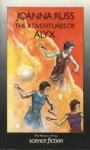
The thing you have to know about Alyx is that although the name stays the same, and some aspects of the character remain the same, trying to establish an internal chronology for these stories is likely to bust your brain. It doesn’t work, and it doesn’t have to work. Maybe it’s the same woman, maybe she’s a time traveller, maybe the name lends certain characteristics (like Julias in Tansy Rayner Roberts’ Love and Romanpunk) … or maybe Russ is playing, and it actually doesn’t matter. Although once you accept that it doesn’t necessarily work, making connections is a lot of fun.
These stories are different genre, with different approaches to narrative – what makes a narrative – so don’t go in expecting a cohesive whole. Of course, it is a whole in that Russ is doing confronting things with her female character: making her the lead, and not making romance important, and exploring reactions to women. That’s still a bold thing to do, and my edition of these stories was published in 1983; they originally came out between 1967 and 1970. I really wish I was alive to experience Russ As She Happened. And it makes me wonder who, if anyone, fills a similar niche today – and whether I am completely missing their stuff, for whatever reason.
I feel like a barbarian myself to admit that I did not love the first two stories. In fact, it took me ages to get through this slim volume because I was so not in love with the first one, and then the second, that I was worried I wouldn’t enjoy the rest. I persevered though, partly from an admittedly perverse desire to be able to say that I had read it, and partly because I knew that the stories changed up so I was hoping that I would come across stories more to my taste later on. And I did. Some of what comes below is my analysis of my own reactions to the stories, rather than a pure review. This might be dismissed as navel gazing; for me, it’s a way of working out how I work with Joanna Russ, such a powerful influence over what I’m interested in.
“Bluestocking” begins in a very self-deprecating way – “This is the tale of a voyage that is on interest only as it concerns the doings of one small, gray-eyed woman.” Not a great start? It gets subversive within moments, though, suggesting that the first man was created from the sixth finger of the left hand of the first woman… but our lady, Alyx, has all six fingers. Alyx is a pickpocket; she gets hired to look after a spoiled young woman. Then there are adventures, of a sort. There’s travelling, and bickering, and a sword fight. It is also supremely brief. I’m not sure whether it was that aspect that most didn’t work for me, but it certainly contributed – I found this story quite frustrating, with all its lacunae and its teasing and… something. “I Thought she was Afeard till she stroked by Beard” worked similarly on me. In this case, Alyx escapes an unhappy marriage; gets on board a ship and has a complex relationship with the captain; and is frustrated by the place of women in the world. I think it’s clever, but for mine there’s just not enough.
I should say at this point that there is more going on here than ‘just’ a narrative, especially in narrative connections; I know Russ is addressing Fritz Lieber, and others. I haven’t read any Lieber. Perhaps this is a fault in me, and the stories would be greatly improved with that background knowledge. But I know Terry Pratchett riffs off Lieber too, and I enjoy those stories; I know Mieville and Reynolds are riffing off others, but I still enjoy theirs too. So… perhaps it’s ok that I don’t enjoy all of Russ’ work? Maybe?
“The Barbarian” is a story that Gary Wolfe, in his essay in On Joanna Russ (… I think?? eep maybe I’m wrong…) suggests is the switch for Alyx between fantasy and SF, which is an intriguing way of seeing it. Here Alyx is again a crim-for-hire, but she doesn’t like what she’s hired to do and things go downhill from there. For me as a reader, though, things started going up. This story appealed more, although I’m not sure why. Maybe it’s a simpler story but with more flesh, more detail?
Then – next – oh, delight: “Picnic on Paradise.” This was originally published alone, as a novel; I guess it’s a novella, by today’s standards? 90 pages in my little pocketbook edition. Alyx, a Trans-Temporal Agent brought from the ancient Mediterranean world to both the future and a different planet. She’s being used to guide a disparate group of tourists across a war-ravaged planet, to keep them safe in the most horrific of circumstances: no access to their technology. There’s an incredibly profound moment at the start, where one of the women asks why Alyx is “covered up” – wearing clothes. So Alyx takes off her shift, therefore mimicking those around her, which group promptly have apoplexy. Alyx is confused, naturally; one of them says that she is wearing her history, which they are not used to. This goes a long way to demonstrating some of the rather large differences between Alyx and her charges. The story is a straightforward one of flight, and fighting for survival: getting lost, getting hungry, literally fighting (nature, each other, etc). It’s Russ, and having read We Who Are About To… I wasn’t surprised that things do not go according to plan, in a drastic way. One of the remarkable aspects is, of course, that the leader is a woman. Making the hard decisions, being contemptuous, fighting – being well-rounded. The tourists are a motley bunch: nuns, macho men, wannabe robots, high-society ladies. They too have their chance to be well-rounded, to interact especially with Alyx but also each other. This isn’t a fun story but it’s a great story, an intriguing one, and one I am so pleased to have read.
The final story in the set is a difficult one in terms of “Alyx canon,” the idea of which I rather suggest Russ would either have rolled her eyes or laughed at. Because Alyx probably isn’t in it. Her descendants might be, but if you read this by itself you wouldn’t have a clue about her. It’s also frustrating me because I know I have read it – “The Second Inquisition” – before, but I don’t know where. Some anthology, some time. Anyway… this too is science fiction, focussed on a young girl whose family is hosting a very odd stranger, who leads the girl in all sorts of directions: physically, introducing her to other, even more strange people; intellectually, introducing her to books and ideas she has never encountered; and culturally, challenging a whole bunch of assumptions within the family and society more broadly. There’s also questions about reality and imagination going on here that I think I missed the first time through. Intriguingly I think this gets a little close to the ‘galactic suburbia’ stories that Russ dismissed, since the focus is very much a suburban home with the occasional break-in of the science fictional. At any rate it certainly makes a challenging and difficult-in-a-good-way conclusion to the collection, because it doesn’t fit neatly into Alyx’s adventures. Which is as it should be, because Alyx – as a woman and as a character – doesn’t fit anywhere comfortably either. And she wouldn’t want to.
An Aura of Familiarity
I hadn’t heard of the Institute for the Future until I found out about the short anthology they put out recently, called An Aura of Familiarity: Visions from the Coming Age of Networked Matter. The point of it is to explore, in science fiction, the possibilities of a human future that is even more hyper-connected than it is today. I’m delighted by the idea of such an institute existing at all, and the fact that they are calling on creative types to offer their perspectives.
This is a lovely-looking book, even in digital format; the pictures throughout, contributed by Daniel Martin Diaz, are fascinating – I’d love prints of them.
Rudy Rucker starts the anthology with “Apricot Lane.” In this version of the networked future, every single item you buy has the ability to speak to your brain – and not just to advertise themselves, but telling you anything they feel like. Not only does this vision of connecting suggest hyperconnection with your belongings (and others’), but the lack of privacy suggested is also staggering. It’s a clever concept, and a horrendous one; I didn’t love the narrative itself though.
“Lich House,” by Warren Ellis, is horrifying in a different way: here, someone has managed to get into a house that ought to be impregnable, and attack the occupant. The ‘getting in’ has involved essentially killing the house, and most of the narrative is actually taken up with the dying of the house, in rather gruesome detail. So, it’s a clever idea – and again a clever vision of connection – but don’t read it for the narrative; it’s a vignette not a story.
Ramez Naam’s “Water” focuses particularly on the commodification of water, although other consumables are also networked and able to advertise directly to your brain (you can turn the ads off, but that costs a lot more). The opening of the story is, again, horrifying – showing how someone might massage the ads you receive to their benefit (this is of course not so far removed from your internet experience today). But the majority of the story is actually about how this networking might be manipulated for economic gain. This is the most interesting story of the first half of the anthology.
Madeline Ashby, the only woman in the anthology, contributes “Social Services” – and, again, showing a theme, this is an intensely creepy story. The networked matter is important to the story but not vital. The point, instead, is in how people manipulate one another and the consequences of that.
“From Beyond the Coming Age of Networked Matter,” by Bruce Sterling – one of the early lights of cyberpunk – takes the idea of networking matter to an extreme and vaguely Lovecraftian end. Disappointingly, it’s the least interesting story.
The final story is from Cory Doctorow. “By His Things will You Know Him” just pips “Water” as my favourite. It’s a close, deliberately claustrophobic story: a man whose estranged father, a hoarder, has recently died – and he has to deal with his effects. The funeral director introduces him to a new programme that will catalogue everything using clever new intelligent devices. Doctorow cleverly entwines the story of grief and the story of obsession; the idea of ‘networked matter’ is fundamental to the narrative but does not dominate, as in some of the others here. It’s a wonderful story that could easily appear in a different setting and still make sense.
Galactic Suburbia 85
In which we talk about gender stuff in publishing and gaming, Alex votes in the Hugos and Alisa’s thesis starts coming together. A good week! You can get us from iTunes or over at Galactic Suburbia.
Caught Our Eye
Sexism in genre publishing: A Publisher’s Perspective
JK Rowling and Robert Galbraith – An Open Letter to Writers & Would Be Writers
The Mary Sue & gaming culture: What we aren’t talking about when we talk about inclusion and representation, and what we are
Culture Consumed:
Alex: Hugo reading (novellas and novelettes)
Alisa: Publishing and Reading as Dissent: Resistance, Literary Tourism and Arsenal Press, Casey Stepaniuk (The Word Hoard Vol 1, Issue 1)
Tansy: Alanna the First Adventure by Tamora Pierce, All-New X-Men: Yesterday’s X-Men, Brian Michael Bendis & Stuart Immonen; Red Sonja #1 by Gail Simone; Much Ado About Nothing!
The Galactic Suburbia Road Trip – we have fun over at the SF Signal Mind Meld!
Tansy’s review of The Other Half of the Sky is up at the Cascadia Subduction Zone.
Kaaron Warren won a Shirley Jackson for “Sky”!
Please send feedback to us at galacticsuburbia@gmail.com, follow us on Twitter at @galacticsuburbs, check out Galactic Suburbia Podcast on Facebook and don’t forget to leave a review on iTunes if you love us!
Some Hugo thoughts
I’ve been doing reading towards voting in the Hugo Awards, so these are some thoughts on what I’ve read recently – all in the shorter fiction categories:
Novelettes
“Fade to White,” Catherynne M Valente (Clarkesworld, August 2012) – DAMN, man. This novelette is astonishing. Non-linear structure, with advertising copy complete with snarky editorial commentary interspersed throughout the stories of two adolescents living in a post-WW2 alternative America: alternative because things have clearly gone from defeating Germany straight to Hot War with Russia, and that war has come to American soil. Not only is this a fascinating and chilling look at the repercussions for adolescents growing up in such a world, it’s also a frightening and perceptive look at how gender and race issues might play out, too, in an America so threatened. A bit like Handmaid’s Tale in that respect. I should have talked about this one last because much as I liked Pat Cadigan’s “The Girl-Thing who Went out for Sushi” (Edge of Infinity), I think this gets my vote.
“The Boy Who Cast No Shadow”, Thomas Olde Heuvelt (Postscripts: Unfit For Eden, PS Publications) – a really lovely story. One of those stories that uses a fantastical idea but makes it normal (well, ish) in the society: in this case, a boy made of glass. The eponymous character is regarded as a freak for having no shadow; the two form a friendship based on their bizarreness. This is poignant and lovely; I’m very happy I got to read it
“In Sea-Salt Tears”, Seanan McGuire (Self-published) – I read the first October Daye book and was completely unimpressed. I had no idea that this was connected to that series until I saw someone mention it on Goodreads. So, with no background at all, I actually really liked this story. Selkie stories are so hot right now (and it’s pretty funny reading this after recently reading Sofia Samatar’s “Selkie Stories are for Losers,” which I adored) – this one felt like it did something a bit new with the mythology, which I enjoyed.
“Rat-Catcher”, Seanan McGuire ( A Fantasy Medley 2, Subterranean). Meh. Cat-fae in 1660s London.
Novellas
After the Fall, Before the Fall, During the Fall, Nancy Kress (Tachyon Publications) – totally my pick. Again with the non-linear structure, as the title suggests. Bits of the story happen in a world recognisably our own where one of the main characters is trying to figure out a series of kidnappings. Bits of it happen in a very weird future world where some cataclysm has occurred and a small remnant population is trying to get on with. And there’s a bit during the fall as well, of course… and by that stage everything has started to come together, and both of the main characters really make sense and are utterly captivating. Very, very nice.
The Emperor’s Soul, Brandon Sanderson (Tachyon Publications) – haven’t managed to finish it yet. Possibly shouldn’t therefore comment.
On a Red Station, Drifting, Aliette de Bodard (Immersion Press) – I don’t know anything about this universe of de Bodard’s, so I have no idea whether I’ve missed important character references or whatever. Nonetheless the story was highly engaging, and made basic sense – war isn’t hard to understand, and the repercussions for refugees are of course familiar. The intricacies of family entanglements are taking to an extreme and fine degree, but again the basic notion isn’t hard to grasp. It’s beautifully written and very absorbing.
San Diego 2014: The Last Stand of the California Browncoats, Mira Grant (Orbit) – have not read, won’t bother because I haven’t read the Newsflesh series (and don’t like zombies).
“The Stars Do Not Lie”, Jay Lake (Asimov’s, Oct-Nov 2012) – interesting idea. Would have been a whole lot better if it wasn’t transparently a Galileo/scientists in general vs Catholic Church story, with little effort to develop an interesting take on the religion.
So, for what it’s worth – those are some of my thoughts!
The Eternal Flame
The following will include spoilers for The Clockwork Rocket, which I discussed over here.
A universe where parts of the spectrum of light travel at different speeds. A race where mothers cannot exist. Vector diagrams. They’re overused, but I’ll use them anyway: Egan is nothing if not ambitious and audacious.
 A warning: the same issues that pertained to Clockwork crop up here. It is most definitely not a book that will work for everyone. You have to fall within a fairly specific range of readers: either someone who really enjoys thinking about physics and won’t be weirded out by the bizarre physics Egan is working through here; OR someone who is willing to skim over the vector diagrams and other physics-lecture bits, and just enjoy the story. Personally, I’m the latter. And the only reason I was willing and able to push through the physics was because I trust Egan to give me a really worthwhile story between, or around, it. I kind of imagined that I was listening to a really, really interesting person who occasionally meandered into talking about stuff I didn’t get, but was bound to get back to the good stuff eventually. And I was right.
The point of the Orthogonal series is to explore two central ideas: how the universe might be different if the speed of light isn’t constant; and how society might be different if mothers didn’t exist – or rather, they cease to exist at the point of childbirth. The story revolves around these two issues, and does so in occasionally remarkable ways. The physics aspect is very much an intellectual exercise; if there is commentary on modern science, aside from the obvious bureaucracy-getting-in-the-way, I missed it through not understanding enough of it. The biological/social aspect, though, includes a huge amount of commentary on modern Western gender relations, and it’s confronting, frightening, and sometimes scathing. I loved it.
Clockwork ended with a crew aboard the Peerless – a mountain launched into space – setting out with the objective of experimenting and thus hoping to find a solution to the probable destruction of their home world by an oncoming storm of meteors. This is only possible because of the different way light and time work in their universe; by moving away and then retuning home, much more time will have passed for them than on the planet. Because of the discoveries and attitudes, I’ve seen this book described as mirroring the Newtonian/seventeenth century European scientific revolution, which I think makes some sense but I wouldn’t push it too far. Along with the very pressing problem of saving the world, the crew carry in their bodies another issue – an issue that was only just being recognised as an issue: the fact that a mother’s flesh splits into her (usually four) children at ‘birth’. Mixing up the historical periods, this might be seen as somewhat comparable to the long period between Mary Wollstonecraft (late eighteenth century) and the suffrage movement of the early twentieth century (…. would that make Yalda both Ada Lovelace and Millicent Fawcett?? I 
 am loving this idea, daft as it is). Women are starting to think that there might be alternatives to simply living with their co and eventually becoming their children.*
To continue this intriguing historical comparison, Eternal Flame is scientifically moving into an Einstein/Hubble frame of thinking, and socially (I can’t believe the gall of this sentence) into the second-wave feminism of the 1970s (I wish there was an author in the story that I could tag as Joanna Russ, but there’s not). In physics, in particular, there are astounding discoveries being made about the properties of light and heat which are beginning to have profound ramifications for how they think about solving their problem (problems actually, since they also left their planet with no way of getting back with the solution…). Socially, the crew has pretty much always accepted women as being just as worthy in science and other jobs as their male counterparts – not least because many of the crew, especially in the sciences, were women. However, biology is still an issue. The original women used a drug, holin, in order to delay the onset of fission (birth). By this stage – three generations later – still use holin but are also basically starving themselves, for two reasons: both to delay birth, and in the hope that their fission will result in two, rather than four, children. Because the Peerless has experienced a population explosion, and they cannot support every pair becoming five. So (to get back to my comparison), the right of a woman to decide when to have children is one of the big issues – as it was with the introduction of the pill and the controversy over abortion (which I know is still ongoing).**
There are three narrative strands going on here, which frequently intersect but deal with different issues for the ship. I assume they’re meant to be of equal importance, but I’ll be honest and say the one that dealt the most with pretty full-on physics definitely took a bit of a backseat for me, even though I could see how vital it was to the story’s point. Carlo is investigating biology and fertility; both the fact that animals appear to exchange information somehow via infrared… something… and the fact that some animals seem to have adapted to biparous fission very easily. Tamara is an astronomer who observes a massive object outside in the void, and develops an audacious plan to use it somehow. Carla, a physicist, is investigating the properties of light and energy and challenging a lot of preconceived notions in the process.
The novel as a whole does involve a lot of physics-lecture stuff. There really are a lot of vector diagrams, and graphs demonstrating energy levels, and… other things. The biology doesn’t get quite the same treatment, perhaps because it’s not quite so radically different from our world. However, the science is not the be-all of the novel – if it had been I probably wouldn’t have persevered. There’s a bit of action, with an excursion out to the Object Tamara observed and some other dangerous moments for characters I had grown fond of. There’s some great character development, in particular as different people consider the biology issues for themselves and reflect on what it means for them individually and as a society; a few make very surprising decisions that are nonetheless entirely consistent. Being set on a spaceship, large as it is, means that the story is necessarily constrained; keeping the focus on three main protagonists helps with it not feeling claustrophobic but rather focussed, which is also aided by making them active in such different spheres. The physics and biology dominate, as discussed; there are also undercurrents of the frustrations of bureaucracy and the impact of history – after all, this is a generation of people working towards solving a problem for a world they have never known.
If you want to be read a science fiction series that will really challenge you scientifically while also (largely) being very readable, coming complete with a compelling storyline, this is it.
You can get The Eternal Flame at Fishpond.
*I’m well aware that this is grossly unfair and generalising to the women before Wollstonecraft, and in fact Egan does not make it nearly so clear-cut; as with real European history, there have always been women who bucked the trend in this world, too.
**I have no idea where Egan could go with this historical comparison for the next book. Still, it was fun while it lasted.***
***I’m not suggesting Egan did this deliberately. I’m quite sure he didn’t.
Abaddon’s Gate

HOOOORAAAAAAAAY.
(Some spoilers below for Leviathan Wakes and Caliban’s War. READ THEM.)
The last line of Caliban’s War was an absolute killer, because I read it when it was first published which meant that the next book was about a year away and GOODNESS ME it was a cliffhanger. So I preordered this as soon as I could and happily, it arrived about a week before I went on holidays. I very carefully put it on a shelf where it wasn’t tempting me to read it… and then this week, on holidays, I cracked it open and devoured it in one day. And it was worth the wait. Oh yes. Thank you, James Corey.*
At the end of Caliban’s War, the protomolecule has been doing weird things on Venus, the Mao-Kwik company has been busted for attempting to weaponise it, and Miller – who died, going with the protomolecule to Venus – has just appeared to James Holden, who has once again (somewhat accidentally) been fundamental to saving the universe (well, the solar system). The conclusion to the series has the protomolecule and its… construction project… out near Uranus’ orbit (it’s basically gone on its own little Grand Tour of the system… and now I’m imagining the Ring being made out of Lego. Oops). Earth and Mars are once again sitting in an uneasy truce with each other, with the Outer Planets Alliance (OPA) not sure where it fits. Meanwhile James Holden is almost happy with his crew (but we all know that won’t last)…. While some of the early story takes place on-planet (or moon), most of it happens on board space ships of varying sizes, which is a big change from the earlier two where Earth and Ganymede in particular played important roles. Much of it also happens a significant time-delay away from official decision-making bodies, highlighting the issues of merely light-speed communication when people are many light-hours apart.
As with the first two books, this is told from multiple perspectives. The only one that is continuous across the three is Holden, master of the Rocinante (and OH! I just GOT the name, in making sure I was spelling it correctly. Don Quixote’s horse!!) and generally known across the solar system as a truth-telling, occasionally annoying, bad-ass. I love Holden. He is far from perfect, but he does the very best he can by his crew – who have, as a group, come a delightfully long way from their dysfunctional beginnings in Leviathan. (They’re still somewhat dysfunctional as individuals, but they work exceptionally well as a team.) He’s finally it together properly with Naomi, he’s getting good above-board work to keep the ship flying (… hmmm. It now occurs to me that there are some distinct similarities between Holden and Malcolm Reynolds. Huh.), and he really is trying to leave his solar-system-shaking days behind him. Honest. The fact that Miller – ghost? or something? – keeps bugging him… well, that’s a sign he’d rather ignore. Pity we all know that’s not going to work.
There are three other narrative streams, and (as with the other books) they have distinctly different parts to play in the story. Melba – not her real name – has one driving ambition, and it is not a nice one. Hers is a really interesting exploration of how an individual impacts on wider events. Holden’s story does, too, except that the way he impacts on wider events is usually accidental – or at least begins that way, as he is driven to bigger events, all to get back to his nice comfortable leave-me-alone life. Melba, though, doesn’t really care what impact she has on other people as long as her goal is achieved. Her development over the novel is the greatest of any character – or perhaps it just seems that way as the reader gets deeper into her head over the course of it.
Melba’s opposite in many ways is Anna, a Methodist minister who’s been out on a Jovian moon with her wife and daughter for two years. Let me say here that one of the most awesome things about this story is the way it takes religion seriously, and as a genuine force to be considered in medium-term science fiction. The religious figures are not perfect, and nor should they be – Corey is representing humanity in its fullness here. But Anna has conversations about the spiritual impact of the protomolecule’s existence, about what it means if there are aliens for those who hold to Christianity (are they fallen, like humanity? if so, does that mean that Christ died for them?) – and that’s fine, that’s acceptable. I can’t express how happy it makes me to see religion acknowledged like that. Anyway – Anna ends up on a ship heading out to the Ring. She gets to play a really important role on a personal level with a lot of people, but she herself basically stays the same over the course of the events.
Fourthly, and acting in some ways as Holden’s opposite, is Bull. An Earther in service to the OPA because of the charisma of its leader, Fred Johnson, Bull is on board the OPA ship going to investigate the Ring as security chief. I really like Bull. He is honest about himself and his limits, he tries hard to get the job done, and he’s willing to take the consequences when they’re in service to a worthwhile cause. It was a small event concerning Bull that brought a tear to my eye, which is not something I expected in a grandiose space tale like this one. Bull has a very tough job, especially as an Earther in charge of a largely Belter (that is, people from the asteroid belt, not from Earth or Mars) crew.
This issue of racism is an intriguing one throughout the series. I think (in my whitey-white way, I hope) that Corey* has done a very good job of showing the colonisation of the solar system as a multi-ethnic business; there are a few lines where someone is described along the lines of “if he was from Earth, he’d be [X]; here, he was a Belter.” The names are a delightful mash of multiple European, Asian, and African backgrounds (maybe South American as well, but I have less familiarity there and can’t be sure to pick it up). Sadly, but realistically, there is still xenophobia – and it’s based largely on where you were born. Planetary birth? You’re a duster, to a Belter. Born in the asteroids or on a moon? You’re a skinny, to an Earth- or Mars-born. And given the political situation – two wars between Earth and Mars, the Outer Planetary Alliance only recently (and that sketchily) graduating from terrorist organisation – place of birth can still be seen as having a significant impact on your politics and views on a range of important issues, like who gets to be boss of the inner solar system. I think Corey does a very good job of showing these issues in a sympathetic, not condemning but not condoning, manner.
This is a brilliant end to an exciting series. There is action, there is drama; there are explosions and chases, personal confrontations as well as planetary ones. Women and men both play important roles, the solar system is not white, and James Holden finally find out what the hell Miller wants with him.
You can get Abaddon’s Gate from Fishpond.
*Yes, I know that James Corey is actually two people.
Iain M Banks, The Hydrogen Sonata, and musings

I read this a long time ago now. It’s been sitting on my shelf at first glaring at me to review it, then looking at me sullenly, and more recently not even bothering to meet me eyes. The reason it’s taken me so long to write anything? I guess partly there was a lot I wanted to say – much of which I have now forgotten, to my chagrin, but it does kinda make a review easier to write. Partly, so many other people have written about it that what could I possibly offer? Not much, really. So why am I doing so now? Well, it was a review book so I would feel bad (… badder…) if I didn’t; and even if others have said these things more eloquently than I, at any rate I get some of my thoughts onto paper (… the screen…).
And now, well, Iain M Banks has died. I think Jonathan Strahan’s reflections say a lot; my own interactions are more recent, and don’t include any Iain Banks stuff (yet). So it feels both more pressing to record my thoughts, and less important. Anyway…
Many of the Culture novels talk about species which have Sublimed; moved on to another plane of existence, which isn’t heaven since it doesn’t exactly or necessarily involve death, but does mean that individuals or species no longer interact with the mundane, physical world. The suggestion is that Subliming is the apex of civilisation, what everyone should be aiming for personally and as a civilisation. As I write this I realise there’s a material/spiritual dichotomy going on here – not that Subliming is spiritual necessarily, but still that tension is present: that getting rid of the physical being is highly desirable. Interesting. This idea has never been the focus of a Culture novel… until now.
The Gzilt, as a collective, are going to Sublime. They’re doing the civilisation-level equivalent of writing their last will and testament, mostly attempting to leave their affairs in order, while some are having the end-of-the-world parties you expect if an asteroid is rapidly approaching. But of course, this is Banks. So things do not go smoothly; there is conflict over who will benefit from their departure (I’m reminded of a poem I read at school, “Where there’s a will there’s a sobbing relation”), and also over the very decision to Sublime. Not everything part of the narrative appears to impact of the Gzilt directly, at first – there are multiple narrative threads going on – but of course they all get tied up eventually. Mostly, quite nicely, and sometimes in wonderfully sneaky ways.
I know some people have complained that this is bloated; that it could have done with some editing. It’s 517 pages, in the trade paperback; probably it could have been shorter, but hello let me introduce you to Patrick Rothfuss or George RR Martin – Banks had nothing on them. Which is not to say that he should be left alone, just that it could be worse! And I will admit that actually? I don’t mind the bloat when it comes from the hand of someone like Banks. (I will out myself here to say that yes, I enjoyed the ridiculous length of Harry Potter and the Order of the Phoenix, and I loved The Wise Man’s Fear. Sue me.) I never once got bored with what Banks was spinning. As the narratives went weird places and the threads appeared to be going in disparate directions, I went along for the ride because I had great faith – which proved worthy – that Banks would reel it all in and everything would have a point. Of course he probably didn’t need all the side alleys. But… so what? Part of me wants to say “if you don’t want to read a long book, don’t read it.” That’s not an entirely useful point of view, I know. And there are some books where even I can see that long meandering sidetracks do indeed detract from the story. For me, this isn’t one of them.
Overall? Fans of the Culture should get on with reading it if they haven’t already. Fans of serious mind-bending SF who haven’t read any Culture could start here, but I would probably recommend Use of Weapons or one of the other earlier ones first. It’s probably also not a great jumping on point for someone who’s never read SF before, although for someone with enough willingness it would be a wild ride…
You can get The Hydrogen Sonata from Fishpond.

 Randomly Yours, Alex