Among Others: not a review
A friend asked me about this book the other day. She knows that I am into the Hugos, and she had heard people on Triple J – a radio station branding itself as the ‘youth station’ – talking about this as having won Best Novel. She said they described it as basically Harry Potter.
I imagine my reaction looked pretty funny, because I just. I can’t even. What?
Yes, there is a boarding school involved in both; yes, there is magic (…maybe?) involved in both.
But still. What?
 Anyway. I loved this book. I read it so long ago that it seems a bit pointless writing anything that pretends to be a review, so I won’t – I just want to note down a few thoughts.
For all that I loved it, I did not love it as much as others. I know it resonated strongly for a lot of people because it reflected their own experiences, of The Discovery of Science Fiction especially. Mine it does not. Partly this is an age thing: Morwenna, the narrator, who tells this book via diary entries, is doing stuff on my birthday. I mean my actual birth day. So there’s that. More significantly though, it does not record my experience of discovering science fiction. In specific terms, I haven’t read most of the authors and titles Morwenna reports discovering (and there are a few I hadn’t even heard of) – I had to promise myself that I will read the novel a second time with pen in hand, to stop myself from feeling bad about not keeping a list of books to read as I read it the first time. In more general terms, this isn’t how I came to it. I started more with fantasy, and I was also reading a broader range of stuff, in my teens. I can remember one kid at my school with whom I shared an interest in speculative fiction, and we never talked about it. So… yeh. For me this reads as a fantasy both in magical terms (which I still think might not necessarily be real) but perhaps even more in the finding-of-like-minds aspects. Outside of cons (and sometimes even there, let’s be honest) I’ve rarely had the sort of experience Walton describes for Morwenna. It’d be nice though.
I really enjoyed Morwenna’s voice, and the novel worked especially well as a diary. She often sounds a bit older than she is, but I think the diary format explains that (as well as her somewhat precocious nature, and her voracious reading lending her an excellent vocabulary): it makes sense for someone like her to be experimenting with language in a private forum, and giving herself permission to push her imagination and storytelling to its fullest extent. I liked her ambiguity – about herself and in her attitudes towards her parents, friends, and school. She has very sensible reasons to be concerned on some of those fronts, especially about her mother, that do not translate to ‘real life’ – but the general feelings can, and do.
I admit that I am surprised that it won the Hugo, given its competition. Everyone seemed to think that GRRM had it sown up; in a year without that, I would have thought Mieville would win hands down, but then I adored Embassytown immensely so possibly I’m biased. But no: a book with a smattering of magic that is all about the discovery of SF and SF fandom won. I think that’s rather lovely, actually, and obviously also reflects the voters themselves… although what it says about them, I’m not willing to speculate.
We Who Are About to…
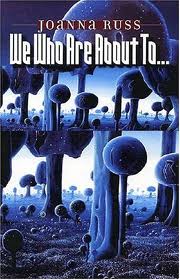 This is not an easy book to read. But it’s a Russ, so that’s not exactly a surprise, is it? She takes an SF trope – the idea that survivors of a crashed spaceship somehow colonise an uninhabited planet – and wreaks merry havoc.
This was apparently first published as two novellas (maybe even novelettes; the book is only 120 pages). By the end of the first half, all but one of the characters is dead. Surely the second half is going to show the sole remaining character that the planet is actually inhabited?
Yeah no. Not so much.
Told from the perspective of a woman who really doesn’t fit in with her fellow survivees, this is quite an uncomfortable read, for a lot of reasons. Firstly there’s the attitudes of each of the survivors: their entitlement, feelings of contempt, and the beginnings of a Lord of the Flies milieu. Then there’s the narrator herself, who while apparently more likeable – if only because the reader has insight into her thought processes – is still an uncompromising and actually rather difficult person to be around. And then there’s the plot, which is basically: crash; deal with each other; deal with being the only human on the planet. The end.
The other characters are very difficult to get your head around because we only see them from the narrator’s point of view, and for quite a limited amount of time. There’s a young girl, clearly spoiled and needy; her parents, who have all sorts of weird things going on with money and work and respectability that actually, when you deconstruct them, aren’t that weird and that makes it all the more uncomfortable (trophy spouse, use of marriage, etc). A jock in a universe that appears to have less use for such types, and a professor who appears to be the polar opposite and whose smugness speaks of all that’s wrong with academia. And two other women – quite different from each other, but sharing elements with our narrator, which makes her uncomfortable and serves to illuminate her character as the story progresses.
The narrator’s background is something of a jumble, which is unsurprising given that Russ writes much of the last half in almost a stream of consciousness. We learn a bit about her experimentation with niche religion and politics, a bit less about her relationships – platonic and sexual – and a bit more about her sheer determination in the face of difficulty. I don’t know that I liked her, but I certainly admired her.
The plot is definitely a secondary consideration here. While it is of extreme importance, because it’s the springboard for Russ’ investigation into character and because it’s an inversion of an SF trope, there’s so little to it (really taking place almost solely in the first half) that it must be secondary, I think. Which is not to suggest that it is poorly constructed or anything like that, of course. It’s confronting and minimal and all the more confronting for that.
This must have issued an important challenge to SF when first published – and still does, I think. It’s not easy, but it is worthwhile.
Galactic Suburbia 67
 In which we talk trolling, internet pile-ons and Twittiquette (it’s a word, right?) as well as Weird Tales, Analog, heavy metal, straight white YA dystopias and (this may shock you) Joanna Russ. You can get us from iTunes or from Galactic Suburbia.
News
Announcing the brand new Last Short Story podcast starring (so far) Jonathan and Mondy.
Tansy visits the Panel 2 Panel podcast to talk about comics with Kitty.
TPP event at Melbourne Writers Festival and Alisa’s Woman Achievers Award
Alisa’s report and Jason Nahrung‘s report.
The Weird Tales dramah:
Round up of links
Jeff VanderMeer’s take on it.
In happier news, Ann VanderMeer now editing at Tor.com
Stanley Schmidt steps down from Analog
When authors go bad (on social media) and reviewers get burned.
What Culture Have we Consumed?
Alisa: Glory in Death J D Robb; trying to read Matched by Ally Condie, Outer Alliance podcast on the lack of queerness in YA dystopias
Tansy: The Imaginarium of Doctor Parnassus; What Women Want by Nelly Thomas; Big Finish Audio – Invaders From Mars by Mark Gatiss & The Chimes of Midnight by Robert Shearman (2002)
Alex: Metal Evolution; We Who Are About to…, Joanna Russ; CSZ special on Joanna Russ; The Lost Books of the Odyssey, Zachary Mason
Please send feedback to us at galacticsuburbia@gmail.com, follow us on Twitter at @galacticsuburbs, check out Galactic Suburbia Podcast on Facebook and don’t forget to leave a review on iTunes if you love us!
Brian Caswell: Merryll and Butterflies
I don’t know how, but I had forgotten about Brian Caswell until my sister linked My Sister Sif with Merryll of the Stones, and I realised that NO nostalgic trip to early adolescence would be complete, for me, without him.
 Merryll of the Stones has time travel, romance, dragons and other mythical creatures, and Wales. Also tragedy, but romance. Old book, and romance… yeh yeh ok, I actually am a total sap. Have we not realised that yet? Whatever.
Megan’s parents are killed in a car crash; she wakes up from a coma speaking Welsh, and conveniently having to go live with relatives in Wales. She meets unpleasant school girls, a mostly sympathetic but vague set of relatives, and the odd and intense Em. She then goes back in time to a period when Wales was being all mythological and warlike, and… there’s a prophecy, and mistaken identity, and struggling to find your way physically and mentally and emotionally, and it is JUST ALL AWESOME. Megan, so far as I recall, is an immensely sympathetic and believable character – not perfect, but aiming for the right; her relationships with the girls around her really resonated with me. Plus, yes, the awkwardness of her relationship with Em had a great appeal – dealing with his intensity and oddness, his secrecy and mystery but he’s neither a vampire NOR A STALKER. Just saying. And again plus, a really cool vision of ancient Wales. I’ve always had a thing for Wales and the Celts. This was absolutely one of my go-to books as a young girl. (And I currently can’t find my copy. I think my sister has stolen it.)
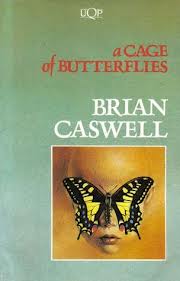 Cage of Butterflies is verrrry different in theme, but equally awesome and resonant in tone and characterisation. Super intelligent teens in a ‘think tank’ educational facility discover that just over there, in the bit of the institute they shouldn’t know about, is a bunch of babies with… abilities. Who do not like being kept in the institute and experimented on.
I remember this as being a bit more plot-driven than Merryll; the lead characters, Mikki and the boy whose name I’ve forgotten, have to find out about the Babies and then have to figure out what to do with/for them and then deal with some consequences (it has a bit of ‘much later…’ as the conclusion). And I definitely remember that as being exciting and tense the first time I read it. However, as with Merryll, the real draw is the characters themselves. Perhaps this won’t surprise anyone, but I was absolutely a square at school, and the idea of a place filled with really smart kids hanging out together and, while not necessarily just sitting around talking about books all day – there are still fights and awkwardness and general teen-type things – there’s no condemnation for being smart. That was a pretty exciting thing to read about. I liked the alternating point of view – girl and boy, who by the way rather like each other, ooh er, as well as working really, really well together and complimenting each other beautifully physically (the boy has, IIRC, something wrong with his legs…) and mentally (different strengths – and genuinely different, not better/gender based. Again, IIRC… maybe I’ve got rosy glasses towards this). It was a delight in general, is what I’m getting at.
Brian Caswell, I owe you a great debt for adding lovely gentle readable and believable romance and characters and story to my life.
Galactic Suburbia 66!!
 In which we suffer post-Olympics slump but make up for it by talking about sport in SF/F: from coyote baseball, holodeck racquetball and the points system of Quidditch to the history of sport in Doctor Who. And don’t forget that Buffy was a cheerleader! You can get us from iTunes or Galactic Suburbia.
News
World Fantasy ballot released.
Mythopoeic Awards include Delia Sherman and Lisa Goldstein
New Science Fiction Awards Database Website by Mark R Kelly (Locus)
Kirstyn McDermott makes Jason Nahrung a mug based on Alex’s GS review of Salvage
New Galactic Chat: Sean interviews Trudi Canavan
Readercon Apology sets the standard.
Feedback: Sean & Kitty on the harassment at cons issue.
What Culture Have we Consumed?
Alex: Existence, David Brin; all of Planetary, by Warren Ellis; Caliban’s War, James SA Corey
Tansy: “Foundlings” by Diana Peterfreund in Brave New Love; Shooting the Poo 14 (Sherlock Holmes) & 15 (Alien movies part 1)
Alisa: Coode St Podcast Ep 112 featuring Genevieve Valentine, and… reading unapologetically is a life skill!
Pet Subject: Sports in SF/F
The tennis match Alisa refers to is this one with Billie Jean King.
Please send feedback to us at galacticsuburbia@gmail.com, follow us on Twitter at @galacticsuburbs, check out Galactic Suburbia Podcast on Facebook and don’t forget to leave a review on iTunes if you love us!
Existence: a review
 I believe this is the sort of novel that people might be thinking of when they suggest science fiction is ideas heavy but character and/or plot light. I’d never really understood that accusation of modern SF… until now. (I would have given it 3.5 if I could.)
It took me more than a fortnight to finish reading this. For fewer than 550 pages, that’s… well, for me that’s positively an age. I did consider giving up on it, several times in fact. But the ideas kept me coming back and made me determined to see it through, to see what Brin did with this sprawling, messy saga. And I think I’m glad that I did. Not absolutely positive, but probably.
Anyway, let me first talk about the positives. There are some really, really awesome ideas here. The basic premise that drives the plot is a first-contact one, but done in a fairly unusual way: a crystal snatched from orbit, activated by human touch and sunlight, that appears to contain alien life of some sort. The unfolding drama of the knowledge revealed – and how it changes, or at least develops, over time – and how humanity deals with it is a genuinely fascinating take on Fermi and all the other variations on “where are the aliens, what will they do when they get here, and how will we respond?” That’s the plot, boiled down to its essentials; and it was fairly intriguing.
Also intriguing was the world Brin set this alien contact against. If there’s a clear explanation of when this is occurring I missed it, but it seems to start only a few decades from now. Complete climate collapse has not occurred but is still very much on the cards; technology has continued to advance in leaps and bounds, towards smart-specs and similar toys imagined by cyberpunk so many decades ago but which still seem elusive in 2012; AI appears to have been achieved, along with other technological wizardry. I liked that there appeared to be variety in this world, in how people dealt with technology at least. I did not especially like the world itself, though – although this is not in itself one of the novel’s negatives. The world is not quite dysfunctional enough to be a dystopia – although that would perversely probably have been easier to read. Instead this is a world apparently divided into ten Estates not just determined by wealth but by allegiance to such abstracts as Science and The Media; a world where inequality is as, if not more, entrenched than today, with apparently few people acting against it, and added fears of technology on the one hand and the ‘Autism Plague’ on the other; frankly, a world that I hope does not come to pass. From an objective point of view, this is a fairly well-described world, although I am unconvinced of its realism.
The novel’s structure is linear chronologically and inconsistent in perspective. Numerous characters act as the focus over the 550 pages: the most prominent are a novelist, a journalist, a society lady, an astronaut, and a peasant. There are also excerpts of such non-plot devices as books and talk shows thrown in, which generally works. These different perspectives serve to give just that, of course – different perspectives on the world and on the events unfolding. Over the course of the novel, there was only one character that I particularly liked, and who did manage to get a word in for the entire length of the novel: the journalist, Tor. She had a fun role to play as the inquisitive, poking-nose-in type, despite various problems hampering her abilities.
This brings me to one of the problems in this novel – two, actually. One is the characters. Most of them weren’t necessarily unlikeable so much as they were unapproachable or uninteresting. Additionally there were a few characters who promised to be or do quite interesting things who just… disappeared. Their narrative stopped popping up, occasionally with little or no resolution to their particular quandary or arc. This was intensely frustrating. This is definitely not a novel for those who prefer their story to be character driven.
The second problem was the structure itself. It was often unclear, at the opening of a new section, exactly who was speaking or where the events were happening. Sometimes that was cleared up, and at other times it was left opaque and mysterious. And sometimes these mysteries resolved with later revelations, but there are still some bits that don’t seem to fit in at all, and really that just seems like a waste of words and my time.
Thirdly, there’s the world itself. I felt like Frank Poole, the dead astronaut who wakes up at the start of 3001: The Final Odyssey to find it’s a millennium later, and suffers a fair amount of culture shock. Now I love cyberpunk and far future stuff, so culture shock isn’t necessarily an unpleasant experience for me. But here, it just made me tired, and irritable. A new piece of technology? Cue eye-rolling and mutters of ‘really? more?’ – because it seems to be set in the near future (as someone one said, near future is within the reviewer’s lifetime), and therefore improbable. The technology may not have been so overwhelming, though, if it wasn’t for the language. Brin has messed with a lot of language to indicate how heavily reliant this version of the future is on computers, frequently turning ‘a’s into ‘ai’: aissistant, for example; or adding ‘v’, as in virtisement; or even combining both in vraiffiti. Add in a whole bunch of gobbledy acronyms (tsoosu=to see ourselves as other see us=viewing yourself through one of the innumerable cams in place in this world; hello, panopticon Big Brother), and I simply found it overwhelming.
Overall, then, this is a big-ideas novel that is let down by two-dimensional characterisation and what occasionally feels like deliberately obfuscating language.
Galactic Suburbia 65!
 In which we discuss gender at the Olympics and sexual harassment policies at conventions, fight about whether we should read the comments, and Alisa reads more novels than Alex & Tansy PUT TOGETHER. You can get us from iTunes or download from Galactic Suburbia.
NEWS:
Readercon harassment discussion:
Masterlist & timeline of links
Cheryl looks at the practical side of developing harassment policies for conventions
Translation awards winners
Travel Fund Mark II sends two Swedish authors to WFC.
What Culture Have we Consumed?
Alisa: Earthly Delights by Kerry Greenwood, Naked in Death by J D Robb
Alex: Stargate Universe season 1; Ashes to Ashes season 3; Silently and Very Fast, Catherynne M Valente; Birds of Prey: Death of Oracle
Tansy: X-Men S.W.O.R.D No Time To Breathe; Uncanny X-Men: Dark Phoenix (The Ultimate Graphic Novels Collection, not Marvel Masterworks as I said in the podcast, worth also noting that the US are more than 20 issues ahead of Australia); Besieged, Rowena Cory Daniells
For next episode: send us your favourite examples of sport in SFF.
Please send feedback to us at galacticsuburbia@gmail.com, follow us on Twitter at @galacticsuburbs, check out Galactic Suburbia Podcast on Facebook and don’t forget to leave a review on iTunes if you love us!
Embassytown: a meandering not-review
These are some random thoughts, often connected to thoughts about other Mieville novels I’ve read; it’s not a thorough-going review, partly because there’s just so much going on that if I tried to write one, I would leave something out and end up feeling annoyed or inadequate; and partly because other people – including the awesome Ursula le Guin! – have already written those. So I won’t even pretend to put myself up there!
Anyway…
Mieville writes urban stories. Here, and in other novels – pretty much exclusively, at least insofar as I’ve come across. There are ‘agricultural’, or non-urban, areas on this world, but even they feel quite industrialised, by modern Earth standards; they’re tamed, and seem to exist almost exclusively to produce for the city, having no existence outside of that. This aspect is neither here nor there in terms of the story, but it is interesting in terms of his focus across the entire oeuvre. Or at least, I think so.
 Also in consideration of all of Mieville’s works that I’ve read comes this observation: they’re all about obsession. Kraken obsessed over belief and social structure; Perdido St Station was obsessed with race; The City and The City was consumed with an obsession for truth on the one hand and blindness on the other. I’m not saying these were exclusive themes or foci, but they were significant and informed the entirety of each story. Embassytown is obsessed with language: how language works, what it does, what it allows. I think this is one reason why I loved it so much – I love language, and thinking about language, and thinking about how language constructs our world view and indeed perhaps even our selves. And so, clearly, does Mieville. The consequences of an entire race thinking about how to lie – not being able to do so, what that means for every layer of society but also for history and story telling and so many other aspects of human society – was totally riveting.
That all sounds mighty highbrow. Of course, as with the other Mieville novels mentioned above, this one works on multiple levels. I think it would be perfectly possible to read this as… not quite a straightforward narrative, because the structure itself isn’t entirely linear and straightforward… but it can be read without your mind being forced off into the philosophical byways indicated above (yanno, if that’s your thing. Me, I like the byways. The nicest flowers are usually there.).
The story itself reflects a post-colonial attitude towards what might happen when humanity spreads its collective wings and goes spreading its presence across the galaxy, thanks to a wonderful take on FTL. It’s not quite the drug-fuelled flight of Dune, it’s not quite the worm-holes of countless SF novels and movies, it’s… something a bit wilder, a bit more out-there, a bit more mysterious and weird and awesome. Ahem. Anyway, Our Heroine escapes from her annoying backwater of a weird human colony, out to the exciting wide galaxy… only to end up at home after a while, and then things get really weird.
Home is the eponymous Embassytown, and the particularly weird bit is how humanity communicates to the indigenes. With difficulty, and two people at a time, is the answer. Confusing? Somewhat. Eventually awesome? Absolutely.
I must admit that I found the first few chapters quite a slog, and if I didn’t trust Mieville to turn on the awesome pretty soon I may not have powered on through. But I did, and my faith was rewarded (obviously). One of the difficulties was the non-linear nature of the narrative. Past/future/present being entangled, chapter by chapter, is not a problem for me – I am constantly intrigued by stories that reveal a conclusion and then explain how characters got there; it’s like studying history, for me. What was a bit of struggle was not having a clear idea of sequence, or even – at the start especially – a clear idea of who was doing what. Like a palimpsest, though, Mieville built up the history/contemporaneity gradually and skilfully and rewarded just that bit of perseverance.
I loved it. It got my Hugo vote. I enjoyed the characters, I loved the intrigue of the humanity/alien interaction, I really enjoyed the philosophical challenges of language and colonialism. LOVE.
Galactic Suburbia 64!
 In which we talk Smurfette, gender bias on Wikipedia, Redshirts, Regency magic and Captain Marvel. Also, Tansy turns the microphone off a lot so you can’t hear her sneezing. You have much to thank her for.
News
Shirley Jacksons! Winners announced.
A new Sleeps With Monsters column by Liz Burke: The Smurfette Principle – We Can Do Better
How Kate Middleton’s wedding gown reveals the gender bias in the Wikipedia system.
Journey Planet Issue 13 – specifically special section on gender parity for con panels including our own Alisa
The ComicCon Batgirl returned to SDCC this year, asking DC Comics about why Stephanie Brown has been removed from the Smallville comics.
What Culture Have we Consumed?
Alisa: Redshirts by John Scalzi (read by Wil Wheaton)
Tansy: The Truth by Terry Pratchett, Sherlock Holmes The Final Problem/The Empty House (Big Finish Productions), Captain Marvel & The Avenging Spider-Man #9 by Kelly Sue DeConnick
Alex: The Secret History of Moscow, Ekaterina Sedia; Salvage, Jason Nahrung; Glamour in Glass, Mary Robinette Kowal
Please send feedback to us at galacticsuburbia@gmail.com, follow us on Twitter at @galacticsuburbs, check out Galactic Suburbia Podcast on Facebook and don’t forget to leave a review on iTunes if you love us!
Ishtar: a review
 (Disclaimer: I know all three of these authors. Not that that would stop me from being dispassionate, of course…)
This is a set of three novellas, set in very distinct times, about the goddess Ishtar. Despite having the same theoretical focus, the three vary greatly in tone, style and actual focus. There are, nonetheless, a couple of clear threads that link them. The first is, of course, Ishtar herself. This is no Botticelli-esque Venus, no whimsical romanticised Aphrodite; all three authors present an Ishtar who is very clearly goddess of war and goddess of love/sexuality, and who embodies the struggles that each of those aspects brings – not to mention the way they work together. Coexistent with this is an attitude towards men that could perhaps be described as contempt, although that may be too harsh; disdain may be closer. Aside from Ishtar, the three stories are all categorised by a general sense of dread, of pessimism and darkness. These are not cheery tales.
I love a fiction book that comes with a bibliography, and Ishtar does just that. I suspect most of the research went into Kaaron Warren’s opening story, “The Five Loves of Ishtar” – although looking at the titles of the articles I can see resonances with the other two stories as well. Warren, though, in opening the set, has the task of placing Ishtar within her original context: ancient Mesopotamia. I know only a little of the history of that area; it certainly feels to me that Warren has captured the sense, if not of the historical area itself, then of how the area might have perceived itself in myth <i>and</i>history. Because Warren sets Ishtar within a place that feels real, where the gods and heroes do walk the earth and do interact with mortals. And she tells of Ishtar and her five loves through five generations of washerwomen, at once a domestic and lowly, yet also incredibly intimate, position. Ishtar’s loves come and go, from Tammuz the Green One in 3000BC to Ashurnasirpal in 883BC. There are some similarities between the five: jealousy, and a love of power, and a lack of understanding of Ishtar herself. To some extent, though, the men are just there to be foils to Ishtar – to provide evidence of time’s movement, since Ishtar changes little; to give Ishtar a canvas on which to act. Ishtar’s involvement with women is of great moment, and I think reveals more of Ishtar’s self. Her interactions with women giving birth, and with her washerwomen, shows a complex character that isn’t entirely comfortable in the world, but doesn’t really know how else to be. There are poignant moments of vulnerability (a goddess concerned about her appearance? unsure of whether she wants a child?), as well as startling moments of horror (the casual brutality of death and war, the creation of a horrific army). This is a complex story as befits a complex character and a complex history, too. Warren does it justice, and sets up the next two stories beautifully: after all, if this is Ishtar in the far ancient world, what might she be like today, let alone in the future?
Deb Biancotti has the task of placing Ishtar in the modern world, and actually for much of the novel Ishtar is not a physical presence; she is a rumour, a hidden force, a menacing shadow. “And the Dead Shall Outnumber the Living” takes place today, in Sydney, and is essentially a police procedural. Adrienne is a detective, and she has a rather nasty case to work on: several men found dead, with their bones smashes to smithereens, who all appear to have been sex-workers. Just the sort of trend that gives police headaches – especially when the cause of death is almost impossible to explain. In searching for clues, Adrienne reconnects with an old friend who used to be involved in the sex workers’ union; meets a priest and a gigolo-cum-witchdoctor type; and comes across a rather odd goddess cult, who are waiting for their goddess to reappear. All of these people give tantalising clues as to what might be going on, where ‘tantalising’ can also be synonymous with ‘frustrating’ and ‘hair-pullingly-ambiguous’. The reader, of course, might have some idea of what is going on – surely Ishtar has to turn up or be involved at some point – but that really doesn’t make a difference to the story itself. Adrienne is a powerful, compelling protagonist, into whose personal life the reader gets just enough insight to understand that while policing is of fundamental importance to her, it’s not quite all she is. She verges on manic sometimes; her determination and dedication is by turns admirable and somewhat frightening. The supporting cast is solid: Steve, her partner-in-policing, is different enough to riff off, with a family to be concerned about and a bit less narrowly focussed; Nina, the prostitute, is the old friend who can say pretty much anything to Adrienne and provides a wildly different perspective. This novella is the most straight-forward of the three, because of its police procedural nature; there is a mystery which must be worked out, and it seems bizarre and unlikely but then clues fall into place. It is the easiest and least demanding to read (which is by no means a slight on Warren or Sparks, or on Biancotti either), but don’t assume that makes it pleasant. Or that it has a nice ending.
One mythological, one mystery… and a post-apocalytpic tale on which to end. Cat Sparks rounds out the set with “The Sleeping and the Dead.” It starts in a blasted desert with a mechanical bull going mad, and really just continues in that trend. Exactly when and where this story takes place is unclear; I presumed it was Australia, but it doesn’t have to be, and it’s sometime in the future of Adrienne’s Sydney – probably within a generation, but that’s just my guess from a few hints here and there. The focus of this story is Doctor Anna, who lives in said desert with a bunch of very weird, fairly crazy nuns with a seriously disturbing ossuary. When one day some men come calling – well, crawling like dehydrated possibly-hallucinating men are wont to – things change; whether it will be for the better or the worse depends entirely on whose perspective you take. Where Warren’s story has an ancient world annals feel to it, and Biancotti’s is a straightforward novel, Sparks’ piece at times feels something like a dream. The narrative is basically straightforward but the links don’t always immediately make sense; and Anna’s obsession with Thomas doesn’t entirely make sense; and time doesn’t always seem to flow in the proper, ordered way it ought. The place of Ishtar in this story is the least obvious of the three; it does make sense towards the end and, credit where it’s definitely due, Sparks does a good job of tying her Ishtar back to Warren’s. I’m not sure how deliberate that was, since I have no idea how closely the three worked in developing their stories, but it certainly felt cohesive.
This is a really impressive set of stories, and they are most definitely worthy of the award nominations they’ve been receiving. I expect this to be a collection that I keep revisiting and, perhaps especially in the past and future Ishtars, I expect to keep finding new nuances and details cleverly hidden away. It would have been so easy to sanitise this goddess and make her palatable; I am so glad Warren, Biancotti, and Sparks had the vision to be true to what I think is the general vibe of the original mythology.

 Randomly Yours, Alex