Multispecies Cities: Solarpunk Urban Futures
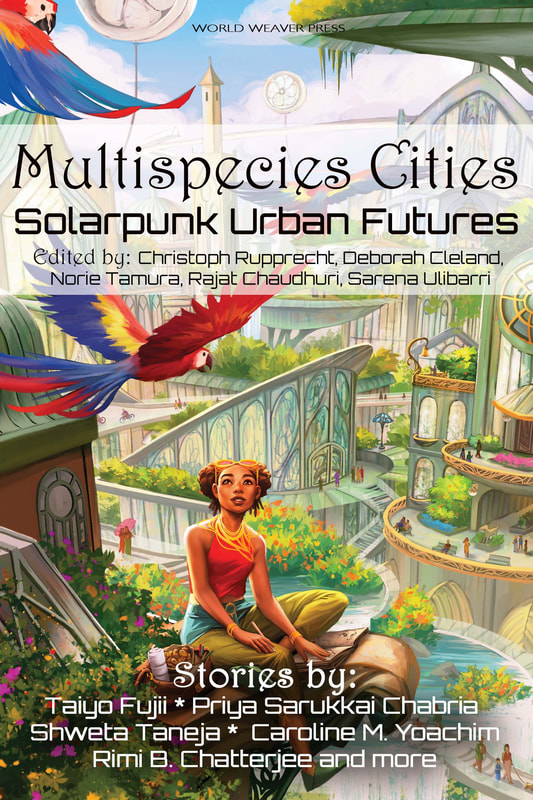
Yup, this one was also on special at World Weaver Press, so I grabbed it as well. I was completely intrigued by the idea of an urban focus for this sort of science fiction – that humans won’t have to abandon living in cities to survive the impacts of climate change, but they also don’t have to be the technological nightmarish warrens of Bladerunner etc. At the same time, they can’t be the same as they generally are now: where we restrict greenery to a few parks, loathe pigeons and rats as the carriers of disease, and so on. There are a few apartment buildings in my city that are starting to introduce the idea of green walls… that just needs to be taken much, much further. Which is part of what this anthology envisions.
As always, didn’t love every story, but as with Glass and Gardens there was no story that I thought was out of place. There’s a big variety in what the stories focus on – human stories that happen to intersect with animals, stories of the city itself, stories of animals and humans together. Where I said that previous anthology felt North-American heavy, this one has consciously set out to be different: there are, deliberately, a range of stories that explore the Asia-Pacific. I LOVE this.
There are a few stories where animals interact, in a deliberate way, with humans. Meyari McFarland’s “Old Man’s Sea” has orcas that have been modified for war, and how they might relate to the humans they now come across. Joel R Hunt has people whoa re able to jack into the minds of animals, in “In Two Minds,” and it’s about as horrific as you might imagine. “The Mammoth Steps” by Andrew Dana Hudson is along similar lines as Ray Nayler’s “The Tusks of Extinction,” with mammoths having been brought back and humans interacting with them… although Hudson’s version is a bit more hopeful. E.-H Nießler also has an orca-human interaction story, in “Crew;” he adds in a chatty octopus as well.
Shout out to Amen Chehelnabi and DK Mok, too: Aussies represent! Chehelnabi’s “Wandjina” is one of the grimmer stories, set basically in the middle of a bushfire, but manages to have hope in there too. Mok’s story “The Birdsong Fossil” is SO Australian, and also on the grimmer end, connecting visions of how science might be/is viewed with the de-extinction fascination; like Chehelnabi, it also ends hopefully, and is a fascinating way to conclude the entire anthology. (And Octavia Cade; NZ is totally Aussie-adjacent… plus her story “The Streams are Paved with Fish Traps” is brilliant.)
A really interesting, varied, anthology.
Glass and Gardens: Solarpunk Winters
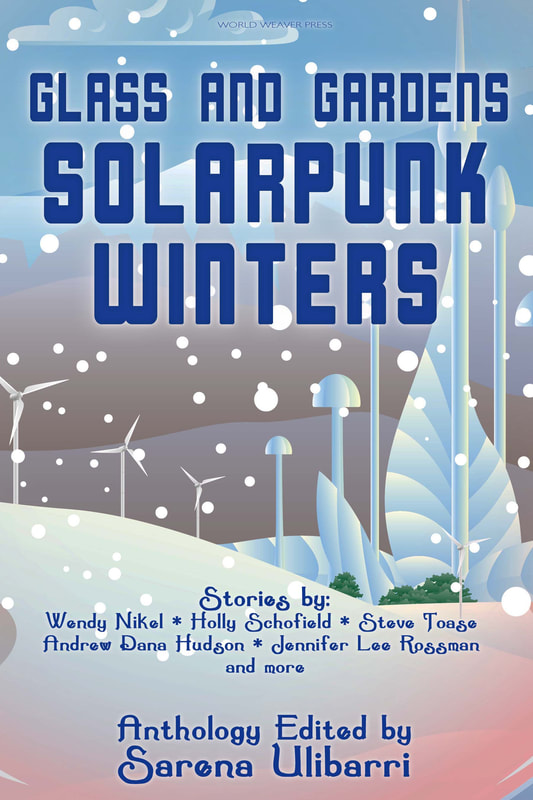
I’ve only recently come across the idea of ‘solarpunk’ – basically a hopeful take on humans living in a post-climate change world, as far as I can tell. I guess this is what ‘hopepunk’ also aims to be? maybe solarpunk is a bit more about the actual mechanics… I don’t know, I’m not going to claim the ability to set genre boundaries. ANYWAY, World Weaver Press has done a bunch of solarpunk anthologies, and a couple of them were on special the other day so I got them.
The first one I read was this, Glass and Gardens. Turns out I was in the right zone for some hopeful SF. As with all anthologies, I didn’t love every story – but also, there were no stories that left me wondering what the editor was thinking. They all fit the overall theme – how to be hopeful when winters have got more extreme or, in a couple of cases, the world has warmed so much that winter no longer happens, with equally disastrous consequences for the environment. It is heavily North American-focused, but honestly as an Australian this is just something I pretty much take for granted.
One thing I particularly liked was that while all of the stories were focused on humans, and what they are doing to live with/ mitigate/ work around climate change, there’s also a focus on how the climatic changes have affected the rest of the species on the planet. It’s s refreshing change and something that seems to be a trope within solarpunk from what I can tell – an acknowledgement that humans aren’t alone on the planet. So there’s Jennifer Lee Rossman’s “Oil and Ivory”, about narwhals and whether they’ll be able to travel underneath pack ice in the Arctic; bears and several other animals in “Set the Ice Free,” from Shel Graves; and several stories that have cities encouraging a lot more greenery and what could be called extreme eco-living compared to today.
An aspect that connects to the idea of hope is the prominence of art in these stories. Your dire post-apocalyptic world has no room for art and beauty. But Sandra Ulbrich Almazan has characters making clothes in a variety of ways in “A Shawl for Janice;” “On the Contrary, Yes” from Catherine F King is entirely focused on art and making art across multiple genres; Andrew Dana Hudson imagines ice-architecture as its own art form in “Black Ice City.”
This is a great anthology, and I look forward to reading more solarpunk.
Rosalind’s Siblings – anthology
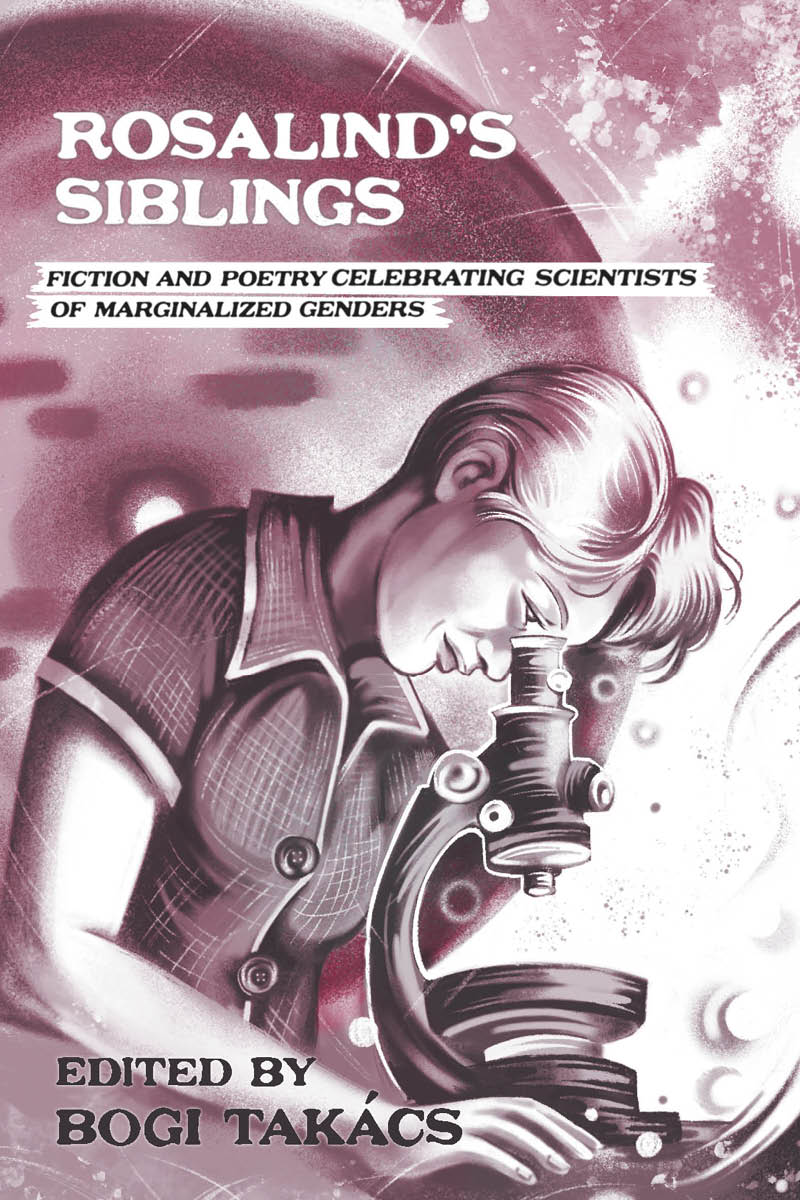
I heard about this anthology c/ Bogi Takács, the editor, and the premise immediately grabbed me (also I trust Bogi’s sensibility). It can be bought here.
The premise here – as the subtitle says – is speculative fiction stories about scientists who are marginalised due to their gender or sex, in honour of Rosalind Franklin – a woman whose scientific discoveries were key to the unravelling of DNA, but who never received the recognition that Watson and Crick did in their own time.
In Takács’ introduction, they note that the stories don’t take a simplistic view of science; there are stories where science is generally a positive force, and stories where it’s not. There are a variety of different sciences presented, a variety of ways of doing science, and a variety of contexts as well. There’s also a range of characters, across gender and and sexuality and neurodiversity and experience and ethnicity and everything else. This reflects the authors themselves, who are also really diverse. The stories, too, vary in their speculative fiction-ness; near-future, far-future, magical realism, on Earth or in the solar system or far away. There are two ‘trans folk around Venus’ stories, as Takács rather amusedly notes – and they are placed one after the other! – but they’re so different that I’m not sure I would have clicked to that similarity without having been made aware of it from the introduction (stories by Tessa Fisher and Cameron Van Sant; they’re both a delight).
As with all anthologies, I didn’t love every single one of these stories – that would be too much to expect. But there were zero stories where I wondered why an editor would include it, and all of them fit the brief, so those are pretty good marks. DA Xieolin Spires’ “The Vanishing of Ultratatts” was wonderful and hinted at an enormous amount of worldbuilding behind the story. Leigh Harlen’s “Singing Goblin Songs” was a delight, “If Strange Things Happen Where She Is” (Premee Mohamed) has gut-wrenching timeliness (science in a time of war), and “To Keep the Way” (Phoebe Barton) utterly and appropriately chilling.
Tusks of Extinction, Ray Nayler
Read courtesy of NetGalley and the publisher, Tordotcom. It’s out in January 2024.
I had read and loved Nayler’s The Mountain in the Sea, so it was a no-brainer that I should want to read this novella. There are some similarities between the two, and a whole lot of differences.
Most importantly, it’s fantastic.
I hadn’t read the blurb before diving in – why would I, when I had high expectations? I assumed it was going to be about elephants, or maybe mammoths, and honestly that was enough. So yes, it’s about mammoths – although not quite as I expected. Nayler dives into the thorny questions around what it might mean, and require to bring mammoths back from extinction: in terms of science (although it’s not overly science-heavy; it’s only novella-length, after all), in terms of mammoths learning how to BE mammoths, and in terms of the human reaction as well. In particular, the focus is on poachers, beginning with elephant poachers and the people attempting to thwart them in various parts of Africa.
There’s a lot of humanity, there’s a lot of animal conservation, there’s a lot of scientific consideration. It’s provocative in the best way – no devil’s advocate crap, but raising important issues that don’t have simple answers. Well-written and engaging, this is a further evidence that Nayler is someone to keep watching out for.
Ares Express, by Ian McDonald

When I read Desolation Road I had no idea that I was reading a companion novel to Ares Express. Happily, it doesn’t matter what order you read them in – there’s no spoilers, and only one character in common… who is fairly central to the plot of both, but in ways that work separately for each novel.
Every time I read a new McDonald novel I’m reminded of just how awesome a creator he is. Here, the focus is a young woman born to a train family – they drive trains around Mars, and everything about the family is focused on the train. It’s a weird mix of a society, because it’s clearly technologically advanced – or at least, there are aspects of that, since they’re living on a terraformed planet and they have various tech things that don’t exist for us. At the same time, though, there are archaic aspects to the human side, including, sometimes, arranged marriage. Such is the future looming for Sweetness Octave Glorious-Honeybun Asiim 12th, and she is not having it. And so begins an adventure across Mars that will eventually have enormous repercussions.
The way McDonald gradually reveals his vision of this future world is masterful. There’s enough, early on, to understand the basics of society… and then slowly, slowly, enough of the history of the place is revealed that the reader’s vision is broadened. It’s looking through a keyhole vs eventually looking through a door. But not stepping through that door – there are still lots of tantalising bits that aren’t fully explained, which just makes it all the richer.
Sweetness is a great focal character: young, impetuous, smart, unafraid of challenges and usually willing to admit when she needs help. I would have been happy with an entire novel focused on her. But McDonald adds Grandmother Taal, and I love her to bits. Old ladies being feisty, taking up the slack when the younger generation is being a bit useless, fearless and clever and willing to meddle: she’s everything I love.
One of the great things about writing a middle-future novel where there’s been some loss of tech for whatever reason is that, despite being over 20 years old now, it still gets to feel vital and believable and not at all outdated. Ares Express is magnificent.
Tomorrow’s Parties (anthology)
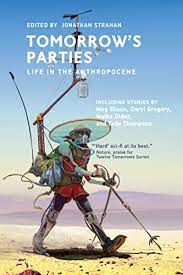
I really have to be in a particular frame of mind to read anthologies, which is why I read several in a row recently – including this one. It’s not that I thought I wouldn’t enjoy them – they’re Strahan anthologies, I’ve never not enjoyed one. It’s just a particular reading experience.
Anyway! Now I have read this awesome anthology and it was as stunning as I expected. As the subtitle suggests, the loose theme is “life in the Anthropocene”, and the authors largely took a similar-ish attitude towards what that means; there’s a lot of climate change-related stories, as is appropriate, and / but all of the authors took quite different approaches to what that might mean.
Every single one of these stories is amazing. I’m intrigued that Strahan chose to open the anthology with a conversation between James Bradley and Kim Stanley Robinson – it’s the sort of thing that I tend to expect at the end of the anthology – and maybe that’s part of the reason for it to be up front: to encourage readers to actually read it. It also sets up the climate change issues that are so front and centre through the rest of the book; the title is “It’s Science over Capitalism: Kim Stanley Robinson and the Imperative of Hope,” which itself speaks volumes.
The ten stories in this anthology are all exceptional.
Meg Elison, “Drone Pirates of Silicon Valley”: the future of online shopping and delivery, yes, but also rich vs poor, and the future of capitalism.
Tade Thompson, “Down and Out in Exile Park”: how communities might live differently, and how that challenges the status quo.
Daryl Gregory, “Once Upon a Future in the West”: multiple perspectives, and quite creepy at times. So many issues – the (negative) future of telehealth appointments, autonomous vehicles, bushfires…
Greg Egan, “Crisis Actors”: a very disturbing story that explores some of the consequences of living in a “post-truth society”. I always adore Egan’s short work.
Sarah Gailey, “When the Tide Rises”: another story that confronts capitalism head-on, bringing back the idea of the ‘company town’ as well as poking at the idea of companies making money from finally doing good for the planet. Brilliant.
Justina Robson, “I give you the moon”: one of my favourites, and not just because it’s one of the most hopeful of the stories. This is post-climate crisis, when humans have figured out how to live in more balance with the rest of the world (her vision is marvellous). Rather than focusing on how we get there, this story is about family dynamics, and ambition. It’s gentle and wonderful.
Chen Qiufan (trans. Emily Jin), “Do you have the Fungi sing?”: the consequences of a hyper-connected world, what happens if an area doesn’t want to participate – and possible alternatives.
Malka Older, “Legion”: completely and utterly different from all of the others, this is the story that’s going to stay with me the longest. Chilling, confronting, challenging… I had to stop reading when I finished this story and take a breath. It takes place over a short period of time – maybe an hour? – in the prep for, and during, an interview on a talk show. The host, Brayse, is interviewing a woman representing Legion, a group who have just won a Nobel Peace Prize. The reader is in Brayse’s head, which starts off as a reasonable experience and then gets… less so. Legion, as the name suggests, are not just one or a small group; they are everywhere, always watching through wearable cameras, and able to call out – or respond to – what they see: micro- and macro-aggressions, and all the ways in which some people are made to feel less comfortable right up to actual harm. Older nails the unfolding of this story perfectly.
Saad Z. Hossain, “The Ferryman”: another incisive take on the consequences of late-stage capitalism, this time how people will respond to death when, for the ‘haves’, death doesn’t need to exist.
James Bradley, “After the Storm”: being a child growing up in the ravages of climate change is likely to suck; at the same time, children do tend to be resilient and make their way within the world that they know. Bradley focuses on teenagers and their experiences – rather than the adults who know how things have changed – and captures the cruelty as well as the love of adolescents beautifully.
All in all, an excellent addition to the literature around ‘what next’.
Someone in Time (anthology)
I am late to the party… however, not SO late, because this just won the British Fantasy Award! Which it absolutely deserves.
I’m sure there are some readers who would avoid this because “they don’t read romance” (hi, I used to be one of those). The reality though is that you do; there’s almost no story – written or visual – that doesn’t include romance somewhere in its plot. What I have learned about myself is that I rarely enjoy what I think of as “straight romance” – that is, stories where the romance is the be-all of the plot; they just don’t work for me, as a rule. What I love, though, is when the romance is absolutely integral to the story and there’s a really fascinating plot around it. Every single one of these stories does that.
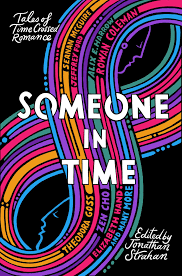
As the name suggests, this is set of stories involving romance and some sort of time travel. It’s a rich vein to mine, and every single one of these stories is completely different. Sometimes the time travelling is deliberate, sometimes not; sometimes the ending is happy, other times not; some are straight, some are queer; some pay little real heed to potentially disrupting the historical status quo; some have easy time travel while others do so accidentally; sometimes the time travel happens to save the world, and sometimes it’s about saving a single person. Sarah Gailey, Rowan Coleman, Margo Lanagan, Carrie Vaughn and Ellen Klages (a reprint) wrote my favourite stories.
And then there’s Catherynne M Valente’s piece. I did love every single story in this anthology; Valente’s story is breathtakingly different in its approach to both structure – eschewing linearity – and theme: the romance is between a human woman and the embodied space/time continuum. Hence the lack of linearity. It’s a poignant romance and sometimes painful romance; it also confronts the bitterness of dreams lost, the confusion of family relationships, the beauty of everyday life, and the ways in which even ordinary people don’t really live life in a straight line, given the ways our memories work (Proust, madeleines, etc). This is a story that will stay with me for a long, long time.
Divinity 36, Gail Carriger
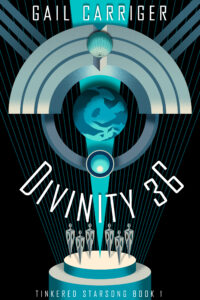
Sooo I missed this when it first came out – but it turns out I’m not too far behind the times as I read this first one (in a day…), went to look for the second one, and turns out it came out the next day (which is today, as I write). And the third comes out in October, so actually I’m doing just fine.
If you just want to buy it, or read what Carriger has to say: https://gailcarriger.com/books/d36/
So there’s many different aliens, pretty much all interacting companionably. One particular species, the Dyesi, search the galaxy for sentients who can sing or dance and then put them through rigourous training and bring them together as pantheons, because at that point those artists are gods. Yes, it’s a bit “The Voice” – or, more accurately, “Idol” where the prize is to ACTUALLY be an idol. And their performances get broadcast across the galaxy, and people literally identify as worshippers and send in votives and so on.
The focus of this series is a refugee who has a lot of trouble with ordinary emotional interactions thanks to childhood trauma. Brought together with new people and compelled to live and work with them, this is inherently a story about found family and in that it is simply lovely. There’s also, of course, music and art, and – amusingly – food and cooking.
This is a very cosy story, as should be no surprise to readers of Carriger’s work: that is, there is real and important trauma in various backgrounds but (so far) little immediate or overwhelming danger to our heroes; there’s a lot of focus on friendship and figuring out how all of that works, with a sense that obstacles can and will be overcome (not in a cheesy way). It’s a generally upbeat, inclusive, humorous, joyful story – and honestly who doesn’t need that in their lives sometimes? If you haven’t read any Carriger but you loved Legends and Lattes, I suspect this will work for you.
Desolation Road, by Ian McDonald

This book should not work.
The first few chapters are “and then this person arrived in this place that has no right to exist”. Sometimes the person or family group have some explanation about who they are or why they’re travelling; sometimes their background is incredibly vague. There are hints and vague hand-wavings at what might be coming in the future because of a particular character, and then it takes a hundred pages for anything like that to happen. There are possibly-magical occurrences, there are references that make it sound like you’ve missed the first two books in the trilogy (Our Lady of Tharsis…) and it takes FOREVER until there is something resembling a narrative.
This book absolutely works. And I don’t know why.
Well, I do: it’s because McDonald is an astonishing storyteller, and all of those things that seem wrong just become utterly intriguing and compelling. Someone who manages to make a time machine because a green person pops up at their camp as they travel across the desert? OK. Triplets who may or may not be clones; twins who split the rational and the mystical between them; someone who has an uncanny way with machines… yep, fine. I’ll read it. People are adults at 10 years old? Oh right, it’s Mars, and the Martian year is 2/3 longer again than an Earth year. So yes, actually, that’s fine.
Imagine writing this, and selling this, as one of your first books.
A Deepness in the Sky
Read via NetGalley and the publisher, Tor. This is a reprint so you might be able to get earlier printings, or this one is out in October 2023.

Where do I even begin?
I have never read a Vernor Vinge story before. According to Jo Walton’s introduction to this one, this and The Fire in the Deep are basically the culmination of his lifetime’s work.
Reading this (admittedly quite long) novel is like reading a trilogy that’s been refined down to just one volume. There is SO MUCH GOING ON – and it all works, and it draws you inexorably on. It’s not particular frenetic in pace – I didn’t feel like I was reeling from one explosion to another – but it’s relentless. It’s like an avalanche.
Partly this is because although the story takes place over decades, there are several well-placed time jumps. I think this is part of where the ‘trilogy refined to one book’ feeling comes from. There’s nothing extraneous. There are moments of people just being people – being in relationship, having families, relaxing – but they don’t feel like padding. It’s all adding together to make these characters intensely real.
There are three strands. Two are human: the Qeng Ho, a loosely connected and enormous group of people whose aim is trade; they travel between planets to sell whatever is needed, and call people on planets Customers – not in a taking-advantage kind of way, but in a ‘this is what we do’ way. Then there’s the people known as Emergents, and I wondered about this name for a long time… before I discovered it was because their society is the Emergency, named for a particularly dramatic time in their political history which has had cascading effects on their political and social structures (to become far more authoritarian than the Qeng Ho countenance) and honestly the name tells you a lot about them. These two groups of humans end up working together – much to the dismay and distrust of both sides – as they go to explore an astronomical anomaly. The third strand is the aliens who live on the planet around that astronomical anomaly, who are not bipeds and whose planetary and biological experience has led them to develop in some very different ways from humans… and yet, they are intelligent, and Vinge suggests convergent evolution in a lot of scientific and technological ways.
As I said, there is A LOT in this novel. Love and betrayal and family and war and technology… and then Jo Walton’s foreword tells me that if I read The Fire in the Deep it may completely change the way I understand this novel? I’m a bit sad that it took me until now to read this, AND YET reading it at this age was actually excellent.
I’m so glad Tor is reprinting this and I hope it gets a lot of love.

 Randomly Yours, Alex