The Greatest Fight of Sunny Granada, and other stories

This is another of the book sent by a Filipino friend. You can buy it over here.
I’d not come across Kenneth Yu’s work before, but apparently this is his second collection of short stories. There’s a really interesting variety in the stories presented here.
The eponymous story is very clearly science fiction, and told non-linearly, about a man who starts off as a boxer/MMA etc on Earth and then leaves the planet to find more career options fighting aliens in the arena. Certainly on one level it’s about fighting as a sport and sport for money, but of course it’s also about family and inheritance and Place as home.
Then there’s “Spider Hunt,” which feels more like fantasy; “The Probe” is maybe SF, maybe fantasy, and works by muddying the lines. “Beats” is also genre-defying, intriguing and mysterious.
While I can see, and appreciate, what “Operation: Bleach” is doing, I’m as white as they come; I suspect it hits far harder for folks with browner skin than mine and who live in a society that upholds my sort of skin as somehow preferable. It’s another story told inventively – a series of newspaper articles and comments – and it’s probably my favourite story of the collection.
I found “Lost for Words” a bit confusing, to be honest – it’s very short, and I don’t think entirely works as a story. Then “All That We May See” tips into horror, “One Morning at the Bank” is a superhero story, and “Blending In” feels basically like realism.
And then “For Sale: Big Ass Sword” is told entirely as an ad on Talipapa, which I understand to be an online trading site for the Philippines; the story leans into folktales/fairy tales, and is a really solid conclusion.
It was never predictable what the next story would be like, and I really enjoyed that aspect, as well as the stories themselves.
Doomsday Dance Party, Nikki Alfar
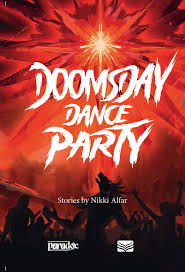
A friend in the Phillipines sent me a copy of this, thinking I would like it. They were, of course, correct; you can get it from the publisher.
I’m not sure if I’ve come across Alfar’s work before – possibly in anthologies? – so it was intriguing to see the variety of short stories she presents here. Some are realist fiction; more are science fiction or fantastical. Most have clear Filipino connections – set in the ‘real’ Philippines or an alternative version – with a couple of exceptions, most notably “The Riddle of the Great Khan’s Great-Great-Granddaughter,” which I loved and is not connected to the Philippines at all. As well, many have elements of Filipino mythology, like the tikbalang and ‘fey folk’ (in English) at the wedding in “Destination: Wedding,” which was absolutely one of my favourite stories. Sometimes, as with that one, it’s because the story is specifically about an experience in the Philippines; other times the Philippines is the setting because it’s the setting, not because Alfar is making a specifically Filipino point (I hope that makes sense). Styles changes across the stories, from relatively straightforward to the more lyrical styling of stories like “El Legado de Lana (Lana’s Legacy)”.
It’s a compact collection, at 155 pages of story. I’m glad it exists and that I got to read it: the stories are a delight and I hope Alfar gets ever more notice, both at home and abroad.
The Fortunate Isles, Lisa L. Hannett

What an amazing, intriguing, occasionally distressing, emotional and beautiful set of stories.
Everything I’ve read by Hannett, I have loved. This is not to say I’ve read everything of hers – some of her work has tended a little too horror, for my delicate reading sensibilities, or at least the descriptions of them have deterred me. But the collections and novel that I have read… I never regret it. And that goes for this, too.
By the way, you can buy it right now!
It’s a set of short stories, but it’s pretty close to being a mosaic novel. The key tying everything together isn’t a person, but the place: the Isles themselves. They’re not a “real” place in that you won’t find them on a map. But once you remember Hannett’s love of, and knowledge about, Viking history, it’s not hard to see how inspired this place (and some events) are by that northern part of Europe. I got to visit Orkney last year, and I could feel resonances with that place as I read. Everything about these stories is connected to the idea of the islands: the people being insular; the space being liminal; whether characters look to land or water as home, inspiration, solace, threat, provider or destroyer.
There are a few characters, and families, who reappear over the course of the stories, reminding the reader that the Isles are a small place and that while some people leave, most don’t – or if they do, they usually come back. Most of the characters are human – usually, mostly – but several of them aren’t, and a few are liminal. There’s magic, but it’s not easy or familiar or common. What there is mostly is humanity. Love and hatred, jealousy, fear and despair, joy and determination. Hannett is really, really good at people. She’s also very good at narrative, don’t get me wrong: the amount of twistiness she can get into just a few pages is remarkable. Mostly, though, I read these stories for the people.
This is a splendid collection and I am delighted it’s been republished.
Snow White, Blood Red

I’ve been meaning to read this book for ages. And I do mean years. Finally got it this year because I was reminded of it by someone when I read a very poor version of the Snow Queen.
Many of the stories are excellent, although it’s not quite the anthology I was expecting. I wasn’t expecting there to be discrepancy in whether the stories were pretty faithful or quite different versions; I found it a bit disconcerting to bounce from one to the other, and then have completely made up (that is, not based on commonly told fairy tales) stories in there as well. I’m not saying any of those three options is bad but it felt jarring to have them all mixed together. But I think that’s mostly my expectations.
Lisa Goldstein’s use of Hansen and Gretel motifs to tell a story about a woman’s relationship with her daughters was a delight and a really intriguing way to end the anthology. I loved Patricia A McKillip’s take on the snow queen and Esther M Freisner’s “Puss” was deeply troubling. Actually a lot of them were deeply troubling, but that was kind of the point both because original fairy tales just were troubling and because this anthology was always intended to be about both the fantasy and the horror aspects of the stories. Hence the title. There were a lot of really great stories in this anthology and I can see why it keeps getting talked about. I guess I finally need to read Angela Carter now
Children of the New World
 This book was sent to me by the publisher at no cost. It will be out on 31 October; RRP $22.99.
This collection of short stories reminded me a bit of Rob Shearman’s work. These aren’t quite as weird as Shearman’s (in the ‘New Weird’ sense, not just really quite strange), but there’s a similarity in the focus on everyday details in a weird, sometimes science fictional setting; an emphasis on relationships and humanity amidst technology and worlds (both local and global) falling apart.
I’ll bet this doesn’t often get talked about as science fiction; I bet it gets discussed as literary fiction, like The Book of Strange New Things. But for me, it’s definitely sf. Continue reading →
The Starry Rift
My copy claims that Sheldon died shortly after completion of this book. WOE.
 Confusingly, the quote on the front of my copy calls this a science fiction novel, which confused me immensely since I thought Tiptree only wrote two, and I have read them both. Anyway, it became a bit clearer as I read: this is three short stories linked together by the idea of two students asking a librarian at the Great Central Library of Deneb University, for help in their research on humans. So you could tenuously see this as one, 1001 Arabian Nights-style narrative, but I think that’s stretching it a bit..
Anyway, the three stories do all centre on humans; in the first and third, it’s humans in conflict with aliens – new aliens – and in the second it’s human on human violence. They are, despite the conflict, surprisingly positive stories about humans overcoming difficulties. All of the stories take place in or around a place called the Rift: an area of space that is relatively empty of stars, and therefore planets – which, pre-FTL, makes it hard to navigate through (something about needing landmarks, I think).
The first story is definitely my devastating favourite. “The Only Neat Thing To Do” got a number of accolades when it was published, and they are well deserved. Coati Cass is 16, space-mad, and has just been given “a sturdy little space-coupe” for her birthday. So off she goes exploring… and of course, runs into something unexpected. The nobility that Tiptree imagines for Coati, and the realism of her voice, are both just wonderful.
“Good night, Sweethearts” is an interesting story of identity, celebrity, loss and starting over. It’s a good story but it doesn’t really stand out for me.
Lastly, and longest, is “Collision”. This story is told both by humans and by the aliens with whom they are coming into contact; the conceit is that this story has been constructed through interviews with participants. There’s a human exploration team, and there’s bad humans called Black Worlders who have been doing some nasty things, and there are aliens who are getting angry at humans… The blurb says that “explorers cross impassable chasms of language, biology and hallucination to prevent a new age of war,” which about sums it up. Like I said before: surprisingly positive.
Overall this may not be quite the strongest of Tiptree’s work, but it’s still damn fine and should be read for “The Only Neat Thing To Do” anyway.
Bonus note: referencing your own work (Brightness Falls from the Air) to make sure it’s clear these stories are in the same world. Good work, Tip!

 Randomly Yours, Alex