When There are Wolves Again, EJ Swift
I read this courtesy of Netgalley and the publisher. It’s out in October.

I have never read a book quite like this.
It is one of my favourite books of the year.
Partly it’s the structure. We open with Lucy and Hester talking in 2070, and then swiftly move to Lucy recounting her life, starting as a child going to stay with her grandparents during 2020 (yes, the real 2020). Chapters alternate between Hester – documentary film maker, estranged from her family, a lineage of dogs her constant companions – and Lucy, growing up in a Britain rapidly coming apart thanks to climate change, also largely estranged from her parents. Both women provide a lens through which to understand the ecological changes being wrought – the heat, the floods, the fires – as well as the attempts at mitigation, particularly through rewilding efforts. These two interwoven narratives – lives that have brushed against one another over decades, then finally cross in 2070 – are a beautiful way of exploring different reactions to events, giving two generational perspectives on those events, and laying out the similarities and differences between the two women.
Partly it’s the climate change. I have read a few books focused on its near-future impacts, but it’s not something I have sought out; I generally find such speculation too depressing to want to immerse myself in. And Swift’s vision definitely has its grim aspects. As well, my exposure has tended to focus on America (because cultural imperialism) or Australia (because home). To read about what might happen in Britain – the fires, the impact of 40+ degree heat in a place where homes REALLY aren’t designed for it, let alone the impact on wildlife and particularly birds – was shocking all over again. Perhaps, even probably, this sort of thing has been written before. But I haven’t read it, and I’m going to go out on a limb and say very little will have been written with the lyricism and intensity that Swift brings.
And partly it’s the ultimate hope that Swift holds out. Between 2020 and 2070, truly devastating things happen, death and destruction and political evil (I haven’t even mentioned Albion First yet). And yet. And yet, there are people actively trying to mitigate the worst effects, who struggle on in the face of immense pressure. Greta Thunberg is name-checked. People push on despite obstacles, mostly as a group, and this offers hope.
I loved it.
Ocean: A History of the Atlantic before Columbus
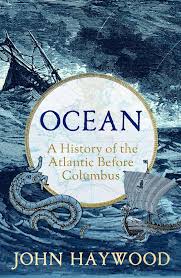
I read this courtesy of the publisher and NetGalley. It’s available now.
Broad sweeping history like this, even when done well, is both very intriguing and enjoyable to read, and occasionally frustrating. As long as you know what you’re reading, you can get around that.
To get the frustrating bit out of the way: the book focuses almost entirely on the European experience. It touches briefly on Africa, and even more briefly on the Americas, but largely through a European lens. Now, I am sure that this is partly a dearth of written records – but a significant portion of the book is about pre-history and/or relies on archaeology, so that doesn’t hold as a reason. I would have less of a problem with this if the book itself made clear it was “the European Atlantic,” but it doesn’t.
So, on the understanding that this book is largely about the European experience of the Atlantic before Columbus sailed across it, this is a pretty good book! It’s a survey, so it covers an enormous swathe of time and, within the European bounds, a broad range of cultures too – which does mean it doesn’t have really nitty-gritty detail, but that aspect is entirely expected.
Having recently visited Skara Brae, on Orkney, I was delighted to discover a section on that site, and to learn more about what it reveals of how Neolithic folks used the ocean. Haywood covers what we can know about how humans have eaten from the ocean (isotopes in bones, how amazing), as well as – when the literary sources exist – how they thought about it, used it in myths and stories, and so on. And then of course there’s sailing, for a variety of reasons and in a variety of vessels.
I left this book intrigued by the different ways people have used this ocean over time. I generally enjoyed Haywood’s writing style, and think this is accessible to the general reader.
History of Writing
Finally finished this today – you know how it is when you’re nearly finished a book, but the last half a chapter just seems like such a slog… yes. Well, that’s exactly how I’ve felt with this book, much as I have enjoyed it.
Let me get the gripes out of the way to start with. Lack of definitions irked me. Maybe Steven Roger Fischer is only writing for experts – although it doesn’t really seem like it – but he talks about graphemes and logography and other such words and doesn’t give a definition for any of them until about chapter 5, and then only defines a couple! So that was a bit annoying. I also should say that I didn’t entirely understand all of it; part of that is me – I am definitely not an expert in the area, and some of it just went over my head, as I knew it would – but some of it is Fischer: while he mostly writes plainly, every now and then he got a bit carried away with fancy-pantsed academic language that may not have been necessary.
Anyway… the first chapter is “From Notches to Tablets” and the second “Talking Art” – fairly obvious what they’re about. Mostly concentrating on the Mediterranean and Mesopotamian area (Fischer is a proponent of the idea that ‘complete writing’ started in just one place, Sumer, and developed everywhere else because of foreign influence), it looks at why complete writing developed, and how, and the advantages that came because of it. Knots, notches, pictography… humans really are quite creative. In the development of writing I particularly like the idea of the rebus – smart cookie, whoever realised that you can substitute a picture of one thing for something else that sounds the same but means something else (eg a bird’s bill for Bill).
Chapter 3 is “Speaking Systems,” It looks at the dissemination of writing throughout the Mediterranean and into India, Phoenicians and the Middle East and all. Basically tracing how syllabaries (where a sign represents a syllable) developed and influenced one another.
“From Alpha to Omega” is the fourth chapter, and there are no prizes for guessing its emphasis: the Greek alphabet. From Greece to the Etruscans to the Romans, and then on into all areas conquered by them, is the story told here. Mention is made of Ogham, Slavonic scripts, and Gothic script too. Very interesting, and lots of pretty pictures showing different writing styles.
Fifth is “The East Asian ‘Regenesis'”, which mostly looks at Chinese writing – its development, changes, and how it has influences cultures within its orbit, such as Vietnam, Korea, Japan and Mongolia. I had already read about the Korean script somewhere else, but the story of it being developed in the 1400s by the king (or at least under his aegis) is a brilliant one. And I had no idea just how complicated Japanese is… crazy, the amount of stuff Japanese kids have to learn just to be literate! And my students complain!
“The Americas,” the sixth chapter, is not one I had expected to be very long, but it was actually quite involved. It looked at who might have had writing when, who influenced who, and what role writing might have played in the different Mesoamerican (primarily) societies. The Spanish have a lot to answer for, with regard to destroying Aztec records, but then I guess we knew that.
Penultimately, “The Parchment Keyboard” looks at the development of handwriting styles in Europe basically from Charlemagne on, the dissemination of them and literacy more generally, and then the development and impact of printing. It always amuses me that we place so much emphasis on Gutenber, in the West, when the Chinese had been using paper and block printing for centuries before him. The joys of Eurocentrism…
Finally comes “Scripting the Future,” which is Fischer’s attempts at prognostication, for the most part. What the impact of computers will be, the likely success of trying create a ‘visual language,’ and the scripts that will still be around in 400 years.
This is a very, very brief overview of the book. I really liked that, in general, Fischer was not triumphalist, smug or assured about the overwhelming use of the Latin-based alphabet. Indeed, he went out of his way to emphasise that this is not necessarily the ‘best’ alphabet – pointing out a lot of the problems with it, calling it deficient, which I liked – and holding up the longevity and usesfulness of Japanese writing systems (three of them!) in contrast. It is mostly readable, and reveals things about writing that I had never thought about. Good for nerds who like thinking about the way things are done, and why, and the history of things we take for granted.

 Randomly Yours, Alex