So Silver Bright
This review contains spoilers for the first two books, but not for this one.

I am pleased to have finished this series! Having the questions of whether Bertie’s parents could or would ever get back together, or even whether she would ever see either of them again; and whether she would end up with Ariel or Nate (or neither? or both?! – as River Song would say, that is a whole other birthday…) in the end were driving me a bit nuts.
And now I know how Mantchev resolved it. And if you haven’t read the books, you don’t. So nyer.
The story opens with Bertie dealing with the aftermath of how she dealt with Sedna, the Sea Goddess, and its repercussions for her father, as well as Nate – whom she has rescued – and Ariel, to whom she is kind of now married… as well as being married to Nate. Um, oops. So, it’s back to the Caravanserai, but not for long because she receives a summons from Her Gracious Majesty to perform before her, and so the journeys of this crazy little troupe continue. They involve bandits, a queen, several tricky journeys, the use of magic, gaining and losing companions, and finally a return to where everything began, the Theatre Illuminata.
The plot is generally well-paced, and there were some clever twists and turns to it. As far as characters go, Bertie did not grow on me further. I really liked her in Eyes Like Stars, the first novel; then she got a little grating in the second, as it didn’t feel like she was quite taking charge enough. By this time, even though it’s only a few weeks after the events in the first story, she has… evened out, maybe? Although she is still being pushed around by the winds of fortune (heh), she feels more balanced, and at the same time more willing to take necessary risks. I don’t think I’m explaining this very well, but the upshot was I think that I like and respect her more in this story, certainly by the end, although I’m still not convinced I’d like to know her in reality.
The rest of the cast don’t change that much, with the exception of Ariel. Nate develops more as an individual because he actually has some page-space, which his kidnapping had largely disallowed for the last book and a half or so, but he doesn’t exhibit any unexpected character traits like sea-sickness or being a mathematical genius. He remains a loyal friend, and a good friend, which is exactly what he should be. Waschbar is probably the most intriguing and underdeveloped of all the characters, with his determination only to steal unwanted items… and just wait til you meet Varvara. But then there’s Ariel, who is developed in this story. We finally get more of an insight into his motivations (aside from lusting after Bertie like nothing else), and that’s unexpectedly poignant (much as I dislike the terminology, I have always been Team Nate).
Finally there’s the fairies, who continue to be awesome and pastry-lusting and crude. Just for bonus marks, there is a marvellous exchange between Moth and Peasablossom on the question of vampire bats: “Don’t be ridiculous… Vampire bats don’t sparkle.” “They do! They’re a great glittery menace!” Ah fairies. So snarky. So true.
The Selected Works of TS Spivet
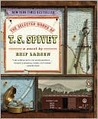 I came to this book really expecting it to be speculative fiction. I don’t know why; I’ve been meaning to read it for years and all that time, I was quite convinced that it had a fantasy element to it. And I guess it sort of does, in that it’s an entirely unlikely story, but it’s not the out-and-out fantasy, or even the Charles de Lint-ish fantasy, that I was expecting. I really liked it though, and I thoroughly enjoyed the marginalia – in fact it’s this element that really makes it stand out.
TS Spivet is twelve years old. He’s also a cartographic genius, and obsessor. He maps everything: from the way the water moves across his parents’ property, to the motion vectors of a man on a bucking bronco. His artistic skill extends to drawing insects and animals and probably anything else that captures his interest. But it’s maps he loves the most.
Life is already difficult for TS as the story opens. His parents are being difficult, which is nothing unusual really; his father appears disappointed in him for not being more like his outdoors-y brother, his mother is obsessed with insects, and… well, that would be a spoiler. It’s just not all sunshine and joy. And then the Smithsonian calls, asking him to come and visit them because of his amazing drawings that have made their way to that hallowed institution. So TS takes off, across the entire US, to get to the Smithsonian where he feels he might be appreciated and where he can do some good.
(This is where I was expecting some fantastic element. I think I was hoping for something like in Libba Bray’s Going Bovine. It didn’t happen. It’s still a good story though.)
TS is an… interesting… character. I hadn’t expected to be quite so enthralled by a twelve year old character, and the reality is that he doesn’t act like one. He’s an innocent, in his expectations of people and his trusting nature, which is occasionally abused by adults who are just trying to get their own way. But at the same time he has, and develops, a canny sense of the world.
I enjoyed the story as a whole, of TS’ journey – and I have no idea about the places in America he travels through, but I hope Larsen has captured something of their true spirit, because it certainly feels that way. However, probably my absolute favourite part was reading about TS reading his mother’s journal about one of her husband’s ancestors, Emma Osterville. A woman like TS in many ways, precocious and fascinated by the natural world, who becomes a geologist. In fact I was so taken in by this story, and it had just enough plausible elements, that I did indeed google her… only to discover that she is as much Larsen’s creation as TS. Oh, so sad.
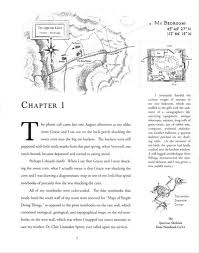 Aside from the somewhat-fey TS, the element that really sets this book apart is its physical nature. Many of the pages look like this, with marginalia and arrows added in – usually just on the sides but sometimes top and bottom too. They elaborate on various points of TS’ life and family; they include a number of his maps and other drawings; and generally provide a commentary that would otherwise be difficult to include but without which this would not be nearly so rich. Think Terry Pratchett’s footnotes, but more visual.
I can definitely recommend this to readers of young-adult fiction. While it isn’t fantasy, it does have that vibe about it; it will also appeal to those who dislike fantasy, and want more ‘mainstream’ literature. The prose is easy to read, elegant, and occasionally poetic; the illustrations add a great depth and joy.
Pure, by Julianna Baggot
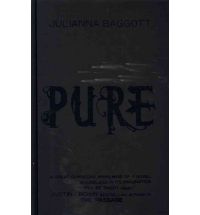
The cover is as difficult to look at IRL as it is here. I like it, it’s clever, but I do wonder whether it will be detrimental to the cause.
This is unashamedly a dystopia – an post-apocalyptic one even – set in the not-too-distant future. Pressia lives with her grandfather in the ruins of (I think) America, where day to day life is a struggle: for food, for shelter, and not unnaturally for any sort of meaning to life. Not only has infrastructure been destroyed and food contaminated, but the people themselves have been intimately changed by the probably-nuclear destruction a decade or so before. Pressia was holding a doll at the time of the detonations; along with scars and other injuries, its head is now her hand. And she could be said to have got off lightly: consider those who were walking a dog. Or holding another person.
This is the truly breathtaking, and the truly frightening, part of Baggott’s worldbuilding. Her conception of how people might learn to cope with surprising, disfiguring and debilitating changes to their bodies is clever and largely sympathetic. Of course, it’s not like there isn’t precedence for this, since people in our world do exactly the same. There are some people that she imagines as pretty awful, but being part of a ‘Groupie’ – an amalgam of multiple people – would likely send anyone mad, so it’s not surprising that they would be vicious. I was especially fascinated by the Dusts, people who have melded with the ground in some way; it’s a horrifying thought and Baggott fortunately does not overuse them, keeping them instead for relevant moments in the story. The question of how these melds could possibly function is only lightly touched on in the story, but I didn’t find that detrimental; it’s a bizarre concept but it’s become such a normal one for Pressia and the others that I, at least, got swept along by that acceptance.
Pressia’s point of view is countered by that of Partridge, who lives inside the Dome: a place of refuge which protected some lucky people from the detonations, and where they continue to live without fear – of the environment anyway. These are the ‘Pure’, because they are still pure human beings, unlike those on the outside. The different reactions of people on the outside looking at the Dome, and vice versa, is nicely captured by Baggott: the variation of adoration to hatred seems quite plausible. It’s not an original idea, and reminded me particularly of some of Sara Genge’s stories from a few years ago (“Shoes to Run,” especially, if memory serves (which it may not)), because of its depiction of the people outside wondering about the people inside. Anyway, Partridge may have a life of food and education but of course not everything is hunky dory. His family life especially is a mess, for a variety of reasons, and he is growing restless – something living in a Dome can’t really cope with. Interestingly, there’s not really one major crisis that makes Partridge finally act, but a series of small ones, like pebbles leading to an avalanche. And an avalanche there is, and Partridge ends up outside the Dome.
Pure could be split roughly into thirds: the first third, worldbuilding and characters; the second, bickering and a few new characters; the last third (actually a bit less) crazy crazy action. I really enjoyed the first part, because the world is intriguing and horrifying and different (at least outside the Dome) and Baggott realises the daily routine stuff quite nicely. I wasn’t especially fond of either Pressia or Partridge, but that didn’t stop me from enjoying their adventures and interactions with others. The second third, however, definitely dragged. There is some action, and some fascinating new characters such as El Capitan, who even gets his own point-of-view chapters. However in general it felt like a lot of to-ing and fro-ing that didn’t advance the story sufficiently for the space it was given. There are some interesting character moments, especially for Pressia, regarding temptation and the easy way out, but they weren’t sufficiently capitalised on. Finally, the last 100 or so pages (of 434) rushed by seemingly at light speed, as revelations were made and discoveries unveiled and yet more characters came on the scene to have a Really Big Impact. While this was an improvement over the middle, it left me with a rather unpleasant sense of confusion, and of being rushed.
I definitely enjoyed this novel, almost exclusively for the worldbuilding; however I don’t think I will be rushing out to buy the sequel, should it be published (this is the first of a ‘projected’ trilogy).
Galactic Suburbia: now half a century old
 In which we leap happily back and forth (with occasional ranting) over those fine lines between feminist critique and anti-female assumptions, plus share our bumper collection of holiday culture consumed. Happy New Year from the Galactic Suburbia crew!
NEWS AND LINKS
Hugo nominations open and we’re gonna have our say
Aqueduct Press will be publishing Brit Mandelo’s thesis, “WE WUZ PUSHED: On Joanna Russ & Radical Truth-telling”!
Islamic superhero comic turned animated series The 99 to screen in Australia (ABC3)
Amanda Palmer’s wedding post
Great piece on how the very idea of ‘Mary Sue’ is sexist, ties into this episode’s theme about the criticism of female characters.
The wealth of powerful girl heroes in today’s YA
WHAT CULTURE HAVE WE CONSUMED?
Alisa: Shades of Milk and Honey, Mary Robinette Kowal; The Freedom Maze, Delia Sherman (with cover art by Kathleen Jennings); The Vampire Diaries; Primeval; The 99; Planetary; Homeland and Boxcutters.
Alex: The Double Life of Alice Sheldon, Julie Phillips; Changing Planes, Ursula le Guin; Perchance to Dream, Lisa Mantchev; Twilight Robbery, Frances Hardinge; Chronicles of Chrestomanci vol 1, Diana Wynne Jones. DOA and Going Postal.
Tansy: The Freedom Maze, Delia Sherman; Beauty Queens, Libba Bray; Snuff by Terry Pratchett, Going Postal (TV) – Batman (animated) & My First Batman Book by David Katz, David Tennant & Catherine Tate in Much Ado About Nothing (DIGITAL THEATRE DOWNLOAD AWW YEAH).
Please send feedback to us at galacticsuburbia@gmail.com, follow us on Twitter at @galacticsuburbs, check out Galactic Suburbia Podcast on Facebook and don’t forget to leave a review on iTunes if you love us!
Perchance to Dream of theatres and adventure
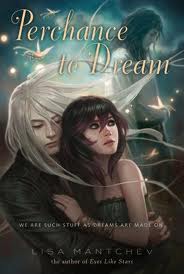 A delightful read, although not as good as the first in the series, Eyes Like Stars. (This discussion contains some spoilers for that book.)
Having discovered who her mother is and wanting to rescue Nate, who might be the love of her life and has been kidnapped by the Sea Goddess Sedna, Beatrice Shakespeare Smith – Bertie – sets out into the world with four miscreant fairies and one devious air-elemental. And this is where one really big difference between the first and second books occurs: the setting. Where the casual magic of the Theatre Illuminata kind of made sense because it’s a theatre, and it seems to occupy a space not really connected to a particular time or space, the ‘real’ world is meant to be just that. So the magic of Bertie’s words, and of some of the other characters met along the way, seemed slightly more out of place. Perhaps this is because I was expecting the story to be more grounded in particularity – perhaps Bertie’s ‘real’ (non-theatre) world isn’t meant to be any more ‘my’ real world at all.
That’s maybe a quibble, but it did still sit at the back of my mind gnawing a bit. There were a couple of other things that gnawed, including Bertie’s relationship with and attitude towards both Nate and Ariel. I’m not a fan of the love triangle at the best of times, and this one made me uncomfortable because I couldn’t tell which one I thought she would, or should, end up with! Perhaps silly, but there you go. I also occasionally had difficulty telling whether something was actually happening to Bertie in the real world, or whether it was a dream, or if it was happening for real but in an other place. It may well be that Mantchev was blurring boundaries deliberately, but I found that this confusion threw me out of the story occasionally.
Nonetheless, I did enjoy this novel. Mantchev has a delightful turn of phrase and it’s fast-moving enough that I basically read it in a sitting (helps that I am on holidays). Bertie continues to be an enjoyable and engaging heroine, who develops by necessity as she encounters difficulties and as she considers the holds that people have on her, and how to be her own person. The fairies are still winsome and incorrigible, and have renewed my own interest in pie. Ariel… continues to be problematic. I don’t especially like The Tempest, but should I ever bother to see it again I will certainly have difficulty viewing him without Mantchev-glasses (I will also suffer from Dan-Simmons-glasses when watching Caliban, so maybe I really ought not to see it again. Oh so sad). The plot, as I said, was fast-moving and had some fun bits, but I think suffers with comparison to the first book. That was so tight, and focussed around one really core issue, that it felt utterly of a piece. Here, although rescuing Nate is central, the action feels more episodic and bound together much more loosely.
I’m intrigued that there is a third (and, I think, final) book in the series; it will be very interesting to see where Mantchev takes Bertie et al next.
Twilight Robbery: the new(ish) Frances Hardinge novel

Reading Frances Hardinge is all about Saracen, for me. Saracen the evil-eyed bully-boy goose.
Of course, there is also Mosca, his owner. This is a world where so many little gods – the Beloved – are worshipped that rather than having their own day, the Beloved have certain hours of a day devoted to them; being born in a Beloved’s time determines your name and, in people’s eyes, your very nature. Mosca was born at the time of Palpitattle, He Who Keeps Flies out of Jam and Butterchurns – Lord of the Flies, if you will. It is an inauspicious name, to say the least, and Mosca’s fierce black eyes and equally fierce temper, and occasional propensity for playing fast and loose with the strict letter of the law, do not help her case. Nor does her ownership and protectiveness of a certain winged warrior. She is wonderful.
There’s also Eponymous Clent, Mosca’s… well. Friend? Protector? She wouldn’t like either of those terms. Co-conspirator, perhaps; ally, usually. Swindler, con-man, runner-away-from-debts and hater of Saracen, Eponymous can usually be relied on to talk his and Mosca’s way out of the trouble that he or she has managed to talk them into. Except at the beginning of this story, where he is in a debtor’s prison and for some reason the town doesn’t seem willing to accept poetry in lieu of actual currency.
Saracen plays a small, though vital, part in the story, just as he did in the preceding novel, Fly By Night – one of my favourite YA books. This time, despite the important role Mosca and Eponymous played in Mandelion, they find themselves once again on the road with little coin for bread or board. Deciding to head for the other side of the river, they find themselves in Toll, a town which prides itself on having the only real bridge across the Langfeather. As with many towns with such a precious commodity and monopoly, Toll is pretty smug. It’s also really, really weird, with some serious discrepancies between Toll-by-Day and Toll-by-Night, which of course Mosca and Eponymous and Saracen end up finding out all about. They just can’t seem to help themselves; start off with a good con or maybe a chance at a reward, ending up uncovering all sorts of interesting things that all sorts of interesting people would prefer to keep covered, thanks all the same, and can I roast your goose?
Hardinge has a wonderful way with words, and is a deft hand at descriptive prose; she’s created a really interesting world here. It’s a fantasy insofar as it’s not our she’s writing about; but at the same time there it’s not magical, nor steampunk. It’s just a world maybe on the cusp of the Industrial Revolution, quite comfortable in itself as a rule even if most cities and provinces aren’t entirely sure who should be ruling them. I really hope there is more Mosca Mye to come.
I Shall Read Midnight
(Sorry, couldn’t help myself with that post title.)
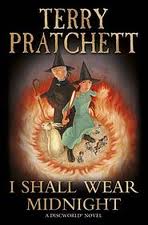 Is it heretical of me to say that I didn’t like this as much as other Pratchett novels? I feel bad for saying it. It’s certainly not that I disliked it – far from it – but I didn’t feel like it flowed as well as some of the other recent stories have.
Overall, I have loved the Tiffany Aching books a great deal. I love that we have followed a character from the age of eight or so, as she discovers that she has to do something that will set her apart from everyone else, and then goes through with it anyway. I love that that character is a girl. I love the way Pratchett has played with and inverted all sorts of tiresome notions from fairy stories and society more generally in writing these stories. I also love that Tiffany is a witch, because I adore the very concept of Headology.
Plus, Nac Mac Feegles for the win.
My issue is not with Tiffany. She continues to be a largely awesome character, who while dealing with adolescence can see the light at the end of that particular tunnel; who has mostly come to grips with being a witch, the burdens of that job and the expectations and responsibilities, while still being human enough to get intensely irritated by them sometimes. Many of the other characters were also brilliant – HELLO Granny Weatherwax and Nanny Ogg, making a comeback appearance! And a new witch, Mrs Proust, who is… all sorts of interesting. I would like to see her interacting with Vimes and the Guard. Or possibly Sybil. Plus the wonderful Preston, who is a totally ridiculous guard.
Also, Nac Mac Feegles. And more of Jeannie, the kelda, whom I love to bits. I love her attitude towards the Feegles… possibly because it reminds me of the way I would like to think that I deal with my students, it occurs to me.
Part of my trouble with this story is with the plot; not the details, but in some of the ways it gets places. There’s a feeling of disconnect between some sections, of moving too abruptly from one idea or action-scene to the next, which made me less than comfortable. I liked the vibe overall, though, of dealing with gigantic issues from history (quite literally) at the same time as dealing with very personal issues. The combination of “all witches are eeevil” with “how will I live with being a witch?” made a lot of sense, and the two complemented each other nicely.
My other minor issue was a feeling of repetition. Now I know, and usually enjoy, Pratchett’s habit of repetition – of phrases turning up again and again, of repeating information with slight changes in phrasing or emphasis. But, and I can’t point to exact instances so you’ll just have to believe me, here it fell a little flat. Perhaps there wasn’t quite the same twistiness, or… I don’t know. It just missed the mark a few times.
Still, it’s an enjoyable book, and I have no hesitation in recommending it. Because, yo, Nac Mac Feegles.
The Sending: Obernewtyn book 6
This review contains spoilers for the previous five books.
It’s important to say at the outset that this is not the book I thought it was.
This is not the final book of the Obernewtyn Chronicles.
I knew that Carmody had wanted to split the last book in half, to properly tell Elspeth’s story; I thought that meant books 5 and 6. No. It meant books 6 and 7 – number 7 being The Red Queen, due out next year. I realised that this book could not be the final one with around 100 pages (of 750) to go. Having just inhaled the other five in preparation for a grand finale, it’s fair to say that I was a little peeved when I came to that realisation. I will try not to let this frustration colour my review….
Let’s recap where we left Elspeth and the Misfits in 2008, with the last book (The Stone Key). Dragon, heir to the Red Queen, is missing, as is Miryum the coercer-knight with the body of her would-be suitor Straaka.The farseeker Matthew is still a slave in the Red Lands. The rebels have destroyed the Council and set up a democracy in its place, with many of them being elected in their cities; the Misfits are slowly, slowly being accepted by society. The Herder Faction has been routed from Herder Isle (sorry, Norseland) thanks to Elspeth. Elspeth has broken Ariel’s hold over Rushton, so there’s no more agonising over he loves me/he loves me not. Sador is basically friends with the Land, and they’ve agreed to send ships to the Red Land to help stop Salamander and the slave trade. Anything else? Maruman is as cranky as ever and oh, Elspeth is only a little closer to having all the necessary keys for stopping a second holocaust from happening.
Elspeth’s quest as Seeker has dominated the plot of the last couple of books; her attempts to find the keys and signs Cassandra left behind have been the motivating force behind most of her actions. Either that, or instructions from the futuretellers, which themselves generally move her quest forward too. The pattern seems set to continue here, with Elsepth having raced home at the end of book 5 on instructions from the oldOnes. Then, for the first half of the book, she finds that she must hurry up and wait as Seeker, while fulfilling her function as Guildmistress and master of Obernewtyn in Rushton’s absence. Important things are happening around her: politically, there are moves to ensure Obernewtyn’s place in the Land is confirmed; people come and go, unexpectedly or not; relationships are formed and changed and, in some cases, severed. But the Seeker’s quest seems a bit stalled, because although the ships are getting ready to go to the Red Lands, where Elspeth and futuretellers have seen Elspeth and Dragon together, Elspeth does not have all of the necessary keys to stop Sentinel from awakening. Plus, Dragon is still missing. Which is a problem.
The first half is light on big action scenes. Some of the most interesting action continues to happen in Elspeth’s dreams, where she learns yet more about the Beforetimers, Cassandra and Hannah (although I was disappointed to see that the publishers have altered the formatting, such that the dreams are no longer in smaller type; this was a marvellous way of making such an experience obviously different from the waking world). That’s not to say that I didn’t enjoy the first half, because Carmody is by and large a skilful writer who makes it very easy to convince one’s self to ‘just read one more chapter’ (although her love scenes are a bit perfunctory). And as I mentioned, there are important things happening – it’s just that most of them in the personal arena, which the Obernewtyn Chronicles really focus on the most. While there have been major battles and a revolution in the preceding books, Carmody has shown herself to be far more interested in people: how they react to falling in love, losing a loved one, meeting foreigners, having prejudices challenged, or running a small community. Or, indeed, being told that you are the only hope for the world in the face of a second holocaust (no pressure). I do think that this volume could have been trimmed down, because there was a lot of repetition of Elspeth bemoaning her fate and going over and over the things she has learnt and still must find out. I understand that that’s probably quite realistic – humans, as Maruman is fond of saying, do constantly gnaw at things, usually unhelpfully. It just got a little boring.
The second half changes things, although I can’t explain how or why without spoiling things terribly. Just take my word for it. There’s a bit more action, a few revelations and a couple of resolutions, as well as a whole new raft of problems to deal with. Unsurprisingly. There is some character development, although Elspeth’s development as a human has stalled somewhat. She doesn’t seem to change much any more, especially in comparison with the first three books. Perhaps that’s an unfair comparison, given she was in her late teens then and there were major upheavals in her life to force change – but I certainly didn’t stop changing when I got to my twenties. Perhaps this too is a result of her quest having not quite stalled, but certainly slowed down.
I have been and remain determined to see Elspeth’s quest to the end, but it would be harder to continue reading if the world’s history were not so enthralling. It’s a post-nuclear holocaust world, and I love that, unlike a book such as John Wyndham’s Chrysalids, mind powers are not a result of mutation caused by that holocaust. Carmody keeps revealing more and more of the Beforetime, the end of which is some time – possibly centuries – into our own future. (It’s depressing to think that there might still be a need for a balance of terror at that point.) The hints that Carmody gives about cryogenics, and gene storage, and computers, are really cleverly done. I seriously hope there is resolution of Cassandra’s story, and Hannah’s, as well as Elspeth’s, in Red Queen. The world itself – or at least ‘the Land’, where Elspeth lives – is perhaps a little hampered by having initially been developed by Carmody as a teen; I don’t find it that rich or compelling. The lands of Sador and the Red Lands, introduced later in the series, are certainly more foreign and interesting. (I presume I am not the only one who spends half their time trying to figure out where in our world these places correspond to.)
This is not a stand-alone book, so do not pick it up if you’re curious about Carmody’s work. If you have been on this journey with Elspeth for a while now and are desperate to see just how Carmody is going to tie all of those threads together, then of course you have to read it… but, I would suggest, wait for the last book to be published.
Ashling
Spoilers for the first two Obernewtyn books.
 Ashling. The point at which Carmody’s editor said, let’s make it big! Sigh. 520-odd pages is large. Still, she is a page turner, so it didn’t take me that long to plough through it a second time.
The book opens with a halfblooded gypsy about to be burned at the stake by a Herder, which is nicely dramatic and also introduces the gypsies themselves, who have only been vaguely alluded to in the previous books. Here, beginning with Elspeth’s rescue of the gypsy woman (oh come on, that’s not a spoiler; as if she could ride past and let it happen!), gypsies and their place in the Land play a large, and intriguing, part. And so does Dragon, the mysterious child discovered in the Beforetime ruins who turned out to be an immensely powerful coercer.
The narrative continues to follow Elspeth and her somewhat torturous groping after her destiny as presented to her by the Agyllian birds, as well as the Misfits of Obernewtyn striving towards acceptance, or at least not open hatred, in the Land. For Elspeth this means travelling away from Obernewtyn for much of the book, meeting new people – gypsies and foreigners amongst them – and experiencing a wide variety of responses to herself and the things she has to say. For the Misfits it means confronting the unTalented rebels also present in the Land, and whether the Talented have a place with them or not.
The word ashling refers to a sort of dream, and dreams play a prominent role here, especially when Elspeth discovers the dreamtrails. This is a really interesting aspect of the world Carmody has created for her Talents, although not many can access them or understand how they work.
This is a third book in what has turned out to be a six-book series, and to some extent it suffers from classic middle book syndrome. It doesn’t really start anything, and it certainly doesn’t bring any real resolution (except in one matter). It definitely doesn’t stand alone, not least because there’s not much effort to explain Obernewtyn and the Misfits, because much more infodump would have made me very impatient. What it does do well, though, is character development. Elspeth is of course the focus – she’s telling the story, after all, and apparently the fate of the world actually does rest on her. But other characters do become more well-rounded. Dragon, the foundling who is gradually being civilised; Matthew, the impetuous and romantic farseeker, has a big role to play; Kella, the healer, whose feelings and attitudes are perhaps the most complex of the lot. And then there’s Brydda, the rebel, who plays Big Bluff Larrikin but whom Carmody rescues from buffoon by giving him gentleness and wisdom as well.
It’s not a perfect book; it’s definitely a bit slow going in some parts, and could have done with some better editing. Still, enjoyable.
Eyes like Stars
 The premise: a theatre set in NoParticularTime, inhabited by every character of every play, who come on stage to perform when their scene is announced. Also inhabited by appropriate backstage personnel, and Beatrice Shakespeare Smith, an inappropriate foundling who loves the theatre (her home) with a passion and who is followed around by the Midsummer Night’s Dream fairies, who are as crude and rambunctious and loyal and awesome as (William) Shakespeare would have wanted. Also, two love interests. With this sort of set-up it would have been hard for me not to be completely in love. Happily, Mantchev does not disappoint.
Beatrice – sorry, Bertie – is a wonderful heroine, defiant and strong-willed, fiercely loyal and amusingly devious. She causes all sorts of mischief in and around the theatre – enough that eventually, she might have to leave, unless she can prove herself. This is a coming of age story, with Bertie discovering her gifts and talents and likes and dislikes, as well as dealing with how other people react to her and act on their own. She faces loss – new and old – and disappointment, confusion (especially about love) and revelation, and the glory of strong and true friendship. Basically, it’s all the good and bittersweet bits of the classic coming of age, in a marvellous and enchanting package.
I loved the Theatre Illuminata. I love the way the scene changes work, I love the irascible backstage types and their petty feuds. I was delighted by how Mantchev took mostly Shakespeare’s characters and used them on stage but also imagined them as people outside of their scenes (much like Rosencrantz and Guildenstern does, without the loopy philosophising and dialogue…). The characters from Hamlet were especially amusing, playing on and reflecting so many of the tensions that can easily be imagined from the play itself, and that might arise from the people playing those characters day in, day out. It’s just really clever. And then there’s the fairies: Cobweb, Mustardseed, Moth, and Peaseblossom. Pulling hair, mooning important people, eating all the cake… it’s all in a day’s work, really, and there better be cake after, too. Oh, and Ariel. I am not a huge fan of The Tempest, but I’ve read and seen it; I loved Dan Simmons’ play on Caliban in Ilium and Olympos… but I’ll never be able to see Ariel in the same light again. (Huh; this connects with Obernewtyn, by Isobelle Carmody, which I’ve also just read. Interesting.)
How much did I love this book? I’ve just ordered books 2 and 3. I HAVE to know what happens.
Slight spoiler: One thing bugged me. She’s all hung up about her mother, and wanting to find her mother, but she doesn’t seem worried about her father until right near the end. This is a girl who’s grown up around Shakespeare, where half the time it’s the mother who is missing, but the father is present. Surely, when she knows neither, she should be curious about both? Also, growing up around those stories, shouldn’t she be wanting to know the romantic story of how they met?

 Randomly Yours, Alex