Sylvia Pankhurst
Recently I’ve been really getting into the history of the women’s suffrage movement in Britain. There are professional reasons for this, but the reality is it’s been a simmering interest for a very long time. I don’t remember what grade it was, but I know I did a research essay on Emmeline and Christabel Pankhurst at school – to my teacher’s complete not-surprise – and was quite inspired. It was probably the first time I had felt that voting was actually something I ought to be interested in. And every now and then when I get discouraged by Australian politics and wonder whether it’s worth voting… well, I remember that although it was easier in Australia, women all over the world fought incredibly hard to get someone like me the opportunity to cast a ballot. Who the heck am I to throw that back in their historical faces?
One of the books I got in a rash of purchasing last year was Sylvia Pankhurst: A Life in Radical Politics. I knew Sylvia had fallen out with her mother and sister, and she went on to form her own (somewhat amusingly named) suffrage organisation, ELFS (East London Federation of Suffragettes). Thanks to a biography of Emmeline Pankhurst I knew a bit more about her politics, and her daring/disgraceful child out of wedlock. I also knew, although I don’t remember why, that she was incredibly important to mid-century Ethiopia, of all (seemingly surprising) places. There is, though, a whole lot more to her than these nuggets.
Mary Davis states right out that her intention is not to write a standard biography. Instead, she is aiming to look particularly at feminism and socialism in Britain in the first half of the 20th century via Sylvia. (She calls her Sylvia throughout, and justifies this with pointing that there were four Pankhursts active at the same time as suffragettes, and Sylvia was not the most famous. She also acknowledges that this is a problematic choice, which delighted me for its frankness.) What this book does then is look first at the development of the WSPU (created by Emmeline and Christable Pankhurst, Sylvia also involved); and then how/why Sylvia broke away as her socialist views conflicted with her increasingly right-wing mother and sister. Sylvia worked to meld her feminism and socialism, although this was incredibly difficult – a whole bunch of trade unions wanted nothing to do with feminism or helping oppressed women. As in so many cases, some of the oppressed don’t want to change the system; they want to get to the top of it and take advantage of it. When women eventually got the right to vote (some in 1917, all in 1928) Sylvia was changing her focus to the proletariat – she was a firm supporter, early on, of the Russian Revolution, and was involved in the Communist Party (well, one of).
Socialism and feminism were, if not acceptable causes, at least ones that other people clearly identified with. But Sylvia was also committed to more intriguing causes, which had fewer proponents in Britain at least: like anti-racism, anti-imperialism and anti-facism. Her newspaper was apparently the first in Britain to have a black journalist write for it. She spoke out on Ethiopia’s behalf when Italy invaded. These things got her some flak, as can be imagined, in Britain. But Ethiopia invited her to live there in the 1950s, and Addis Ababa has a street named after her, and her son still lives there (or did in 1999 when the book was published).
I love a good bio. Sometimes they can wander aimlessly, and sometimes they can focus too much on one aspect of a life. Davis’ approach seems, to me, to be the best of both worlds. It doesn’t pretend to be exhaustive; it does focus on one aspect, but that’s the whole point. And I really liked that it pointed out some aspects of British history, too, like bits of labour history that don’t often make it into mainstream historical narratives. In fact this is pretty much a checklist for the history of oppression: workers and women and black people are all covered, and all shown to have vital and real histories. Who knew? This book is a really great way into these areas of history, especially the suffrage/socialism aspect (and it’s only 120 pages long!).
Goldfinger
This review is part of Project Bond, wherein over the course of 2014 we watch all of the James Bond movies in production order.
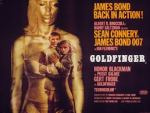
Summary: the greatest threat to the world is a gold-dealer who wants to irradiate the US’s stockpile of gold. Also, Pussy Galore has a Flying Circus. And Shirley Bassey manages to rhyme Midas with spider.
Alex: after two Cold War movies, we get one that’s entirely focussed on stopping a British citizen with a weird accent from destroying Britain and America’s ability to shore up the pound and dollar with their gold reserves. That’s an exceptionally weird premise for a movie made in 1964, and does not seem like the sort of thing that should lead to an exciting spy film of the sort surely already expected from the franchise.
Speaking of the franchise, this movie contains some of the most icon parts of the Bond oeuvre. It is in this film – in the opening sequence – that Bond zips out of a wetsuit to reveal a white tuxedo (after previously taking a fake duck off his head; it was his disguise). Felix Leiter is played by a different actor from the one that appeared in Dr No, hinting at the possibility that James Bond and his cohorts are not necessarily stable characters (… or that they’re Time Lords). Bond visits Q in his lair, and we get some snark and the admonition that the gear be returned in working order please, Bond. And Goldfinger and Bond share that immortal conversation:
Bond: Do you expect me to talk?
Goldfinger: No, Mr Bond, I expect you to die.
(Thank you, Randall, for this marvellous geeky take on the line). Bond also utters the phrase “heroin-flavoured bananas,” which for some reason hasn’t been as memorable.
There are several ladies featured in this film – more than in the previous two films together. Incidentally, Bond is making out with a nameless woman in the prologue when there’s an attempt at assassination (he sees the assailant reflected in her eyes, promptly turning her to take the
 brunt of the blow); he’s being massaged by “Dink” when he encounters Leiter for the first time (he dismisses her with a smack on the butt because they’re dealing with “men’s business). More seriously, Bond seduces Jill Masterson when spying on Goldfinger (for whom she works) – she’s the one that ends up dead from being painted all in gold. He encounters her sister Tilly; they don’t have time to get it on before she’s dead, trying to kill Goldfinger in revenge. And then there’s… ahem… Pussy Galore. Played by
 Honor Blackman, who by my reckoning might be the first appearance of someone who’s done the James Bond/Doctor Who double. Galore is a pilot, working for Goldfinger, and perfectly comfortable with his ostensible plan of making a very large amount of money by stealing it. Until she is wooed by Bond, that is, and SOMETHING MAGIC HAPPENS when they have sex but I’m not allowed to mention the trope that this is part of (even though James himself pointed it out during our viewing). What’s really
  awesome about Galore, though, is that she is entirely competent and self-assured (except when Bond is tripping her over and forcing himself onto her… which was way too close to that “she said no but she didn’t really mean it” thing… actually, it’s not CLOSE to it, it IS it.) And she runs a Flying Circus made up entirely of lady pilots, who are all also perfectly competent pilots, even in spite of having to wear black jumpsuits with serious Madonna cone bras underneath.
Yet again, this is not an entirely white film, which I still find intriguing. Of course, the roles for non-whites aren’t awesome… The best of them is Oddjob, Goldfinger’s manservant. Oddjob never really speaks; he grins a lot, and occasionally gestures while saying “Ah” – I’m not sure whether we’re meant to think this is Korean or what. Anyway, he has the coolest hat in the world, with a steel brim: he decapitates a statue with it, and knocks out Tilly Masterson (or possibly kills her. It’s not clear). There are also a lot of apparently-Korean servants running around to do Goldfinger’s bidding, none of whom speak, and a “Red Chinese” agent who has provided the dirty atomic bomb with which Goldfinger plans to irradiate Fort Knox.
Finally, in case we didn’t already know it, Bond is a snob. While having dinner with M and the head of the Bank of England, the latter deplores the brandy while the former doesn’t understand. Bond articulates its inferiority like he’s reading from a wine directory. But he’s also not above cheating, “playing games” with Goldfinger by switching his golf ball during their game of golf. Interestingly, he’s also shown as indecisive when faced with a ticking bomb. Obviously this was done to raise the tension – omg will Bond survive?!?!? – but the result is to make him dither over which wire to pull. And in the end, he’s not the one that disarms it. So he’s not all-knowing after all.
James:
As a young fella growing up watching James Bond I have to confess to being much more interested in the Bond Gadgets than the Bond Girls so I enjoyed seeing the genesis of Q Branch and the start of a long interplay between Bond and Q himself. Also, hello DB5 … perhaps my favourite of all the bond cars – the very car used in the movie was sold recently. Goldfinger introduces another recurring Bond theme, the apparently accidental ‘car race’ vs a girl down a mountain road; another childhood favourite. 2.5 Martinis.
Riddick

Some people will probably find this unbelievable, but I was disappointed by Riddick, the third in the Richard B. Riddick series.
Did Diesel and Twohy realise that Riddick was going to be such a badass when they named him Richard B. Riddick? It makes him sound like a cartoon character.
There are spoilers below, if you care.
I was disappointed to be disappointed, because I really like the first two films. I am so not the target audience of Pitch Black; I do not like horror, I do not tend to like creature features, I do not enjoy being scared. But Pitch Black… well, it has Claudia Black and Radha Mitchell, which helps. The planet and its creepy inhabitants are just so crazy that I liked them, and I found the interaction between the different sorts of characters – the scared, competent pilot; the wine snob; the drug-addicted cop; the imam; and the Riddick – quite enthralling. As for Chronicles of Riddick, I’m only a little embarrassed to say that I love this insane b-grade dystopic over-the-top sf action film. Hell, it has Karl Urban in awesome makeup, and it has mad sets, and Crematoria is spectacularly nuts as a planet. So going into Riddick, I thought – well, how bad can it be? From the ads it was clear they were taking the franchise back to the Pitch Black model, which is fine; I was expecting some equivalent fight scenes against humans and weird aliens, some snappy dialogue, maybe a plot. Also Katee Sackhoff!!
There were some entertaining bits, I’ll admit. That Riddick is now so notorious that mercenaries know his name, and the smart ones know to be terrified, allowed for some pretty amusing scenes. The aliens were indeed as weird and unlikely as I expected. There was a brief shot of Karl Urban in his eyeliner. Sackhoff (whose character is Dahl, which is a very unfortunate name) is kickass with a sniper’s rifle. That one of the mercenaries was actually there in order to get information about the drugged-up Johns from Pitch Black gave it something of a Die Hard 3 feel, which I really liked, and meant that it did actually tie into both parts of Riddick’s past. I was intrigued by the back-to-basics appearance of the film, back to the first appearance of Riddick; it seems to suggest that Riddick makes more sense in a mostly-fighting-animals world, rather than even pretending to fit in, or interact, with humanity like in the second. And that’s an idea worth exploring.
But.
Oh, but. The first third or so of the film is basically Riddick-as-Robinson Crusoe, which was weird. Especially the bit where he domesticates a canine because… does that kind of make the dog a replacement for Jack/Kyra? Also, Riddick with a dog? That he feeds and cares for? ?!?!? That was all a bit odd. And then the movie proceeds to the fighting-the-mercenaries bit, which is where the vague plot actually starts. And Dahl arrives. In a very tight outfit, with belts and straps that emphasise her bust even more. And half the time when the dialogue involved her, it was someone being sleazy. Even Riddick himself gets in on it, which shocked me enormously. The merc on the other team – fine, I understand, he’s a douche; that’s been established already, he doesn’t like a woman being in authority over him, and she can deal with him. It’s not nice, but the writers seem to think that that helps to establish him as being Super Bad. However, I honestly don’t remember Riddick being sleazy or misogynist in the other films. Did I miss something? He’s totally big-brother to Jack/Kyra – actually, not even that to Jack, he’s completely dispassionate. Maybe there’s a moment of maybe-electricity with the pilot, Fry, but no suggestion that they make out, as far as I recall. The comment that Riddick makes towards Dahl is just so crude that I was disgusted. Over at The Mary Sue, the argument is that Dahl – established as lesbian early on, in a moment that impressed me – uses her last line as a come-on to Riddick. I actually didn’t read it this way; for me, it seemed to reflect the situation they were in (a very intimate embrace on a rope hanging from a plane). Maybe I’m just in denial.
I am glad I did not pay to see this, but got to see it at a friend’s house. That said, Diesel has just announced the fourth movie… which makes my prediction of Riddick: the Search for Furya (based on the final 60 secs of this film) all the more likely. If they can get Karl Urban back into his eyeliner, I probably will go and see it. Because I am weak like that.

 Randomly Yours, Alex