The Eagle and the Lion: Rome, Persia, and an Unwinnable Conflict
I read this thanks to NetGalley and the publisher, Apollo. It’s out now.
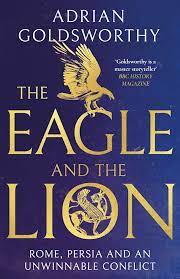
Some time back I read a book about the Mongolians, in particular at the western edges of their advance, and how those kingdoms related to what I know as the Crusader States. It completely blew my mind because I’ve read a bit about the ‘Crusades’ general era, and that book made me realise just how western-focussed my understanding had been: the invading Europeans connecting back to Europe and maybe Egypt (thanks to Saladin); maybe you’d hear about the Golden Horde occasionally. But interacting with the Mongols was HUGELY important.
This book does a similar thing for Rome. My focus has always been on the Republic and early principate, so maybe that has had an influence. But in my reading, Crassus’ loss at Carrhae is present but (at least in my hazy memory of what I’ve read), it’s almost like Parthia comes out of nowhere to inflict this defeat. Persia then looms as the Big Bad, but I think that dealing with the Germanic tribes and the Goths etc seem to take a lot more space. Even for the eastern empire, which is definitely not my forte, regaining Italy etc and fighting west and north (and internally) seems to get more attention.
And then you read a book like this. It is, of course, heavily leaning in the other direction; that’s the entire point, to start redressing some of the UNbalance that otherwise exists. These two empires could be seen as, and describe themselves as, the “two eyes” or “two lanterns” of the world (those are Persian descriptions); for basically their entire collective existence they were the two largest empires in this area (China probably rivalled them at least at some points, but although there were tenuous commercial connections, they’re really not interacting in similar spheres). It makes sense that the relationship between them, and how they navigated that relationship, should be a key part of understanding those two empires.
Goldsworthy does an excellent job of pointing out the limitations in ALL of the sources – Greco-Roman, Parthian, Persian – and clearly pointing out where things could do with a lot more clarity, but the information just doesn’t exist. Within that, he’s done a really wonderful job at illuminating a lot of the interactions between Rome and Parthia/Persia. And he also clearly points out where he’s skipping over bits for the sake of brevity, which I deeply appreciate in such a book.
It’s not the most straightforward history book of the era. It covers 700 years or so, so there’s a lot of dates, and a lot changes in this time as well – republic to principate to later empire, for Rome; Parthian to Persian; countless civil wars on both sides. A lot of leaders with the same or similar names, unfamiliar places names, and all of those things that go towards this sort of history book requiring that bit more attention. I definitely wouldn’t recommend this as My First Roman History Book! But if you’re already in the period and/or area, I think this is an excellent addition to the historiography. Very enjoyable.
The Daughter of Doctor Moreau, by Silvia Moreno-Garcia
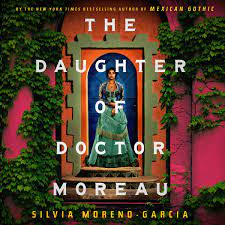
I don’t think I’ve read The Island of Dr Moreau – or if I have, back when I thought I should read some classic SF, it was so long ago that I have no memory of it. I know the basic idea of the story: an island, where Dr Moreau has been doing human/animal hybrid experiments; I think things go badly? That’s it. I assume Moreau has a daughter in that story, but honestly maybe Moreno-Garcia just added her in? I don’t know, and actually I don’t care. I’m sure that for Wells aficionados there are lots of clever little moments in this novel. I didn’t see them, and it didn’t make a lick of difference. This story is fantastic in and of itself.
It’s set between 1871 and 1877, in what is today Mexico – specifically, Yucatán, which (I have learned) has sometimes been regarded basically as an island due to both geography and history. The story is told from alternating points of view. One is that of Carlota, the titular daughter, a young adolescent at the opening of the story. The other is Montgomery Laughton, an Englishman.
Carlota has grown up at Yaxaktun, a remote ranch, where her father has been undertaking experiments in creating human/animal hybrids. He doesn’t own it; he has been supported by Hernando Lizalde, who is expecting to get pliant workers out of the deal. Her mother is unknown, and her companions have been the hybrids themselves, along with the housekeeper Ramona. She hasn’t particularly wanted to leave, and has had a fairly good if spotty education courtesy of her father.
Montgomery has been away from England for many decades, and has spent several years now vacillating between intermittent work and considering drinking himself to death. He arrives at Yaxaktun to be the new mayordomo, although whether he’s meant to be more loyal to Moreau or Lizalde is unclear. His tragic backstory is gradually laid out although it’s never played up enough to really make him the focus of the story; for all that he shares narrator duties, Carlota is absolutely the centre of this book.
As you might expect, things do not go as Dr Moreau would like. His experiments do not produce the results he desires – and whether that’s perfecting human/animal hybrids for themselves, or somehow finding ‘cures’ to human problems, is debatable. Lizalde gets impatient at the lack of results, and brings the threat of shutting Moreau down. And then there’s Lizalde’s son, who visits and meets the lovely (and unworldly) Carlota, which has obvious consequences.
Along with the main narrative is the real-world historical situation that Moreno-Garcia sets the novel against. It’s a time when the descendants of Spanish colonists are figuring out their place in this world, when the question of who will rule and what the country will look like is pressing. It’s also of course a time of deeply consequential racism – towards the ‘Indians’, the native Mayans, as well as the not-officially-enslaved Black and other non-white people who live in the area. All of this informs how people interact, depending on how they ‘look’.
Moreno-Garcia writes a wonderful novel. The characters are vital and vibrant, the story is well paced, and the historical context makes it even more nuanced and interesting.
A Question of Age, Jacinta Parsons
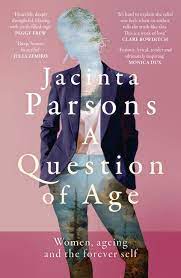
Not the sort of book I would gravitate towards; but I heard Parsons speak at the Clunes Booktown festival this year, on a panel about ageing – which was interesting itself – and I decided it would be worth reading.
This is in no sense a self-help book, as Parsons says in the very first sentence. It’s part-memoir, in that it includes a lot about Parsons’ reflections on her own life and experiences – growing up, living as a white, disabled, woman, conversations she’s had with women about the idea of age and ageing; partly it’s philosophical reflections on the whole concept of ageing, particularly for women; and it also bring together research about what age means in medical and social contexts, the consequences of being seen as ‘old’, what menopause is and means, and many of the other issues around ageing. I should note here that it’s not just ‘life after 50’ (or 60, or 70); there’s also exploration of the experience of little girls growing up, the changes from adolescence into adulthood, and then into ‘middle age’ and ‘being older’.
It’s a book that’s likely to make many readers feel pretty angry. Not at what Parsons is suggesting (in my view), but the facts that she lays bare. About the way that girls are treated as they mature; about the way ‘old’ women are treated; at the way ‘old’ bodies are viewed, and everything around those moments. It made me realise how privileged I have been, in either not particularly experiencing (or not noticing) a lot of the sexualisation that women experience, and in not having a career that’s geared in any way around my appearance. I had a discussion recently with someone who mentioned that they didn’t feel like they were allowed to let their hair go grey, as I am – that their appearance was too important in their (corporate) work, and grey wouldn’t fit the image. I felt so, so sad that that’s what the world is enforcing. (I have always delighted in my grey streaks; it’s only partly because I am too lazy to bother with colouring it.)
Parsons is at pains to discuss what her identity means in the context of ageing – being white, and being disabled, being cis; she strives to include the experiences of queer, trans, and especially Indigenous Australian women throughout. It’s not even 300 pages in length so clearly it’s not the definitive book on the topic: a book with the same origin written by an Indigenous woman, or a collective, is going to turn out very different. Parsons is making no claim to be all-encompassing and I liked that. This is a deeply personal book, while also including a lot of science and stats and other women’s voices.
In many ways this feels like the start of a conversation. To use a meta book analogy, this isn’t the prologue – we’ve been having these conversations and there’s been research done in some important areas – but it’s around chapter 1 or 2. There’s still so much more to explore, and to examine, around ideas of ageing. And individuals need to be having these conversations, too – older women with younger, as well as peers.
Very glad I picked this up.

 Randomly Yours, Alex