Die Hard, by Jon Lewis

I received this c/ the publisher, Bloomsbury.
Yes, this is a book. No, it’s not the book that Die Hard the movie is based on. (Yes, at least to some degree the movie is kinda based on a book. Ish.) Yes, this is an academic-ish take on the movie. Yes, I received this just in time for Christmas, and yes I am Gen X enough that this fact made me giggle-snort.
In under 100 pages, Jon Lewis situates the movie Die Hard within Reagan-era politics and economics. The way it sits within an America still coming to grips with its loss in Vietnam and the events of the American embassy in Tehran, among other things. And the way Americans view terrorism and terrorists, too, and how that connects to Hans and his crew – these things may not have been directly in McTiernan’s mind, but the zeitgeist is real.
The book also situates the film within the larger action movie oeuvre, and situates John Maclaine alongside and against other action-movie heroes. I did not know that the director also did Predator (and The Hunt for the Red October)! I had no idea that the white ribbed singlet – the wife-beater – so iconically (for me) worn by Maclaine was first made iconic by Brando in A Streetcar named Desire. But I can absolutely see how the libertarian hero – often but not always affected by experiences in Vietnam – were a significant feature of this moment in American cinema. The “hard-body” heroes of Stallone and Schwarzenegger are different from the slighter Willis – what that means for relatability is interesting – and I had no idea that Maclaine’s pithy quips almost certainly derive at least in part from Willis’ TV detective.
Lewis spends a surprising amount of time recounting the beats of the film – surprising because I assume no one is picking this book up who hasn’t already watched the film (possibly several times, maybe not necessarily at Christmas) – but does usually tie this narrative recounting in to his theorising. My one significant gripe is that in listing the “whammies” – the moments of violence that punctuate the story – Holly’s punching of the reporter isn’t mentioned. It’s not as excessively violent as other moments, and it doesn’t kill anyone, but it’s definitely a shock. And one of the threads that Lewis follows throughout is the question about whether Maclaine is a decent husband (no), and – I think by extension – a decent father. This moment shows Holly getting to defend the kids, rather than Maclaine.
Anyway: if you or someone you know has a habit of watching Die Hard for Christmas, or quoting any of the eminently quotable one-liners at dubiously appropriate moments, and they don’t mind a bit of broader cultural discussion this is likely to be a good book for them.
Artifact Space, Miles Cameron
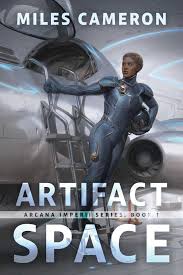
I received this to review courtesy of the publisher and NetGalley.
Is Marca Nbaro really just too good, too fast? Yes.
Is some of the ‘science’ highly dubious, and does much of the technology require quite a lot of hand-waving? Also yes.
Did I absolutely devour this book and am I eyeing off the sequels? Also yes.
Nbaro grew up in an orphanage, which was hell, and now she’s shipping out on one of the nine greatships of human space, the Athens. It’s all she’s ever wanted to do and be. Of course, getting there wasn’t at all straightforward, and the first few weeks aren’t straightforward either. And then when things settle down for her personally, things go very sideways for the ship.
One thing I appreciated, in my current need for not-too-confronting fiction, is that we don’t start off in the Orphanage. There’s enough to understand just how dreadful Nbaro’s life was there, but there’s no dwelling on the horror. Instead, this is a very smartly paced story: it’s basically the written version of an action movie, and it’s good at it.
I can’t quite figure out the politics behind the human world here: Nbaro hasn’t exactly joined the military – they’re a merchant service more than a military – but there are nonetheless marines, and the ship has weapons… everyone is encouraged to be involved in trade while they’re serving… it’s a weird mix of capitalism and socialism. Doesn’t really bare close examination, but at least it’s slightly different from unrestrained capitalism. Mostly.
Look, overall, this is a swash-buckling action novel with an outrageously clever and capable lead character who is nonetheless very appealing, and I enjoyed it a lot.
Taco, by Ignacio M. Sanchez Prado
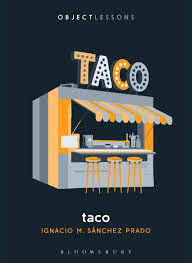
I received a copy of this from the publisher, Bloomsbury, at no cost. It’s out now.
I love everything about the Object Lessons series. Basically I’ll read every single book, no matter the subject matter. In this case, the subject matter is a bonus: I am a massive fan of food history, and food as social commentary. The taco works beautifully for that.
I am Australian, which means I have little knowledge of “the taco” as cultural object. My first experience was your classic Old El Paso hard shell, and I was well an adult before I discovered that this was not the “authentic” way to eat them – and having said that, Sanchez Prado’s discussion about the question of authenticity is a thing of absolute beauty. I knew that there was controversy within the US about Mexican food, because racism; I knew that “Mexican food” is a multifaceted thing. Sanchez Prado brings all of this to light in a rigorous and readable way – within the under-150-pages context of an Object Lessons book. He provides an extensive reading list, too, for those who want to go further.
This is a fabulous celebration of what was once street food, poor food, and has now suffered “elevation” and popularisation and has become symbolic of much, much more than some food wrapped in some other food. It’s a great introduction to a lot of issues. Definitely one for the food nerd in your life.
Fearless Beatrice Faust
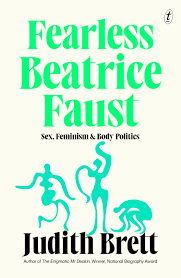
I very rarely read biographies of modern people. Faust only died in 2019, so that’s VERY modern by my standards. But I’ve been interested in how people approach modern biographies, for a project, and so this one was recommended. Having enjoyed Brett’s “From Compulsory Voting to Democracy Sausage,” I was fairly sure I’d enjoy her style, so this seemed like a good option.
Turns out, Faust was an amazing woman. Would I always have agreed with her? Oh no. Would I probably have found her abrasive to work with on a committee? Oh yes. Would I nonetheless have loved to be a neighbour, occasionally going over for coffee and hanging out? For sure.
Faust had a difficult upbringing: her mother dies from childbirth complications, her father is distant, her eventual stepmother unpleasant, and Faust herself is a sickly child (and continues to have multiple chronic conditions for most of her life, which are an enormously complicating factor for her). Yet she is clearly highly intelligent; she gets into Mac.Rob, the select-entry Melbourne girls’ school, and then Melbourne University to do an honours degree in Arts, and eventually an MA. Over her lifetime she writes many tens of thousands of words, and basically becomes a public intellectual – but not an academic, mostly because of misogyny.
Faust was extremely open about her life: her sexuality and sexual experiences, her abortions, her accidental addiction to benzos – all were fuel for public talks, articles, government submissions, and the many letters she wrote to friends.
She was also the founder of the Women’s Electoral Lobby, a key member of the Abortion Law Reform League, and various other women-focused campaigns. Her relationship with “women’s lib” and some aspects of feminism were fraught – she’s just that bit older than many of the agitators of the early 70s – and she definitely had some views that 1970s feminists had a problem with. In particular, some of the ways she talked about pronography, and – even more problematically – her apparent defence of some paedophiles were very troubling. Brett goes into these topics in great depth, sympathetic to Faust in that she tries to understand her views as well as possible, and present them fairly, but not so sympathetic that Faust gets a pass when she is saying unwholesome things.
Brett’s overall style is intriguing. She was approached by Faust’s friends, after she died, saying that she would be a good subject – and Brett said yes for many reasons, including the personal connection (living in Melbourne, some of the same haunts). Brett is not absent from the text, and I appreciated this aspect a lot. That’s not to say that Brett makes it all about her. I mean that Brett will mention when Faust’s reasoning is ambiguous, or when she got something wrong; and in dealing with some really hard topics – like her views on paedophilia – Brett wrestles with why Faust may have thought the way she did, and also calls her out for views that are pretty clearly inappropriate by today’s standards. Brett insightfully considers the question of whether Faust would be considered a TERF today, because she believed that biology was a significant part of a person’s identity; she concludes that it would be easy to say yes, but that Faust’s view is more nuanced than many TERFs, so perhaps not (Faust also didn’t seem to have a problem with a trans woman she spent some time with).
Beatrice Faust absolutely deserved to have a biography written about her. I’m glad Judith Brett was able to do so.
The Dead Withheld
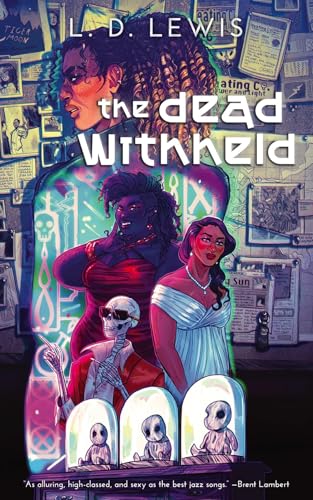
Oh look, another Neon Hemlock. Am I finally catching up on all of the novellas that have been piling up in my electronic TBR? Yes I am!
I love it when folks play with the hardboiled detective story, and make it way more interesting than ‘morose middle aged white man who drinks too much and investigates sad crimes.’ In this case, we have ‘morose unclear-aged woman who drinks too much and investigates sad crimes’ – who can also see ghosts (not entirely unusual in her town) and summon them, occasionally has to deal with demons, is in a friends-with-benefits relationship with Carmen, a demon running a bordello… and got into the PI business in an attempt to find the killer of her lover, now dead several years.
Dizzy is a wonderful character. Once a musician, she’s given that up to be a PI, and she is currently fairly messed up by the unanswered questions in her life; and she has done some questionable things in trying to resolve them – violence, and holding souls captive, to name just two. She’s also a devoted and fierce friend, honest about her failings, and has the sort of drive to get answers that can make or destroy a person.
Exactly when and where the story is set is opaque – there’s mention of “the Former United States”, but if there are clues about exactly where this is set, this Australian could not find them. But that’s irrelevant to the story, because it’s not about technology it’s about magic. The story also doesn’t care about politics; it cares about love, and revenge, and finding your way after you’ve been lost for a long time.
Again: it’s Neon Hemlock. High quality.
No Such Thing As Duty
Do I know anything at all about W. Somerset Maugham? I do not! Have I ever read anything he wrote? I have not! Did I still enjoy this fantastical take on a period in his life? Certainly did!
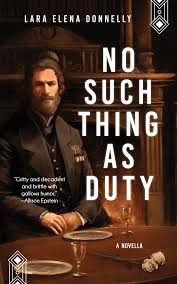
William is in Romania. He is dying of TB, and he has left his unhappy marriage – but also his daughter – in England. His lover Gerald is somewhere on the western front, current fate unknown. On paper he is working for a newspaper; in reality he is… sort of a spy. Ish. It’s World War 1, but you’d be forgiven for not realising that – there’s only one mention of the Kaiser, and no other leaders. In fact initially I thought it was WW2 from some other hints, but that mention of the Kaiser seals it.
An assignment comes to William: contact a man who can apparently get one of their agents out of Bucharest, which an Englishman would be unable to do. And so he contacts Walter, and they start getting to know each other, and things happen, and Walter is a surprise.
It’s a Neon Hemlock, so you know you’re going to get a) quality and b) queer content. This novella does not disappoint; it’s well written, well paced, and made me go look up Maugham’s life to see where Donnelly had shoehorned this story in.
Countess, by Suzan Palumbo
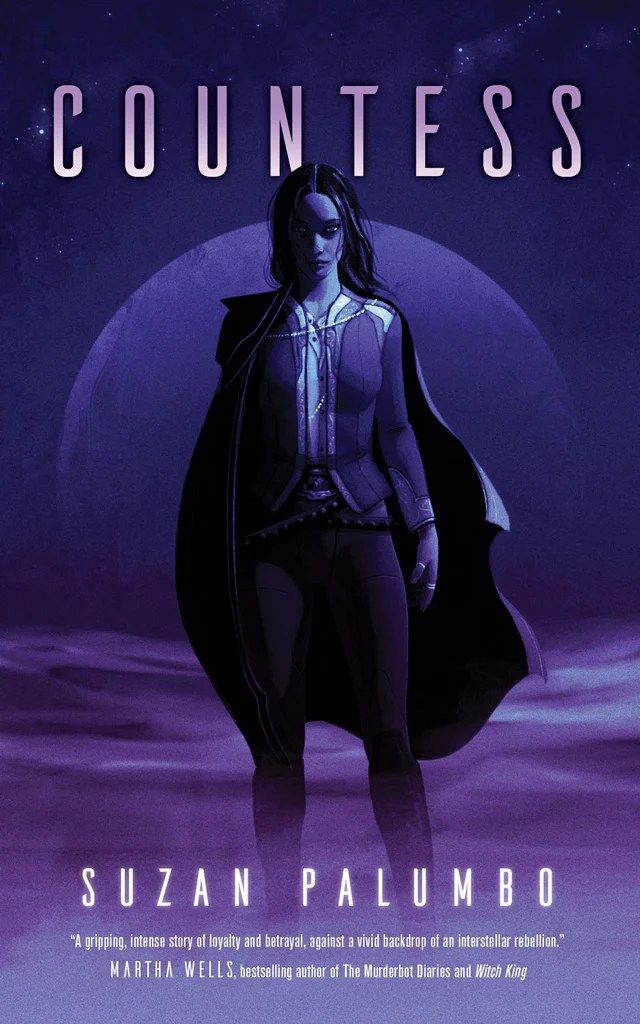
Did I ignore this book for several months because I have never read The Count of Monte Cristo? Yes.
Was that foolish? Also yes.
Should I have paid attention to the fact that this is a) gender flipped (mostly), b) space opera, and c) a novella, NOT LIKE the 1000+ PAGE PLUS ORIGINAL? Oh yes.
So, this book is great. Like everyone who has raved about it has suggested. A young migrant woman rises through the military hierarchy of her beloved adopted home, desperately proving that she can be as good as any of the white-skinned folks (did I mention this is anti-colonial as well?) of her new planet. And then, of course, things go very bad because Jealousy, and she ends up in prison. It’s not too much of a spoiler to say she escapes (the original is basically one long revenge fantasy, as far as I can tell), and then things… well. Things change.
Palumbo writes beautifully, illuminating the relatively-newly-colonised planets as distinct places but also evoking the original Terran homelands, especially of the Caribbean. I did go and read the Wiki for The Count after reading this, to get a sense for how closely she kept to the original, and the answer is ‘pretty close but also not slavish’ – SEE LENGTH in particular. Having said that, this is obviously an excellent example of how you don’t need to have read the original even when it’s clearly a book riffing off another: Palumbo has made this story all her own.
Magnificent.
The Folded Sky
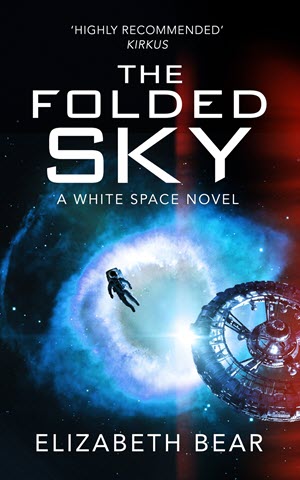
Apparently I didn’t review either Ancestral Night or Machine? Oops.
Quick recap: very far future, galactic colonisation, (most) humans live alongside other species, they have ‘right-minding’ to deal with anti-social tendencies, and there’s an ongoing search for the remnants of long-dead very powerful alien predecessors. Also, there’s FTL travel, through White Space.
The three books in the White Space series are connected by being set in the same universe and dealing with some of the big issues, and events from previous books make the next books happen, but there’s basically no character connections.
In this book, the archinformist (historian) Dr Sunya Song has left her family to go do research in one of the most exciting discoveries in centuries – an ancient AI left by that predecessor civilisation. Of course, things do not go at all as planned, starting with the very snarky AI ship she travels on, moving rapidly to a pirate attack, and then the arrival of her arch-nemesis. And there are the actual and attempted murders.
This is a space opera, with a whole lot of discussion about inter-species relationships on a personal and societal level, with both the continuation of racism and the desire to understand The Stranger playing significant roles. There’s also some interesting crossover between this and Arrival / “Story of Your Life” in terms of how someone can come to understand a species whose entire way of looking at reality is utterly different from your own.
On a more mundane level, this is also a murder mystery, since Song gets involved in that side of things, when perhaps she shouldn’t.
Overall this is a really fun story, with characters I enjoyed and a plot whose resolution I didn’t entirely expect. However I must note that there were disappointments, particularly in some poor editing. For example on p414 of the trade paperback, and a few other times, questions are asked and then not answered in the conversation. Obviously this is sometimes deliberate, but there’s no suggestion that’s the case here – it just feels like a line is missing. There’s also some repetition of information that feels like it’s been doubled up because someone wasn’t sure where it should go.
Will I read another book in this series? Of course I will.

 Randomly Yours, Alex