Nonesuch, Francis Spufford
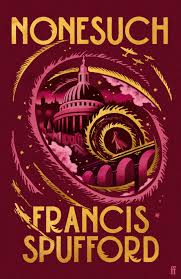
Read courtesy of the publisher and NetGalley. It’s out at the start of March.
Firstly: be aware that this is the first of a duology. Did I know this going in? No. Did I think it would have an amazing conclusion? Yes. Did it have a great conclusion? Yes. Did I then turn the page to discover “To be concluded”? What do you think.
So it’s the eve of World War 2, as the novel opens. Iris works in London, for a stockbroker; what she really wants is to be the stockbroker, but that’s not happening for a woman in England in 1939. She’s also a self-identified ‘bad girl’: she has relationships with men that are largely transactional – not strictly in the sex-work sense, but in the sense that she’s definitely looking to get something out of it. Mostly she’s looking to move up in the world, away from her suburban roots (it is England in 1939).
Then she meets Geoff, and then a weird Watcher follows her home, and then World War 2 starts, and then the Blitz begins. It’s a lot.
This is most definitely a fantasy novel. There are “angelic beings” – for want of a better term (they’re definitely not angelic in the sense of perfectly good, because I’m pretty sure that would rule out being sarcastic); there’s a shadowy occult society, and magic is real if hard to access, and eventually there is Nonesuch – a place where, if you can access it, you might change history.
And yet. The fantastical elements are a surprisingly small part of the story. An enormous amount of the book is actually about surviving in London in 1939 and 1940. Everyone surviving – the descriptions of bomb shelters, and the lack of supplies, and general atmosphere of fear are exquisitely drawn. And Iris surviving – how she has lived up til now (perfectly well, if sometimes precarious), how that changes when she meets Geoff (much more complicated), various real and important moral quandaries. It’s not that the fantastical elements were extraneous – I was always itching to go back to them – but the mundane sections didn’t bore or worry me, or make me impatient. They’re necessary and they’re amazing.
I have never read anything by Spufford, and I was actually quite surprised to discover he’s a he. Iris is drawn so convincingly, and sympathetically, with determination and ambition and unwelcome vulnerability; she’s so angry when she’s vulnerable but never made to seem lesser to the reader when she is – I just assumed it was a woman writing her. So that was a shock, but takes nothing away from Iris. She’s vital and alive, she makes bad decisions and sometimes she makes them right, she’s brave and she has to make real decisions about morality, and living with her brain and ambition in 1939 must have truly sucked.
If I could hold my breath until the sequel arrives I would consider it, but that would be stupid. I’m so excited that I am really quite nervous to see where it goes.
Object Lessons: Snack
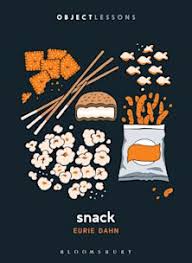
I read this courtesy of NetGalley and the publisher, Bloomsbury. It’s out now.
Like the other excellent Object Lessons books, this combines a deeply personal reflection on the topic along with some historical, cultural, and almost anthropological observations. It’s such a short book – barely over 100 pages – but it covers a lovely range of topics. Chapters include: Origin stories; Infantile Snacks; Fruits and Vegetables; Guilty Pleasures; and Chocolate and Dried Squid. One of those chapters is only a page long.
The author is the child of Korean migrants to America, and so her story is one of figuring out where she fits – and of enjoying both deeply American and deeply Korean snacks. She explores what makes a food a snack, and changing attitudes to the whole question of snacking. There’s an entire section about the relationship of diet culture to snacking (arguing that the diet industry actually promotes snacks, which when I thought about it for a whole 3 seconds I realised was staggeringly and twistedly reflected in my knowledge of advertising). And then there’s the fact that Big Tobacco bought into the food industry when theirs was starting its downward spiral…
The book is very American, as Dahn herself recognises early on; she mentions some American snacks I’ve never come across, but of course much of it translates to Australia as well. I think it’s a result of this focus, plus the question of migrants and snacks, that means some of the framing for the book is around the question of how invented Flamin’ Hot Cheetos, and their subsequent place in the American psyche (do these exist in Australia? Certainly they’re not ubiquitous. I assume I could find them in a speciality store, which is itself an amusing reflection given Dahn’s discussion of finding dried squid in Korean speciality stores in her youth).
The personal side really works in this context. Discussing one’s childhood snacking, the snacks one then foists on one’s own child – all very relatable.
This is a delightful little book.
Object Lessons: Lipstick
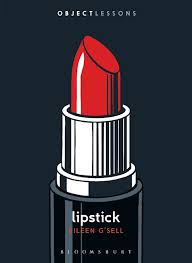
I read this courtesy of NetGalley and the publisher, Bloomsbury. It’s out on Feb 19.
I have a fraught relationship with the idea of femininity. I obstinately rebelled against participating in most forms for a long time, for complex reasons that mostly had to do with what I thought was important about my identity. Eventually, I realised I was being stupid, and that things I enjoyed were not things that got in the way of who I was. I was 35 when I decided actually, I do like lipstick, and started regularly wearing it to work, and when I went out.
So this new Object Lessons, about lipstick, and in particular about how it is viewed, used, stigmatised, discussed, and historicised? This book was written for me.
And it is very well written. As with all of this series, the book is intensely personal as well as being well researched and reported. Given the way lipstick is viewed by different groups and individuals I particularly liked the way G’Sell incorporated the views of other people – those who love wearing it, and those who hate it, all for valid and important reasons. There aren’t all that many apparently innocuous objects that can get such intense, contradictory, and equally important reactions (although the bra does spring to mind, as it were).
As always, we get some history – folks of all genders wearing makeup in ancient Greece, 1930s film femme fatales, etc – as well as some anthropology (Iranian women wearing lipstick, examining the perennial comment about sales of lipstick going up in times of economic hardship), along with the intensely personal reflections.
The list of chapter titles will give a sense of what the book encompasses:
- Painted Ladies and Tainted Men
- Painted Ladies and Painted Men
- Lipstick Feminism and Sticky Pleasures
- Whitewashed Beauty, Appropriation, and Lipstick Legacies
- A Femme-Friendlier Future?
I loved it. This is a book for anyone who has thought about what it means to wear lipstick. or makeup more generally.
Object Lessons: Ballot

You can take compulsory voting from my cold dead hands.
I read this book c/ NetGalley and the publisher, Bloomsbury. It’s out now.
I love every Object Lessons book. In some ways, this one is like the rest – part history, part social commentary (almost anthropology), part personal experience. However, it’s a much more immediately relevant topic than, say Skateboarding or Perfume. As well, all of those have been partisan – they’re written by people who like skateboarding and perfume – but it’s much more obvious in this one: the author is outspokenly progressive – votes Democrat, because America, although – happily – she is also very clear on the failures of various Democratic leaders.
Compulsory voting forever.
One important thing to note here is just how American this book is – more noticeably than many of the others I’ve read. The author is American, and it’s one of the most personal Object Lesson I’ve read, so the narrow focus flows from that. Which is not inherently a problem – American voting is a fascinating / appalling thing to view from afar. What is… let’s say disconcerting is the way the book is written without acknowledging that it is, functionally, entirely aimed at an American audience. Does anywhere else vote on its judges? The local equivalent of district attorneys or sheriffs? Maybe they do, but nonetheless – that shit’s wild. Plus all the state vs federal laws, not to mention the college system OMG. Thus much of what the author says is not automatically applicable to my experience, and I would guess not to the experience of many other people around the world. (This comment also reflects that I had not carefully read the blurb, so partly this is on me.)
I will fight for compulsory voting.
(Note: it’s actually not compulsory to vote. It’s compulsory to get enrolled; then it’s compulsory to choose between a fine ($100) or rocking up at the election and having your name marked off. No one compels you to mark a ballot and put it in the box.)
I knew some bits and pieces examined here. The whole voter ID thing, and how it’s manipulated – wild. (Doesn’t happen in Australia.) “Use it or lose it”?? See note re: compulsory voting. The ways in which prison populations – mostly filled with people who can’t vote – are still counted as population for purposes of figuring out county borders etc?? Everything about this system makes me, an Australian with a clearly perfect and incorruptible election system,* laugh at the idea of America as a wonderful democracy.
Another thing to note is that this is not a history of the physical ballot process, which I initially assumed it would be. The process (as it happens/ed in the USA) is covered super briefly. Instead, this is essentially an overview of voting practices in the very recent US past. Which is certainly interesting, if not what I thought I was getting (see previous comment about not having read the blurb, and that’s on me.)
It’s very well written, and completely depressing.
* This is a joke.

 Randomly Yours, Alex