Sublimation, Isabel J Kim
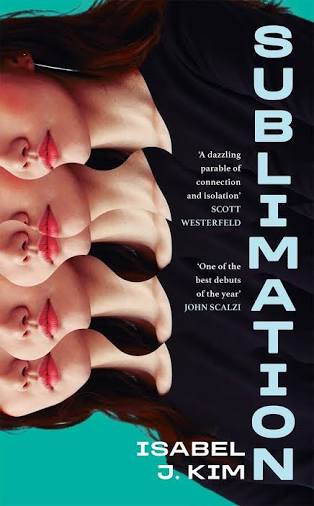
I feel like I’m late to this party, because so many people I know have been talking about it, but it’s actually only a 2026 book! So I am not late, they’re just early.
This book is brilliant and if you’re up for a world that’s just off from ours – in a very significant way and yet still the world is recognisably ours – you would do worse than just go out on a limb and read this. But if you need to know more…
This is a world where crossing a border might give rise to an “instance” of yourself. Not sure if you do want to go home from that holiday? Not sure if you want to take that overseas posting? Being forced out of your home by natural or human forces? Any of these might create an instance. Who is a real, live, human being, with all of your memories and traits up to that moment. They are you. But they stay, while you go – or they go, and you stay.
I’m sure you can imagine some of the large-scale problems, as well as the small-scale. For migration, as well as for families.
Soyoung instanced when she was a young girl; she lives in Korea, while her instance, who goes by Rose, lives in America – with the instance of Soyoung’s mother. Yujin instances when he leaves Korea for study leave in the US; they also live in those two countries.
Here’s the thing I didn’t mention: if instances meet, and touch, they will generally reintegrate. Again, you can probably imagine the large- and small-scale problems. What if one instance wants to reintegrate, and the other doesn’t? Reintegrating gives the person both sets of memories – imagine living like that!
And now, imagine the techbros rubbing their hands at the opportunities this affords: what about something to guarantee forced reintegration can’t happen? What about… well, there are all sorts of possibilities if instancing could somehow be managed.
Sublimation isn’t about the technological stuff, exactly, but it does run through the whole book: Yujin’s instance, YJ, works for the company who made MERGEBREAK (bracelets that should stop reintegration). And the whole question of reintegrating or not is at the core of the novel, so external efforts to affect that are pretty important.
This is a book about migration, of course: about choosing to migrate, about the consequences of doing so, and what it means to leave somewhere. And it’s about identity – how could it not be: what does it mean if you’re torn between choices? How can you reconcile with yourself?
I haven’t even mentioned the structure of the novel. First thing: large swathes of it are written in the second person. Bold choice! It means you (heh) switching between a Soyoung, Rose, Yujin and YJ – you say, you do, you think – and it makes the whole experience remarkably visceral. And when you (heh) suddenly flip to reading in the third person, it’s quite discombobulating. Which is really clever. Second thing: there’s a lot of asides about literature across the novel. There are references to a Korean fairytale, a Korean song, The Odyssey, and the Book of Genesis. The last two are what I know best, but they all suggest the same thing: in a world where instancing has always happened, how does that change literature? What if Odysseus instanced when he left Ithaca – what does that say about him? And what if – this one is the most challenging, IMO – the act of creating the world (and everything in it) was one absolutely epic example of instancing?
Some thoughts about the very end below the cut, but look – this book is just great, you should read it.
Continue reading →

