Our Lady of Battles
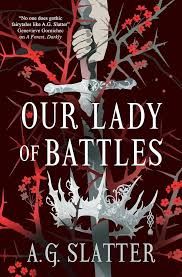
Read courtesy of NetGalley and the publisher. It’s out in February.
A new AG Slatter is a must-read for me, particularly stories set within the Sourdough universe. This novel does not disappoint, so there is no sense in which this is an entirely objective review. I have always enjoyed Slatter’s style, I have always enjoyed her characters, and I am willing to follow her along whichever tricksy traipsing way she chooses to charge.
You don’t need to have read any other Sourdough stories to appreciate this one, but if this works for you do I have some good news for you! (Bad news for your TBR pile.)
With that out of the way: Slatter has done a simply brilliant job here of complicating the whole “regain the throne” idea, and does so through – as I always expect – complicated, complex, interesting, and absolutely never boring women.
Five Ports was, until a few years ago, ruled by the Mentoras line, descendants of (later St) Callwen Mentoras. They were overthrown for a variety of reasons by the Woodcutter Kings, and it is he-who-would-be-the-last in that line that the True Princess, last of the Mentoras line, Emlyn, kills by creeping into the palace – alone, via tunnels she knows from childhood – thus cutting short what might have been a protracted siege that would be particularly bad for the ordinary townsfolk. And then everyone rejoices and Emlyn gets on with ruling with no hassles… HAHAHA.
It’s clear from early on that things are not quite as they should be for Emlyn. There are vague references to an “other”, and her mentor, the Beldame, keeps a very close eye on her. I had a range of theories about what was going on here, and absolutely none of them were correct. Fortunately it’s not too long before we – and everyone in Five Ports, and in Emlyn’s entourage – learn the truth, and then things get REALLY interesting.
By interesting I mean Emlyn evinces a passionate desire to make Five Ports a thriving, socially conscientious, and equitable city, and does her best to make it happen; there’s an extended (slightly unexpected) underworld journey, there are revelations about identity, and questions about family; there are double-crosses and sneakiness, and a bit of romance; and a serious consideration of the role of both (externally and internally imposed) obligations and guilt, how far you can let those change you or mould your world, and when you might let them go. This doesn’t cover everything, of course.
There are some great male characters here, for sure, because Slatter doesn’t really do boring characters; but it’s the women who are the focus. Emlyn is wonderful – layered like an onion, honed as a warrior, with a sharp political perspective. The Beldame is wonderfully complex and just gets more so as the book progresses. Emlyn’s maid is a bright little spark, Gabri puts a welcome degree of complexity on the idea of a monarch’s concubine. Even the incidental women – the nuns of St Callwen, the noblewomen who’ve survived in Five Ports, various others – have hints of depth.
Like I said: zero objectivity. This is a great book.
Stargate SG1: season 6
Season 1; Season 2; Season 3; Season 4, Season 5
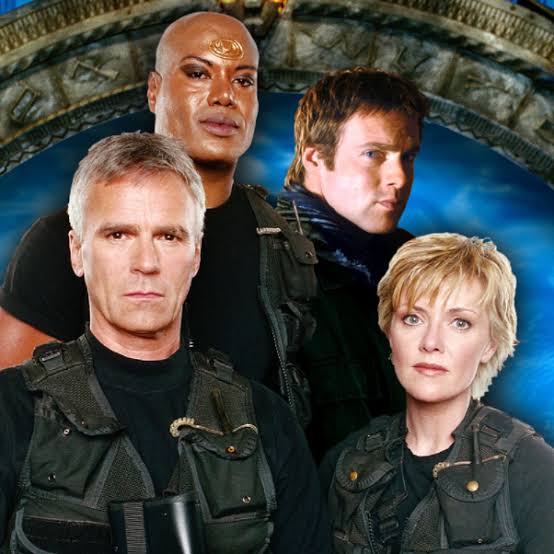
With Daniel gone, we have SG1 auditioning new geeks for the team, and it’s not going well (nine, to date). Sam’s hair is a teeny bit longer and less funky, and then we have the team go to Area 51 to view the new X302. It’s a very pretty aircraft, and is probably capable of hyperspace travel… what could possibly go wrong.
One of the early episodes takes us back to Antarctica, and brings the anthropocentrism of the show into relief. The Antarctic gate might be one of the oldest in the entire system! Ooooh. Anyway they also dig up a body (not their first, they’ve found Jafar there before) and, discovering that the cells appear intact, they decide to thaw her out. HAVE THEY LEARNED NOTHING. (Also, my post-2020 eyes say: those surgical masks are not being won properly. One of them hasn’t even expanded the folds. Might as well not be wearing it.) The frozen lady learning language and early reactions are very reminiscent of Leeloo in Fifth Element. And it all escalates to O’Neill being the only one left infected with the disease she’s carrying and therefore requiring a symbiote from the Tok’ra to survive – who coincidentally carries vital intel. The whole question of bodily autonomy here is a fascinating one, since O’Neill has always vehemently rejected the idea of blending. But of course his commitment to the cause – plus a desire to live I guess – trumps that. And the episode ends with O’Neill being taken through the gate in a rescue container, which – given it’s being carried by four people, two on either side – looks remarkably like a coffin. So that’s some symbolism then.
The whole question of bodily autonomy has, of course, always been present. And it recurs in the very next episode, with a whole town infected with infant Goa’uld – and even Sam (apparently) compromised. Followed by the next episode where we have O’Neill’s body acting on the information of his symbiote, because he was able to influence it – in particular the idea that no one should be left behind. Ba’al tortures him terribly and the sarcophagus is used, violating O’Neill’s body in horrible ways. (And we get our first glimpse of Mysterious!Daniel.)
Continue reading →Wind of Earth, Wind of Tau Ceti
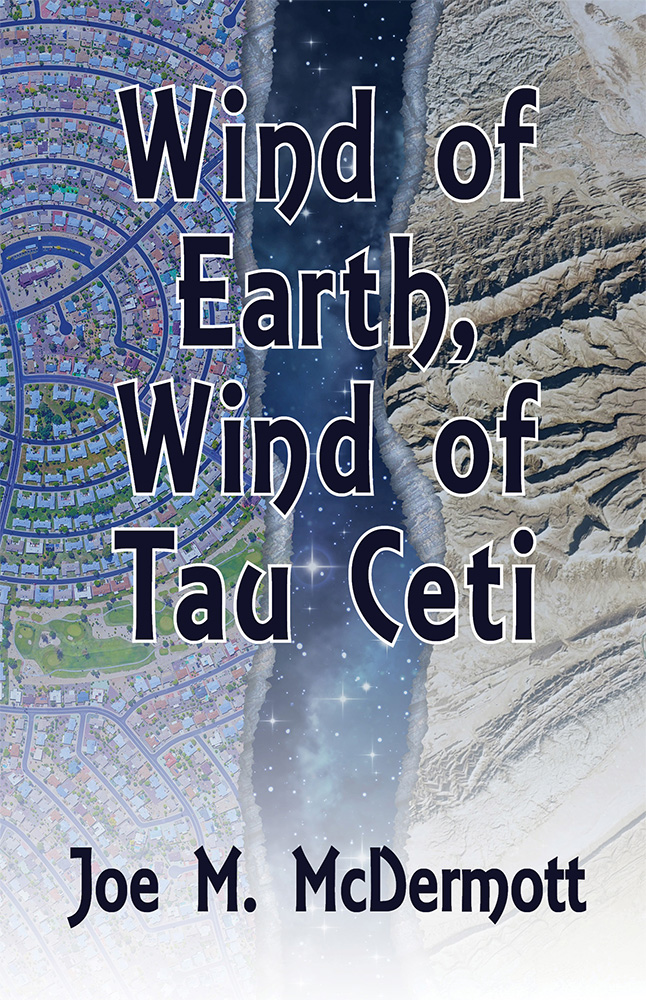
I read this thanks to the publisher, Aqueduct Press. It’s out in December, and can be preordered from their website.
This is a “fix-up” novel, comprised in part of stories published elsewhere. I hadn’t read any of those, so this was entirely new to me – I therefore don’t know whether McDermott has made any changes to the originals. Additionally, I would describe it as more like a mosaic novel than a traditional narrative. It doesn’t follow linear time, it doesn’t follow all the same characters – but, as a mosaic, it builds up a picture of a time, a society, and a person.
The novel opens with the titular Wind as a grandmother on Tau Ceti. Her daughter-in-law has died; Wind is trying to help her son and granddaughter. Humans are still living under domes as they terraform the planet, and while the planet isn’t quite as inimical as it could be, it’s still not easy. There is a shift, then, too Wind as an adolescent on Earth: her parents are divorcing, the custody battle is bitter – and neither parent is great. Wind’s relationship with her father and grandmother are central, as is the slowly decaying social and physical infrastructure around her.
The rest of the novel follows Wind initially to the moon, to live with her mother, and then eventually to Tau Ceti. Different chapters follow a school friend of Wind’s, techs who work on the stasis chambers, Wind’s eventual husband and child. It means we get a broader understanding of the problems confronting different parts of society, and how different folks are coping with it, than would be possible just through following Wind – who isn’t privileged, far from it, but still has a particular experience.
Something I can’t figure out is whether some of the discrepancies across the novel are deliberate – perhaps to reflect how memory works; or whether they’re an artefact of coming from various original stories. They’re not massive discrepancies – what Wind was like as a child, mostly; I choose to read them as deliberate, and see them as adding to the mosaic-ness.
One thing I will note: sometimes it’s remarkable what small thing stands out as an indicator of how an author’s background is different from a reader’s. There’s a moment when one of the characters is bemoaning their lack of a water ration and begs access to Wind’s so he can have a shower. Wind agrees but says he can only have a really short one. Just three minutes. As someone who lived through a prolonged drought, for whom a three-minute standard is entirely standard (and entirely sufficient)… well. Lol, I guess.
I really, really enjoyed this. It’s science fiction interested in social development and social issues. Wind is entirely believable, and her Earth society is – sadly – too. McDermott’s style is engaging and immersive. I’m glad this exists.
The Ongoing Odyssey of Jack de Crow
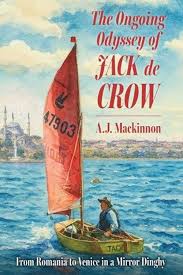
Read c/ NetGalley and the publisher. It’s out in January.
I read the first Jack de Crow some years ago, and was fascinated by Sandy’s adventures – and also a little, well, nonplussed at his remarkable laissez faire attitude. Which is partly a reflection on me and my preference for things to be somewhat organised, and partly amazement that his extraordinary “she’ll be right” attitude did not turn into serious catastrophe.
Twenty years later, Mackinnon goes out again – in a different Crow, which is a whole (remarkable, boggling) story in its own right – this time going from east to west – Romania to Venice.
How you’ll feel about this book will depend on two key things, for my money:
- How do you feel about someone who sets out on an epic voyage with really very little by way of preparation?
- How do you feel about someone who only manages to avoid catastrophe through the fact that helpful strangers turn up an astonishing number of times?
… it really is remarkable that Mackinnon doesn’t suffer any worse on this trip than he did. He capsizes, loses bits of kit, loses his wallet, sleeps rough; deals with an epic amount of administration and contradictory instructions (his boat is so small it doesn’t fit within a lot of regulatory frameworks).
Still: those are the parts that had me shaking my head in disbelief. Other parts had me shaking my head in awe, particularly the fabulous places he sees from the water, and yes those instances when someone with whom he doesn’t share a language turns up to save the day. Mackinnon has an easy-to-read style – although again, sometimes his breeziness in the face of near-disaster is a bit much – and a delightful turn of phrase. He’s well read in history and mythology and literature, and makes various connections along the way, which isn’t hard when you’re sailing in the Aegean and you have some Classics background.
If you enjoy travel books, this will probably appeal. If you’re less easily freaked out by things going wrong during someone else’s travels than I, you will probably enjoy this even more than I did – and, despite what it sounds like, I did enjoy it! I have had small adventures myself but for ones like this I am delighted to be an armchair traveller and enjoy someone else’s descriptions.
Stargate SG1: season 5
Season 1; Season 2; Season 3; Season 4
Previously, on… the team got stuck four millions of light years away, with Apophis on their tail. It’s very much a frying pan / fire situation, as although Apophis seems to be dead – or at least everyone on his ship is – the ship is infested with Replicators. Whee!
Plus, Sam has kept her very cute pixie cut.
Meanwhile Teal’c has been brainwashed back to being in love with Apophis; there’s an entire episode of going through his backstory so that he can re-live how he got to being anti-Apophis. So that was traumatic, especially for Dr Frasier, who feels he’s being tortured by having pain meds withheld.
IMPORTANTLY! This is season 5! Which means episode 100! Which means “Wormhole X-treme”!!! I cannot tell you how often “It’s what I do” (etc) gets used in my house. I love everything this episode says about how the show thinks about itself. Why doesn’t someone who’s out of phase fall through the floor? And I’m pretty sure most of the cast of the show are folks who work on Stargate.
I really like that Stargate follows up on some of its earlier narratives, and there’s quite a few in this season. We go back to Cassandra, and the fact that there are still effects from Nirrti’s actions years before. And then we flip back to the planet of the Unas, because an arse has kidnapped some and enslaved them, and Daniel insists they need to do something about it. They’re not even being subtle about the metaphors in this one. In the very next episode we get some fallout from the Russians using the stargate. This episode is basically a variation on The Mummy?? Goa’uld was in a sarcophagus but because his priests rebelled, something was put inside to eat him while being kept alive by said sarcophagus… and the something is also riffing on Alien, coming out of a cocoon and scuttling around. When you factor in that it’s got a symbiote inside, which means it’s looking to find a new host, it’s an even closer parallel. More follow up stories follow: back to the Tollan. Narim has Sam’s voice as his house’s voice and that’s just creepy. And to connect another set of dots, the Tollan are secretly being bullied by the Goa’uld Tanith! We meet those arses the Aschen again. I have to see Kinsey’s face again though, so that’s less than awesome. A bit later in the season we get an episode harking back to that NID black ops team: this time, SG1 has to undo some mistakes made by those other arses. It’s further proof that those “my country right or wrong” types really are awful.
Continue reading →Helm, by Sarah Hall

I have no idea who recommended this book to me. But it was strongly enough suggested that I immediately got it from the library, and here we are.
This book is brilliant.
I’ve classified it under fantasy, as it kind of is – I mean, some of the narrative is from the wind’s perspective, and it imagines life from the perspective of people ranging from a Neolithic woman to a modern meteorologist. But it’s really one of those books where clear genre boundaries break down. It’s not exactly realist literature, as that description points out, but… *shrug*. Maybe it’s an example of how genre descriptions can sometimes be useless. (I note that Goodreads calls it magical realism.)
So: the Helm is the only named wind in England. It exists for very particular meteorological reasons in a very specific part of Cumbria. And sometimes it can be immensely destructive. This is the wind that Hall gives a voice to, and – not exactly volition, but certainly awareness. That’s one part of the book.
As well as Helm’s experience of the world, Hall presents other stories across several centuries. There’s NaNay, a Neolithic villager who has a vision as a child that drives her entire life. There’s Michael Lang, in the thirteenth century – a spectacularly zealous Christian man convinced Helm is of the devil. The eighteenth century Catherine de Peyster, married to a strongly Christian man for whom Catherine’s playful pagan ways are anathema. Thomas Bodger, gentleman scientist of the nineteenth century, come to try and understand Helm and leaving his ailing wife at home. Little Janni, mid-twentieth century, who plays with Helm and whose imaginings are too much for her mother. Jude Ferguson, retired copper and avid hang glider. And Selima, the meteorologist – living some indeterminate time in the future, but not too far – investigating plastic particulates in the atmosphere and dealing with anti-science types.
It’s a glorious spread of stories. They’re all people who want to understand, but who go about it in very different ways. Mostly not wrong (although Michael Lang, I’m unconvinced by), but ways that would generally be seen as incompatible. With the exception of NaNay, we’re plonked into the middle of a story: we get glimpses of where Selima or Jude have been, to bring them to their point of contact with Helm, but no great detail. And we’re left in the middle, too; Hall has no problem with ambiguity or a lack of resolution. NaNay, though: we get pretty much her entire story, which is such a fascinating choice I’m going to be chewing on it for a while.
And to complement all of this, there are wonderful informative section that reminded me of some of Kim Stanley Robinson’s choices, in books like 2312: a list of Helm’s alternative names, or descriptions of objects found around Helm’s area, or other named winds around the world.
In all, this is an absorbing, glorious, brilliant book.


