Helm, by Sarah Hall
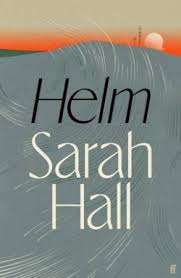
I have no idea who recommended this book to me. But it was strongly enough suggested that I immediately got it from the library, and here we are.
This book is brilliant.
I’ve classified it under fantasy, as it kind of is – I mean, some of the narrative is from the wind’s perspective, and it imagines life from the perspective of people ranging from a Neolithic woman to a modern meteorologist. But it’s really one of those books where clear genre boundaries break down. It’s not exactly realist literature, as that description points out, but… *shrug*. Maybe it’s an example of how genre descriptions can sometimes be useless. (I note that Goodreads calls it magical realism.)
So: the Helm is the only named wind in England. It exists for very particular meteorological reasons in a very specific part of Cumbria. And sometimes it can be immensely destructive. This is the wind that Hall gives a voice to, and – not exactly volition, but certainly awareness. That’s one part of the book.
As well as Helm’s experience of the world, Hall presents other stories across several centuries. There’s NaNay, a Neolithic villager who has a vision as a child that drives her entire life. There’s Michael Lang, in the thirteenth century – a spectacularly zealous Christian man convinced Helm is of the devil. The eighteenth century Catherine de Peyster, married to a strongly Christian man for whom Catherine’s playful pagan ways are anathema. Thomas Bodger, gentleman scientist of the nineteenth century, come to try and understand Helm and leaving his ailing wife at home. Little Janni, mid-twentieth century, who plays with Helm and whose imaginings are too much for her mother. Jude Ferguson, retired copper and avid hang glider. And Selima, the meteorologist – living some indeterminate time in the future, but not too far – investigating plastic particulates in the atmosphere and dealing with anti-science types.
It’s a glorious spread of stories. They’re all people who want to understand, but who go about it in very different ways. Mostly not wrong (although Michael Lang, I’m unconvinced by), but ways that would generally be seen as incompatible. With the exception of NaNay, we’re plonked into the middle of a story: we get glimpses of where Selima or Jude have been, to bring them to their point of contact with Helm, but no great detail. And we’re left in the middle, too; Hall has no problem with ambiguity or a lack of resolution. NaNay, though: we get pretty much her entire story, which is such a fascinating choice I’m going to be chewing on it for a while.
And to complement all of this, there are wonderful informative section that reminded me of some of Kim Stanley Robinson’s choices, in books like 2312: a list of Helm’s alternative names, or descriptions of objects found around Helm’s area, or other named winds around the world.
In all, this is an absorbing, glorious, brilliant book.


