Flavour, by Sabrina Ghayour
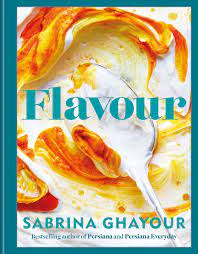
This book was sent to me by the publisher, Hachette, at no cost. It’s out now, RRP $45.
I have reviewed three of Ghayour’s previous cookbooks, and own all of them. I am confident to say that if I was only allowed to own one writer’s cookbooks, I would be incredibly sad AND I would choose Sabrina Ghayour.
As with all of her books, this one is laid out beautifully and the accompanying pictures are appropriately mouth-watering. Few of the recipes have really extensive ingredient lists; Ghayour is definitely in favour of simplicity and being straightforward. Where there is a longer list, it’s generally herbs and spices, most of which I would regard as accessible in Australia. There are a few points where there’s a translation necessary for Australian audiences – I believe pul biber is usually sold as Aleppo pepper here; and when Ghayour calls for “four preserved lemons”, she does not mean four of the my one-doesn’t-fit-in-your-palm homemade preserved lemons. Ghayour has continued here something I’ve loved from the last couple of books: a suggestion or two of what you might serve with the present recipe – a salad to go with a meat dish, for instance. I love that she has given thought to which flavours complement one another.
The chapters include Salads; Little bites and Savoury treats; Meat, poultry, Fish and Seafood; Vegetables and Pulses; Pasta, Noodles and Grains; and Sweet. Recipes are clearly marked Vegetarian and Vegan.
Things I have made:
- Dried Lime and Spice Marinated Lamb chops – I used steak, because I just cannot be having with chops. I had never blitzed dried limes before but they are a flavour BOMB and this was absolutely delicious.
- Lamb, Dried Fig and Preserved Lemon Tagine – going on high rotation. Love a good casserole, and the flavours are fresh and unctuous.
- Crispy Sticky Harissa Lamb – also delicious. Honey, rose harissa (I bought some because of Ghayour, and it’s great!), rice vinegar, soy and cornflour for the sauce.
- Pan-fried Salmon with Barberry Butter – I have barberries because of a meatball recipe or two, but this is another excellent way to use them.
- Root Vegetable, Chickpea, Feta and Barberry Tart – O.M.G. This was amazing. I think we ate it for three? four? meals in the week. Filo pastry, parsnip, carrot (I didn’t use celeriac – I don’t think it’s that accessible here). This is AMAZING and I LOVED IT. SO EASY.
- Creamy Spiced Sausage Pasta – the creaminess is from mascarpone, which I was surprised by and it was really good. You get the sausage out of its casing, which is always the best way to use it, and then it’s tomato and spice and the mascarpone.
- Harissa, Tahini and Lamb Spaghetti – another to go in high rotation. I was surprised by the harissa and tahini together, but it was brilliant.
- Mushroom Spaghetti with Creamy Pistachio and Garlic Sauce – yes, I know, it’s boring but this is another banger. The creaminess is from tahini again, and it works amazingly with the pistachio. I added some snow peas and asparagus, because I have an abundance, and used noodles instead of spaghetti because I had none.
I haven’t made any of the sweets yet, but I am eyeing off a few; and there are several other recipes that I already know I want to make. This is a great cookbook.
84K, by Claire North

I thought that, because I had read the first two books in Claire North’s Songs of Penelope series, that I had a handle on what Claire North’s writing was like.
Ha ha ha.
Ha ha.
Yeah no, turns out. 84K has been on my TBR list for a long time, and I was killing time in the library recently when I saw it just sitting there. So, fate dictated that I must pick it up. And I started reading it, and … oh my.
This is completely different from Songs of Penelope, is the first thing to say. People who go from this to ancient mythological Greece must have their heads spin, because doing it in the reverse did so to me.
This is not-too-far future England; this is nightmarish capitalism, business and government together, with basically no difference between them, and the literal end-point of the idea of human resources. Justice is privatised beyond even what the USA currently does; every crime has a cost, determined by accountants based on the societal worth of the victim (she was trash) and the perpetrator (he has a very promising swimming career ahead of him). This is people refusing to see what has been done to their society, in their name, while they get some personal gain from it; and just occasionally someone saying Enough.
This was a hard book to read, mostly for the subject matter. It’s not entirely unrelenting but it’s pretty close. North is doing a lot here, and really, really wants you to think about what’s happening. I can imagine this being compared to The Handmaid’s Tale and other stories that project from current events, and take political horror to its grim logical conclusion. It’s a totalitarian society where most people don’t realise it; it’s business being far more important than humans; it’s the personal cost of defying a society where most members don’t see a problem. And those things just don’t feel that far away anymore.
It’s also occasionally hard to read from a structural point of view; again, Songs of Penelope did not prepare me for a non-linear narrative structure. There, it really wouldn’t have worked; here… well. North is a poet; she is a skilled weaver of stories; she layers meaning on meaning and idea on idea so that by the time the story brings you back to the starting point, you’ve got so much knowledge and awareness of what’s going on that you’re close to bursting.
This is a phenomenal book. It deserved all of the accolades. (I’m still glad I read Songs of Penelope first.)
Multispecies Cities: Solarpunk Urban Futures
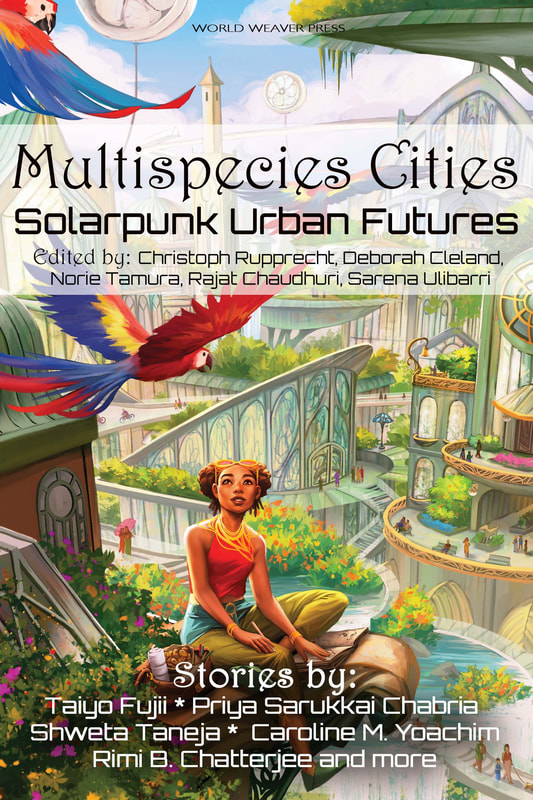
Yup, this one was also on special at World Weaver Press, so I grabbed it as well. I was completely intrigued by the idea of an urban focus for this sort of science fiction – that humans won’t have to abandon living in cities to survive the impacts of climate change, but they also don’t have to be the technological nightmarish warrens of Bladerunner etc. At the same time, they can’t be the same as they generally are now: where we restrict greenery to a few parks, loathe pigeons and rats as the carriers of disease, and so on. There are a few apartment buildings in my city that are starting to introduce the idea of green walls… that just needs to be taken much, much further. Which is part of what this anthology envisions.
As always, didn’t love every story, but as with Glass and Gardens there was no story that I thought was out of place. There’s a big variety in what the stories focus on – human stories that happen to intersect with animals, stories of the city itself, stories of animals and humans together. Where I said that previous anthology felt North-American heavy, this one has consciously set out to be different: there are, deliberately, a range of stories that explore the Asia-Pacific. I LOVE this.
There are a few stories where animals interact, in a deliberate way, with humans. Meyari McFarland’s “Old Man’s Sea” has orcas that have been modified for war, and how they might relate to the humans they now come across. Joel R Hunt has people whoa re able to jack into the minds of animals, in “In Two Minds,” and it’s about as horrific as you might imagine. “The Mammoth Steps” by Andrew Dana Hudson is along similar lines as Ray Nayler’s “The Tusks of Extinction,” with mammoths having been brought back and humans interacting with them… although Hudson’s version is a bit more hopeful. E.-H Nießler also has an orca-human interaction story, in “Crew;” he adds in a chatty octopus as well.
Shout out to Amen Chehelnabi and DK Mok, too: Aussies represent! Chehelnabi’s “Wandjina” is one of the grimmer stories, set basically in the middle of a bushfire, but manages to have hope in there too. Mok’s story “The Birdsong Fossil” is SO Australian, and also on the grimmer end, connecting visions of how science might be/is viewed with the de-extinction fascination; like Chehelnabi, it also ends hopefully, and is a fascinating way to conclude the entire anthology. (And Octavia Cade; NZ is totally Aussie-adjacent… plus her story “The Streams are Paved with Fish Traps” is brilliant.)
A really interesting, varied, anthology.
Glass and Gardens: Solarpunk Winters
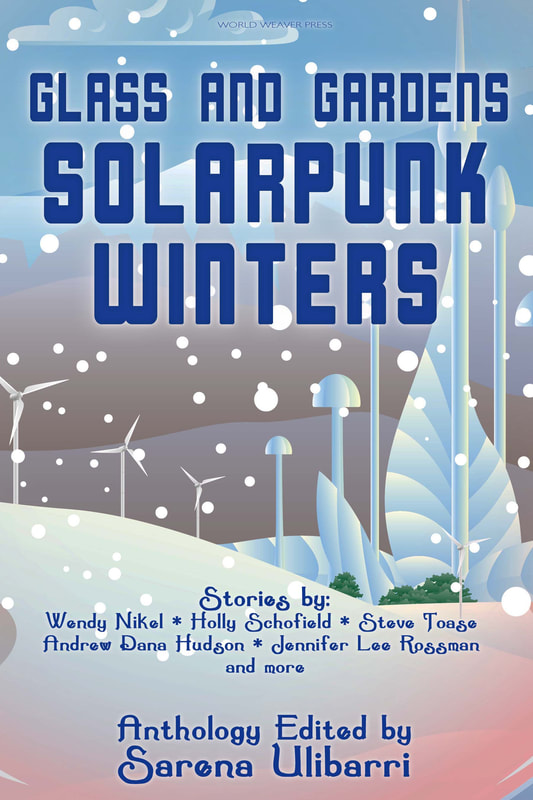
I’ve only recently come across the idea of ‘solarpunk’ – basically a hopeful take on humans living in a post-climate change world, as far as I can tell. I guess this is what ‘hopepunk’ also aims to be? maybe solarpunk is a bit more about the actual mechanics… I don’t know, I’m not going to claim the ability to set genre boundaries. ANYWAY, World Weaver Press has done a bunch of solarpunk anthologies, and a couple of them were on special the other day so I got them.
The first one I read was this, Glass and Gardens. Turns out I was in the right zone for some hopeful SF. As with all anthologies, I didn’t love every story – but also, there were no stories that left me wondering what the editor was thinking. They all fit the overall theme – how to be hopeful when winters have got more extreme or, in a couple of cases, the world has warmed so much that winter no longer happens, with equally disastrous consequences for the environment. It is heavily North American-focused, but honestly as an Australian this is just something I pretty much take for granted.
One thing I particularly liked was that while all of the stories were focused on humans, and what they are doing to live with/ mitigate/ work around climate change, there’s also a focus on how the climatic changes have affected the rest of the species on the planet. It’s s refreshing change and something that seems to be a trope within solarpunk from what I can tell – an acknowledgement that humans aren’t alone on the planet. So there’s Jennifer Lee Rossman’s “Oil and Ivory”, about narwhals and whether they’ll be able to travel underneath pack ice in the Arctic; bears and several other animals in “Set the Ice Free,” from Shel Graves; and several stories that have cities encouraging a lot more greenery and what could be called extreme eco-living compared to today.
An aspect that connects to the idea of hope is the prominence of art in these stories. Your dire post-apocalyptic world has no room for art and beauty. But Sandra Ulbrich Almazan has characters making clothes in a variety of ways in “A Shawl for Janice;” “On the Contrary, Yes” from Catherine F King is entirely focused on art and making art across multiple genres; Andrew Dana Hudson imagines ice-architecture as its own art form in “Black Ice City.”
This is a great anthology, and I look forward to reading more solarpunk.
Rosalind’s Siblings – anthology
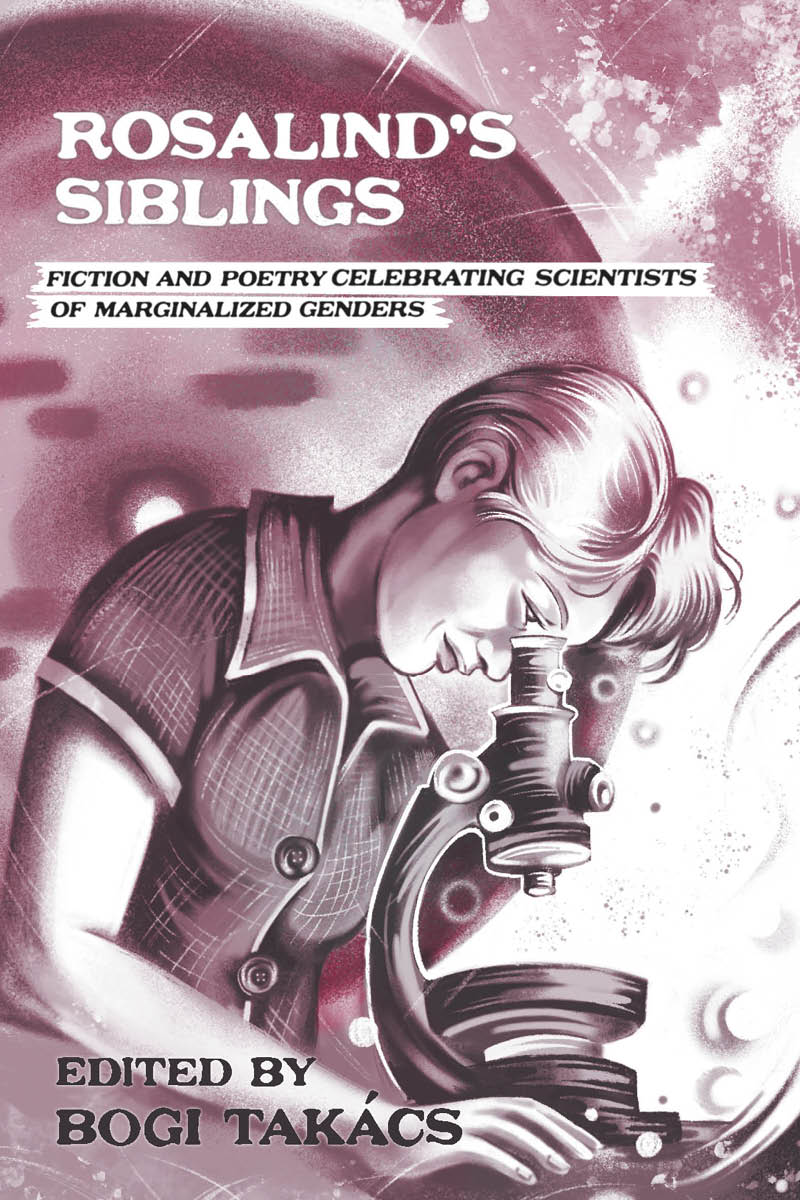
I heard about this anthology c/ Bogi Takács, the editor, and the premise immediately grabbed me (also I trust Bogi’s sensibility). It can be bought here.
The premise here – as the subtitle says – is speculative fiction stories about scientists who are marginalised due to their gender or sex, in honour of Rosalind Franklin – a woman whose scientific discoveries were key to the unravelling of DNA, but who never received the recognition that Watson and Crick did in their own time.
In Takács’ introduction, they note that the stories don’t take a simplistic view of science; there are stories where science is generally a positive force, and stories where it’s not. There are a variety of different sciences presented, a variety of ways of doing science, and a variety of contexts as well. There’s also a range of characters, across gender and and sexuality and neurodiversity and experience and ethnicity and everything else. This reflects the authors themselves, who are also really diverse. The stories, too, vary in their speculative fiction-ness; near-future, far-future, magical realism, on Earth or in the solar system or far away. There are two ‘trans folk around Venus’ stories, as Takács rather amusedly notes – and they are placed one after the other! – but they’re so different that I’m not sure I would have clicked to that similarity without having been made aware of it from the introduction (stories by Tessa Fisher and Cameron Van Sant; they’re both a delight).
As with all anthologies, I didn’t love every single one of these stories – that would be too much to expect. But there were zero stories where I wondered why an editor would include it, and all of them fit the brief, so those are pretty good marks. DA Xieolin Spires’ “The Vanishing of Ultratatts” was wonderful and hinted at an enormous amount of worldbuilding behind the story. Leigh Harlen’s “Singing Goblin Songs” was a delight, “If Strange Things Happen Where She Is” (Premee Mohamed) has gut-wrenching timeliness (science in a time of war), and “To Keep the Way” (Phoebe Barton) utterly and appropriately chilling.
The Tigris Expedition, Thor Heyerdahl

All of the things I said about The Ra Expeditions also apply here. Although this is happening in the late 1970s, so the racism is both a bit less, but also even less comfortable, if that’s possible.
Interestingly, I didn’t find this as historically problematic as Kon-Tiki or Ra. I think that’s mostly because he’s only sailing around places where there is actual archaeological evidence for contact – Mesopotamian stuff found in the Indus Valley, and vice versa – so there clearly was contact, although at how many degrees of separation is unclear from just those remnants. Although I did have to stop and laugh when Heyerdahl earnestly suggests that just because there’s a similarity between how a place name is said today, and how we think a word was said in a language nobody now speaks – well, that’s evidence that they might be the same place!
For real.
ANYWAY. I don’t need quite such an expurgated version of this book as with the other two, because the ideas and the language aren’t quite as offensive. And as with the other two, this is genuinely a fascinating adventure story. Getting the built made – of reeds, in Iraq – is another amazing story of ingenuity and the problems of materials etc in an area that really didn’t have ‘modern’ resources at the time. Was importing South American boatbuilders the most authentic way of doing it? Probably not. Anyway, then you’ve got eleven men on this little boat navigating the Arabian Gulf Persian Gulf Sumerian Gulf (there’s a whole thing about which name is appropriate), which is filled with enormous boats and isn’t all that easily navigable… and they go to Oman, and Bahrain, and Pakistan, and then back west – honestly it’s an amazing journey, with a lot of quite serious problems that they do manage to overcome. Heyerdahl is open about some of the friction experienced between the men – he has to be, given there’s someone with a camera filming them for much of the voyage – as well as their frustrations about what’s going on on land.
Would I recommend this wholeheartedly? No. Would I recommend it with reservations? Sure. Only to an historically literate reader, who’s in a place to deal with fairly stereotypical 1970s attitudes. It’s probably the best of the three in terms of not being problematic.
Left-handed and Sinister Booksellers, Garth Nix
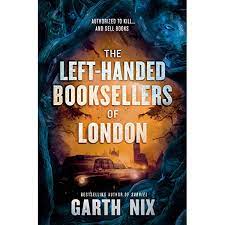
Apparently I didn’t review The Left-handed Booksellers of London when I read it, which leaves me with questions… mostly “why??” and “what was I thinking??”
I have loved pretty much everything of Nix’s that I’ve read, and this was no exception. Set in a 1983 with a history that’s slightly tangential to our own world (Clementine Attlee had me HOWLING with laughter), it’s about a girl, Susan, who has a terrible experience with something otherworldly and gets rescued by a bookseller… but not as you know them. Merlin is a left-handed bookseller, meaning he gets directly involved in dealing with incursions of Old World powers and idiot mortals who decide to meddle in things they ought not to. Adventures and revelations and betrayals ensue. Susan isn’t who she thinks she is, the world isn’t as she thinks it is, etc. I love Susan, I love Merlin, everyone should read this.
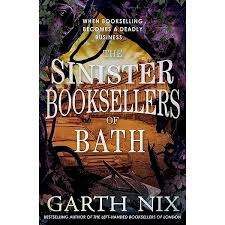
…ALL of which is why I have been looking forward to getting my hands on the sequel! It’s very much a sequel, don’t read this without the first (and why would you??). Susan continues trying to navigate in this newly expanded world she finds herself in; Merlin gets himself into some trouble early on and then they all spend the rest of the book investigating the consequences. Vivien, Merlin’s sister, is back, as are some of the assorted bookseller family members. There’s a mystery, there’s some mayhem, personal crises to be dealt with… and it’s all written as beautifully as Nix ever does. I loved it. A lot. I anticipate re-reading this, and trying to get it into other people’s hands if they’ve somehow slept through it.
Below the Edge of Darkness, Edith Widder
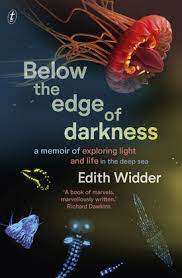
I heard Edith Widder on Unexplainable – one of my very favourite podcasts, such that I went back and listened to the year’s worth of episodes that happened before I found them (c/ Gastropod, another of my very favourite podcasts). She talked about deciding to use red light rather than white light when exploring the mid ocean and how that was a new thing, when she suggested it, and I was both boggled and entranced. I love me a good deep-sea exploration story, so when I discovered that the library had her book, I grabbed it.
I realise that the subtitle is “a memoir of…” but I didn’t realise that this was actually a memoir – that is, there’s more about her personal life than I had expected. Which isn’t a problem, it simply surprised me. Pretty much everything she talks about from her personal life is tied to her professional life, so in that sense it is very much a memoir rather than an autobiography: we don’t learn everything about her childhood, just about the very dramatic events that led her to eventually study bioluminescence and marine biology.
(Yes, I was one of those children who thought being a marine biologist would be cool. Yes, I thought it would involve whales and dolphins rather than plankton. No, I don’t love boats that much.)
Widder has been a leading light (heh, heh) for many decades in studying bioluminescence, and in figuring out how to video critters in the mid ocean – the largest living space on the planet – without actually interfering with their natural behaviour. If you’re interested in giant squid, you may actually already know of her: she’s responsible for the first footage of one underwater. She discusses a lot more than that, of course – ups and downs in research, things not going as planned, and generally learning really cool stuff about the place we know the least about on our planet. It’s nearly a cliche that we have better maps of the back side of the moon than of the depths of the ocean… but it’s true.
This book is awesome. The one thing I will say is that she does occasionally go on environmental tangents that feel disconnected from the rest of the chapter. Don’t get me wrong, she’s absolutely right and the book is absolutely the right place to be making the points (because I know she says it elsewhere as well). It just didn’t flow as seamlessly as it might have, which was a bit jarring overall. Nonetheless, it is generally really well written, and Widder has a brilliant sense of humour which often comes out in her footnotes. My very favourite is in discussion of the comparison of eye size, when she gives metric measurements for a giant squid’s eyes (30cm), and then says that in “American units” that’s 1/5 Danny DeVito’s height.
Highly recommended for my fellow science nerds, and fans of ocean science in particular.
Tusks of Extinction, Ray Nayler
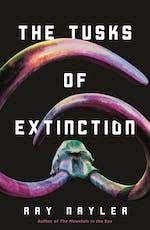
Read courtesy of NetGalley and the publisher, Tordotcom. It’s out in January 2024.
I had read and loved Nayler’s The Mountain in the Sea, so it was a no-brainer that I should want to read this novella. There are some similarities between the two, and a whole lot of differences.
Most importantly, it’s fantastic.
I hadn’t read the blurb before diving in – why would I, when I had high expectations? I assumed it was going to be about elephants, or maybe mammoths, and honestly that was enough. So yes, it’s about mammoths – although not quite as I expected. Nayler dives into the thorny questions around what it might mean, and require to bring mammoths back from extinction: in terms of science (although it’s not overly science-heavy; it’s only novella-length, after all), in terms of mammoths learning how to BE mammoths, and in terms of the human reaction as well. In particular, the focus is on poachers, beginning with elephant poachers and the people attempting to thwart them in various parts of Africa.
There’s a lot of humanity, there’s a lot of animal conservation, there’s a lot of scientific consideration. It’s provocative in the best way – no devil’s advocate crap, but raising important issues that don’t have simple answers. Well-written and engaging, this is a further evidence that Nayler is someone to keep watching out for.
Ares Express, by Ian McDonald

When I read Desolation Road I had no idea that I was reading a companion novel to Ares Express. Happily, it doesn’t matter what order you read them in – there’s no spoilers, and only one character in common… who is fairly central to the plot of both, but in ways that work separately for each novel.
Every time I read a new McDonald novel I’m reminded of just how awesome a creator he is. Here, the focus is a young woman born to a train family – they drive trains around Mars, and everything about the family is focused on the train. It’s a weird mix of a society, because it’s clearly technologically advanced – or at least, there are aspects of that, since they’re living on a terraformed planet and they have various tech things that don’t exist for us. At the same time, though, there are archaic aspects to the human side, including, sometimes, arranged marriage. Such is the future looming for Sweetness Octave Glorious-Honeybun Asiim 12th, and she is not having it. And so begins an adventure across Mars that will eventually have enormous repercussions.
The way McDonald gradually reveals his vision of this future world is masterful. There’s enough, early on, to understand the basics of society… and then slowly, slowly, enough of the history of the place is revealed that the reader’s vision is broadened. It’s looking through a keyhole vs eventually looking through a door. But not stepping through that door – there are still lots of tantalising bits that aren’t fully explained, which just makes it all the richer.
Sweetness is a great focal character: young, impetuous, smart, unafraid of challenges and usually willing to admit when she needs help. I would have been happy with an entire novel focused on her. But McDonald adds Grandmother Taal, and I love her to bits. Old ladies being feisty, taking up the slack when the younger generation is being a bit useless, fearless and clever and willing to meddle: she’s everything I love.
One of the great things about writing a middle-future novel where there’s been some loss of tech for whatever reason is that, despite being over 20 years old now, it still gets to feel vital and believable and not at all outdated. Ares Express is magnificent.

 Randomly Yours, Alex