2016Snapshot: Cheryl Morgan

 Cheryl Morgan is a writer, editor, critic, publisher, radio presenter and expert on trans history. She has no idea how she managed to end up with so many interests, and often wishes that there were more hours in the day, but at least she is never bored. Cheryl is of Welsh ancestry and currently lives in the English portion of the Disunited Kingdom. She has formerly lived in Australia and California, and very much wishes she had been able to stay in either of those places.
At a recent con in Finland (so jealous) you presented a panel on Trans Representation. Do you think that panels along these lines have become easier to present, or more generally accepted, in the last few years? Does it seem like people are more interested in discussing genuine diversity of gender?
I’m not sure. I remember doing a trans panel at the Toronto Worldcon in 2003 and there were something like 8 people in the audience. LGBT panels at Finncon and Archipelacon have been packed out. I was a bit worried about a trans-only one, but we got a very good crowd (I have asked for numbers). So from that point of view things are looking good.
On the other hand, those panels happen because the Finns trust Suzanne van Rooyen and I to do a good job, and they have firm evidence of demand. I’m not sure that the same panels would work elsewhere. My local convention, BristolCon, doesn’t have them, but that’s because it is a one-day event with only two program rooms and an enormous amount of competition for program slots. I don’t know whether an Eastercon would run such a thing.
Something you’re currently involved with is presenting a show on the radio station Ujima. What does the radio show let you do? And what’s it like preparing for a regular show like that?
Being a presenter on Ujima is a great privilege. The station broadcasts mainly to the Afro-Caribbean community in Bristol, and I certainly don’t fit that demographic. However, the station management, and in particular my Producer, Paulette North, have a commitment to diversity. Having a trans woman fronting a women’s interest show appeals to them.
My main job on the show is to showcase feminist issues, which I am very happy to do. I’m also encouraged to do features about books. That enables me to run interviews with many famous authors, and a bunch of talented locals. I have to branch out of the SF&F field occasionally for the show, but that’s probably good for me. Finally I have to fill my diversity role by talking about LGB, and particularly Trans, issues.
A two hour radio show might not sound like much work, but it is. It can take me a couple of days to find all of the guests and research questions to ask them. I also have to decide what music to play. And although the show is only 2 hours long the studio is in Bristol, so doing the show takes up much of the day with far more travel than air time.
It is, of course, tremendous fun. Had you told teenage me that I would one day have my own radio show I would have laughed at you and said that dreams like that don’t come true.
Thanks to the hard work of Juliet McKenna and her colleagues, we are starting to get somewhere with the VAT issue. It is now legal to sell ebooks without charging VAT if you email the book to the customer rather than allow them to download it direct from a website. I know that sounds stupid, but that’s the way government bureaucracies work. In the longer term the EU does want to sort this out, but as 52% of my fellow Brits have just thrown a gigantic spanner in the works no one has any idea of over what timescales that will happen, or if the UK will be affected.
Meanwhile I am definitely planning to do more books. I can use Kickstarter and Patreon now. Watch this space.
What Australian work have you loved recently?
Well obviously I am very fond of Letters to Tiptree and Galactic Suburbia, but that’s kind of incestuous. I do have a copy of Angela Slatter’s Of Sorrow And Such waiting to be read, and I’m looking forward to that. What I have read is an early ARC of Foz Meadows’ debut novel, An Accident of Stars. I’m slightly reluctant to pass judgement as the book was clearly still in the process of being edited, but there’s some really good material in there and I very much like how Foz handled the trans character.
Which author (living or dead) would you most like to sit next to on a long plane trip and why?
I would appreciate a chance to catch up with Neil Gaiman, because although we have known each other for decades he’s so much in demand that when we are in the same place together we rarely get time for more than a few minutes chat. Then again, knowing Neil he probably looks forward to long plane trips as an opportunity to get some writing done.
So I think I will go for China Mieville. We have a lot of interests in common besides fiction. Also all of the other women on the plane would be incredibly jealous of me.
Crossposted, along with all the other Snapshot interviews, at the Snapshot blog.
2016 Snapshot: Jonathan Strahan


Jonathan Strahan is an award-winning editor, anthologist, and podcaster. Since 1997 he has has edited more than fifty anthologies including The Best Science Fiction and Fantasy of the Year, Infinity, New Space Opera, and Eclipse anthology series. He is the recipient of the World Fantasy Award, a three-time winner of the Locus Award, a four-time winner of the Aurealis Award, and an ten-time Hugo Award nominee. He is the reviews editor of Locus, and the co-host of The Coode Street Podcast. He lives in Perth, Western Australia with his wife and their two daughters. (Photo by Cat Sparks; used with permission.)
Your new anthology of originals is Drowned Worlds, with authors confronting the prospect of, as the title suggests, Earth drowning. What led you to imagine such a theme for an anthology, and has it turned out like you expected?
Every book changes as you work on it, shifts and changes in your hands before you finally deliver it to the publisher. A lot of that has to do with communicating with authors and how they bring their own worldview to the challenge you’ve placed before them. Drowned Worlds is a good example of this. It started out simply as a book of stories that featured inundated landscapes. I’d recently read Paul McAuley’s story “The Choice”, which features a drowned England, and then picked up a copy of Ballard’s The Drowned World, which is hypnotic, powerful and crazy. I thought a book of stories in that space could be fun. That was my inspiration. It quickly became clear that the authors saw Drowned Worlds as a climate change challenge, and one story after another took us there. One even managed to do it by leaving the ‘drowning’ off camera, and showing us a parched landscape in a world where rising sea levels had radically changed everything. So it didn’t turn out at all like I expected. It didn’t even strictly hit the original theme, but I’m very happy with it. Why? I think it touches on a nerve, is timely, and shows what writers are focussed on right now. That’s a good thing.
You edited your tenth volume of the Best Science Fiction and Fantasy of the Year for Solaris Books this year. What do you see as the main value of such an endeavour, and what sort of audience are you imagining when you put the table of contents together?
The first book I edited was a year’s best anthology. That was back in 1997, so I’ve been doing this for nearly twenty years. I think the essential value of ‘year’s best’ anthologies as a project remains unchanged. They serve as simple one-stop shops for readers, where readers can find some of the best stories of the year in a single book. Given the incredible variety of places where stories get published, I think that’s valuable. I think they serve as books of record. There always is a varying number of ‘year’s bests’ being published, but collectively they tend to provide a good record of what the field has been doing over time. You wouldn’t want to rely on a single series to give you that overview, but collectively they do a good job of recording the history of SF/F. I think they also stand as one reader’s record of the history of the field. Gardner Dozois’ nearly 40 year long library of SF, my own 20 year long one, and others give readers a picture of the field from one perspective, which is interesting. And finally they can be a tool for change over long periods of time. An editor, if lucky, can mount an argument over many years about what excellence is in SF/F and that can have an effect. And, perhaps less pretentiously, they are pretty good reading value. As to what sort of audience? Hmm. I suppose a blend of me (we can only read from our own perspective after all), and an idealised notion of a reader who is interested in the SF/F field who has a broad taste. I edit a best science fiction and fantasy. By it’s nature, it’s a book less interested in definitions, more willing to tolerate ambiguity and strangeness, and the reader I imagine wanting my books is a reader who considers that a good thing.
Bridging Infinity is planned for later this year (2016), and Infinity Wars for next year. You’ve edited original anthologies, best-ofs, and author collections, as well as short stories for various venues. Do you see yourself continuing to work across a variety of projects for the future? Are there authors you’d really like to collect, or themed anthologies you’re desperate to pitch?
I do. I can’t imagine just doing one thing, but editing original anthologies, year’s bests, single-author collections, reviews and so on helps to keep editing fresh and new for me. In terms of authors I’d like to collect, there are so many! From Keith Roberts and Howard Waldrop, to Margo Lanagan and Elizabeth Hand, there are many many short fiction writers I’d like to see properly collected and presented to readers. I’m hoping Geoff Ryman’s “100 African Writers” project will also see more new books coming from the many African nations that are producing great writers. As to anthologies, I don’t know. I’m actually thinking on that right now.
What Australian work have you loved recently?
I’ve read a few things I’ve really loved. Greg Egan’s “The Four Thousand, the Eight Hundred” is a really powerful piece of science fiction that came out last December and should in my opinion have won all sorts of awards. Sadly, it hasn’t so far. I really enjoyed Angela Slatter’s debut novel Vigil, and just finished Garth Nix’s latest Old Kingdom novel, Goldenhand, which was smart and funny and moving and absolutely wonderful. I also loved James Bradley’s terrific novel Clade. There has been other stuff, but those stand out.
Which author (living or dead) would you most like to sit next to on a long plane trip and why?
I don’t know. I’m tempted to say Garth Nix, because he’s already a good friend, or Sean Williams. Um. Robert Heinlein, I think. Why? Because he was so fundamental to me as a young reader and young person growing up. I’d love to have been able to sit down and talk to him about his worldview and his books. I think a good long flight – hopefully in First Class – would give me a chance to talk to him about those stories that I loved so much and to get a feeling for the person behind the stories.
Crossposted to the Snapshot blog, along with all the other interviews.
2016 Snapshot: Lisa L Hannett
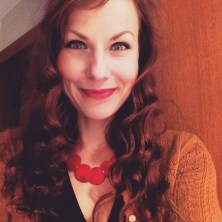 Lisa L. Hannett has had over 60 short stories appear in venues including Clarkesworld, Fantasy, Weird Tales, Apex, the Year’s Best Australian Fantasy and Horror, and Imaginarium: Best Canadian Speculative Writing. She has won four Aurealis Awards, including Best Collection for her first book, Bluegrass Symphony, which was also nominated for a World Fantasy Award. Her first novel, Lament for the Afterlife, was published in 2015. You can find her online at http://lisahannett.com and on Twitter @LisaLHannett
You recently won the Ditmar Award for Best Novel for Lament for the Afterlife – congratulations! What’s the response been like to this novel, and what was it like to write?
Thanks! I was (and continue to be) so chuffed that Lament won a Ditmar for Best Novel; it was a wonderful and surreal experience hosting the awards ceremony at Natcon this year, having no idea who the winners would be, and then announcing my own name in that category! More importantly, though, it felt really special to receive this nod from my peers, especially since Lament is my first novel.
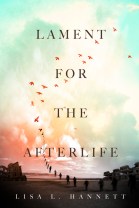 Writing this book was a fascinating challenge, to be honest. At one of the launches, I mentioned that Lament was a complicated response to my perhaps naïve question: “Why war?” and that’s still how I think of it. I am perpetually interested in war stories — particularly wars that seem futile, or that drag on endlessly, or that seem hopeless — and I’m also constantly attracted to narratives exploring ideas of masculinity and/or what it means to “be a man”, which is no doubt also one of the reasons I’m so hooked on researching and writing about the Viking Age. I’m always wondering what happens to the regular folks when they’re confronted with huge social upheavals, and I’m also interested in the power of language to effect change (for better or worse). So, bearing all this in mind, working on Lament meant I was immersed in a bunch of topics that I find so absorbing, which made writing it — well, I won’t say fun because it was sometimes really hard, especially when dealing with such harrowing material. (The footage I watched of WWI soldiers suffering from shellshock while researching this story will be burned into my memory forever.) But it was engrossing, and putting this story together certainly made me grow as a writer. The book’s unconventional structure meant that I could write Peytr’s life narrative out of sequence, which I’d never attempted before, and that also opened up a lot of possibilities in terms of characterisation, plot, and world building. It also meant I avoided the mid-novel slump, since I wrote the middle of the novel after writing everything but the final chapter. It’s a bleak story, so people who are after a cheerful escape won’t necessarily find it’s up their alley, but I couldn’t in good conscience write this story in any other way.
One of the best responses I got was from my editor at ChiZine, who said she was bawling her eyes out at the end, which was the perfect reaction in my opinion. Another brilliant surprise I got was listening to the Writer & The Critic’s “Fab 50” episode and hearing Kirstyn McDermott (whose writing I admire immensely) pick it as her #1! That was pretty exciting. Of course, it was so great seeing Lament get positive reviews on Kirkus, i09, Publishers Weekly, SF Signal and to see it longlisted for the Sunburst Award in Canada. But probably the very best responses have been from soldiers who’ve read the book, given it five stars, then said I’d nailed the guys’ sweary voices, the overall tone, the confusion and dread and boredom of being on the frontlines, and so on. Man, that was as much an honour as it was a relief.
You and Angela Slatter have collaborated on a number of collections in Australia, such as The Female Factory, and these works are quite different for you both. How do you go about writing those stories?
In many ways, Angela and I have such different interests in reading and writing — she’s an enormous crime buff, for instance, and can write a cracking mystery tale, whereas I love reading and watching crime stories but don’t know if I’d ever write one; she’s got such a strong commercial voice, whereas I love veering off into experimental narrative structures; she’s often drawn to writing strong female characters, which I also love doing, but I find myself often depicting vulnerable men — but we have so very many interests in common (mythology, history, fairy tales, etc etc etc) there’s always a place where our styles and ideas can overlap.
When it came to writing The Female Factory, Alisa had given us the challenge of creating Science Fiction pieces (which neither of us do overly much) so it was fantastic having two minds on the job! We brainstormed as much for that collection, I’d say, as we did when writing Midnight and Moonshine, even though that book was about three times longer. No matter what we’re working on together — whether it’s stories about raven-women and Norse gods or about kids cobbling a mother together out of stolen body parts — we always discuss the main ideas, character arcs and plot points together before starting a project. Then, usually, one of us writes the opening, or a key scene, or something crucial to kick things off. Once there are words on the page, we pass the document back and forth between us — adding bits, deleting bits, editing each other’s paragraphs, building on them — until we’ve got the whole thing drafted. This process sometimes takes up to ten drafts, which is many more than we do when working on stories individually. Mostly this is because we’re perfectionists, but also because we’re communicating so clearly and extensively throughout the drafting process; we add loads of comment bubbles explaining the changes we’ve made, and why, so that we’re both on the same page and aiming for the same narrative goals. Also, by the time we’ve gone through this many drafts, the “voice” of the piece no longer seems to be either just Angela’s or just mine. Instead, it’s a third voice that you won’t find in our individual projects — and I think that’s an important feature of our collaborations. Most of all, our partnership works because we’re so open to discussion, we’re not precious about being edited, and because we trust each other implicitly.
You often seem to have a lot of projects on the go at the same time. What’s the most exciting one you’re working on at the moment?
I’ll narrow it down to two because I’m equally excited about them! I’m a whisker away from finishing the edits on my next collection, The Homesteaders, which is a sort of follow-up book to Bluegrass Symphony. Backwoods witches, immortal soothsayers, bear-shaped child-stealers, raven-shaped miners, and lots of ghosts appear in these short stories, and they’re all tinged with a down-home country twang. I’m also doing rewrites on my next novel, Ketill’s Daughter, which is the first in a two-book series called The Invisible Woman. Set in Viking Age Norway, this first book tells the early story of Unn the Deep-Minded — wife of one king, mother to a second, and eventually a famous Viking herself — as she struggles to find her own fame and fate in this warrior world, all while her shape-shifting time-travelling fylgja (a kind of spirit guide) keeps butting in to mess things up for her… The second book in the series (called Deep-Minded) will follow Unn out of Norway into medieval Ireland, Scotland, and finally Iceland.
What Australian work have you loved recently?
Alison Goodman’s Lady Helen / The Dark Days Club is such a rollicking read! I enjoyed it so much, I’m dying to read the next book in the series. James Bradley’s Clade was an astounding work of speculative fiction, and though I read it last year, I still think about it frequently. Another Book One I devoured last year was Kim Wilkins’ Daughters of the Storm; I’m hanging out for Sisters of the Fire! And of course, Angela Slatter’s Vigil: it’s a really fun urban fantasy set in Brisbane, and I gulped it down almost whole.
Which author (living or dead) would you most like to sit next to on a long plane trip and why?
Well, they’d have to be outgoing enough to kick off the conversation because, usually, I’m one of those people on planes who’s like, I don’t care how close together our seats are: please don’t talk to me I just want to read my book and watch a crappy movie and hopefully fall asleep. BUT, assuming I was in a chatty mood … and excluding any writers who are currently my friends (because how to choose only one?!) … I’m going to go with the first name that pops into my mind, and that’s David Malouf. I’ve recently re-read Ransom, which is an incredible reimagining of the story of King Priam, Hector, and Achilles, and good lord it’s a brilliant book — as brilliant as An Imaginary Life, really — and I’d love to have a long talk with him about it, antiquity, poetry, myths, short stories, the libretti he’s written, the great breadth of his knowledge about language, life, the universe, and everything — and I’d also like to ask him where he’s stashed the painting that’s ageing on his behalf (because, seriously, how is it possible that he’s 82? He looks at least twenty years younger. Witchcraft, I say! Or a supernatural portrait.)
Crossposted to the Snapshot blog, along with all the other interviews.
2016Snapshot: Katharine Stubbs

In the past, Katharine has been mentor and municipal liaison for NaNoWriMo (2005-2012), was the Northern Territory judge of the CBCA Book of the Year Awards for 2013/14, and is currently the Judging Coordinator for the Aurealis Awards.
You’ve recently taken over as the chief organiser of the Aurealis Awards – congratulations – and you’ve been involved as a judge for quite a long time. What value do you see in these awards?
Thank you! I don’t think it’ll be something I can manage for very long, there is so much work behind the scenes that it’s a little overwhelming. Tehani Wessely has been doing such an amazing job though, and she’s trained me well – and she’s still a few pixels away from helping me with further advice!
The value I see is having a group of people not only read the same works, but the collection of works from the entire year and be able to see both what we have to offer in that genre but also how it stacks up in general against each other, in an all-encompassing way. The more people on a panel the better in a way, to get as much of a balanced and invested view as possible, whilst also still making it manageable for the publishers or authors submitting copies, and the convenors managing their panels. We have a number of other awards in Australia but not all are judged by a panel – they can be judged by the public or members to a particular convention or group, which means that while the pool of voters is much, much larger, they may not have read the entire scope of what’s eligible for that year – hence the different results over the different awards. I like that the Aurealis Awards makes it as manageable as possible to read everything that’s eligible – we really push for everything that’s eligible to be entered as early as possible – and the discussions that come from this are grand.
It certainly makes it easier for the public who may not have the time or desire to read a hundred books a year, to have a shortlist to dive into!
You’ve done a lot of work as an intern for two Aussie indie presses, Fablecroft and Twelfth Planet Press. What drew you to wanting to be involved in these two endeavours?
I think it started out as just wanting to be helpful in general, and from there it’s expanded into taking on small projects here and there, handling the slush pile and taking pitches, and being mentored in how to proof and edit manuscripts. It’s all so interesting and I’m really passionate about doing it all full time one day – I can dream, at least! I love that indie press can do projects you’d rarely see from big publishers, and that authors have more say in what goes into their book as a whole – the graphic designs and the media. It’s such a nice step between the big publishers and really high quality self-publishing – more say in your book without having to do all the work! Indie publishers are also so much more a labour of love, too. We’re certainly not there for the pay (though the tea and chocolate is lovely!)
What plans do you have for future involvement in the Australian science fiction scene?
Oh, goodness only knows. I’d love to be part of a comeback of a ASIF https://aussiespecficinfocus.wordpress.com/ style website, and really push more media on the excellent books we have here – especially from small press and self-published works.
As for anything else it’s a little hard, still, being stuck up in a remote part of Australia away from all the action – there’s so much I can do online, but it keeps me safe from doing anything really crazy, like joining a concomm. I’m happy seeing what comes in the next few years and flailing madly for volunteering when it happens. I still feel quite new and like I should keep quiet as I don’t know enough to do much… but I think I’d love to edit an anthology one day.
What Australian work have you loved recently?
Hrm, what have I read so far this year? I’m part of a re-read of the Twelve Planets series by Twelfth Planet Press, where we read and review one book each month. Some I read when they first came out so it’s been a few years, and some I never actually got around to reading so it’s been excellent so far! What else… The Dark Days Club by Alison Goodman – that was very enjoyable and I can’t wait for book two. The Ghost by the Billabong by Jackie French had a few speculative aspects, and I was sobbing by the end of it so I totally got attached to the poor characters. Squid’s Grief by DK Mok, and Vigil by Angela Slatter were both so engaging I couldn’t put them down, and I read them as quickly as possible – I loved the characters so much, and I was so happy when DK told me I’d probably be able to hug her main character without getting stabbed – that’s exciting. Defying Doomsday anthology edited by Tsana Dolichva and Holly Kench absolutely blew me away and I really, really hope we get some novels spawned from some of those short stories.
Other than that I’m really looking forward to Sisters of the fire by Kim Wilkins, If Blood Should Stain the Wattle by Jackie French, Swarm by our magical trio, Den of Wolves from Juliet Marillier… and countless other things. This is another awesome aspect of working with the Aurealis Awards, it’s impossible to miss what’s coming out! (But a little more impossible to have time to read it all!)
Which author (living or dead) would you most like to sit next to on a long plane trip and why?
Charles M. Schulz (creator of the Peanuts comic strip, Snoopy, etc) is such an amazing creator. He counts as speculative fiction, right? C’mon, Snoopy thought he was a WWI flying ace fighting the red baron! Jim C. Hines would agree with me.
Fine, after all the work we’ve done for Letters to Tiptree, I think I’d have to say Alice Sheldon. I’m not entirely sure that she’d want to talk to me, but I’d love to hear her just talk about opinions about just about anything. Or if someone was sitting next to her so I could listen in on their conversation. Hang on, since it’s a long plane trip, surely I can say that I’m sitting in the middle of a set of four seats on say, an British Airways A380-800 flying from Singapore to London on my way to Helsinki Worldcon 2017, right?
So let’s say I’d like Joanna Russ to be seated in Row 25D, Alice Sheldon in 25E, I’ll take 25F, and Charles Schulz in 25G. That flight would go by so fast. I wonder what movies they’d all put on?
Crossposted to the 2016 Snapshot blog, along with all the other interviews.
Galactic Suburbia: Ghostbusters
Ghostbusters (2016) Spoilerific!

Was it better than the original? Did we love it or hate it? Was it appropriate for a 6 year old? If you want the new Ghostbusters movie thoroughly Spoiled, who you gonna call?
You can get us from iTunes or at Galactic Suburbia.
Some links to other think pieces/reviews:
Ghostbusters is Still Haunted by Negative Racial Tropes (Polygon)
The Clothes of Ghostbusters (Women Write About Comics)
Ghostbusters 1984 vs Ghostbusters 2006 (Book Smugglers)
Not discussed but interesting: the clothes of Ghostbustersthe clothes of Ghostbustersthe clothes of Ghostbusters
Please send feedback to us at galacticsuburbia@gmail.com, follow us on Twitter at @galacticsuburbs, check out Galactic Suburbia Podcast on Facebook, support us at Patreon and don’t forget to leave a review on iTunes if you love us!
2016 Snapshot: Kate Forsyth


Kate Forsyth wrote her first novel aged seven, and has now sold more than a million copies around the world. Her novels include The Beast’s Garden, a retelling of ‘Beauty & the Beast’ set in the underground resistance to Hitler in Nazi Germany; The Wild Girl, the story of the forbidden romance behind the Grimm brothers’ fairy tales; and Bitter Greens, a retelling of Rapunzel interwoven with the true life story of the woman who wrote the tale, which won the 2015 American Library Association Award for Best Historical Fiction. Kate’s children’s novels include The Impossible Quest, The Puzzle Ring and The Gypsy Crown. Named one of Australia’s Favourite 15 Novelists, Kate has a doctorate in fairy tale studies and is an accredited master storyteller.
Your most recent book comes from your research into the fairytale of Rapunzel, and connects to your wonderful novel Bitter Greens. What was it like to prepare The Rebirth of Rapunzel for a general audience, rather than an academic one? Do you feel like you’ve got Rapunzel out from under your skin now, having spent so long thinking about her?
It was great fun putting THE REBIRTH OF RAPUNZEL together. I included my doctoral thesis, which examined my long-held fascination with ‘Rapunzel’ and how I used it to write Bitter Greens, along with a number of topic-related essays, articles and poems. I did not rewrite my doctoral thesis for this publication, as my style has always been accessible rather than academic, and I trust greatly in the intelligence of my audience. So it was more a matter of deciding what to include, and putting it into order, than any new writing or research.
And yes! I think I have finally exorcised Rapunzel …
Last year saw the publication of The Beast’s Garden, a take on “Beauty and the Beast” set in Nazi Germany. What did you feel that you could accomplish by choosing that particular setting for the novel? Continue reading →
The Lost Child of Lychford
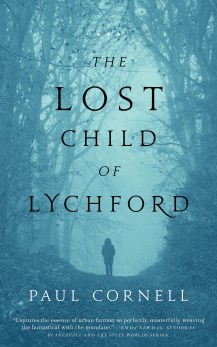 On sale 22 November from Tor.com. Sent to me by the publisher at no cost.
Previously in Lychford, three women discovered that Bad Things were going down in both a spiritual and literal sense in their village. Together, they managed.
Now, it’s some time later… in fact, it’s Christmas. So you just know something bad is going to happen. Lizzie is the pastor and she’s relatively settled; Autumn is still running her magic shop and she’s taken on Judith, ostensibly as her shop assistant but actually because Autumn is Judith’s apprentice in witchy business. And yes, something bad is happening. Whether it’s worse than the events of the first story is debatable; it certainly affects a few people more immediately, viscerally and unpleasantly than the attempted Evilness of the first story.
Like last time, Judith – the old woman who is cranky and impatient – is my favourite. I felt that she got a bit less airtime this time, although I haven’t actually compared the two; it was just my gut feeling. Nonetheless cranky ladies FTW; I love her practical get-it-done nature and her impatience with what she sees as uselessness. I also love that she is willing to work with the younger women and accept that there are other ways of doing things… eventually…. plus she clearly loves the town, and her son; everything she’s about is protecting the place, and indeed giving everything in the service of that. She takes her responsibilities very seriously.
Lizzie is a bit more fleshed out here than in the first story; she’s less burdened by guilt (as I remember it) and therefore (?causality?) able to act a bit more. Autumn, though, continues to be almost a cipher. She doesn’t get much character development or airtime (although she does make a tremendous sacrifice which Cornell writes nicely).
Again, I’m not sure that this is especially a huge contribution to witchy stories, but it’s engaging and well-written, fast-paced and enjoyable.
Dusk or Dark or Dawn or Day: Seanan McGuire
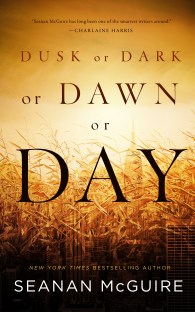 Due out from Tor.com in January 2017. Sent to me by the publisher at no cost.
I’m really not one for what’s hot in genre. I only knew about the zombie/unicorn thing when the awesome Zombies vs Unicorns came out. Still, if Seanan McGuire is writing about ghosts, that probably means they either are, or are about to be, hot, right?
Jenna is a ghost, living in New York. The story opens with her death, and as it progresses we discover more and more about what it means to be a ghost – what they can do, if not why. And it’s all about time. Ghosts exist because of people who die before their time, and that gives them a connection to time – giving it and taking it.
This is a just-slightly-alternate version of our world, with some people at least being aware of ghosts on some level. And there are also witches, who have an uneasy relationship with ghosts. And with each other.
Jenna is often focussed on her own time on earth, and when she will be able to move on. Occasionally, this preoccupation got a little wearing – understandable, but sometimes not seeming relevant to the narrative. Nonetheless the narrative flows well, as you would expect from McGuire, but more than that for me the story is about delightful relationships. Not all of the relationships are easy – Jenna and Brenda, for instance, have known each other for many years but wouldn’t be described as BFFs by any stretch of the imagination. Perhaps my favourite is Jenna and Delia; in fact I would love to see an entire story about Delia, Jenna’s landlady who is a ghost and one feisty, feisty lady. With a parrot called Avocado.
Look, it’s Seanan McGuire. You know you want to read it. I’m sorry it’s not out until January, but it gives you something to look forward to, right?
Farscape: s1, e8
Each week on a Sunday afternoon, join Alex (of Randomly Yours, Alex) and Katharine (of the unpronounceable Ventureadlaxre), as they re-watch the Australian-American sci-fi show Farscape, notable for the Jim Henson animatronic puppets, the excellent mish-mash of accents, and the best OTP ship of all time.
Season One, Episode Eight: That Old Black Magic
Whilst in a marketplace on a planet, Crichton gets tricked away by some old wizard guy for his own sick and twisted games. Which, in turn, show that more people than we think can be sick and twisted also.
K: Rygel needs medication? Ah well, life comes and goes. Bring back the cute bird instead.
A: And John’s in his old space suit!
AHAHA Rygel has man-flu and Crichton is grossed out by the idea of raw brains. Continue reading →
Godless, by Ben Peek
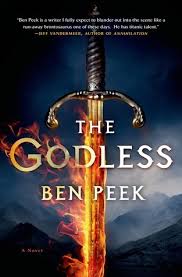 This book was sent to me by the author, at no cost.
It was fascinating, when I started this, to realise just how long it’s been since I read some epic fantasy.
Quite a while.
This is definitely epic fantasy. You can tell because the blurb begins by telling you it’s fifteen thousand years since something happened, and that something is the War of the Gods rather than a generation ship leaving Earth.
So the gods are dead (or dying), and most humans have just been getting on with their lives: knowing that there used to be gods, and that the consequences of their war and deaths are all around – in the mountains called the Spine of Ger, in the ocean called Leviathan’s Blood – but really, just living. There are a few exceptions, though: those who seem to have some of the gods’ power in them. For most humans, those people are cursed and to be avoided – not least because some of them used their powers to rule parts of the world, with varying levels of success or violence.
The narrative is told through three different characters. Ayae is young, a cartographer’s apprentice, a refugee in Mireea, and about to discover that she is cursed. The middle-aged Bueralan is a mercenary captain employed by Mireea who finds himself going surprising places. And Zaifyr… well, he’s completely unexpected. Old, troubled, complex, selfish, blunt, powerful. Much as I think he would hate it, he really binds everything in the narrative together because of his history, and because of his actions throughout the story.
Godless has action and betrayal, sieges and death and confusion and loss. So, epic. And it’s the first of a trilogy, so nothing is resolved – well, there are deaths, but given this situation that may actually not be as final as in other stories. This book definitely doesn’t stand by itself because the last couple of pages are evil, evil cliffhangers.
My one real problem with this book had more to do with the presentation than the narrative. There are numerous points at which characters are reminiscing about the past, but the text’s appearance doesn’t make it clear what’s happening in the past or in the present. In some books that’s because the characters themselves are confused, but that’s not the case here. It would have been good, therefore, to have the font make the time differences obvious – or even just a break in the text itself would have helped. It meant that I had to work harder than was necessary. There were also a number of typos and odd sentence structures, which frustrated me.
I am definitely looking forward to the second book in the series.

 Randomly Yours, Alex