Galactic Suburbia 89
 In which we recommend books to buy as presents, books we love, books we made, and basically BOOKS BOOKS BOOKS. You can get us from iTunes or at Galactic Suburbia.
Alisa’s picks: 2012; Trucksong; A Trifle Dead; Rosaleen Love’s Twelve Planets collection; the entire Twelve Planets suite (get them while they look the same! especially Love & Romanpunk)
Alex’s picks: Temeraire by Naomi Novik; Ocean at the End of the Lane by Neil Gaiman; Shades of Milk and Honey by Mary Robinette Kowal; Left Hand of Darkness by Ursula Le Guin; House of Suns by Alistair Reynolds
Tansy’s picks: Glitter and Mayhem; Chicks Unravel Time; The Wife in Space; The Worst Witch books by Jill Murphy; Creature Court trilogy (Power and Majesty)
Culture Consumed:
Alex: Reap the Wild Wind, Julie Czerneda; Ocean at the End of the Lane, Neil Gaiman
Tansy: Flying Higher eds by Michael Damian Thomas & Shira Lipkin [download free from Smashwords], Doctor Who: Prisoners of Time 1-4, Supurbia by Grace Randolph, Elizabeth Sladen the Autobiography, The She-Hulk Diaries by Marta Acosta
Alisa: Glamour in Glass, Mary Robinette Kowal
BLATANT PLUG: Songs For Europe, two short plays about Eurovision & war by John Richards of Splendid Chaps & Lee Zachariah of the Bazura Project on this week only as part of the Melbourne Fringe.
Please send feedback to us at galacticsuburbia@gmail.com, follow us on Twitter at @galacticsuburbs, check out Galactic Suburbia Podcast on Facebook and don’t forget to leave a review on iTunes if you love us!
Reap the Wild Wind

I read this thanks to a recommendation from Helen Merrick, who I seem to recall being a massive Czerneda fan. I understand that this is a prequel series, written after the world in question becomes part of a wider galactic network. Not having read the later books, I can’t say how an already-fan would respond; but I imagine there are some awesome moments of filling-in-gaps. Because it is indeed a wonderful novel, and I do fully intend to go and find the rest of the trilogy, and probably the later series as well.
Told mostly from the adolescent (unChosen, in the parlance of her people) Aryl’s point of view, this is a story of a world that – as far as Aryl is concerned – is entirely static, as it should be. One of the characters comments on Aryl and her people living in an eternal ‘now’ – and although that’s not entirely fair, because their lives do revolve around the season of harvest, it does make sense because their knowledge of history and their expectations for the future are exceptionally limited. But this is not, overall, a bad thing: Aryl’s family and friends live full, rich and generally rewarding lives. Without interference – and of course you know there’s going to be interference – the Yena live.
Aryl lives on Cersi, a world that is home to three different sentient species. Aryl is of the Om’ray, human-types who live in Clans in disparate parts of the world and who rarely interact with each other except when one of the boys leaves on Passage, drawn by a woman who has become sexually mature (there’s some mental communication stuff which makes this basically make sense). The Oud and the Tikitik are not humaniform, and they are more technologically advanced than the Om’ray – they swap the Om’ray for some things in exchange for technology. The Agreement is meant to guarantee stability (if not stagnation) between the three. But then things change – strangers come. And strangers are not accommodated within the Agreement, which sets off all sorts of problems between the species, and within them as well.
There’s a lot of things going on within this book. Biological sexuality is not something that develops in Om’ray but seems to basically be on or off, which is intriguing and means that sexual tension isn’t really an issue (well, it is at one point, but it doesn’t overwhelm the whole story); issues of difference, and allowances for degrees of difference, are central to the Om’ray story and whether Aryl can be truly part of her Clan. In sweeping terms this is both a coming-of-age story, for Aryl, and also a first-contact story – and that part I think is done very well done, because it’s neither entirely positive nor entirely negative. Part of the story is told from the perspective of a boy from a different Clan, and this allows Czerneda to show the different perspectives of the Om’ray themselves, within their general similarities.
I think this counts as science fiction, because the strangers are aliens and there are issues of technology etc. It includes elements of fantasy, too, which I think work nicely within the story as a whole.
Reap the Wild Wind is well-paced, with an intriguing world and winsome POV characters. Very enjoyable.
You can get Reap the Wild Wind from Fishpond.
Essays, jellyfish, and the multiverse
A while back a colleague introduced me to Arts and Letters. This is a wonderful site that collects essays from around the web, most of them free to read, and – in my case – delivers them to my blog feed for idle consumption. There are a lot that come through that I just don’t care much about, but that’s ok; it’s easy enough to swipe them away as read. But sometimes there are some absolute joys in the mix. Some essays and some reviews that I know I would never have come across otherwise.
Tim Flannery’s “They’re taking over!” about jellyfish, for example. I remember reading a while back that Japan was having serious jellyfish issues, to the point where chefs were making serious attempts at turning them into delicacies so that the population could try and eat their way through them… or something… Anyway, this essay is actually a review of Stung! On Jellyfish Blooms and the Future of the Ocean
Over at Aeon, Andrew Crumey explores the idea of the multiverse through both physics and literature, showing how the former has sometimes followed the latter in positing and explaining the idea of multiple, parallel, divergent universes. Someone who references Borges and Feynman, Baudelaire and Everett in the same 2,600 words was pretty much always going to be writing an interesting essay, and that is indeed the case. The idea of the multiverse is a confronting one for a Christian, but that’s fine; it’s not like I’m not used to that. I enjoyed how Crumey meandered around ancient Greek and Roman philosophy through to 19th century literature, and tied together 20th and 21st century physics. Not being as au fait with the physics as I might like (nor, honestly, the philosophy), I can’t say whether it’s entirely trustworthy in the connections it draws – and I refuse to read the comments, because I just bet they range from ‘multiverse?? You loony!’ through to other unsavoury comments (but hey, at least it wasn’t written by a woman pretending like she understood the science, right?) – but as a keen general reader, it was certainly absorbing and persuasive.
Galactic Suburbia 88: Hugos
 In which, Hugos. Get us at Galactic Suburbia or iTunes.
Tansy, Alisa and Alex gather only minutes after the Hugo ceremony to discuss the results! Because, HELLO: Tansy won one!!
Hugo winners
The Stats, Statbadgers!
Tansy’s Hugo Post
Culture Consumed:
Alex: The Adventures of Alyx, Joanna Russ; BSG rewatch yet again; The Memcordist, Lavie Tidhar; Firebugs, Nina Kiriki Hoffman
Alisa: KickAss 2; Enchanted Glass, Diana Wynne Jones; Ugly, Robert Hoge
Tansy: Fringe Season 1, Dorian Gray Season 2, Ugly, Robert Hoge
Plugs: Splendid Chaps Nine/Women, featuring Tansy: September 15
Glitter & Mayhem released and partying, glitter skate style.
Please send feedback to us at galacticsuburbia@gmail.com, follow us on Twitter at @galacticsuburbs, check out Galactic Suburbia Podcast on Facebook and don’t forget to leave a review on iTunes if you love us!
Adventures of Alyx
No, I did not misspell my own name (although someone at work did yesterday…) – Joanna Russ called her character Alyx, and I have finally read the collection of four short stories + one novella about said adventurer.
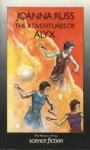
The thing you have to know about Alyx is that although the name stays the same, and some aspects of the character remain the same, trying to establish an internal chronology for these stories is likely to bust your brain. It doesn’t work, and it doesn’t have to work. Maybe it’s the same woman, maybe she’s a time traveller, maybe the name lends certain characteristics (like Julias in Tansy Rayner Roberts’ Love and Romanpunk) … or maybe Russ is playing, and it actually doesn’t matter. Although once you accept that it doesn’t necessarily work, making connections is a lot of fun.
These stories are different genre, with different approaches to narrative – what makes a narrative – so don’t go in expecting a cohesive whole. Of course, it is a whole in that Russ is doing confronting things with her female character: making her the lead, and not making romance important, and exploring reactions to women. That’s still a bold thing to do, and my edition of these stories was published in 1983; they originally came out between 1967 and 1970. I really wish I was alive to experience Russ As She Happened. And it makes me wonder who, if anyone, fills a similar niche today – and whether I am completely missing their stuff, for whatever reason.
I feel like a barbarian myself to admit that I did not love the first two stories. In fact, it took me ages to get through this slim volume because I was so not in love with the first one, and then the second, that I was worried I wouldn’t enjoy the rest. I persevered though, partly from an admittedly perverse desire to be able to say that I had read it, and partly because I knew that the stories changed up so I was hoping that I would come across stories more to my taste later on. And I did. Some of what comes below is my analysis of my own reactions to the stories, rather than a pure review. This might be dismissed as navel gazing; for me, it’s a way of working out how I work with Joanna Russ, such a powerful influence over what I’m interested in.
“Bluestocking” begins in a very self-deprecating way – “This is the tale of a voyage that is on interest only as it concerns the doings of one small, gray-eyed woman.” Not a great start? It gets subversive within moments, though, suggesting that the first man was created from the sixth finger of the left hand of the first woman… but our lady, Alyx, has all six fingers. Alyx is a pickpocket; she gets hired to look after a spoiled young woman. Then there are adventures, of a sort. There’s travelling, and bickering, and a sword fight. It is also supremely brief. I’m not sure whether it was that aspect that most didn’t work for me, but it certainly contributed – I found this story quite frustrating, with all its lacunae and its teasing and… something. “I Thought she was Afeard till she stroked by Beard” worked similarly on me. In this case, Alyx escapes an unhappy marriage; gets on board a ship and has a complex relationship with the captain; and is frustrated by the place of women in the world. I think it’s clever, but for mine there’s just not enough.
I should say at this point that there is more going on here than ‘just’ a narrative, especially in narrative connections; I know Russ is addressing Fritz Lieber, and others. I haven’t read any Lieber. Perhaps this is a fault in me, and the stories would be greatly improved with that background knowledge. But I know Terry Pratchett riffs off Lieber too, and I enjoy those stories; I know Mieville and Reynolds are riffing off others, but I still enjoy theirs too. So… perhaps it’s ok that I don’t enjoy all of Russ’ work? Maybe?
“The Barbarian” is a story that Gary Wolfe, in his essay in On Joanna Russ (… I think?? eep maybe I’m wrong…) suggests is the switch for Alyx between fantasy and SF, which is an intriguing way of seeing it. Here Alyx is again a crim-for-hire, but she doesn’t like what she’s hired to do and things go downhill from there. For me as a reader, though, things started going up. This story appealed more, although I’m not sure why. Maybe it’s a simpler story but with more flesh, more detail?
Then – next – oh, delight: “Picnic on Paradise.” This was originally published alone, as a novel; I guess it’s a novella, by today’s standards? 90 pages in my little pocketbook edition. Alyx, a Trans-Temporal Agent brought from the ancient Mediterranean world to both the future and a different planet. She’s being used to guide a disparate group of tourists across a war-ravaged planet, to keep them safe in the most horrific of circumstances: no access to their technology. There’s an incredibly profound moment at the start, where one of the women asks why Alyx is “covered up” – wearing clothes. So Alyx takes off her shift, therefore mimicking those around her, which group promptly have apoplexy. Alyx is confused, naturally; one of them says that she is wearing her history, which they are not used to. This goes a long way to demonstrating some of the rather large differences between Alyx and her charges. The story is a straightforward one of flight, and fighting for survival: getting lost, getting hungry, literally fighting (nature, each other, etc). It’s Russ, and having read We Who Are About To… I wasn’t surprised that things do not go according to plan, in a drastic way. One of the remarkable aspects is, of course, that the leader is a woman. Making the hard decisions, being contemptuous, fighting – being well-rounded. The tourists are a motley bunch: nuns, macho men, wannabe robots, high-society ladies. They too have their chance to be well-rounded, to interact especially with Alyx but also each other. This isn’t a fun story but it’s a great story, an intriguing one, and one I am so pleased to have read.
The final story in the set is a difficult one in terms of “Alyx canon,” the idea of which I rather suggest Russ would either have rolled her eyes or laughed at. Because Alyx probably isn’t in it. Her descendants might be, but if you read this by itself you wouldn’t have a clue about her. It’s also frustrating me because I know I have read it – “The Second Inquisition” – before, but I don’t know where. Some anthology, some time. Anyway… this too is science fiction, focussed on a young girl whose family is hosting a very odd stranger, who leads the girl in all sorts of directions: physically, introducing her to other, even more strange people; intellectually, introducing her to books and ideas she has never encountered; and culturally, challenging a whole bunch of assumptions within the family and society more broadly. There’s also questions about reality and imagination going on here that I think I missed the first time through. Intriguingly I think this gets a little close to the ‘galactic suburbia’ stories that Russ dismissed, since the focus is very much a suburban home with the occasional break-in of the science fictional. At any rate it certainly makes a challenging and difficult-in-a-good-way conclusion to the collection, because it doesn’t fit neatly into Alyx’s adventures. Which is as it should be, because Alyx – as a woman and as a character – doesn’t fit anywhere comfortably either. And she wouldn’t want to.
Cute things
Yup, more knitting, for babies again. The monsters are Claudes, from Rebecca Danger; the booties and cap are ones that I have knitted heaps over the last few months – they’re incredibly rewarding because they’re done SO FAST. 

Galactic Suburbia does Saga
Galactic Suburbia Episode 87: Saga Spoilerific Book Club
 For the first time in years, all three hosts of Galactic Suburbia have read the same thing at the same time! So buckle up, it’s time for another installment of the Spoilerific Book Club! (Get us at iTunes or Galactic Suburbia.)
We’re taking on the Eisner-award winning & Hugo-nominated comic Saga, written by Brian K Vaughan and drawn by Fiona Staples, published by Image Comics.
For this episode we look at the 12 issues which have been collected as the first two trade editions of Saga and we spoil EVERYTHING, so don’t listen unless you’ve a) read it or b) don’t care about spoilers. Which while being spoilers aren’t story-destroying spoilers, ifyouknowwhatimean.
We discuss tree rockets in space, breastfeeding, childbirth, violence, men with TV screens for head, gay sex, straight sex, parents-in-law, mutilated bodies, fatherhood, brothel planets, child prostitutes, romance novels, the sexual anatomy of giants, Lying Cat, and character deaths.
PLEASE NOTE THE EXPLICIT TAG. (It’s not that racy; we just have to be careful.)
AND WE REALLY MEAN IT ABOUT THE SPOILERS.
The issue that was (briefly) too racy for ComiXology, and why this was a double standard. Because it wasn’t the issue with the child prostitutes.
Please send feedback to us at galacticsuburbia@gmail.com, follow us on Twitter at @galacticsuburbs, check out Galactic Suburbia Podcast on Facebook and don’t forget to leave a review on iTunes if you love us!
An Aura of Familiarity
I hadn’t heard of the Institute for the Future until I found out about the short anthology they put out recently, called An Aura of Familiarity: Visions from the Coming Age of Networked Matter. The point of it is to explore, in science fiction, the possibilities of a human future that is even more hyper-connected than it is today. I’m delighted by the idea of such an institute existing at all, and the fact that they are calling on creative types to offer their perspectives.
This is a lovely-looking book, even in digital format; the pictures throughout, contributed by Daniel Martin Diaz, are fascinating – I’d love prints of them.
Rudy Rucker starts the anthology with “Apricot Lane.” In this version of the networked future, every single item you buy has the ability to speak to your brain – and not just to advertise themselves, but telling you anything they feel like. Not only does this vision of connecting suggest hyperconnection with your belongings (and others’), but the lack of privacy suggested is also staggering. It’s a clever concept, and a horrendous one; I didn’t love the narrative itself though.
“Lich House,” by Warren Ellis, is horrifying in a different way: here, someone has managed to get into a house that ought to be impregnable, and attack the occupant. The ‘getting in’ has involved essentially killing the house, and most of the narrative is actually taken up with the dying of the house, in rather gruesome detail. So, it’s a clever idea – and again a clever vision of connection – but don’t read it for the narrative; it’s a vignette not a story.
Ramez Naam’s “Water” focuses particularly on the commodification of water, although other consumables are also networked and able to advertise directly to your brain (you can turn the ads off, but that costs a lot more). The opening of the story is, again, horrifying – showing how someone might massage the ads you receive to their benefit (this is of course not so far removed from your internet experience today). But the majority of the story is actually about how this networking might be manipulated for economic gain. This is the most interesting story of the first half of the anthology.
Madeline Ashby, the only woman in the anthology, contributes “Social Services” – and, again, showing a theme, this is an intensely creepy story. The networked matter is important to the story but not vital. The point, instead, is in how people manipulate one another and the consequences of that.
“From Beyond the Coming Age of Networked Matter,” by Bruce Sterling – one of the early lights of cyberpunk – takes the idea of networking matter to an extreme and vaguely Lovecraftian end. Disappointingly, it’s the least interesting story.
The final story is from Cory Doctorow. “By His Things will You Know Him” just pips “Water” as my favourite. It’s a close, deliberately claustrophobic story: a man whose estranged father, a hoarder, has recently died – and he has to deal with his effects. The funeral director introduces him to a new programme that will catalogue everything using clever new intelligent devices. Doctorow cleverly entwines the story of grief and the story of obsession; the idea of ‘networked matter’ is fundamental to the narrative but does not dominate, as in some of the others here. It’s a wonderful story that could easily appear in a different setting and still make sense.
Weimar
In something of a break from my usual reviews, have one about a history of Weimar Germany.
 This is not the book I thought it was going to be. I bought it in the expectation that it would be an in-depth look at the history of Weimar Germany as a political and economic institution, because that’s what I’m particularly interested in. Instead, this takes a much broader look at Weimar Germany as a particular period in a nation’s history, and consequently looks at politics, economics, architecture, sound and vision, philosophy and sexuality across 1918-1933: how these things developed, changed, challenged and were challenged, and what it all meant to at least some of the people living there at the time.
A couple of things to note first of all: one, I am horrified and deeply ashamed that some members of the Lutheran and Catholic Churches espoused the anti-Semitic rhetoric of the age. Yes, church leaders have never been exempt from secular pressures and concerns, and there have been instances of the Church being subsumed into nationalistic/ worldly concerns across its entire history. Nonetheless, the attitudes of some high-profile members (and it was only some) was horrifying to read. And two, if a nation needed an incredibly selfish reason to be inclined towards accepting refugees these days, the list of people who fled from Germany after 1933 should stand as a reminder that people who are forced to leave their country often have exceptional skills to offer the place that will accept them. Perhaps if PNG plays its cards right, it will experience quite the efflorescence in the coming decade?
What did I learn? Well, the politics and development of events across the Weimar period was set out fairly clearly, and added some depth. The economics section proved that I am really not an economic historian, and the imperative towards growth that allowed hyperinflation to get a hold (because <i>some</i> inflation is a good thing) just doesn’t actually work in my brain. The exploration of the Weimar milieu, though, was the bit that I was both not expecting and got the most out of. The impact of architecture – the development of radio (microphones!) and cinema – the sexual reform movement: I understand a little better why the conservative and radical Right were so incensed by what they saw changing, and how they reacted. Weitz makes the Weimar period sound quite captivating if you happened to be in the right place at the right time: Berlin, basically, in the mid-late twenties; and if you had money to burn. If you were planning a time-travel visit, you would arrive in 1925 and leave before 1930; you’d make sure you had a good middle-class office job, too – Weitz is careful to mention that life for the majority was not the glitzy, cabaret-soaked free-loving experience that is sometimes upheld as “Weimar’s golden period.” In fact, the insight into working-class lives is also remarkable – and horrendous.
One of the foci for Weitz, because it apparently was for many of the commentators of the time, was the ‘mass’ aspect of Weimar society: an era of mass communication, mass society… more people moving to the cities, the blurring of art as being for mass consumption or not… it seemed at a few points that Weitz was using Weimar as a case-study in what mass society can be, when it has such poor pre-conditions as Germany in 1918.
I did not love the penultimate chapter. He spends a long time going over what a couple of philosophers and architects do after they flee Germany in 1933. And that was interesting, but it did not need to take forty pages. Forty pages would have been better spent doing more of a survey of the variety of intellectual and art-types that he had covered over the book, not obsessing Herbert Marcuse and Hans Morgenthau – whose work as transmitted by Weitz, I freely admit, I do not understand and care little for.
Overall, this does work as a good introduction to the issues, history, and implications of the Weimar period for Germany, and less completely, Europe and America. If you are interested in history beyond the political and economic, this is the sort of coverage that will work.
You can buy it at Fishpond.
Newsroom
Sick of Australian politics? and Australian media? Watch Newsroom!

We watched the entirety of season 1 in just a couple of days. Much like watching West Wing (which is unsurprising), coming back to reality after watching this is enough to cause a smidgen of despair. In terms of the way politics is discussed, anyway. There were a few things I did have an issue about; well, mostly the portrayal of women.
Newsroom is about one of US cable TV’s most-loved news anchors and his awakening to the duties* of civilising America. There’s a lot of quoting of Don Quixote (we skipped back and rewatched the bit at the end of the last episode where MacAvoy starts quoting totally appropriate sections of DQ, and got inspired for all of five minutes about going and memorising appropriate bits of Cervantes, Shakespeare, Milton and Chaucer to spout at appropriate points in time).
It is the anti-Frontline.
The show is pretty coy for a while about MacAvoy’s own personal politics – Republican or Democrat – making the point that that shouldn’t matter, in the reporting of the news; the story, and presenting a balanced/fair (there’s a lot of discussion about what actually is necessary to make reporting balanced and fair) story. One of the very cleverest bits of the show is that they use real news stories to base each episode around. The date is shown in every episode – sometimes later, sometimes earlier, depending on how much of a reveal the specific news-focus is – and the the news itself actually plays a major part in every episode. Like what I think usually made the best episodes of West Wing is when the political decisions themselves were a crucial part of the story. Unlike how Grey’s Anatomy focuses on actual medicine (ie not).
My problem with the show, which makes me a bit sad, is the representation of women. Some spoilers below here.
The women: Maggie, a ditzy intern who clearly has some skills but is pretty insecure, makes some dreadful mistakes and, especially at the start, appears to be in a borderline abusive relationship. Sloan is a spectacularly intelligent economist with monumental ethics who is utterly clueless about emotional stuff. And Mckenzie, the world’s greatest executive producer – recently returned from two years producing the news from Afghanistan and Iraq – sometimes feels as ditzy as Maggie, and only really shows any competence when she’s in the room pushing MacAvoy to be the best he can (thus, facilitating a man). My total favourite overall is Leona – Jane Fonda rocking as an older, tough, “I can kill you with my brain if you’re worth the time” channel owner; but she doesn’t get that much airtime. There’s also a few other women whom I think of as “all the ones with long hair and the black chick too” – because they’re just background characters (which is not in itself objectionable since there are a few purely background male characters too, that’s fine). I do think the show passes the Bechdel test, which is nice; it would take some effort to make a show where discussing the news is central to not have two women doing so. My problem is that these three women do not really get the development and complexity that the male characters do.
Will MacAvoy is an ass. He’s brilliant and selfish and vain and on a mission to civilise. Jim is sweet and competent, hopeless in personal stuff and yet clearly has more of a clue than Maggie (who has been in a relationship for what, a year?) about her own life. Don is even more of an ass than MacAvoy and for the first few episodes I was quite happy to see be hit by a bus; I was shipping Maggie and Jim so hard. But he comes through in awesome news-ways and he has self-realisation when it comes to his relationship with Maggie. Neal has the struggler’s back story and does a lot of silly things but also comes through a number of times as vital to the team (also, is a true believer of Bigfoot). Leona’s counterpart in the older-tougher stakes is Charlie, who isn’t quite a major player but still has some emotional moments, especially towards the end of the season.
The gender development is uneven and it got to me. It was balanced by the fact that almost every episode had me wishing I could sit down every journalist in the country to watch every episode back to back and then set homework. So that helped. It is also genuinely fascinating to have an insight into how a news programme is actually put together (one version of it, anyway).
*Which I always think of as “doooty,” thanks to West Wing and the discussion about Gilbert and Sullivan.

 Randomly Yours, Alex