Galactic Suburbia 78
 In which awards are dissected into itty bitty bits and eaten with relish. Tasty tomato relish.
You can get us from iTunes or at Galactic Suburbia.
Solstice Awards
This looks like a short podcast, but it isn’t. No culture consumed for you! Which does mean that Alex will have read ALL THE BOOKS by the time we join you again.
(Well, that’s what Tansy thinks anyway… we’ll see how much reading vs how much knitting gets done!)
Please send feedback to us at galacticsuburbia@gmail.com, follow us on Twitter at @galacticsuburbs, check out Galactic Suburbia Podcast on Facebook and don’t forget to leave a review on iTunes if you love us!
Knitting a stegosaurus
I did so. The spikes are not entirely straight, and it turns out the grey was a larger (heavier?) yarn than the green so they’re a bit skewiff, but… she’s pretty cute, I reckon.
An interview with Thoraiya Dyer
Thoraiya Dyer is an award-winning Australian writer based in the lush, sweeping NSW Hunter Valley. Her short fiction has appeared in Clarkesworld #75, Apex #35, Redstone SF and Nature; it is forthcoming in Cosmos #51 (full list). Her collection, Asymmetry, is out now from Twelfth Planet Press.
 I’m holding off on reading Asymmetry until I have holidays, but I’m going to guess it’s a set of four stories, since the others have been… did you have a theme in mind when you started writing for your collection? Or particular stories that you’d been wanting to write?
The Golden Day: a review
I picked this book up at The Moat, a bar/restaurant slightly underneath the Victorian State Library. It has a shelf of books that can be taken by customers on the proviso that at some stage, you put one in yourself – although a further proviso is “No Dan Brown” (seriously it 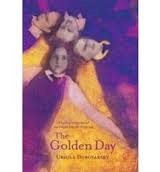 says that on the sign). Anyway I’d heard of Dubosarsky and never read any of her stuff, and the cover was immediately entrancing – look at that purple! and the gold is luminous!
There’s a little bit of Picnic at Hanging Rock around this book, which Dubosarsky herself acknowledges, as well as a lot of inspiration from art – especially that of Charles Blackman, whose paintings and drawings provide the chapter headings. It also, she says, draws on her own memories of being a Sydney schoolgirl.
Eleven little girls have a somewhat peculiar teacher, who takes them out of school down to the nearby gardens, to consider the world and attempt poetry and to listen to a gardener-cum-poet, Morgan. (It’s fair to say that there were a lot of alarm bells for me as a teacher with this book! The 60s were truly a different world…) But something happens – something unexpected and terrible, but probably not what you’re thinking: let me spoil this slightly and say nothing happens to the girls themselves, IT’S OK Tansy can read this if she hasn’t already.
While the ongoing repercussions of the Serious Event colour the entire book, Dubosarsky works other issues in, in the same way that such issues would probably be experienced by your average kid. It opens on the day Ronald Ryan is hanged (the last such event in Australia); the Vietnam War is ongoing. Closer to home, things are not entirely well in the homes of at least one of the girls, although exactly what is going on is never fleshed out; the reader sees glimpses in the way that a casual schoolfriend sees glimpses, only when they’re allowed or by accident.
It’s a very short book – 150 pages of well-spaced type. It’s a delightfully written book, with evocative descriptions of schoolrooms and gardens and slightly creepy creeks. Dubosarsky captures the innocence and bewilderment and childish cunning of children very nicely too; a student would have no trouble seeing themselves in this novel, in the attitudes and expectations of the schoolyard. It’s also potentially a frustrating book. It begins in 1967, with the girls about 10 years old; it covers about a fortnight in their lives, mostly in the schoolroom with occasional forays outside. It then jumps to one afternoon in 1975, with four of the girls sitting their final HSC exam, and a final intriguing addendum to their experience eight years earlier. The story is left ajar – not quite open, not quite closed… I guess this is fitting since the girls themselves are on the cusp of adulthood, so their lives at this point are liminal, balancing between two aspects.
The Golden Day is intriguing, and luminous like its cover; I have no doubt this will stay with me into the future. Especially when considering excursions.
You can buy The Golden Day at Fishpond.
An interview with Livia Day
In just a few days, A Trifle Dead will be launched – a book I’ve been looking forward to reading for rather a long time. Livia Day is another name for Tansy Rayner Roberts, another voice of Galactic Suburbia and overall awesome author. I decided to throw some questions at her and see what happened…
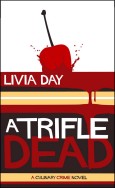 You’ve picked yourself a nom de plume for your first published crime novel. How did you pick it, why did you pick it, and have you been practising a Livia Day autograph?
OMG I hadn’t even thought of a Livia Day autograph. I only have a few days to figure that one out before the launch! Thanks for the head’s up.
I have actually just finished writing an article I was commissioned to do for Writing Queensland about this whole topic so I’ll keep it fairly brief this time: I wanted to differentiate between my crime writing and fantasy writing selves. Livia is after my favourite imperial Roman woman, the one I never managed to name one of my children after (believe me, I considered it!) and Day is from teenage newspaper editor Lynda Day in Press Gang, one of my first fictional heroes.
Given the title, and its setting in and around a cafe (I’ve read the first chapter thanks to Salvage), clearly food is going to play some role in the novel. How important is food, do you think, in setting up a world? I can think of lammas bread from Lord of the Rings, and vaguely remember exotic English teas from ancient kids’ books, but a lot of the time food doesn’t seem to get much of a look in.
Food is a great storytelling device! I do a lot of worldbuilding through social customs in my fantasy writing, and food is key to that – in A Trifle Dead food is certainly relevant to character traits. Almost everything in crime fiction comes down to the psychology of characters, the reason why people do what they do. My protagonist is a professional cook and cafe manager and she uses food in many ways – to heal, to nurture, to manipulate, to bribe, to cement friendships. In the opening chapters she is actually using food as a kind of anti-siege weapon, to rid herself of the over-protective men in her life.
I think part of the reason that culinary themes work so well with crime fiction is because it gives us something comforting to balance out the scary or more confronting themes to do with murder and darker psychologies. I love Kerry Greenwood’s Corinna Chapman and the baking she does in those books – and one of my favourite crime series of all time, the Roman historical mysteries about Falco the informer (by Lindsey Davis) uses food as worldbuilding as well as to express character.
Then there’s Agatha Christie, of course, herself an experienced chemist – every bite in those books could potentially kill you!
Why Hobart, aside from it being your home town?
Well you see, it’s my home town… but that doesn’t mean it was the default for these books. I actually found it quite confronting to write something set in my own home town, especially when I was much younger. One of the oddest things about doing that is how your own version of a place you know intimately can clash with other people’s perceptions – I think I’m going to have a much better time selling the idea of Hobart being a fun, arty and cosmopolitan centre than when I first started working on this manuscript years ago, because we’ve had a bit of a media renaissance around here in the last year or two thanks to MONA and other cultural events.
But of course the short answer is that Tabitha grew out of this city – her story couldn’t be told anywhere else.
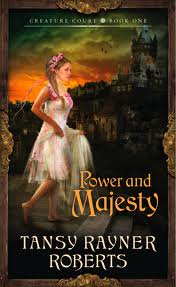 You’re most well known for your fantasy novels, The Creature Court trilogy, and by me originally for the Kassa Daggersharp pirate fantasies. Does crime writing require a different part of your brain?
It certainly has a different skillset – much tighter plotting is required! You can’t just take people off down a meandering path, or let your imagination run completely unfettered. It’s harder in some ways and easier in others – the biggest difference is not actually the genre aspect, but the difference between writing in an imaginary world and the current world. Being able to throw in pop culture or technology references, and so on. I had to think a lot more about the constraints because in all the crime fiction I grew up reading, no one had mobile phones or Twitter or DNA testing, and that sort of thing makes it kind of difficult to get away with a lot of the more traditional crime fiction twists. Sure you can have your character’s mobile phone get broken but that’s cheating…
Do you have further stories in mind for Tabitha Darling?
Oh, yes, I’m contracted for a sequel, Drowned Vanilla. Even more than A Trifle Dead it is about internet culture and creative culture and how these two things interact. The story is about a girl who goes missing from a house that’s full of webcams. But mostly it’s about ice cream. Oh my goodness I know so much about the history of vanilla that I didn’t know before writing this book!
After that, we’ll see – if the readership is there, I will happily continue with Tabitha’s adventures in catering and murder mystery solving – I’m deeply in love with the eccentric ensemble cast she has gathered around her, and any excuse to spend more time with them.
Is there anything else we should know? Like other exciting books?
 Just that my early fantasy books are being made available as e-books by Fablecroft – Splashdance Silver is up now on Kindle, Wizard’s Tower and Weightless Books, and the other two Mocklore Chronicles are shortly to follow. The third one was never officially published before so that’s quite exciting to people like yourself who had a fondness for my funny pirate witch explosive magic books…
You can read Tansy’s blog, and get to grips with her Doctor Who obsession, while Tabitha Darling has a tumblr (of course; she’s so hip). You can buy A Trifle Dead over here, at Twelfth Planet Press.
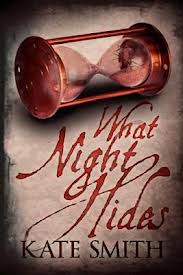
What Night Hides: review
I first read this book in manuscript form, because Kate is a long-time (I could hear the objections over the water and out of the future when I considered writing “old”) friend of mine. When it got published – last year! – Kate sent me a copy with the inscription “at last” – and at last I have got around to reading it. Of course, I remembered the awesome denouement, which meant I didn’t get the same thrill as I did the first time through; nonetheless it was still a wild ride.
 One of Kate’s great talents is an ear for odd, rhythmical, and charming description. She links together sometimes outrageous words to compose a scene, drawing in visuals and sounds and even scents to bring together a very real, if whimsical scene: “colder rays and tentacles of witch light fountained, splashing in an ever-widening search pattern over spines and shelves, turning the cobwebs infra-blue…” (34). She also has a habit of incorporating music and lyrics into her stories, sometimes making connections that seem quite peculiar unless you’re able to follow the devious turnings of her brain and keep up with the pop culture references.
As to plot – it’s urban fantasy, I guess? The chief characters are Josh, who appears to have no memories older than a few months; his new employer, Scarlet, a Nichtthane – someone responsible for keeping the bogeymen away from humanity; and Kelly, Scarlet’s seneschal, largely responsible for keeping Scarlet herself away from humanity, at least until she’s appropriately caffeinated. There’s a lot of banter and discussion of shoes in between dealing with vampires, were-creatures, and other, less immediately recognisable, supernatural critters. The common thread through it all, at least in theory, is Josh and his past; actually though I think Scarlet and Kelly’s relationship is the more interesting, as Scarlet continues to deal with being nearly immortal and Kelly shows that although intensely loyal, he doesn’t belong to Scarlet – there’s a wider world requiring attention. These stories were initially written as short stories, and sometimes it feels like it. Overall, though, they do hang together nicely.
I was also amused, of course, to recognise two of my very own connections to Kate within these pages: a vampire with a tshirt reading “it’s all liminal to me” – liminal being my very favourite word and one I’ve made Kate roll her eyes over too many times to count; and another character wearing a tshirt reading “Dear Pluto, no matter what they say you’ll always be a planet to me” – a tshirt that I own, courtesy of the author. Does this mean that I have been Tuckerised??
This is my first review for the Australian Women Writers Challenge for 2013!
You can buy What Night Hides at Fishpond.
A history of blue
Did you know blue has been the favourite colour of Westerners over the last couple of centuries?
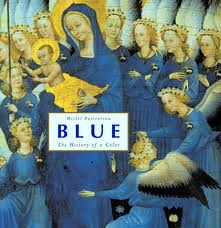 This book is and intriguing idea, although not entirely well executed. I enjoyed the broad sweep of time that Pastoureau attempted to cover – the Neolithic and ancient use of colour very briefly, the medieval world and on in a bit more detail – because the comparison across hundreds of years is fascinating. Unsurprisingly though, this was also one of its downfalls, since the occasional times it treated an idea or subject in detail it felt out of place; and the lack of detail in some areas annoyed me. In some ways this felt, perhaps deliberately, like this was a preparatory work; a number of times Pastoureau raised questions as areas requiring further research, or mentioned medieval manuscripts that have yet to be transliterated or studied in any fashion.
In appearance this is halfway between a history book and a coffee table number. It’s beautifully presented, and the pictures themselves are delightful – most pages have one or two, sometimes three, pictures, illustrating some pertinent point about where and how blue was being used, or other uses of colour at relevant points. But the text is too dense to really work as an art book, while it’s not long enough somehow for it to feel like a really serious treatment of the subject – especially not over such a vast span of time.
As a history book, I remain unconvinced by some of Pastoureau’s suggestions about how blue worked in culture. The lack of blue in very early art, Neolithic right through to much ancient illustration, is curious but I didn’t entirely buy his explanation for its lack of symbolism and therefore appearance and I’m not sure why. Perhaps it just didn’t feel explained enough to accept such a radical idea. This problem permeated much of the text, in fact; the sober, moral overtones that blue acquired thanks to the Protestants, as well as the issues discussed around its symbolism in the later medieval period, were presented as a little bit too definitive, a little bit too unarguable, for me to be entirely comfortable. Clearly Pastoureau was not setting out to write the definitive work on the colour; he himself points out that a vast amount more work needs to be done in a whole range of areas before such a thing is possible. And perhaps it’s also a fault of translation; maybe there was a bit more uncertainty in the original French?
Anyway, overall this is a fascinating book that has made me think about colour and its uses, but not entirely satisfactory.
Galactic Suburbia 77
 In which Alex eats fig frangipane made by her friend Dan… and Alisa and Tansy are bad at birthdays. If you eat cake while eating this podcast, let us know what kind! You can get us from iTunes or at Galactic Suburbia.
HAPPY BIRTHDAY US WE ARE THREE!
News
TIPTREE AWARDS
Random House and their new digital only imprints – specifically Hydra.
SFWA response to Hydra letter
Random House responds
NOTE: Since we recorded this, revisions have been made to the Random House imprint contracts.
Culture Consumed
ALISA: the life of a publisher…
TANSY: A Game of Thrones (the book) and nothing else ever again because THERE ARE MORE BOOKS.
ALEX: Warehouse 13, season 1; Shadow Unit; Arc 1.4; The Triangle; Anita Sarkeesian’s first Tropes vs Women in Video Games
Since we recorded this, Sean the Blogonaut has also posted about his thoughts on rape threats & gender issues in “grimdark” fantasy.
Please send feedback to us at galacticsuburbia@gmail.com, follow us on Twitter at @galacticsuburbs, check out Galactic Suburbia Podcast on Facebook and don’t forget to leave a review on iTunes if you love us!
Galactic Suburbia 76
 In which we celebrate the real beginning of awards season, taste honey and launch Alisa into her new world as PhD student of publishing… You can get us from iTunes or at Galactic Suburbia.
News
Nebula shortlist
SF Signal Nebula post (with unfortunate comments and awesome responses)
Stella Prize longlist with special appearance by our own Margo Lanagan.
The Kitschies winners announced
Interesting link found after recording: Lavie Tidhar on the Kitschies & diversity
Libba Bray on misogyny at the Oscars
Also, go read NK Jemisin talking about race, misogyny & Quvenzhané Wallis with “Fantasy fans, where’s your outrage?”
We didn’t discuss that one on the podcast because – well, what can we possibly say as three white women that Jemisin didn’t say a million times more effectively? Read her instead.
Thoraiya Dyer interviewed for Cosmos Magazine about how becoming a full time mum was actually great for her writing career.
Splashdance Silver back in e-edition – Tansy’s first novel, now celebrating its 15th anniversary.
Culture Consumed
ALEX: Etiquette and Espionage, Gail Carriger; The Chains that you Refuse, Elizabeth Bear; Rainbow Bridge, Gwyneth Jones; Caprica.
TANSY: Perfections, Kirstyn McDermott; For Darkness Shows the Stars, Diana Peterfreund
ALISA: The Honey Month, Amal El-Mohtar
New Segment: Diary of a Publisher – it’s our duty (and that includes all our listeners) to keep Alisa honest as she walks away from her dayjob to take up the challenge of a PhD in creative publishing. Mind the flannel!
It’s our birthday next fortnight – have cake ready for when you listen!
Please send feedback to us at galacticsuburbia@gmail.com, follow us on Twitter at @galacticsuburbs, check out Galactic Suburbia Podcast on Facebook and don’t forget to leave a review on iTunes if you love us!
Tiptree Award Anthology #2
 For those just joining us, James Tiptree Jr was a magnificent SF writer whose work Robert Silverberg once described as “ineluctably masculine.” Which is amusing because she was actually Alice B Sheldon. Anyway, in 1991 some people decided there should be an award named for a woman, and that it should be given to works that “explore and expand gender”. So, to be quirky, they named it for Sheldon/Tiptree. And the award has been going since then, and there are now a number of anthologies that reflect it: excerpts from novels, complete short stories, but also other work that reflects the issues that the award desires to highlight. Which is awesome.
Debbie Notkin’s introduction does a marvellous job of discussing the very first award and how it was decided on, as well as – most interestingly – pointing out that each jury has been forced to decide all over again what it means to “explore and expand gender.” Which is good to be reminded of, because there are definitely stories in the anthology whose inclusion I was a little confused by. And this, Notkin says, is totally fine.
In honour of Tiptree/Sheldon, the anthology opens with a short essay from Julie Phillips, the biographer of Tiptree/Sheldon (which I reviewed here, and as I write I am listening to The Writer and the Critic discuss it), about talking and talking too much which is completely fascinating (and somewhat connected to the current furore over Hilary Mantel’s words about the media representation of royalty?). It’s matched with a letter from Sheldon herself, to the psychologist Rudolf Arnheim, talking about identity and science fiction and science and friendship, which is such a nice touch. And then the anthology jumps straight into Raphael Carter’s “Congenital Agenesis of Gender Ideation by KN Sirsi and Sandra Botkin,” which can only be read by itself, must be read in a single sitting, and may then require that you sit staring at a wall for a few minutes. Because it is mind blowing. It’s written as a thoroughly researched scientific article, where two scientists from different backgrounds come to a startling discovery about how gender is perceived and what that means for identity and… that doesn’t really explain it at all. It’s very accessible as well as challenging and I can absolutely understand why it won.
L Timmel Duchamp’s collection Love’s Body, Dancing in Time was shortlisted in 2004, and from it this anthology includes “The Gift.” For all that it’s set in a distant future where the narrator is a travel writer who discusses other planets rather than other countries, there’s something rather medieval in its suggestion that there is more to an understanding of gender than a basic dichotomy. And I don’t mean ‘medieval’ in a pejorative sense, but in the sense that some medieval thinkers seemed to be groping towards a similar sense – and for similar reasons as suggested here. That aside, one of my favourite parts of this story is the description of the meal composed around the ideas of Matrix Aesthetics. And made me wish that something similar could possibly exist, that combined visual, aural, and taste sensations all designed to complement one another.
The next two parts of the anthology are again from 2004, this time excerpts from the winning novels. The Tiptree Award is an interesting one in that it seems to me one of the few really big-name awards that considers all work for one award (shorts and novels), and which is not afraid of having a tie (which has happened a few times). Firstly here, Joe Haldemann’s Camouflage – the first four chapters and “and two from a little further along,” according to the reading notes. I HAVE to read this novel. It’s utterly gripping, right from the start: an alien comes to earth millennia ago, and is capable of changing its outward appearance to be… whatever it likes. Imagine the consequences of that on ideas of gender and identity. This is complemented by an excerpt from Johanna Sinisalo’s Troll: A Love Story, which I imagine I will also get around to reading. Translated from the Finnish, it does indeed involve a troll, as well as (again according to the reading notes) mail-order bride slavery and Finnish folklore and homoerotic imagery. In this excerpt, the narrator’s night has started badly, with a failed date, and gets worse when she finds a bunch of boys attacking an animal. Things get weirder after that.
“Looking for Clues” is Nalo Hopkinson’s guest of Honour speech from WisCon (the convention where the Tiptree is announced) in 2002. As a woman of colour, as she explains in her speech, finding people “like her” was one of the aims of her extensive early reading – because there weren’t that many. She takes a winding road through various media and her experiences to look at the different sorts of role models (and not) available through her childhood and teenaged years, as well as making pointed remarks about people who insist on remaining ignorant about the issues. It would have been a brilliant speech to hear in person.
Eileen Gunn’s collection Stable Strategies is another one that got shortlisted in 2004, and as a representative this anthology chose “Nirvana High,” co-written with Leslie What. This is one of the inclusions that I simply do not get. It’s a clever story and it says interesting things about difference, and about growing up as ‘different’, but I don’t see that it says things about gender that connect it to the Tiptree. But I’m sure Notkin would say “and?”
From 1996 comes Jonathan Lethem’s “Five F***s” (sorry, I would like to keep this profanity free!). It’s a series of six vignettes, and in all of them there is a woman whose life appears to be different each time she has sex with a particular man. Indeed, it’s not just her life, but the world around her; in this sense it reminds me a bit of Lathe of Heaven. The lover does not appear in every story; in all but the first, there is a different man – Pupkiss, a policeman (mostly). So there are elements of the procedural to some of the sections, but not really. It’s one of those stories, as you may be able to guess, that is particularly hard to explain. It should just be read.
Carol Emshwiller’s “All of Us Can Almost…” is another story in the I don’t entirely get it pile. Shortlisted in 2004, it’s about desire and lying and determination, and while I think it’s a very good story and fascinating in what it says about interactions between people and expectations, I don’t entirely see that the gender aspects – which I can see – are an interesting enough or explored enough aspect to get it shortlisted. Again, refer to Notkin’s advice.

Gwyneth Jones is rapidly becoming one of my favourite authors, so I was pleased to see an entry from her here. Rather than a piece of fiction, it’s a paper she gave called “The Brains of Female Hyena Twins: On the Future of Gender,” presented at the Academic Fantastic Fiction Network conference in 1994. In it, she ranges far and wide over scientific papers that discuss aspects of gender and biological sex in animals (those hyenas, peacocks, lizards and fish…), as well as gender and sex in humans and their malleability, as well as some frightening aspects of the battle of the sexes. It’s erudite and occasionally witty (insofar as such a topic ought to be), and outright challenging to biological determinists.
The penultimate place belongs to Ursula le Guin, for Another Story, or A Fisherman of the Inland Sea which I have read before but fell in love with all over again, reading it here. The planet of O is such a richly realised place – their marriage customs so breathtakingly original – and they’re not even the centre of the story, which is I think mostly about scientific research and its impact on individuals, as well as the impact of family, and the choices that we make… It’s wonderful.
Finally, Jaye Lawrence’s “Kissing Frogs” is described as “a pleasing after-dinner mint of a story” by the reading notes, and I think that’s about right. It’s a retelling of the fairy story, of course; it’s amusing and sweet and I can’t go into any details because the point of it is the little twists Lawrence weaves in. A highly enjoyable way to complete the anthology, anyway.
What this anthology does, and I presume what it set out to do, is give a broad overview of the point of the Tiptree Award – showcasing works that various juries have thought worth honouring, as well as including work that must help to inform the juries, and authors, and readers about the ideas of gender that the award wants to recognise. It succeeds in this aim, and no doubt in a secondary aim as well – of publicising those names whose work has been recognised, so that they get more recognition, and more people are challenged and inspired by their words.
You can get this anthology from Fishpond.

 Randomly Yours, Alex