Beyond the Blue Mountain
I received this book via NetGalley.
Interesting overall but with some frustrating gaps.

The intro to this book explains that it was begun as a memoir for children and grandchildren and later expanded for a general readership. This explanation is useful because it doesn’t read as a polished memoir. There are lacunae and years brushed over; the most egregious is what happens to his first wife. She is mentioned as having post partum depression with their first child, then the depression recurs over the next several years, and eventually she just… disappears from the story. And then he talk about holidaying with the woman who was initially his PA, and with whom he spends his retirement. In a book designed for the family this makes sense – the kids know what happened to their mum. For me this was just bewildering.
As the blurb outlines, this is partly the memoir of a rock climber, about which I’m not especially interested except that it does mean travel to interesting places, and partly the memoir of an almost accidental MI6 officer. That bit is also mostly interesting in the way it’s told here because of the travel involved. I’m not particularly up on the political intricacies of places like Benghazi in the 1960s and 70s so there were swathes of narrative where the assumed knowledge – which I don’t have – meant I didn’t have a solid grip of what was happening: names that meant nothing, dates likewise. Nonetheless, this was an overall entertaining story with some interesting insights into different places from the perspective of a intelligence officer who didn’t seem to perceive himself as a spy.
Neptune, by Ben Bova
I received this to review c/ NetGalley. Kinda glad I didn’t spend money on it… which gives you a hint of what this review will say.

Oh boy.
Do not come for character development or realistic relationship building.
The overall narrative is interesting enough and the theory that drives the second half of the plot itself is fine. But the scientific consequence isn’t nearly developed enough; it’s a leap. I’m all for short sharp stories, no need for a trilogy, but this was just a bit silly.
Lots of spoilers follow.
Character development: there really is none. The woman, Ilona, whose obsession with finding her father’s remains somewhere on Neptune funds the first venture to the planet, and basically drives the entire narrative? So little development as to be non-existent. The old space-sailor on his last adventure? basically no development beyond that. The scientist who doesn’t actually seem to have any real knowledge of Neptune, but who is in love with Ilona after a brief meeting… is just a nothing. And even the scientist who joins the second mission, apparently as a government stooge, is just… a nothing. There are hints of the possibility of intrigue: is she deliberately seducing the other scientist? is she also just a pawn? WHO KNOWS. WHO CARES.
When Ilona and co get to Neptune they discover her father is dead – OF COURSE – but they also discover what turn out to be alien remains. And somehow, very quickly, it’s decided that these aliens were responsible for destroying life on Uranus (how did we come to that conclusion? who knows!) and also an ice age on Earth. As I said, as a premise I am SO HERE for this idea. Explore the repercussions of this for me – either on Earth or in the wider galaxy! … but that basically doesn’t happen. There’s a politician who is worried for his career and scientists who don’t like it – which again, cool! explore this angle – but no. No exploration. It just ends up being boring.
And the conclusion is simply appalling. Like, really awful. Ilona’s obsession with having lost her father leads to her bearing his clone. This is gross and nonsense and just weird.
I won’t be reading anything else by Ben Bova having read this.
The Rebel Suffragette
I received this to review via NetGalley.
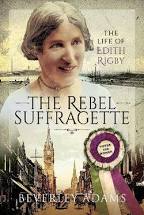
The good things:
- It’s always good to have another woman featured in a history book! And I mean that very seriously. Minor men have had tomes devoted to them. To have an individual suffragette whose name is not Pankhurst (not that I don’t love a Pankhurst) get a book is AWESOME.
- I love suffrage history in all its guises and having a book that’s about circumstances outside of London – or Manchester – is great.
These things are big and important. The negative things are generally smaller, so although there are more they are basically balanced in my mind. But these are important things to note, I think:
The negative things
- There are some really annoying editorial aspects. Partly this is about commas instead of semi colons, which I think must be from the editor becuase I’ve seen the same thing in other books from this publisher. It irks the editor in me.
- There’s a chapter about “Men and the Media”, which has basically nothing to do with the suffragette in question. If the author had placed her in a wider context more often, then this might almost have made sense a chapter – but even then I’d be dubious. This chapter had no place in this biography. And nor did the chapter about the relationship between the royal family and the suffrage question – it was completely out of place.
- The title. Almost by definition if you were a suffragette you were a rebel, and Edith did nothing that was rebelling against the WSPU general vibe. So the title is click bait at best.
- One of the historian’s problems with writing such a biography is the dearth of resources. There’s a fine line to be walked in between theorising from thorough research, and making vague suppositions about things like, in this case, the relationship between wife and husband.
- A couple of specific irritants: the idea that women went in hunger strike to be classed as political prisoners becuase then they’d get better perks, rather than becuase of a real political reason, is just insulting. Also, the author suggests that the whole WSPU and Pankhursts ditched campaigning in WW1, when actually Sylvia Pankhurst was disowned by her mother and sister for doing the opposite.
Finally, I found the discussion about whether 21st century can or should condone the militancy of the suffragettes quite lacking in depth. It was more a series of questions than a rigorous interrogation of the place of violence in political campaigning. And it didn’t really need to be included – there’s no need to pass judgement on the subject of your biography.
Overall I think this is a really worthwhile biography – Edith was clearly a fascinating woman and I greatly appreciated being able to learn about her place in the suffrage movement. I’ve seen the picture of her being removed from the gates of Parliament and had no idea who she was! It’s not perfect, but it’s a good addition to the suffrage library.
The Scholars of Night

Read courtesy of NetGalley.
Well that was a completely bonkers read.
When I first asked to review this, I didn’t realise it was a reprinting; I’m not enough of a Ford fan to know that he’s passed on. Then I read Charles Stross’ introduction, in which he talks about this being published in 1988 and setting out the political context for the younger audience, and I wondered what this was going to be like.
Completely bonkers, is the answer.
It’s a spy novel,
It has a possibly-undiscovered Christopher Marlowe play.
It has scholars and spies and disaffected patriots and mercenaries and… just a most remarkable cast, and a complicated narrative that eventually makes sense, and PhDs playing Diplomacy and people making Marlowe jokes and war game simulations and BONKERS.
It’s awesome. The only downside is that some bits (eg who knew who was who) got a bit complicated so reading it over a few days, I wasn’t always sure of exactly what was known to various people. But it all came good in the end. Basically.
Huge fun.
You Sexy Thing, by Cat Rambo
I received this to review via NetGalley.

This is right on the edge of “too silly” for me. It mostly doesn’t fall over, but skirts precipitously close. There’s mention of magic to do various things (although it all happens off-stage) at the same time that this is a galaxy-spanning society with a multitude of species and, it seems, a variety of FTL options for travelling around. There’s a bit of prophesying going on, too, just to add to the mix.
The blurb suggests this is Farscape meets Great British Bake Off. Yes to the Farscape: improbably different alien species interacting, living and working together; up to and including a biological ship, now I think about it. There’s also a bit of Firefly. These comparisons are good for me; if you’re able to suspend your disbelief about humans and squid-like and bird-like and vegetative species all being in the same place, then you’ll be fine with this. The GBBO comparison is a bit thinner and honestly that’s where I was a little disappointed. Cooking is definitely a factor here – the protagonists are running a restaurant when everything goes to hell in a handbasket, and features sporadically throughout. It’s not a competition and there’s not much baking, and really there could have been more food in general. So if what you’re really craving is a pretty food-based narrative, I don’t think this will meet your needs.
The story is a fairly straightforward one – which isn’t a negative: Niko and her companions were soldiers, now run a restaurant, things go boom (not their fault, swear), and then adventures ensue. Including hijacking and piracy and identity trouble and pasts coming back to haunt, etc. It’s fast paced, there’s a good amount of banter, there’s engaging characters, and no desire to make this any sort of morality tale or a solemn exposition of galactic society. It’s a romp, and for that it was well worth it.
(It should be said that there’s some rather surprising violence about halfway through – surprising because up to that point it hadn’t been graphic at all – which I found disquieting because it seemed so out of place.)
All up, a fun read, and honestly isn’t that something we need right now?
The Nile: A New History of the World’s Greatest River
I received this book courtesy of NetGalley.
I should start by saying that this book is not quite the book I expected. Given it’s the Nile, and given the blurb, I expected the book to be much more about the swathes of history involved in that region of the world. There is, of course, discussion about the role of the Nile in the grand sweep of ancient Egyptian history, and what might be called “medieval” history for want of a better term. There’s mention of ancient Nubia, and some commentary on “medieval” Ethiopia, as well as the Rift Valley and the Olduvai Gorge. However, the reality is that the vast majority of this book is focused on European, and in particular British, colonialism – efforts to control the various parts of the Nile for their own purposes. So I was surprised by that, and occasionally disappointed that it was so modern in focus.
This is also not “just” a history book, and in general this is a good thing. It has aspects of a travel memoir; the author has travelled to every country he mentions, I think, and to most of the parts of the Nile and its tributaries discussed. So there are sections where Tvedt is quite personal in his writing, reflecting on his own experiences and how this matches – or doesn’t – with historical or literary representations of the places. This aspect I enjoyed a lot.
As well, there are aspects of historical theorising that I found quite intriguing. The author challenges Edward Said’s theories about ‘orientalism’ and whether it’s appropriate for this challenge to apply to all aspects of European writing; and challenges most historians in their refusal to consider the very solid, material, and geographic nature of a river like the Nile. I don’t know that much about the theories he’s challenging so I can’t say with full confidence whether he makes perfect sense; but certainly many of the ideas he raises seem fair.
But overall, the book is indeed about the Nile: as something that has shaped geography, as something that has shaped the civilisations that exist along its banks and those of its tributaries, as something that has contributed hugely to political tensions over the last 150 years or so. I had no idea there was a 1929 Agreement that basically said upstream countries could do nothing with the Nile unless Egypt agreed! And of course for most of those upstream countries, this was signed by the imperialist powers then in control… so since the 1960s there’s been argument about whether those powers had the right to sign on behalf of these now-existing countries. Nor had I ever considered the notion of the Nile as a weapon (withhold water, or release too much if you’ve got a dam); or the idea that the Suez Canal crisis can also be linked to control of the Nile.
I learned a lot about the realities of European colonialism and imperialism in the Nile basin – primarily the British, but also German and Italian (I didn’t learn anything new about Belgium, and Leopold). The machinations made me sick all over again: water for Egypt so Egypt can grow cotton to supply to England for the cotton mills…
In terms of structure, the book basically flows from the Nile Delta (seriously under pressure thanks to climate change) to the various sources of the Blue and White Niles (hello, Stanley and others). So it’s not chronological; I quite liked this geographical perspective, though, and it certainly makes sense in the context. Each chapter is broken into what are basically vignettes. It means the author doesn’t have to make one solid narrative for each geographical area, but instead takes various different issues and treats them in sometimes one, sometimes five, pages.
This is a thoroughly researched, detailed, meticulous and very clever story of the Nile.
A Master of Djinn
Fatma: an Egyptian woman dressing in smart (dapper, even) Englishman’s suits; a woman in the still male-dominated world of the Egyptian Ministry of Alchemy, Enchantments, and Supernatural Entities; someone with the tenacity, determination, and bull-headedness that characterises the best (fictional, I suspect) investigative types. I love her madly.
Fatma lives in an alternative Cairo: it’s 1912 and thanks to a man living several decades earlier, djinn and other such ‘supernatural entities’ walk the streets not only of Egypt but elsewhere in the world. They’ve added art and craft and technology, as well as opportunities for crime and political scheming to the world. Egypt has become the sort of world player that it didn’t manage until probably the 1950s in our world (thanks to imperialism etc). And I love this, too: I love Clark’s evocative descriptions of Cairo – by which I do not mean that it’s all “exotic” or whatever; I mean that his descriptions bring the streets and palaces and people to life in the ways that the best literature does.
Everything about this novel is marvellous. I love the characters; I love the setting. I love the exploration of how humans might interact with the supernatural when it becomes basically mundane, and I love the police investigation aspect (a lot). I love that it’s set in Egypt and deals sensibly, sometimes snarkily, with the imperialism issues that would still have been present despite the magical changes (the patronising ‘exotic’ comments from the white mouths are just… so on point). I love the language and the pacing and the revealing of important clues and… Look. Everyone should read this.
The Good Wife of Bath
I received this as a review copy via NetGalley.
I love a story about reclaiming women – whether it’s in history or fiction. Turns out I’ve read a few of these recently: Wendy, Darling and Forces of Nature for example. And The Good Wife of Bath fits into that space: yes, it’s that Wife of Bath, perhaps Chaucer’s most contested character (from The Canterbury Tales anyway).
I have to admit it’s a long, long time since I studied Chaucer at university, and I’m not sure I read all of the Wife’s Prologue and Tale even then (I found the language really hard going, not going to lie). Which means that people who’ve never read any Chaucer (like, most of the population, surely) will be just fine with reading this. If you do know the Wife’s original story I guess you get that extra frisson when a name is dropped, but it’s not essential to the story. Honestly I got more of that from the fact Chaucer is a character in the book and I know bits and pieces about his life courtesy of Who Murdered Chaucer? which I recently re-read.
Anyway. The story is Eleanor’s biography, basically beginning with her marriage at age 12 to a stranger several decades older than she is. Which is a deeply unpleasant thought, but it wasn’t until I got to the Author’s Note that it occurred to me that many people would find this shocking – the shocking-ness of not knowing this was at least sometimes a reality in the 14th century, I mean. 12 was the legal age of marriage in much of Europe for much of the Middle Ages, a fact I already knew and so I guess I’ve already dealt with being shocked by that. (I still don’t find it a pleasant idea, don’t worry.) In Chaucer’s recounting, the Wife talks of having had five husbands, and how she has tried to have mastery over them. Two thirds of the book is Eleanor as wife: who she marries, why, and what her life is like in each circumstance. In many ways it’s an exploration of the possibilities for a woman in the late 14th century: a good life or hard, a loving husband or abusive, allowed by her husband to participate in decision making or treated like a child, and the fact that her property becomes his property at marriage. And then the last third is Eleanor attempting to live as a feme sole, or sole woman – not connected to a man – which basically translates to “target”.
What Eleanor doesn’t personally experience, the women within her circle do. And overall that means that this book has some hard parts to read. Life for everyone in the Middle Ages had its brutality, especially compared to many of the things I take for granted in 21st century urban Australia; and the mid 14th century has the added bonus (?) of the Botch – what we call the Black Death. Life for women had its particular brutalities, and Brooks presents these as a part of life. Eleanor is at times very poor, and at times relatively wealthy; living on a farm or in town; respectable and not, surrounded by family and not. Brooks explores the lot. And by including Chaucer as a character, with as accurate a biography as is available, Brooks also includes bits of the contemporary politics (Lollards, John of Gaunt, 1381…).
The one thing I was left feeling a bit… confused by is the subtitle: A (Mostly) True Story. I love an unreliable narrator, and Eleanor certainly has the potential to be one. But nowhere is there a clear suggestion that she is being slippery, or fiddling with facts to make herself look better, or do anything other than present her story as she experienced it. So the suggestion that she is somehow being crafty in presenting her story doesn’t make sense. I actually forgot it was the subtitle while reading, because it’s just not relevant.
Overall, this is a great addition to the reclaiming of women’s voices within fiction. It’s fairly long; that’s balanced by being very readable, and smartly paced: it’s certainly not a trial to read. Definitely recommended to the historical fiction crowd, or if you were compelled to read any of Chaucer at any stage.
Salmon, by Mark Kurlansky
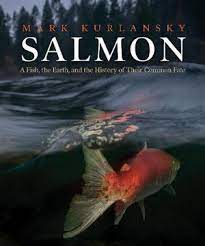
I received this book via NetGalley.
I’ve read a lot of Mark Kurlansky books, because I’ve really enjoyed the way he takes one thing – salt, in particular – and investigates its history and place in the human and natural world. Sometimes his work can feel a bit too general; I think this is a function of the format and his purpose, which is to present a wide-ranging view of the chosen topic. However, he does also present specifics – vignettes, effectively, to illuminate a broader point.
All of these comments stand for Salmon.
The first chapters are largely about the biology of the fish, which is way more complicated than I had realised – what even is a salmon, basically?? – and about its natural habitat and habits. Most salmon return to their natal spawning ground for their own spawning, and then die, which is just a whole thing when it comes to life cycles and how on earth they find their way back to a particular river after hanging out in the ocean for a variable number of years.
Much of the rest of the book is a litany of how humans have placed the existence of salmon in peril: through destruction of habitat in a multitude of ways, and directly through overfishing. Kurlansky touches on several ways in which indigenous peoples in what are today the USA and Canada and Japan used and managed salmon over hundred or thousands of years to demonstrate the possibility of living in balance… but all of that is against the construction of dams and other ways that ‘progress’ and ‘civilisation’ have led to the destruction of rivers, in particular. Honestly most of this book was pretty depressing to read. There’s so much we just don’t really understand about how to make it possible for salmon stocks to redevelop… which leads to further catastrophe in the food web. Salmon is, to an extent, just a symbol for how much the last 300-odd years of industrial development have ravaged the environment. So that’s fun.
If you can handle the story of environmental destruction, this is a readable and generally approachable book. As noted above, Kurlansky necessarily goes in for some generalisations – it’s a result of making a readable book for the general public, I think. But he does present specifics – about particular rivers, about particular indigenous groups, about particular styles of fishing, and so on – and there’s no doubt that he’s put an enormous amount of research and work into telling this story. It’s a sobering read, and it’s a worthwhile one.
Bread & Water
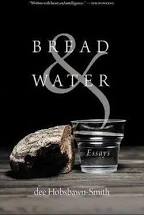
I received this book to review via NetGalley.
This is a set of essays, many published elsewhere previously, written by a woman who has been many things: a chef, a restaurant owner, a writer; mother, both married and single; a culinary student and a teacher; resident on farms and in cities and, as these essays are written, back on the farm that was originally set up by her grandparents. The essays are ruminations on life, reflections on choices both good and bad, an exploration of cause and consequence, and a meditation on – as the title suggests – food and water: the place of both in our lives, how they can impact on the way we live, the positives and negatives.
When I read a book like this I think, How can I find more books like this? What category do they come under? I’m not interested in reading just any essays on life; the focus on food and, I suspect, having a female author make these particularly appealing. I’m also not always interested in just reading about food for its own sake – the connection to life more generally, here, as well as the stories behind the growing and making of food, helps make these essays intensely readable and occasionally challenging.
Hobsbawn-Smith is writing these essays having moved back to the Canadian prairie. She reflects on many moments in her life, from horse riding as a teen to the area around her farm becoming a lake for seven years, with stories of her sons growing up in between. Sometimes she recounts stories for their own sake; more often she’s thinking about what they mean – how they reflect and connect to other moments in her life, what they show about the importance of family and feeding each other, how she has come to be the person she is today.
I didn’t always agree with the conclusions about life that Hobsbawn-Smith reaches; and I suspect that, given the differences between us (age, aspiration, location) she wouldn’t have a problem with that. But I do feel challenged – reminded, rather – to consider food more meaningfully, to remember the love that making and giving food can show; to try and take life just a little slower; and to be more aware of where food comes from. Trying to be intensely locavore is something that works if you’ve got the time and the money, which is something society as a whole needs to struggle with – and it’s not something that’s particularly doable for me right now. But I can, for example, be more mindful of seasonality.
These essays were deeply enjoyable to read, both on an intellectual-challenge and -stimulation level and also as prose in and of itself. Hobsbawn-Smith writes beautifully of food, and nature, and experience; she has an entire essay of her love for a temperamental oven, which is a delight. She made me remember that food is more than fuel, that life can be lived slowly, and that doing so is worthwhile.


